


CHINA J-VALVES Offers Various High-quality I ndustrial Ball Valves
J-VALVES, a distinguished professional ball valve manufacturer rooted in China, takes pride in its extensive product portfolio. Our offerings span a wide range, including trunnion-mounted ball valves, floating ball valves, high-temperature ball valves, high-pressure ball valves, metal-sealed ball valves, ultra-low temperature ball valves, DBB ball valves, Three-way And Four-way Ball Valve, and fully welded ball valves. Each product is a testament to our commitment to precision engineering and reliable performance. Meticulously crafted, they are designed to not only meet but exceed the most stringent industrial demands, ensuring stable operation even under extreme conditions. This enables us to provide our clients with high-value services and makes our valves widely sought-after in industries.
Product Category
Contact Us


-
J-VALVES-Q347F
-
J-VALVES
Overview of the J-VALVES ANSI three piece stainless steel flange trunnion ball valve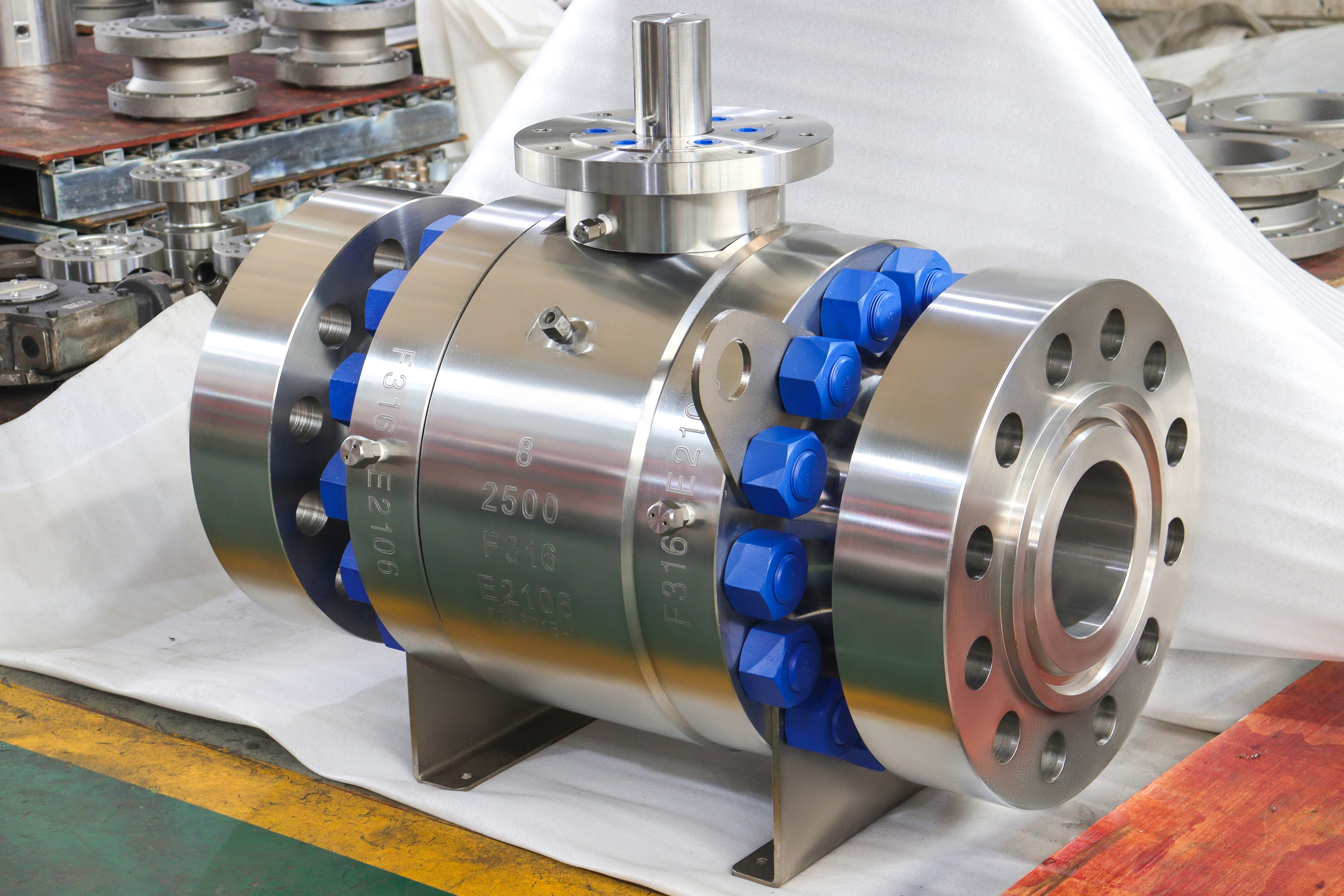
ANSI is not a rating and it is not a material. On a ball valve the word is shorthand for three ASME dimension standards, and each of them decides a different thing: B16.5 fixes the flange and its facing, B16.34 fixes the wall thickness and the pressure temperature table, and B16.10 fixes the face to face length. A buyer who asks for an ANSI valve is asking for a valve that will bolt to an ANSI flange and fit an ANSI gap, and everything else about it is still open.
This page is built around that split, because most of the arguments about a stainless valve are really arguments about which of the three the other party is talking about. The valve in the photographs is the extreme case: an eight inch three piece body at Class 2500, forged in F316, with ring joint flanges and a worm gear carrying a chainwheel. At that size and class every one of the three standards has teeth.
The body is three pieces, bolted, with both trunnion bearings in the centre section and a support foot welded to each side of it. The feet are not decoration. An eight inch Class 2500 valve is a heavy piece of stainless, and a valve that hangs on two pipe flanges without a foot puts its own weight into the joint it is bolted to.
The grade family behind the page is the austenitic set: F304 and F316 as the standard carbon versions and F304L and F316L as the low carbon versions, all forged to ASTM A182. The photographed valve is stamped F316 with a heat number, and the other three grades are order options on the same forging route rather than different products.
Design and Construction
The centre section carries the ball, both seat assemblies and both trunnion bearing blocks, and it is the part that never comes apart. The end caps bolt to it, one on each side, and each cap carries its own gasket and its own ring of studs. Because the bearings stay in the centre, the stem axis and the lower trunnion axis are set once at the works and survive every cap removal afterwards.
At Class 2500 the flange facing is ring joint on this build, and that is a construction decision rather than a preference. A ring joint closes on a metal ring seated in a groove, so the seal is made by the ring against two grooves and the studs only have to bring the faces together. The groove profile is part of the flange, cut to the ring series ordered, and a groove that has been painted, burred or over-torqued cannot be repaired on site.
The operator on this valve is a worm gear with a chainwheel on the input shaft. A gear multiplies a small hand effort into a large stem torque over many turns of the wheel, and the chainwheel moves the point of effort away from the valve, which is what a buyer needs when the valve is installed above a walkway or inside a pipe rack. None of that changes the valve; it changes who can operate it and from where.

Material Options
The four grades divide by carbon and by molybdenum, and the division has consequences in the ASME B16.34 tables that are easy to miss. F304 is the plain eighteen eight grade and sits in group 2.1. F316 adds molybdenum and sits in group 2.2, which is the group that resists chloride pitting and crevice attack. F304L and F316L drop the carbon below three hundredths of a percent and sit together in group 2.3.
Group 2.3 is rated below the other two, and this is the part buyers get wrong. At Class 300 and 38 C the tables read 720 psi for a group 2.1 or group 2.2 body and 600 psi for a group 2.3 body. The low carbon grades are not a free upgrade for corrosion resistance; they trade a little pressure rating for weldability, and the trade is visible in the table before it is visible in the field.
The L grades exist for one reason: welding. A low carbon austenitic body does not sensitise in the heat affected zone the way a standard carbon one can, so the chromium stays in solution and the grain boundaries keep their corrosion resistance after a weld. On a flanged valve that is never welded, the L grade is a small step down in rating for a benefit nobody collects, which is why the ordering question is always whether a weld is planned.
| Component | Standard Material | Optional Upgrade | Service Notes |
|---|---|---|---|
| Body and end caps | ASTM A182 F316 forging | F304, F304L or F316L on the same forging route | Group 2.1 for F304, 2.2 for F316, 2.3 for the L grades |
| Ball | F316 with electroless nickel plating | Hard chrome; tungsten carbide; cobalt based hard facing | Coating is a wear surface on a corrosion resistant base |
| Trunnion | F316 surface hardened | 17-4PH precipitation hardening stainless | Both bearings in the centre section |
| Stem | 17-4PH stainless | F316 with electroless nickel; nickel based alloy for sour service | Blowout proof, keyed to the gear input |
| Seat | PEEK for the high temperature end | Reinforced PTFE; metal seat with flexible graphite | The seat sets the valve temperature, not the body |
| Body joint gasket | Flexible graphite spiral wound | Metal ring joint gasket, octagonal or oval | Two joints per valve, one gasket each |
| Bolting | A193 B8M studs with A194 8M nuts | B7 studs with 2H nuts | B7 on a stainless body is the corrosion weak point |
| Support | Welded foot each side of the centre section | — | Carries body weight off the mating flanges |
Technical Specifications
What a standard fixes, the table below fixes too: size, class, grade, the flange standard and facing, the test regime and the documents. All of it is checkable against a catalogue and against the certificate that arrives with the valve.
What belongs to a drawing stays on the drawing. Wall thickness is a worked calculation against ASME B16.34 and belongs in the design file. Face to face is tabulated in ASME B16.10 by size and class and is confirmed on the general arrangement drawing that ships with the order. Printing either of those on a product page, without a drawing behind it, is printing a number nobody has signed.
| Item | Value |
|---|---|
| Size | 8 inch, DN200 |
| Pressure class | Class 2500, recorded as PN 420 in API 6D clause 7.2 |
| Body style | Three piece forged body, trunnion mounted ball |
| Body material | ASTM A182 F316 as stamped, ASME B16.34 group 2.2 |
| Rating | Group 2.2 at Class 2500 reads 6000 psi at 38 C |
| Flange | ASME B16.5 Class 2500, ring joint facing on this build |
| End options | Butt weld ends to ASME B16.25 |
| Face to face | ASME B16.10 for NPS 8 Class 2500, confirmed on the signed drawing |
| Temperature, body | Group 2.2 service range down to minus 254 C; the flange end rating stops at 1000 F, which is 538 C |
| Temperature, valve | Set by the seat: about 260 C for PEEK, 200 C for PTFE, metal seat for higher |
| Operator | Worm gear with chainwheel on the input, as photographed |
| Seat design | Single piston effect as standard; double piston effect or double isolation on request |
| Product standard | API 6D; API 608 stops at Class 600 |
Standards and Compliance
B16.5 is the flange standard and it does two jobs at once: it fixes the outside diameter, the bolt circle, the bolt count and the facing, and it fixes the pressure temperature rating of the flange pair. That is why a 2500 class flange is not simply a thicker 900 class flange. Its bolt circle and facing are their own series, and a mating flange either matches them or the joint does not close.
B16.34 is the valve standard for the wall and the rating. It assigns every pressure boundary material to a group, gives each group its own table, and the table is read at the design temperature rather than at ambient. B16.10 is the third and the least glamorous: it tabulates face to face lengths by size and class so that a replacement valve drops into the gap the old one came out of.
API 6D sits over the three of them as the product standard for this valve. API 608 is the one usually quoted on stainless data sheets, and it does not reach this valve: its scope covers flange sizes DN 15 to DN 600 at classes 150 to 600. A Class 2500 body is outside that on class alone, so the documents that travel with it are the 6D set.
| Requirement | Standard | What J-VALVES Supplies |
|---|---|---|
| Flange dimensions and facing | ASME B16.5 Class 2500 | Ring joint groove cut to the ring series ordered |
| Wall thickness and rating | ASME B16.34 group 2.2 | Design calculation; 6000 psi at 38 C |
| Face to face length | ASME B16.10 | Confirmed on the signed general arrangement drawing |
| Pipeline valve requirements | API 6D | Marking, documentation, cavity and drain provisions |
| Pressure testing | API 598 | Shell at 1.5 times, seat at 1.1 times the rating |
| Fire test | API 607, or ISO 10497 as the equivalent | Type test with a size and class scope on the certificate |
| Material certificate | EN 10204 3.1 | Body and trim, heat number matched to the marking |
| Forging examination | ASTM A388, supplementary | Ultrasonic examination when the order asks for it |
Manufacturing Process
The body is forged, not cast, so there is no pattern and no sand and no cast skin to hide a shrink. A billet is upset and punched and the shape is then cut out of solid material, which is why the surface on the photographs is machined all over and why the raised characters sit so sharply. The consequence for the buyer is a dense grain structure and an absence of porosity; the consequence for the supplier is a long machining cycle on a large forging.
The three pieces are machined as a set. Bore, seat pockets and joint faces are cut with the caps located on their own spigots, so the seats land concentric with the ball when the valve goes together. On a three piece body this is the operation that separates a good valve from an ordinary one, and it is completely invisible from the outside.
Assembly follows the machining: seats and springs into the centre section, ball between them, caps landed, studs brought up in stages in a cross pattern. The gearbox is fitted after the valve has been cycled on the stand, because the gear is set against the torque the valve actually needs rather than against a catalogue figure for the model.

Quality Control and Testing
Identity comes first. The heat number raised on the body is matched to the mill certificate, and where the order asks for it a positive material identification reading confirms that the body and the trim are the grades claimed. On an eight inch stainless forging this is worth the extra hour, because a mixed part in a 2500 class body is not a cosmetic problem.
| Step | What Is Checked | Standard or Acceptance |
|---|---|---|
| 1 Material | Heat number against the mill certificate; chemistry and tensile | ASTM A182 F316, EN 10204 3.1 |
| 2 Identity | Positive material identification on body and trim when ordered | Grade match, no mixed parts |
| 3 Dimensional | Ring joint groove profile, bolt circle, face to face | ASME B16.5 and B16.10, or the signed drawing |
| 4 Machining | Seat pocket concentricity, joint face flatness, groove finish | Drawing tolerance |
| 5 Shell test | Body and both body joints at 1.5 times the rating | API 598, no leakage |
| 6 Seat test | Each seat at 1.1 times the rating, cavity vented | API 598; zero visible leakage on soft seats |
| 7 Function | Quarter turn through the gear with the torque recorded | Record issued with the test report |
| 8 Final | Cavity drained, bore dried, grooves masked, paint, caps | Works standard |
The shell test carries more weight on a three piece body than on a two piece one, because there are two joints holding full pressure at the same time. A weep at that stage is a machining or a torque fault, and the place to find it is the test bay rather than a commissioning site with a crane booked.
The seat test is run on each seat separately with the cavity vented, so the result is two numbers rather than one impression. On a soft seated build the acceptance is no visible leakage. On a metal seated build the acceptance is the leakage rate the standard tabulates for that size, and buyers who want zero leakage should hear that before the order rather than after.

Applications and Industry Service
The homes for a valve at this class are high pressure process lines, gas injection and wellhead adjacent flow lines, and the high pressure side of chemical plants where the medium has decided the grade and the line has decided the class. Stainless at 2500 is not a common combination, and where it appears the reason is usually chloride plus pressure rather than either one alone.
Where the class is high and the valve is large, the operator becomes part of the specification. A gear is standard at this size, a chainwheel is added when the valve cannot be reached, and an actuated version is chosen when the valve has to move on a signal rather than on a person. The pad on the body is the same in all three cases, which is what makes a later change of mind possible.
It is not a universal valve. Above the flange end rating the body belongs to a different material group. Where the medium attacks 316 the answer is a higher alloy rather than a heavier wall. And where the line runs cold, the austenitic body is comfortable while the seat and the gasket may not be, since both carry limits of their own.

Installation, Operation and Maintenance
Handle the ring, not just the valve. A ring joint closes on a metal ring that seats in two grooves, so the ring has to go in dry and clean, sit square in its groove, and be new unless the supplier says otherwise. A ring that has already been compressed once should not be reused, and a groove that has been damaged in transit will leak no matter how much torque is applied to the studs.
Support the body before the flange studs are tensioned. The feet welded to the centre section exist so the valve carries its own weight into the structure; hanging an eight inch 2500 body on two pipe flanges puts that weight into the joint and into the pipe, and the joint is usually the first thing to complain.
In service the valve is operated a quarter turn through the gear and the position indicator shows where it is. The stem is blowout proof and retained by the body, so packing can be adjusted under pressure and the upper stem seal can be replaced after the cavity has been vented. Neither body joint can be opened under pressure, because both see full line pressure around the whole circle.
How to Specify and Order
Six things decide the valve: the size and class, the body grade with the certificate requirement, the flange facing and the ring series, the seat type and whether double block and bleed is required, the operator, and the face to face standard. Four of those are usually missing from a first enquiry, and the two most often missing are the facing and the seat type.
Three questions are about the line rather than the valve: the medium with its chloride content, the design and operating temperature, and how often the valve will be cycled. The medium decides the grade, the temperature decides the seat, the pressure decides the class, and the cycling decides whether the operator is a gear, a chainwheel or an actuator.
Documents should be named on the order. The list is EN 10204 3.1 for body and trim, the hydro record, the dimensional report, the fire certificate with its size and class scope printed on it, and A388 ultrasonic examination if the forging is to be examined. All of them can be supplied, none of them are in the default delivery, and the order is the only place to ask.
FAQ
Q: What does ANSI mean on a ball valve?
A: Three ASME dimension standards used together. B16.5 fixes the flange and its facing, B16.34 fixes the wall thickness and the pressure temperature rating, and B16.10 fixes the face to face length. ANSI is not a rating and not a material, so an ANSI valve still has to be specified by class, grade and facing.
Q: Why is a ring joint facing used at Class 2500?
A: Because the joint closes on a metal ring seated in a groove rather than on a compressed sheet gasket. The studs only have to bring the two faces together, and the ring does the sealing, which is what the pressure and the thermal cycling at this class ask for.
Q: Is F304L as strong as F304?
A: No. F304 sits in group 2.1 of ASME B16.34 and F304L in group 2.3, and group 2.3 is rated lower: at Class 300 and 38 C the tables read 720 psi against 600 psi. The low carbon grade is bought for weldability, and the rating is what it pays.
Q: Does API 608 cover this valve?
A: No. API 608 stops at Class 600 and DN 600, so a Class 2500 body is outside its scope on class alone. The valve is an API 6D product and the documents that travel with it are the 6D set.
Q: Why does this valve have a chainwheel?
A: Because the operator is a worm gear and the chainwheel moves the point of effort away from the valve, so it can be operated from a walkway when the valve itself is above reach. The gear turns hand effort into stem torque; the chainwheel only decides where the hand is.


Hot Products


News
Stainless Steel Ball Valve Grades: 304, 316 And 316L, And What Actually Decides
Molybdenum is the difference that decides the duty, carbon is the difference that gets missed, and the chloride in the line matters more than the price.
Read More
Ball Valve Spare Parts for Overseas Projects: The Wear Part List, The Quantity Math, And Four Traps
Why isolation valves fail on calendar time, not cycles. Wear part lists, Poisson stock maths, seat kit traps and the clauses that decide year six.
Read More
Ball Valves On A Bottom Loading Gantry: Creep, Dry Break And The Test That Proves Neither
A loading gantry cycles a ball valve far more than it is designed for and still cannot prove shut-off. Where creep starts, and what to specify.
Read More
Lined Ball Valves in Acid Service: The Liner Does Not Fail, The Steel Behind It Does
The valve came out of the line looking better than most valves that come out of a hydrochloric acid line. Three inch, PFA lined, cast body, Class 150, fourteen months in service on a 32 percent acid transfer duty at 55 to 60 degrees C, about forty open and close cycles a week. The paint was intact.
Read More