


CHINA J-VALVES Offers Various High-quality I ndustrial Ball Valves
J-VALVES, a distinguished professional ball valve manufacturer rooted in China, takes pride in its extensive product portfolio. Our offerings span a wide range, including trunnion-mounted ball valves, floating ball valves, high-temperature ball valves, high-pressure ball valves, metal-sealed ball valves, ultra-low temperature ball valves, DBB ball valves, Three-way And Four-way Ball Valve, and fully welded ball valves. Each product is a testament to our commitment to precision engineering and reliable performance. Meticulously crafted, they are designed to not only meet but exceed the most stringent industrial demands, ensuring stable operation even under extreme conditions. This enables us to provide our clients with high-value services and makes our valves widely sought-after in industries.
Product Category
Contact Us


-
J-VALVES-Q347F
-
J-VALVES
Overview of the J-VALVES three piece stainless steel trunnion ball valve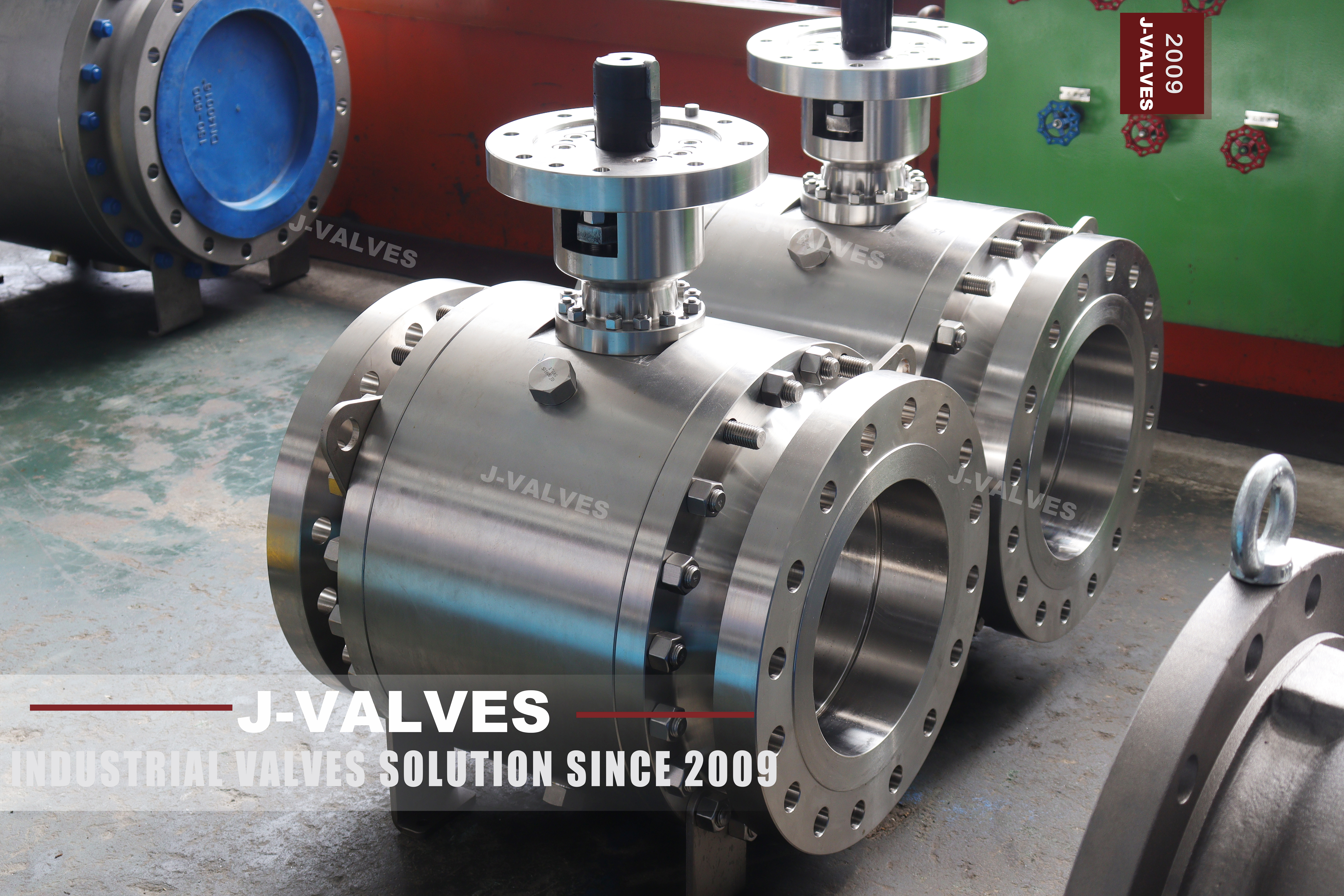
This is the stainless half of the forged three piece family, and like every range page it is a grid rather than a valve. The published span is half an inch to 56 inch, Class 150 to 2500, with a forged body in F304, F316, F316L, F321, F347, F44 or F904L. What the grid does not say, and what this page is mostly about, is that the grade and the class are two independent decisions and neither one implies the other.
Buyers arrive here for two different reasons. Some need a stainless body because the medium would eat carbon steel, and the class is whatever the line runs at. Others need a valve that still has a rating at a temperature where carbon steel has lost most of its own, and for them the stainless body is a temperature decision rather than a corrosion one. Both are legitimate, and they lead to different grades.
The distinction has a number behind it, and the number is in ASME B16.34 rather than in a catalogue. At ambient, carbon steel and austenitic stainless are almost the same at the same class. At 800 F they are not: in Class 900, carbon steel in group 1.1 has fallen to 805 psi while the austenitic grades in group 2.2 still hold 1265 psi. That crossover is the reason a stainless valve exists in high temperature service at all.
Design and Construction
The body is three pieces, side entry, with both trunnion bearings in the centre section and two caps on their own stud rings. That is the same architecture as the carbon range and it is deliberate: a buyer who has qualified a three piece body for maintenance access should not have to requalify it because the grade changed. The caps carry the flanges and the joint, the centre section carries the ball, the seats and both bearings.
The seats are arranged in the same four ways as the rest of the family, and on a stainless valve the arrangement matters for a reason that is easy to miss. A metal seat with a flexible graphite seal is offered to a temperature well above the body ceiling, and a double piston effect seat cannot relieve a heated cavity into the line. Put those two together on a hot stainless valve with no relief device and the cavity becomes the weakest point in an otherwise sound installation.
The stem is 17-4PH or F316 with electroless nickel, keyed for the operator and retained by the body so that it cannot blow out. On a stainless valve the stem is also the part most exposed to galling, because stainless on stainless will pick up under load if the wrong pair is used. The usual answer is a hardness difference between the stem and the gland, and it is a detail worth asking about on a valve that will be cycled often.
The ends are raised face or ring joint to ASME B16.5, with butt weld ends to ASME B16.25 available. The end type is not cosmetic on a stainless valve: above 1000 F the rating tables in ASME B16.34 apply to butt weld ends only, so a flanged valve has a lower ceiling than the same valve welded in. That is the single most useful thing to know before choosing ends on a high temperature stainless build.

Material Options
The grades are a ladder and each rung buys something specific. F304 is the base austenitic, good for water, most food service and mildly aggressive chemicals, and it is in group 2.1. F316 adds molybdenum and moves to group 2.2, which is the grade for chlorides: seawater, brine, and the chemical streams where 304 pits. F316L is the low carbon version in group 2.3, bought for weldability rather than for corrosion.
Above that the ladder splits. F321 and F347 are stabilised against sensitisation with titanium and niobium respectively, which is a welding and high temperature argument rather than a corrosion one. F44 and F904L are super austenitic grades with much higher molybdenum and nickel, and they are the answer where 316 is not enough but a nickel alloy is more than the duty needs.
| Component | Standard Material | Optional Upgrade | Service Notes |
|---|---|---|---|
| Body and caps | ASTM A182 F304 forging, group 2.1 | F316 or F316L for chlorides; F321 or F347 stabilised; F44 or F904L super austenitic | Forged to shape; pickled and passivated |
| Ball | F304 or F316 with electroless nickel | Hard chrome; tungsten carbide coating; cobalt based hard facing | Coating is a wear surface on a corrosion resistant base |
| Trunnion | F316 surface hardened | 17-4PH precipitation hardening stainless | Both bearings in the centre section |
| Stem | 17-4PH stainless | F316 with ENP; nickel based alloy for sour service | Hardness difference against the gland to limit galling |
| Seat | PTFE or reinforced PTFE | PPL; PEEK; metal with flexible graphite | The seat sets the valve temperature |
| Body joint gasket | Flexible graphite spiral wound | Metal ring joint gasket | One per joint |
| Bolting | A193 B8M with A194 8M nuts | B7 with 2H nuts on a carbon body only | Stainless bolting to match the body |
| Ends | Raised face or ring joint to ASME B16.5 | Butt weld to ASME B16.25 | Above 1000 F the table is written for weld ends |
Two rungs of that ladder are worth a sentence each because they are bought for the wrong reason most often. F316L lowers the carbon and raises nothing else: on a flanged valve that is never welded it buys no corrosion resistance over F316, and the reason to specify it is a weld procedure that cannot tolerate sensitisation. F321 and F347 are the same idea with a stabilising element, and they matter where the valve will see a long heat soak in service rather than a short weld cycle.
Technical Specifications
The table fixes the range and the standards and leaves the single valve to the drawing. That is the correct shape for a range page: it tells a buyer whether the combination they need exists, not what the valve will measure.
| Item | Value |
|---|---|
| Size range | Half inch to 56 inch, DN15 to DN1400 |
| Pressure class | Class 150 to 2500, PN20 to PN420 in the API 6D designation |
| Body style | Three piece forged body, side entry, trunnion mounted ball |
| Body material | ASTM A182 F304 as standard; F316, F316L, F321, F347, F44 or F904L on request |
| Material group | ASME B16.34 group 2.1 for F304, group 2.2 for F316, group 2.3 for the low carbon grades |
| End connections | Raised face or ring joint to ASME B16.5; butt weld to ASME B16.25 |
| Face to face | ASME B16.10 for the size and class, confirmed on the signed GA drawing |
| Bore | Full bore or reduced bore to the API 6D table |
| Seat | PTFE, reinforced PTFE, PPL, PEEK, or metal with flexible graphite |
| Seat arrangement | Single piston effect standard; double piston effect or combined DIB on request |
| Temperature | Minus 29 to plus 425 C published for the range; the seat sets the working limit |
| Stem | Keyed, blowout proof, anti-static, low emission packing to ISO 15848 |
| Operator | Lever, worm gear, pneumatic, electric, hydraulic or gas-hydraulic |
| Product standard | API 6D; API 608 applies only up to Class 600 |
Wall thickness and face to face are not in that table for the same reason they are not on the carbon page: the first is a calculation and the second is a drawing dimension for the size and class ordered. On a stainless valve the calculation carries an extra term, because the allowable stress is read from the austenitic group rather than from the carbon one.
Standards and Compliance
ASME B16.34 organises austenitic stainless into groups rather than into a single curve, and the group number is what turns a class into a pressure. F304 sits in group 2.1, F316 in group 2.2, the low carbon grades in group 2.3, and the stabilised grades follow in their own group. Two valves with the same class and different groups do not have the same rating at the same temperature, which is why a data sheet that quotes a class without a group is quoting half a specification.
The comparison with carbon steel changes with temperature and that is the point most often lost. At ambient the austenitic grades are slightly weaker: in Class 150, group 2.2 gives 275 psi against 285 psi for group 1.1 carbon. At 800 F the position reverses sharply, and in Class 900 the austenitic grades hold 1265 psi while carbon steel has fallen to 805 psi. Stainless is therefore not a stronger material; it is a material whose strength decays more slowly.
The ceiling on a flanged stainless valve is worth stating precisely. The group 2.2 ratings are tabulated to 1000 F, which is 538 C, and above that temperature the table applies to butt weld ends only. That is why a metal seat offered to a much higher figure cannot be delivered on a flanged body: the seat material may survive the temperature, but the flange has no rating there.
| Requirement | Standard | What J-VALVES Supplies |
|---|---|---|
| Wall thickness and rating | ASME B16.34, group 2.1 to 2.3 by grade | Design calculation and rating from the group table |
| Pipeline valve requirements | API 6D | Marking, documentation, cavity and drain provisions |
| Soft seated ball valves | API 608, Class 150 to 600 only | Applies to the lower part of the range |
| Pressure testing | API 598 | Shell at 1.5 times, seat at 1.1 times the rating |
| Fire test | API 607, ISO 10497 as the equivalent | Type test certificate with a size and class scope |
| Low emission | ISO 15848 | Stem seal arrangement certified with a class |
| Material identity | PMI on body, ball and stem | Reading recorded against the certificate |
| Material certificate | EN 10204 3.1 | Body and trim, heat number matched to the marking |
Manufacturing Process
A stainless forging is machined with the same sequence as a carbon one and with one extra discipline: nothing that has touched carbon steel may touch it. Carbon steel tooling, wire brushes, grinding wheels and even a mild steel lifting hook will leave free iron on a stainless surface, and free iron is where pitting starts. That is why a stainless shop separates its tools and why the parts are handled differently after machining.
After machining and any welding, the parts are pickled and passivated. Pickling removes the heat tint and the chromium depleted layer that welding leaves behind; passivation restores the passive film over the whole surface. A valve that skips this step looks acceptable and corrodes first at the welds and at the machined corners, which is exactly where a buyer will look when it fails.
Assembly follows: seats and springs into the centre section, ball between them, caps landed, studs brought up in stages in a cross pattern, then test, drain, dry, mask and pack. On a stainless valve the masking matters twice over, because a painted or grit contaminated face is a leak and a scratch on a passive film is a corrosion site.

Quality Control and Testing
The identity check is the most important test on a stainless valve, because 304 and 316 are visually identical and a mixed part cannot be found by looking. Positive material identification on the body, the ball and the stem is a reading rather than an opinion, and it is the only way to know that the certificate and the valve are describing the same object.
| Step | What Is Checked | Standard or Acceptance |
|---|---|---|
| 1 Material | Heat number, chemistry, mechanical properties | Grade ordered, EN 10204 3.1 |
| 2 Identity | PMI on body, ball and stem | Reading matches the certificate |
| 3 Surface | Pickled and passivated, no free iron, no heat tint | Works standard |
| 4 Dimensional | Flange facing, bolt circle, face to face, bore | ASME B16.5, B16.10, API 6D bore table |
| 5 Machining | Seat pocket concentricity, joint face flatness | Drawing tolerance |
| 6 Shell test | Body and both body joints at 1.5 times the rating | API 598, no leakage |
| 7 Seat test | Each seat at 1.1 times the rating, cavity vented | API 598; zero visible leakage on soft seats |
| 8 Final | Drained, dried, masked, painted, capped, marked | Works standard |
Intergranular corrosion testing to ASTM A262 is a supplementary requirement rather than a routine one, and it is worth ordering on a stabilised grade that will run hot, because that is the failure mode the stabilised grades exist to prevent. On a duplex body the equivalent question is the ferrite balance, which is a microstructure check rather than a corrosion test.

Applications and Industry Service
The ordinary homes for this range are chemical and petrochemical plants where the medium decides the grade, seawater and desalination systems where 316 is the minimum, food and beverage and pharmaceutical service where a stainless body is a hygiene requirement as much as a corrosion one, and pulp and paper lines where chlorides and temperature arrive together.
The high temperature argument is the second home and it is less obvious. A stainless valve at 800 F holds a rating that a carbon valve of the same class has already lost, so on a hot line the stainless body is a way of keeping the class rather than a way of resisting the medium. That is a different purchase, and it changes which grade is right: at that temperature the stabilised grades come into their own.
One more step exists above this ladder and it is not on this page. Where chlorides are concentrated enough to crack austenitic stainless under stress, the answer is duplex rather than a higher molybdenum austenitic grade, because duplex resists chloride stress corrosion cracking in a way that no 300 series grade does. Buying F44 for that duty is buying the wrong kind of corrosion resistance at a higher price.
The range is the wrong answer below the low temperature floor, where the seat and the gasket fail before the body does, and above the published ceiling, where the ends have to change before the grade does. It is also the wrong answer where the medium attacks austenitic stainless at all, which in chlorides above a certain concentration means duplex or a nickel alloy rather than a bigger molybdenum number.

Installation, Operation and Maintenance
Stainless bolting galls if it is tightened dry, and the failure is silent: the stud picks up in the nut, the torque reading lies, and the joint is loose before it is tight. A nickel based anti-seize compound on the threads and under the nut face is the standard remedy, and it should be applied to the studs rather than to the flange faces, which have to stay clean and dry.
On a butt weld end the inside of the pipe is purged before welding, because an oxidised root in a stainless line is a corrosion site that no amount of external passivation will reach. On a ring joint facing the ring goes in dry and the faces are brought together evenly; a ring that has already been compressed should not be reused.
Operation is a quarter turn, and the low emission stem sealing is certified to a class rather than being a description. Maintenance is the three piece routine: isolate, vent, drain, relieve the cavity if the seat is double piston effect, break the two joints, and replace the gaskets when the caps go back on. On a stainless valve the joints are also the places where a scratch will start a pit, so the faces are handled rather than levered apart.
How to Specify and Order
Six things decide the valve and the grade is the one that needs the most thought. Size and class come from the line; the grade comes from the medium and the temperature together; the end type follows from the rating ceiling; the seat follows from the temperature; the seat arrangement follows from whether the cavity can relieve itself; and the operator follows from the duty.
The certificate requirement belongs on the order as well, because on a stainless valve the paper is part of the product. EN 10204 3.1 for body and trim, PMI readings recorded against it, the pickling and passivation record, the pressure test records, and the intergranular corrosion test if a stabilised grade has been ordered for a hot service. All of them can be supplied and none of them arrive unless they are asked for.
FAQ
Q: Which stainless grade should be ordered for a given medium?
A: F304 for water, steam condensate, food service and mildly aggressive chemicals. F316 where there are chlorides, which covers seawater, brine and most chemical streams. F321 or F347 where the valve will run hot or will be welded and cannot be sensitised. F44 or F904L where 316 pits but a nickel alloy is more than the duty needs. The class does not change with the grade, so the grade is chosen on the medium and the temperature alone.
Q: Is stainless stronger than carbon steel at the same class?
A: At ambient it is slightly weaker. In Class 150, group 2.2 austenitic stainless is rated at 275 psi and group 1.1 carbon steel at 285 psi. The position reverses as temperature rises: at 800 F in Class 900 the austenitic grades hold 1265 psi while carbon steel has fallen to 805 psi. Stainless is bought because its rating decays more slowly, not because it starts higher.
Q: Why can the metal seat not deliver 650 C on a flanged valve?
A: Because the flange has no rating there. The group 2.2 pressure temperature table stops at 1000 F, which is 538 C, and above that temperature the ratings apply to butt weld ends only. A metal seat may survive a higher temperature, but the body it is fitted to is outside the table that gives the valve its pressure rating, so the seat figure is not a permission.
Q: What is pickling and passivation for?
A: Pickling removes the heat tint and the chromium depleted layer left by welding; passivation restores the passive oxide film over the whole surface. A valve that skips the step looks acceptable and corrodes first at the welds and machined corners. It is also the step that removes free iron picked up from carbon steel tooling, which is the most common cause of early pitting.
Q: Why does the valve need a PMI check if it comes with a 3.1 certificate?
A: Because the certificate describes the heat, and the valve has to be made of that heat. 304 and 316 are visually identical, so a mixed part cannot be found by looking, and a positive material identification reading on the body, ball and stem is the only way to tie the certificate to the object in the crate.


Hot Products


News
Stainless Steel Ball Valve Grades: 304, 316 And 316L, And What Actually Decides
Molybdenum is the difference that decides the duty, carbon is the difference that gets missed, and the chloride in the line matters more than the price.
Read More
Ball Valve Spare Parts for Overseas Projects: The Wear Part List, The Quantity Math, And Four Traps
Why isolation valves fail on calendar time, not cycles. Wear part lists, Poisson stock maths, seat kit traps and the clauses that decide year six.
Read More
Ball Valves On A Bottom Loading Gantry: Creep, Dry Break And The Test That Proves Neither
A loading gantry cycles a ball valve far more than it is designed for and still cannot prove shut-off. Where creep starts, and what to specify.
Read More
Lined Ball Valves in Acid Service: The Liner Does Not Fail, The Steel Behind It Does
The valve came out of the line looking better than most valves that come out of a hydrochloric acid line. Three inch, PFA lined, cast body, Class 150, fourteen months in service on a 32 percent acid transfer duty at 55 to 60 degrees C, about forty open and close cycles a week. The paint was intact.
Read More