


CHINA J-VALVES Offers Various High-quality I ndustrial Ball Valves
J-VALVES, a distinguished professional ball valve manufacturer rooted in China, takes pride in its extensive product portfolio. Our offerings span a wide range, including trunnion-mounted ball valves, floating ball valves, high-temperature ball valves, high-pressure ball valves, metal-sealed ball valves, ultra-low temperature ball valves, DBB ball valves, Three-way And Four-way Ball Valve, and fully welded ball valves. Each product is a testament to our commitment to precision engineering and reliable performance. Meticulously crafted, they are designed to not only meet but exceed the most stringent industrial demands, ensuring stable operation even under extreme conditions. This enables us to provide our clients with high-value services and makes our valves widely sought-after in industries.
Product Category
Contact Us


-
J-VALVES-Q47F
-
J-VALVES
Overview of the J-VALVES 4x3 inch Class 900 A105N trunnion ball valve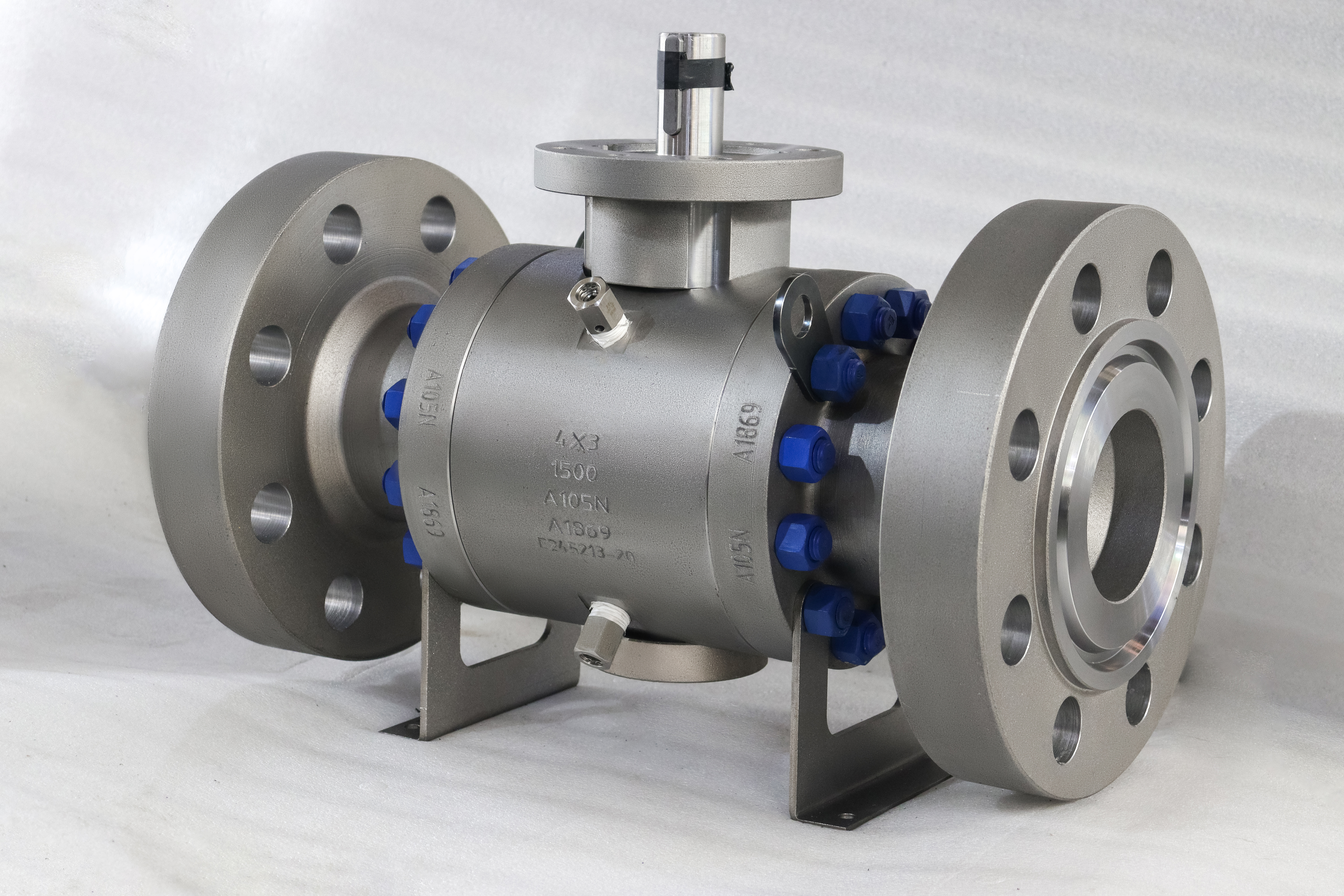
The size is written 4x3 because there are two numbers and both matter. The ends and the flanges are four inch, so the valve bolts into a four inch line; the bore is three inch, so the passage through the ball is one size smaller than the pipe it sits in. That single step is what the valve is for, and it is also the thing most easily lost when the same paragraph of catalogue text is reused across a range.
It is a Class 900 valve, so it is a high pressure valve, and it is a three piece forged body with a trunnion mounted ball. The body is A105N, which on a carbon steel valve is a statement about heat treatment rather than about alloy, and the flanges are raised face or ring joint to ASME B16.5 with butt weld ends available. What it is not is a full bore valve, and any buyer who needs to run a pig through the line should stop at that sentence.
Where a reduced bore valve earns its place is on lines that were sized for a future flow rate, or that have a restriction elsewhere already, or that simply do not need the full passage because nothing will ever be pushed through them. On those lines the smaller bore buys a smaller ball, a smaller seat, less operating torque and a lighter valve at the same class, which at 900 class is not a small difference.
Design and Construction
The body is three pieces: a centre section with both trunnion bearings, and two end caps that carry the four inch flanges and their own stud rings. The ball sits in the centre section between two seats, and the bore through the ball is three inch, so the flow path steps down inside the valve rather than at the pipe. That step is machined into the caps and into the ball, and it is the one dimension on this valve that cannot be checked with a tape measure at the flange.
The trunnion arrangement is the standard one for this family. Both bearings are in the centre section, the ball does not travel with pressure, and the seat load comes from a spring pack plus the pressure term. Because the ball is smaller than the line, the force the pressure puts on it is smaller than it would be on a full bore four inch valve at the same class, which is the mechanical reason a reduced bore valve turns more easily.
There are three pressure boundaries and one of them is easy to forget on a valve of this shape. The joint under each cap is one, the stem packing is the second, and the cavity plug low on the body is the third. The plug is how the cavity is vented for a double block and bleed check, and on a reduced bore body the cavity around the ball is larger than the bore, so a bleed there tells the operator more than a sight glass would.
The seat arrangement is a choice rather than a fixed feature. Single piston effect is the default and relieves a heated cavity into the line on the low pressure side; double piston effect seals from both directions and needs an external relief route for the cavity; the combined arrangement does both in one seat ring. On a Class 900 valve in a process where the line can be blocked in and warmed by the sun, that choice is worth more attention than the bore.

Material Options
A105N is written with an N for normalised, and the honest way to read it is as A105 with a stated heat treatment rather than as a separate grade. ASTM A105 is a carbon steel forging specification, the normalising is what refines the grain after forging, and the certificate is where the heat treatment cycle is recorded. A supplier who writes A105N is telling the buyer something real about the process, but it is not a different alloy and it does not change the pressure rating.
What normalising buys is toughness, and toughness is what matters when the line runs cold. On a valve ordered for a low temperature service the answer is not a harder carbon steel but a different specification: A350 LF2 is the low temperature forging grade, it is impact tested, and it is what should be on the order when the design temperature goes below the carbon steel floor. The A105N described on this page is the standard temperature build.
| Component | Standard Material | Optional Upgrade | Service Notes |
|---|---|---|---|
| Body and end caps | ASTM A105N forging | A350 LF2 for low temperature; A182 F316 for corrosion | Normalising recorded on the certificate |
| Ball | A105N with electroless nickel plating | Hard chrome; tungsten carbide coating; cobalt based hard facing | Three inch bore in a four inch body |
| Trunnion | A105N surface hardened | 17-4PH precipitation hardening stainless | Both bearings in the centre section |
| Stem | 17-4PH stainless | A105N with ENP | Blowout proof, keyed |
| Seat | PTFE or reinforced PTFE at the low end | PPL; PEEK; metal with flexible graphite | The seat sets the working temperature |
| Body joint gasket | Flexible graphite spiral wound | Metal ring joint gasket, octagonal or oval | One per joint |
| Bolting | A193 B7 with A194 2H nuts | B8M with 8M nuts for the stainless build | Carbon bolting on a carbon body is correct |
| Ends | Raised face or ring joint to ASME B16.5 | Butt weld ends to ASME B16.25 | The flange is four inch whatever the bore is |
The stainless upgrade deserves one line of its own, because it is the option most often taken for the wrong reason. F316 is bought for chlorides and for a certificate, not for pressure: a Class 900 valve in F316 is read in group 3.1 of ASME B16.34 rather than in the carbon column of group 1.1, and the two columns do not give the same allowable at the same temperature. Upgrading the body does not raise the class.
Technical Specifications
The table carries the two numbers that define this valve and separates them, because writing four inch in one line and three inch in another is how a buyer ends up with the wrong product. The flange size sets what the valve bolts to; the bore sets what flows through it; the class sets the pressure; and the face to face is read from the valve size rather than from the bore.
That last point is worth stating plainly. ASME B16.10 gives face to face dimensions by valve size and class, so a 4x3 Class 900 valve takes the NPS 4 Class 900 dimension, not a NPS 3 one. A valve built to the three inch length would not fit the four inch gap in the line no matter how well it was made, and the drawing is where the number is confirmed before anything is cut.
| Item | Value |
|---|---|
| Size | 4x3 inch, DN100 x DN80, four inch ends with a three inch bore |
| Pressure class | Class 900, recorded as PN 150 in API 6D clause 7.2 |
| Body style | Three piece forged body, trunnion mounted ball, side entry |
| Body material | ASTM A105N forging, normalised, ASME B16.34 group 1.1 |
| Ball | A105N with electroless nickel plating, three inch bore |
| Bore type | Reduced bore, one size below the valve size per the API 6D table |
| Flange | ASME B16.5 Class 900, raised face or ring joint |
| End options | Butt weld ends to ASME B16.25 |
| Face to face | ASME B16.10 for NPS 4 Class 900, confirmed on the signed GA drawing |
| Temperature | Minus 29 to plus 425 C as published; the seat sets the working limit |
| Seat | PTFE, reinforced PTFE, PPL, PEEK, or metal with flexible graphite |
| Seat arrangement | Single piston effect standard; double piston effect or combined DIB on request |
| Stem | 17-4PH, keyed, blowout proof, anti-static |
| Operator | Lever, worm gear, pneumatic, electric or hydraulic |
| Design standard | ASME B16.34 and API 6D |
| Test standard | API 598, shell at 1.5 times and seat at 1.1 times the rating |
Standards and Compliance
API 6D is the product standard here and it does two jobs on this page. The first is the bore: the standard carries a table of full bore and reduced bore dimensions, and a reduced bore valve is one that follows the reduced line of that table rather than a bore somebody chose. The second is the class: at 900 the valve sits outside API 608, whose scope stops at Class 600, so the documents that travel with it are the 6D set.
ASME B16.34 supplies the pressure boundary. Class 900 is a class number, group 1.1 is the material group for a carbon forging, and the rating is the intersection of the two at a temperature. That is why the same class number produces different pressures on a carbon body and on a stainless one, and why the material group has to be named whenever a rating is quoted.
Fire testing and low emission testing are type tests with a scope, and both are worth asking about by certificate rather than by adjective. API 607 and ISO 10497 describe the same fire test; API 6FA has been folded into 607, so a page that lists all three is listing one test three times. Low emission is certified to ISO 15848 with a class attached to a specific stem seal arrangement.
| Requirement | Standard | What J-VALVES Supplies |
|---|---|---|
| Wall thickness and rating | ASME B16.34 group 1.1 | Design calculation, rating from the group table |
| Pipeline valve requirements | API 6D | Marking, documentation, cavity and drain provisions |
| Reduced bore dimensions | API 6D bore table | Bore confirmed on the drawing and checked at final inspection |
| Soft seated ball valves | API 608, Class 150 to 600 only | Does not reach Class 900 |
| Pressure testing | API 598 | Shell at 1.5 times, seat at 1.1 times the rating |
| Fire test | API 607, ISO 10497 as the equivalent | Type test certificate with a size and class scope |
| Flange dimensions | ASME B16.5 | Raised face or ring joint cut to the facing ordered |
| Material certificate | EN 10204 3.1 | Body and trim, heat number matched to the marking |
Manufacturing Process
The body starts as a forging and the caps are where the reduced bore is made. Each cap carries a four inch flange at one end and a three inch bore at the other, with the transition machined inside, so the cap is not a simple tube: it is a stepped part with a seat pocket at the small end and a flange at the large one. Machining that step without leaving a ledge that traps debris is a small craft point that shows up later as a dirty sample or a slow flush.
The bore through the ball is cut and then the ball is lapped against its seat, the same way as on any trunnion valve, but on this build the lapping has to be done against a seat pocket that is concentric with a three inch bore inside a four inch cap. That is the operation where a reduced bore valve either runs true or develops a tight spot halfway through the quarter turn.
Assembly, testing and packing follow the family routine: seats and springs in, ball between them, caps landed, studs brought up in stages in a cross pattern, shell test, seat test, drain, dry, mask the faces, paint, cap the ends. The masking step matters as much here as anywhere, because paint on a ring joint groove will leak later and the gasket will be blamed.

Quality Control and Testing
Every valve is shell tested, seat tested and dimensionally checked, and on a reduced bore valve the dimensional check carries one extra item: the bore has to be the reduced bore for the size and class, not a full bore that was described as reduced or a bore that was chosen to use up a ball from another order.
| Step | What Is Checked | Standard or Acceptance |
|---|---|---|
| 1 Material | Heat number and heat treatment against the certificate | A105N, EN 10204 3.1 |
| 2 Identity | PMI on body and trim when ordered | No mixed parts |
| 3 Bore | Bore diameter against the API 6D reduced bore table | Drawing and standard agree |
| 4 Dimensional | Flange facing, bolt circle, face to face for NPS 4 Class 900 | ASME B16.5 and B16.10 |
| 5 Machining | Seat pocket concentricity, joint face flatness, groove profile | Drawing tolerance |
| 6 Shell test | Body and both body joints at 1.5 times the rating | API 598, no leakage |
| 7 Seat test | Each seat at 1.1 times the rating, cavity vented | API 598, zero visible leakage on soft seats |
| 8 Final | Drained, dried, faces masked, painted, capped | Works standard |
The shell test is the one that finds a bad cap, because each cap carries a machined step and a joint face and both are under full pressure at the same time. The seat test is the one that finds a bad lap, and on this valve it is run with the cavity vented so that the result is a seat result rather than a combination of seat and cavity leakage.

Applications and Industry Service
Reduced bore valves are specified where the line does not have to be pigged and the flow does not need the full passage. That covers a lot of process piping: branch connections, bypasses, drain and vent headers, isolation in front of equipment that has its own restriction, and lines that were sized for a future rate that has not arrived. In each of those the smaller bore costs less, weighs less and turns more easily at the same class, and none of those advantages is available on a full bore valve.
The valve is wrong for a line that will be pigged, for a line where the pressure drop across the valve matters, and for a slurry or a medium that settles in a step. A reduced bore body has a cavity around the step and a change of section that a full bore body does not have, and on a dirty service that is where solids collect. The question to ask is not whether reduced bore is cheaper, because it always is; it is whether anything will ever have to pass through the valve that cannot pass a three inch bore.
The 900 class limits the service as much as the bore does. Above the published temperature the material group changes; below it the seat changes before the body does; and where the medium attacks carbon steel the answer is a higher alloy rather than a thicker wall. On a four inch line at 900 class, those three questions come before the question of bore.

Installation, Operation and Maintenance
The valve goes in on the four inch face to face dimension and the pipe is brought to it, not the other way round. On a ring joint facing the ring goes in dry, sits in the groove and sets the gap between the faces, so the studs are tensioned to bring the flanges together evenly rather than to compress anything. A ring that has already been compressed once should not be reused.
Operation is a quarter turn. On a Class 900 valve of this size the operator is a lever on the smaller builds and a gear on the larger ones, and the position indicator is what the operator reads. The body retains the stem, so it cannot blow out, and the packing stays adjustable with the line live; the upper seal can be renewed once the cavity is vented.
Maintenance means taking the caps off, and on a double piston effect build it also means relieving the cavity first, because that seat arrangement does not relieve itself. What comes out is the ball and both seats; what goes back in is a matched set, because a new ball in an old seat is a leak looking for a commissioning date. Both joints are then re-gasketed and re-torqued in the cross pattern.
How to Specify and Order
The size has to be written as a pair, and the order should say both numbers explicitly: four inch ends, three inch bore, reduced bore to the API 6D table. Writing 4 inch and leaving the bore to the supplier is how a full bore valve arrives on a line that was priced for a reduced bore one, and the difference is visible only after the valve is on the ground.
Five more things decide the valve: the class, the body grade with its heat treatment and certificate, the flange facing, the seat material and arrangement, and the operator. Two of those are regularly missing from the first enquiry, and they are the facing and the seat, which are also the two that change the delivery most.
Documents should be named rather than assumed: EN 10204 3.1 for body and trim, the heat treatment record for the normalising, the shell and seat test records, the dimensional report with the bore, and the fire test certificate with its scope if fire safe is being claimed. All of them can be supplied, and none of them are in the standard crate unless the order says so.
FAQ
Q: What exactly does 4x3 mean?
A: Four inch ends and a three inch bore. The flanges, the bolt circle and the face to face are all NPS 4, so the valve replaces a four inch valve in a four inch line; the passage through the ball is one size smaller, so the flow area is that of a three inch valve. Both numbers belong on the order, because either one on its own describes a different product.
Q: Which face to face dimension applies to a reduced bore valve?
A: The one for the valve size, not the bore. ASME B16.10 tabulates by valve size and class, so a 4x3 Class 900 valve takes the NPS 4 Class 900 dimension. A valve built to the three inch length would not fit the four inch gap in the line, however well it was machined.
Q: Is A105N a different grade from A105?
A: Not a different alloy. A105 is a carbon steel forging specification and the N records that the forging was normalised, which refines the grain and is stated on the material certificate. It is a real statement about the process, but it does not change the material group and it does not raise the pressure rating.
Q: Can a pig pass through this valve?
A: No. A reduced bore valve has a step inside the body and the bore is smaller than the pipe, so a pig will not pass. If the line has to be pigged, the valve has to be full bore, and no amount of cleaning or guidance will make a three inch passage pass a four inch pig.
Q: Why keep the reduced bore if it costs flow area?
A: Because on a line that is never pigged the smaller bore means a smaller ball, a smaller seat and a lighter body at the same class, and all three reduce the torque the operator has to apply. On a Class 900 valve that difference is worth having. What it costs is pressure drop and the ability to pass anything larger than the bore.


Hot Products


News
Stainless Steel Ball Valve Grades: 304, 316 And 316L, And What Actually Decides
Molybdenum is the difference that decides the duty, carbon is the difference that gets missed, and the chloride in the line matters more than the price.
Read More
Ball Valve Spare Parts for Overseas Projects: The Wear Part List, The Quantity Math, And Four Traps
Why isolation valves fail on calendar time, not cycles. Wear part lists, Poisson stock maths, seat kit traps and the clauses that decide year six.
Read More
Ball Valves On A Bottom Loading Gantry: Creep, Dry Break And The Test That Proves Neither
A loading gantry cycles a ball valve far more than it is designed for and still cannot prove shut-off. Where creep starts, and what to specify.
Read More
Lined Ball Valves in Acid Service: The Liner Does Not Fail, The Steel Behind It Does
The valve came out of the line looking better than most valves that come out of a hydrochloric acid line. Three inch, PFA lined, cast body, Class 150, fourteen months in service on a 32 percent acid transfer duty at 55 to 60 degrees C, about forty open and close cycles a week. The paint was intact.
Read More