


CHINA J-VALVES Offers Various High-quality I ndustrial Ball Valves
J-VALVES, a distinguished professional ball valve manufacturer rooted in China, takes pride in its extensive product portfolio. Our offerings span a wide range, including trunnion-mounted ball valves, floating ball valves, high-temperature ball valves, high-pressure ball valves, metal-sealed ball valves, ultra-low temperature ball valves, DBB ball valves, Three-way And Four-way Ball Valve, and fully welded ball valves. Each product is a testament to our commitment to precision engineering and reliable performance. Meticulously crafted, they are designed to not only meet but exceed the most stringent industrial demands, ensuring stable operation even under extreme conditions. This enables us to provide our clients with high-value services and makes our valves widely sought-after in industries.
Product Category
Contact Us


-
J-VALVES-Q347F
-
J-VALVES
Overview of the J-VALVES 16 inch cast steel trunnion ball valve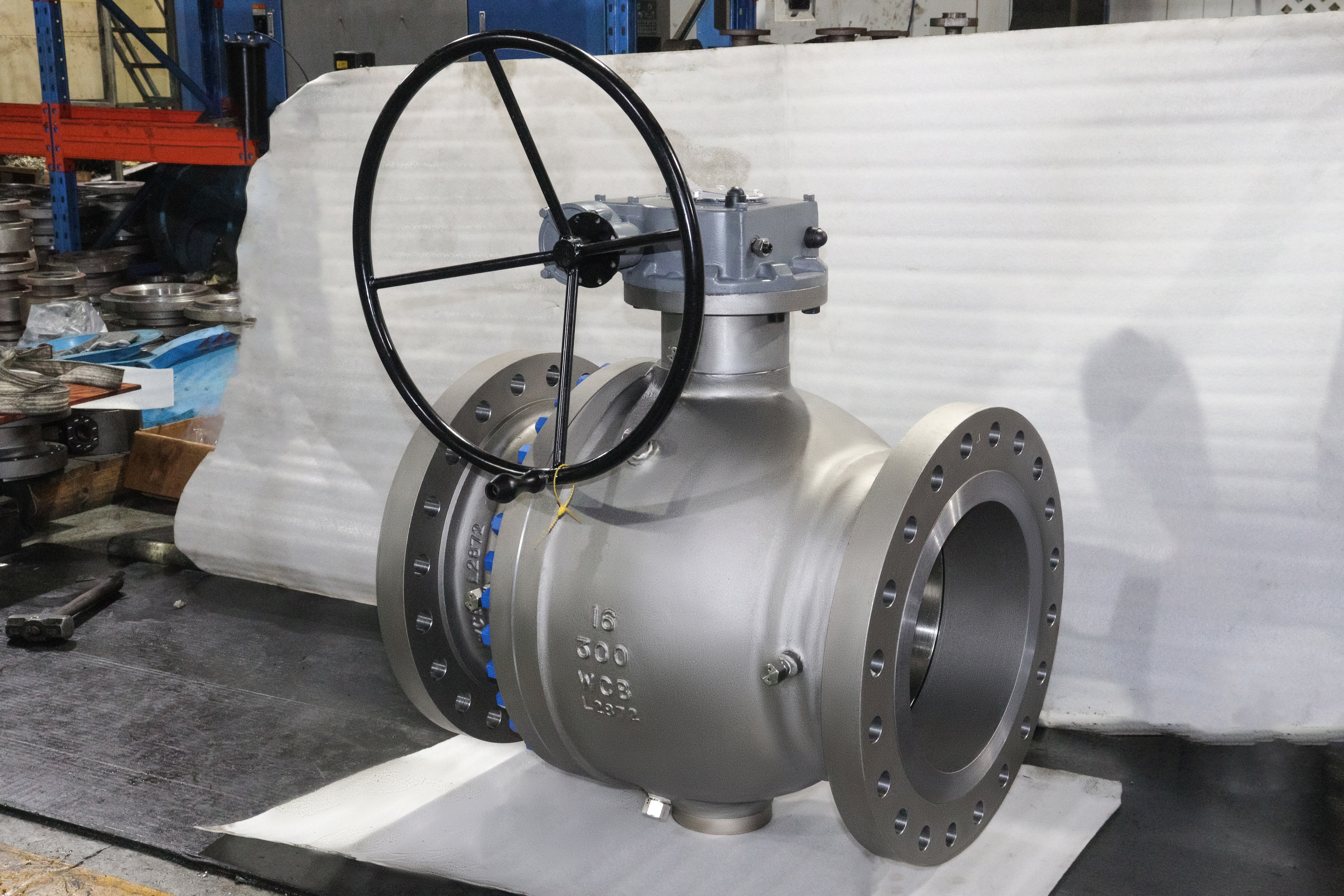
This is a sixteen inch Class 300 trunnion mounted ball valve with a two piece body cast in ASTM A216 WCB, raised face flanges drilled to ASME B16.5, and a spur gear operator on a bolted top pad. The ball is carried on an upper and a lower trunnion, so the seats do not have to hold the ball against line pressure. It is the size and class that mainline block valves, station isolation and large water headers are usually built around.
Sixteen inch is a size where this valve is built as a casting, and the photographs on this page are of a casting. The surface shows the sand texture of an A216 part and the paint sits on that texture rather than on machined steel. A three piece forged body is also available at this size and is covered on its own page, so the choice is not cast versus forged in the abstract: it is which body structure, which joint count, and which inspection route the line needs.
The service it suits is the ordinary one: natural gas transmission and city gate stations, water transmission mains, cooling water headers, and utility piping where Class 300 is chosen for the allowable at temperature rather than for a high pressure number. Class 300 carbon steel carries 51.1 bar at 38 C in group 1.1 of ASME B16.34, and a sixteen inch line rarely runs above that.
Design and Construction
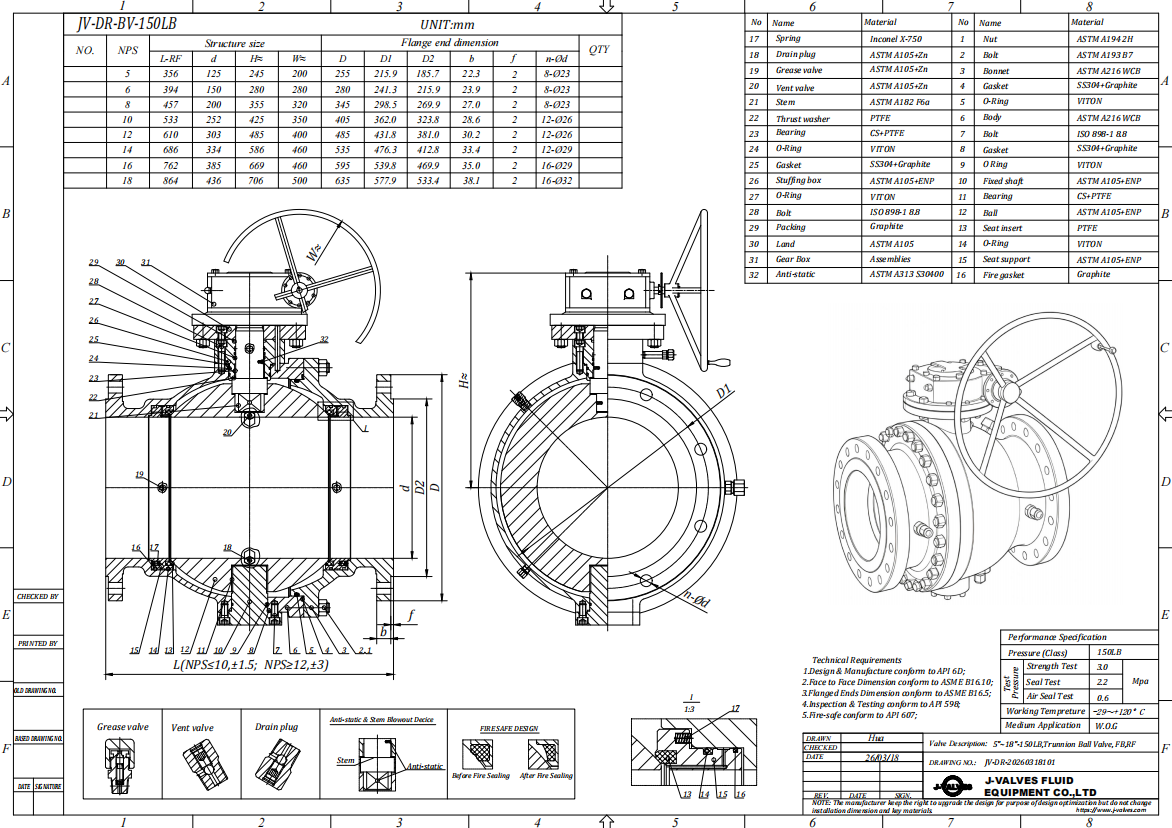
The body is two pieces: a main body and one bolted end cap. The cap has to pass the ball, so the opening it covers is larger than the bore and the joint is the widest pressure containing circle on the valve. That is the geometric reason the body joint of a two piece valve is a serious joint and not a service hatch, and it is why the number of studs around it is a drawing item rather than something copied from a flange table.
The ball sits on an upper and a lower trunnion, and the trunnions take the thrust that a floating ball would put into the seats. Seat load comes from a spring pack plus whatever the line pressure adds, and because the ball does not travel, the operating torque stays close to constant across the pressure range. On a sixteen inch valve that is the difference between a gear operator and a lever: a lever at this size would need more hand force than one person can apply.
Three joints sit on one valve and they are not the same thing. The two pipe flanges are the pipeline's joints and are made with the pipe's gaskets and studs. The body joint is the valve's own pressure boundary and is closed in the works. The drain plug at the bottom of the body is the third, and it is a threaded pressure boundary opening that is often the first to be forgotten when a valve is installed in a pit.
Material Options
The body is A216 WCB, a cast carbon steel in group 1.1 of ASME B16.34. The two alternatives that matter are A105 and A350 LF2. A105 is the forging grade and sits in the same group with the same allowable line, so it buys soundness and shape, never a higher class. A350 LF2 is the low temperature grade and moves the floor from minus 29 C down to minus 46 C, which matters on cold climates and on refrigerated service. It does not move the top.
The trim is where the temperature actually stops. A soft seat closes the valve long before the body reaches its ceiling: reinforced PTFE is good to about 180 C, PPL to about 280 C, PEEK to about 260 C, and a metal seat with flexible graphite to about 425 C. The catalogue range of minus 29 to 425 C is a body range with a metal seat; with a PTFE seat this valve is a 180 C valve.
| Component | Standard Material | Optional Upgrade | Service Notes |
|---|---|---|---|
| Body and end cap | ASTM A216 WCB cast carbon steel | A105 forged (same group 1.1); A350 LF2 for minus 46 C | Cast body; supplementary RT or UT only when ordered |
| Ball | WCB or A105, electroless nickel plated | Hard chrome; stainless hardfacing; solid F316 | ENP is a coating, not a material grade |
| Trunnion and support | A105, surface hardened | 17-4PH precipitation hardening stainless | Upper and lower trunnion, paired bore |
| Stem | 17-4PH stainless | A105 with ENP | Blowout proof, retained by the body |
| Seat | PTFE or reinforced PTFE | PPL; PEEK; metal seat with flexible graphite | The seat, not the body, sets the valve temperature |
| Packing | Flexible graphite with stainless reinforcement | PTFE V-rings | Live loaded on request |
| Body joint gasket | Flexible graphite spiral wound | Metal ring joint gasket | Body joint only; never a flat PTFE sheet |
| Bolting | A193 B7 with A194 2H nuts | B8M with A194 8M | Body joint studs are not pipe flange studs |
Technical Specifications
The specification table fixes what a standard fixes: the size, the class, the flange drilling, the material identities and the standards the valve is built and tested to. Those are the rows a buyer can check against a catalogue and against the certificate.
It cannot fix the dimensions that belong to a drawing. Wall thickness comes from the design calculation in ASME B16.34 and is reported on the drawing, not on the data sheet. Face to face is read from ASME B16.10 against the size and class, and confirmed on the GA drawing issued with the order. Any page that prints those numbers without a drawing behind them is printing something nobody signed.
| Item | Value |
|---|---|
| Size | 16 inch, DN400 |
| Pressure class | Class 300, recorded as PN 50 in API 6D clause 7.2 |
| Body style | Two piece, bolted end cap, trunnion mounted ball |
| Body material | ASTM A216 WCB, group 1.1 |
| Flange | ASME B16.5 Class 300, raised face, 647.7 mm outside diameter, 571.5 mm bolt circle, 20 bolt holes 1-1/4 inch, raised face 469.9 mm |
| End options | Butt weld ends to ASME B16.25 on request |
| Face to face | ASME B16.10 for NPS 16 Class 300, confirmed on the signed GA drawing |
| Rating | 51.1 bar at 38 C in group 1.1 of ASME B16.34 |
| Temperature, body | minus 29 C to 538 C, with the practical ceiling at 425 C because of graphitisation |
| Temperature, valve | Set by the seat: about 180 C PTFE, 280 C PPL, 260 C PEEK, 425 C metal |
| Seat design | Single piston effect as standard; double piston effect on request |
| Operator | Spur gear with handwheel, IP67 housing, on a bolted top pad |
| Paint | Manufacturer standard over blasted cast surface; flange faces and the raised face left bare |
Standards and Compliance
The design standard is ASME B16.34 for wall thickness and rating, plus API 6D for a pipeline valve. The rating is a table lookup in group 1.1: 51.1 bar at 38 C, falling as temperature rises. The group service range is minus 29 C to 538 C, and the upper half of that range comes with a caveat rather than a permission: above 425 C, carbon steel carbide phases can graphitise, so the material is allowed but not recommended for long term service there.
Pressure testing follows API 598: the shell test at 1.5 times the rating and the seat test at 1.1 times the rating. The test pressures are fixed by the standard; the acceptance criterion is not. A soft seated valve is expected to show no visible leakage at the seat, while a metal seated valve is accepted against a leakage rate tabulated by size. That distinction decides whether API 598 on a data sheet means a bubble tight valve or a valve that passes a table.
There is one standards point specific to this design. API 608 covers steel ball valves at flange sizes DN 15 to DN 600 and classes 150 to 600, but it excludes trunnion valves fitted with double piston effect seats. A single piston effect valve on this page sits inside API 608; the moment the seat is changed to DPE, the product standard becomes API 6D. Fire testing is API 607 with ISO 10497 as the technically equivalent route, and it is a type test: read the size and class range on the certificate, not the logo.
| Requirement | Standard | What J-VALVES Supplies |
|---|---|---|
| Wall thickness and rating | ASME B16.34, group 1.1 | Design calculation; 51.1 bar at 38 C |
| Pipeline valve requirements | API 6D | Marking, documentation, cavity and drain provisions |
| Product standard, soft seated | API 608 | Applies with single piston effect seats |
| Product standard, DPE seats | API 6D | API 608 excludes trunnion valves with DPE seats |
| Pressure testing | API 598 | Shell at 1.5 times, seat at 1.1 times the rating |
| Fire test | API 607 or ISO 10497 | Type test certificate with its size and class scope |
| Flange drilling | ASME B16.5 Class 300 | 20 holes on a 571.5 mm bolt circle, raised face 469.9 mm |
| Material certificate | EN 10204 3.1 | Body and trim, heat number matched to the marking |
Manufacturing Process
The route starts with a pattern and a core box, not with a billet. The casting is poured to A216 WCB chemistry, cleaned, blasted, and then machined. Because the two halves are machined as a pair, the bore, the seat pockets and the joint face share a datum; that pairing is what keeps the ball centred when the cap goes back on after a seat change, and it is the reason a cap from another valve of the same size should not be expected to fit.
Flange facing and drilling come next, then the joint face and its gasket groove, then the seat pockets. Holes are drilled and tapped to the drawing, and the body is marked with the size, the class, the material and the heat number. Marking is done before assembly so that the numbers cannot be confused between two valves on the same bench.
Assembly is where a two piece valve earns or loses its reputation. The ball and seats go into the main body, the cap is landed on its spigot, and the studs are brought up in a cross pattern in stages rather than in one pass. After the hydro test the cavity is drained, the bore is dried, the flange faces are masked, and the valve is painted. The masking is the step that decides whether the raised face arrives bare.

Quality Control and Testing
Every valve gets the same eight checks, and the records leave the works with the valve. The first is material identity: the heat number on the body is matched to the mill certificate and, when the order asks for it, to a PMI reading on the body and the trim.
| Step | What Is Checked | Standard or Acceptance |
|---|---|---|
| 1 Material | Heat number against the mill certificate; chemistry and tensile | ASTM A216 WCB, EN 10204 3.1 |
| 2 Dimensional | Flange outside diameter, bolt circle, hole count, face to face | ASME B16.5 and B16.10, or the signed GA drawing |
| 3 Casting soundness | Visual on machined faces and the joint; RT or UT when ordered | A216 supplementary requirements are not automatic |
| 4 Machining | Seat pocket concentricity, joint face flatness, raised face finish | Drawing tolerance; gasket seating surface |
| 5 Assembly | Ball freedom, seat contact, stud torque in cross pattern | Works procedure, torque recorded |
| 6 Shell test | Body and body joint at 1.5 times the rating | API 598, no leakage |
| 7 Seat test | Each seat at 1.1 times the rating | API 598; zero visible leakage on soft seats |
| 8 Final | Bore dried, faces masked, paint, caps, marking readable | Works standard |
Two of those rows are worth arguing about at enquiry. Casting soundness is the row where a cast body differs from a forged one: A216 requires chemistry and tensile results, and radiographic or ultrasonic examination sits in the supplementary requirements, which are only applied when the purchase order says so. Bailing and repair welding are permitted by the specification within limits, and the repair record is a document the buyer can ask for.
The other row is the final one. Face masking, bore drying and cap fitting look like packing detail and are not: a valve that arrives with paint on the raised face will leak at the flange joint and the leak will be blamed on the gasket, and a valve that arrives with water in the cavity will be blamed on the seat the first time it is opened in freezing weather.

Applications and Industry Service
The usual home for a sixteen inch Class 300 trunnion valve is a gas transmission or distribution station, where it isolates a filter separator, a regulator run or a metering skid. The same valve appears on water transmission mains and on cooling water headers in power and process plants, where the medium is benign and the size is the problem rather than the chemistry.
It is also a valve that gets specified when it should not be. Class 300 is not a substitute for a higher class on a line that really runs at a higher pressure, and a cast body is not a substitute for a forging where the buyer's specification calls for one. The honest limits are simple: above 425 C the body material needs replacing, below minus 29 C the body material needs replacing, and where the medium attacks carbon steel no amount of paint helps.

Installation, Operation and Maintenance
Support the valve. At sixteen inch the valve is a structure in its own right and the pipe flanges are not designed to carry it; the body has feet or pads for that purpose on most builds, and where it does not, a pipe support goes under the body. Bring the flange faces parallel, fit the gasket, and tension the studs in a cross pattern in two or three passes, then check the body joint studs as well, because a valve that was handled on site may have had them disturbed.
In service, the operator is a gearbox. Turn the handwheel, watch the position indicator, and do not extend the handwheel with a pipe: the gearbox is sized for the valve, and a cheater bar converts a hard-to-turn valve into a broken gear case. The limit stops are set in the works; if the valve is motorised later, the actuator's end stops are set against the valve's, not the other way round.
What can be done without isolating the line is limited, and it is worth saying plainly. Packing can be adjusted and, on some builds, the upper stem seal renewed after the cavity has been vented. The body joint cannot be opened under pressure: it is the largest pressure boundary on the valve and it holds full line pressure across the whole circle. Any work on the ball, the seats or the joint starts with isolation, venting and drain.
How to Specify and Order
Six items decide the valve, and four of them are usually missing from the first enquiry. They are the size and class, the flange facing and standard, the body material with the certificate requirement, the seat type and whether double block and bleed is needed, the operator, and the face to face series.
The remaining questions are about the line rather than the valve: the medium, the design and operating temperature, the design pressure, and whether the valve will be operated often or left in one position for years. A valve that is cycled daily and a valve that is a permanent block are the same casting with different seats and different operators, and the price difference follows the seats.
Where a buyer needs documents, they should be named on the order: EN 10204 3.1 for the body and the trim, the hydro test record, the dimensional report, the fire test certificate with its size and class scope, and supplementary radiography or ultrasonic examination if the casting has to be examined. None of those are refused; all of them have to be asked for, because none of them are in the default delivery.
FAQ
Q: Is the body cast or forged on this valve?
A: Cast. The body and the end cap are ASTM A216 WCB castings and the photographs show the sand texture. A three piece forged body is available at the same size on a different page, so the question is which structure the line needs, not which one is possible.
Q: Does the 3.1 certificate prove the casting has no internal defects?
A: No. ASTM A216 asks for chemistry and tensile results, and radiographic or ultrasonic examination sits in the supplementary requirements, which apply only when the purchase order calls for them. If the casting has to be examined, say so on the order and ask for the film or the report with the certificate.
Q: Can a double piston effect seat be supplied, and does the standard still apply?
A: It can be supplied. API 608 excludes trunnion valves fitted with double piston effect seats, so a DPE build is certified to API 6D instead. A single piston effect build stays inside API 608. The seat type therefore changes the product standard as well as the behaviour.
Q: What can be serviced without taking the valve off the line?
A: Packing adjustment, and on some builds the upper stem seal after the cavity has been vented. Nothing on the body joint can be opened under pressure: that joint is the largest pressure boundary on the valve and sees full line pressure around the whole circle.
Q: Why is a gear operator fitted instead of a lever?
A: At sixteen inch the hand force a lever would need is beyond what one person can apply comfortably, and the gear also lets the valve be fitted with a motor later. The gearbox is sized for the valve, so a pipe on the handwheel is not a way to make a stiff valve turn.


Hot Products


News
Stainless Steel Ball Valve Grades: 304, 316 And 316L, And What Actually Decides
Molybdenum is the difference that decides the duty, carbon is the difference that gets missed, and the chloride in the line matters more than the price.
Read More
Ball Valve Spare Parts for Overseas Projects: The Wear Part List, The Quantity Math, And Four Traps
Why isolation valves fail on calendar time, not cycles. Wear part lists, Poisson stock maths, seat kit traps and the clauses that decide year six.
Read More
Ball Valves On A Bottom Loading Gantry: Creep, Dry Break And The Test That Proves Neither
A loading gantry cycles a ball valve far more than it is designed for and still cannot prove shut-off. Where creep starts, and what to specify.
Read More
Lined Ball Valves in Acid Service: The Liner Does Not Fail, The Steel Behind It Does
The valve came out of the line looking better than most valves that come out of a hydrochloric acid line. Three inch, PFA lined, cast body, Class 150, fourteen months in service on a 32 percent acid transfer duty at 55 to 60 degrees C, about forty open and close cycles a week. The paint was intact.
Read More