


CHINA J-VALVES Offers Various High-quality I ndustrial Ball Valves
J-VALVES, a distinguished professional ball valve manufacturer rooted in China, takes pride in its extensive product portfolio. Our offerings span a wide range, including trunnion-mounted ball valves, floating ball valves, high-temperature ball valves, high-pressure ball valves, metal-sealed ball valves, ultra-low temperature ball valves, DBB ball valves, Three-way And Four-way Ball Valve, and fully welded ball valves. Each product is a testament to our commitment to precision engineering and reliable performance. Meticulously crafted, they are designed to not only meet but exceed the most stringent industrial demands, ensuring stable operation even under extreme conditions. This enables us to provide our clients with high-value services and makes our valves widely sought-after in industries.
Product Category
Contact Us


-
J-VALVES-Q347F
-
J-VALVES
Overview of the J-VALVES DN300 PN25 F316L Three Piece Trunnion Ball Valve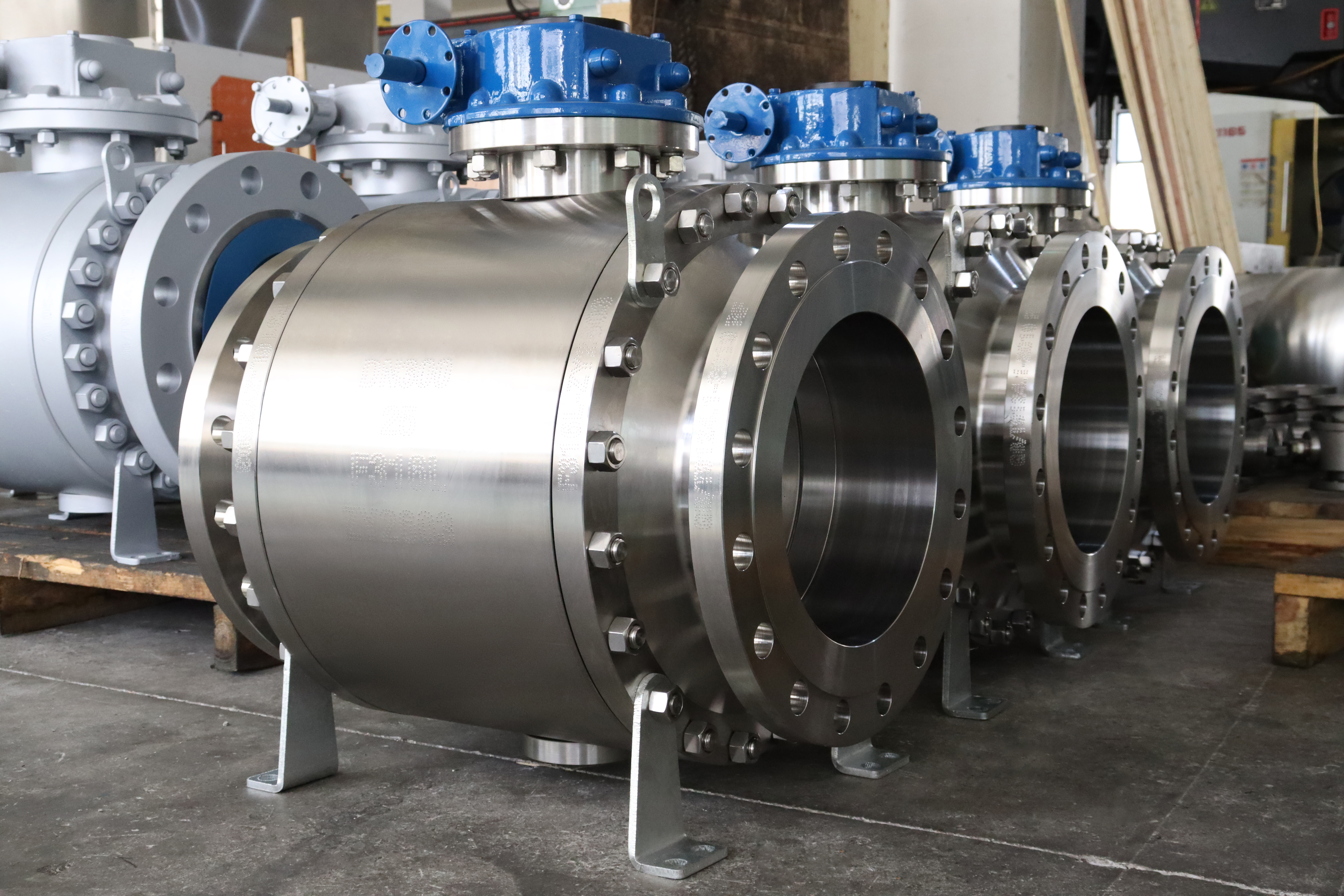
Almost every part of this valve is stainless steel and one of them is not. The body is forged F316L, the ball is F316L, the trim is stainless or 17-4PH, and the bolting is listed as either A193 B7, an alloy steel, or A193 B8M, a stainless grade, with A194 2H or 8M nuts. The page offers the two as equals. They are not equals, and the choice is made on the order rather than at the works.
Why it matters is electrochemistry rather than strength. A stainless body joined by alloy steel studs puts two different metals in contact in the same wet film, and the less noble one loses. On a dry indoor line nothing happens; on a coastal site, in a washdown bay or on a cooling tower the studs are the first thing to show rust, and a stud that has rusted no longer carries the tension it was tightened to.
Design and Construction
The body is three pieces: a centre section that holds the ball and the trunnions, and an end cap on each side. That is two bolted joints instead of one, so the bolting count on a DN300 valve is roughly double that of a two piece body of the same size, and each joint is a pressure boundary tested with the shell. The arrangement buys access to the ball from either side without cutting the line, and it pays for that access in studs and gaskets.
The ball is solid F316L, carried on an upper and a lower trunnion, with the stem in 17-4PH. The body and the end caps are forged and then machined, and the joint faces are cut square to the bore so that the gasket is loaded evenly when the studs are taken down. That is what makes a three piece body work at this size: two joints that each behave like a flange, around a centre section that is not re-machined.
The studding that holds the valve together is often the same studding that holds the valve to the pipe. A stud passes either through the body joint or through the valve flange and the pipe flange, and its length is decided by the whole stack: facing thickness, gasket thickness and nut height all sit on it. That is why the stud length belongs on the drawing, and why a valve ordered without the mating flange details is a valve ordered with a guessed stud.

Material Options
The page offers F316L as standard with F316 and F304 as alternatives, and each is a different body code rather than a price point. The code on the plate is what the certificate is written against, and this page is written on F316L because that is the code in the product name. Where a stainless body is chosen for a chloride duty the code carries the decision; where it is chosen because the whole plant is stainless, the code carries less of it.
The bolting option is the one worth arguing about. A193 B7 is a chrome molybdenum alloy steel: strong, cheap, and not resistant to the atmosphere it stands in unless it is coated. A193 B8M is a stainless grade: it resists that atmosphere, it is weaker, and it galls when a stainless nut is run onto a stainless stud without a lubricant. The nut has to match the stud, A194 2H for B7 and A194 8M for B8M, and a mixed pair is the commonest mistake made at the bench.
The gasket belongs in the same decision because it sits in the same joint. A spiral wound gasket with a graphite or PTFE filler suits a raised face; a ring joint gasket suits a grooved facing, and the two are not interchangeable on one flange. The gasket type and the stud grade are chosen together by whoever assembles the joint stack, which is why both belong on the order rather than in a note to the works.
| Component | Standard Material | Optional Upgrade | Service Notes |
|---|---|---|---|
| Body and end caps | F316L forged austenitic stainless | F316 or F304 on request | code as stamped |
| Body joints | two bolted joints, six stud sizes | no | each one a pressure boundary |
| Ball | solid F316L | with nickel or chrome surface | polished before assembly |
| Trunnion | F316L or 17-4PH | surface hardened | upper and lower |
| Stem | 17-4PH | on the order | anti blowout, retained by the cover |
| Seat | PTFE | reinforced PTFE, PPL, PEEK or metal with graphite | sets the temperature ceiling |
| Bolting | A193 B7 with A194 2H | B8M with 8M, or the reverse | the pair has to match |
| Gasket | spiral wound with graphite filler | PTFE filler or ring joint | follows the facing |
| Coatings | none as standard | zinc flake or molybdenum disulphide | named on the order |
Technical Specifications
The class line decides the bolt circle, so it has to name one system. PN 25 is a European class with a European drilling; class 300 is an ASME class with a different drilling and a different rating. The page carries both on one line, and on the order one of them has to go. Whichever is chosen, the stud diameter, the stud count and the hole size come from the flange standard rather than from the valve maker.
At PN 25 the flange is to EN 1092-1, and the page also lists GB/T 9113 PN 25 as an alternative. Those are two documents, and a counter flange bought to one of them should be checked against the valve drawing rather than assumed to match the other. The check costs a drawing review; a mismatch costs a shutdown. This is the sort of thing that is settled before the valve is machined, not after it lands on site.
The face to face length on the page is quoted to ASME B16.10 while the flanges are European, and the two systems do not necessarily agree at DN300. The length, and the facing that goes with it, have to come from the system the pipe was built to. The stud length follows from the same place: a raised face joint and a ring joint joint are different stacks, and one set of studs cannot serve both.
| Item | Value |
|---|---|
| Nominal size | DN300 (twelve inch) |
| Pressure class | PN 25 as flanged |
| Body style | three piece, two bolted body joints |
| Ball support | trunnion mounted, upper and lower |
| Bore | full bore or reduced bore |
| Body material | F316L forged austenitic stainless, code as stamped |
| Body options | F316 or F304 on request |
| Ball material | solid F316L |
| Trunnion material | F316L or 17-4PH |
| Stem material | 17-4PH |
| Seat material | PTFE as standard |
| Seat options | reinforced PTFE, PPL, PEEK or metal with graphite |
| Packing | graphite with wire reinforcement, or PTFE V rings |
| Gasket | spiral wound with graphite or PTFE filler, or ring joint |
| Bolting option one | A193 B7 studs with A194 2H nuts |
| Bolting option two | A193 B8M studs with A194 8M nuts |
| Bolt coating | applied by the fastener supplier, named on the order |
| End connection | EN 1092-1 PN 25 raised face |
| Flange alternative | GB/T 9113 PN 25, check the drilling against the drawing |
| Face to face | named from the system the pipe was built to |
| Design standard | API 6D, with ASME B16.34 underneath |
| Test standard | API 598 or API 6D |
| Shell test | one and a half times the rating |
| Seat test | one and a tenth times the rating, both directions |
| Temperature range | minus 29 to plus 425 Celsius, metal temperature |
| Temperature ceiling | set by the seat and the packing, not by the body |
| Operation | worm gear as standard at this size |
| Bolting certificate | EN 10204 3.1 per lot on request |
Standards and Compliance
A193 and A194 are the two documents behind the bolting. A193 covers the studs and gives the grades, B7 and B8M among them; A194 covers the nuts and pairs 2H with B7 and 8M with B8M. Neither is a valve standard, and neither is covered by the valve body certificate. If the order wants traceable bolting it has to ask for it, because the bolting is bought in as a separate lot and arrives as one.
That is where EN 10204 becomes useful. A 3.1 certificate is issued by the manufacturer inspection and states the results of the specified tests against the order; a 2.2 certificate is a statement of compliance without those results. For a body forging the 3.1 is the normal requirement; for studs it is asked for less often, and it should be asked for wherever the atmosphere is the reason the valve is stainless in the first place.
Where the line is sour, the material requirement reaches the bolting as well. NACE MR0175 puts bolting in scope, and the grade and its condition have to be declared rather than assumed from the fact that the body is stainless. The declaration is a line on the certificate, and a supplier who cannot put that line on the certificate has not met the requirement, however good the body is.
| Requirement | Standard | What J-VALVES Supplies |
|---|---|---|
| Pressure boundary | ASME B16.34 | rating and minimum wall |
| Pipeline valve | API 6D | design, marking and test |
| Flange, European | EN 1092-1 PN 25 | drilling and facing |
| Flange, alternative | GB/T 9113 PN 25 | check against the drawing |
| Studs | A193 grades B7 and B8M | strength and material of the stud |
| Nuts | A194 grades 2H and 8M | matched to the stud grade |
| Testing | API 598 or API 6D | 1.5 times shell, 1.1 times seat |
| Sour service | NACE MR0175 | bolting is in scope |
| Certificates | EN 10204 3.1 | per lot, on request |
Manufacturing Process
The studs are bought in rather than made. A fastener supplier rolls or cuts the thread, applies the coating if there is one, and marks the grade on the end of the stud. The valve maker controls the length, the pairing with the nuts and the point at which they are fitted, and that is the limit of what a valve drawing can promise about them. A rolled thread resists fatigue better than a cut one, which matters on a joint that is opened and closed.
Assembly places the gasket, inserts the studs and runs the nuts down in a cross pattern in stages rather than in one pass. Whether the threads are lubricated decides how much of the applied torque reaches the stud as tension, and that is why a torque figure has to come from the fastener supplier table for that grade and that lubricant. A figure taken from a general table is a figure for a different joint, whatever the diameters say.

Quality Control and Testing
The bolting is checked at goods in rather than at assembly. The grade marking on the end of the stud is read against the certificate, the thread is gauged, and the lot is kept together so that a mixed box never reaches the bench. A box of studs with two grades in it is the failure mode that matters here, because the two look alike and the difference only shows up as rust two winters later.
A magnet will separate an alloy steel stud from an austenitic one most of the time, but cold work makes some stainless grades slightly magnetic, so the marking and the certificate are what count. A material identification report on the bolting is available when the order asks for one. It is a small line on a purchase order and it is the only evidence that the stud in the joint is the grade the drawing names.
The pressure test is run with the joints assembled, so the studs are loaded to one and a half times the rating along with the body. A joint that weeps at that pressure is more often a bolting problem than a gasket problem: uneven take up, a damaged coating, a stud bottomed in a blind hole. The test record does not separate the two, which is why the assembly instruction is part of the quality system rather than a note for the fitter.
| Step | What Is Checked | Standard or Acceptance |
|---|---|---|
| Body forging | heat number and certificate | read against the plate code |
| Bolting | grade marking against the certificate | checked at goods in, not at assembly |
| Bolting identity | report per lot when ordered | one line on the purchase order |
| Thread | gauged before the lot is released | kept as one set |
| Gasket | type matched to the facing | not interchangeable |
| Shell test | body and both joints at 1.5 times | joints loaded with the body |
| Seat test | both directions, cavity open | API 598 acceptance |
| Marking | plate, certificate and drawing | size, class, code, heat |

Applications and Industry Service
The bolt choice is a site question. Dry indoor plant, oil and gas service and high temperature duty are places where B7 does the job and has done for decades. Coastal sites, offshore structures, washdown bays, cooling towers and chemical plants are places where an uncoated alloy steel stud is the wrong fastener on a stainless valve, and where the cost of the stainless option is smaller than the cost of the first inspection that finds rust.
It is the wrong valve where the temperature is high enough to take the strength out of a stainless stud, and where the joint will be broken often enough for galling to become a maintenance cost. On a line opened at every shutdown, a stainless stud and a stainless nut without a lubricant will seize, and a seized nut on a DN300 joint is a joint that gets cut off rather than opened. That is a decision about the atmosphere and the maintenance plan, not about the valve.

Installation, Operation and Maintenance
The joint is made up with the flanges parallel and the studs free in their holes; a valve pulled into line by its studs distorts the body and loads the gasket unevenly. The nuts go down in a cross pattern in stages, and the joint is re-torqued after the first thermal cycle, because the gasket takes a set and the stud tension falls with it. Lubricant on the threads is part of the procedure rather than a workshop habit, and it is named in it.
When the joint is broken, the studs and nuts are replaced rather than reused if the coating is damaged, and they go back with a new gasket. Reusing a stud that has been stretched, or pairing a B7 stud with a stainless nut because that is what was in the box, is how a joint that passed its test leaves the works and fails on site. The parts are cheap against the shutdown; the rule is to keep them as a set.
How to Specify and Order
The order needs the size, the class in one system, the flange standard and facing, the body code, the ball and the seat, the gasket type, the operator, the test standard and the certificate grade. Two more lines belong on it that are usually left off: the stud grade with its matching nut grade, and the coating if there is one. Those two lines are what keep the bolting from being whatever was in stock.
Then say what the atmosphere is, because that is the fact the bolting decision rests on. A valve ordered as stainless throughout, for a coastal site, with alloy steel studs, is a valve that will be blamed for rust it did not cause. Written the other way round the order says F316L body, B8M studs with 8M nuts, lubricated as the fastener supplier directs, and the joint stops being the weak point.
FAQ
Q: Should the studs be B7 or B8M?
A: It depends on the atmosphere and the temperature, not on the body material. B7 is an alloy steel with higher strength and no resistance of its own, so it needs a coating and a dry or benign site. B8M is stainless, resists a coastal or washdown atmosphere, is weaker, and galls unless it is lubricated. The order should name one, because a page that offers both as equals has not made the decision.
Q: Do stainless studs need a lubricant?
A: Yes, and for two reasons. Stainless threads gall when they are run together dry, and the lubricant also decides how much of the applied torque becomes stud tension. That is why the torque figure comes from the fastener supplier table for that grade and that lubricant rather than from a general table for the diameter.
Q: Does a stainless valve arrive with stainless bolts?
A: Not necessarily. The bolting is a separate purchase and the page lists B7 alloy steel first, with B8M as the alternative. If the reason for the stainless body is the atmosphere, the studs have to be specified separately or the joint becomes the part that rusts. It is one line on the order.
Q: Which nut goes with which stud?
A: A194 2H is the nut grade for A193 B7, and A194 8M is the nut grade for A193 B8M. A stainless nut on an alloy steel stud, or the reverse, is a mixed pair: it changes which metal corrodes and it changes the load the joint will take. The pair is quoted together.
Q: Why does the page show both PN 25 and class 300?
A: Because it mixes two systems on one line. PN 25 is a European class with a European drilling and class 300 is an ASME class with a different drilling and rating. Only one of them can be ordered, and the flange standard that comes with it decides the bolt circle and the stud count.
Q: Does the body certificate cover the bolting?
A: No. The body certificate is written against the heat number of the forging. The studs and nuts are a separate lot with their own certificate, and a 3.1 for the bolting has to be asked for. Where the atmosphere is the reason the valve is stainless, that certificate is the evidence that the right grade was fitted.


Hot Products


News
Ball Valves On A Bottom Loading Gantry: Creep, Dry Break And The Test That Proves Neither
A loading gantry cycles a ball valve far more than it is designed for and still cannot prove shut-off. Where creep starts, and what to specify.
Read More
Lined Ball Valves in Acid Service: The Liner Does Not Fail, The Steel Behind It Does
The valve came out of the line looking better than most valves that come out of a hydrochloric acid line. Three inch, PFA lined, cast body, Class 150, fourteen months in service on a 32 percent acid transfer duty at 55 to 60 degrees C, about forty open and close cycles a week. The paint was intact.
Read More
Ball Valves in Amine CO2 Capture: Heat Stable Salts, Rich Amine, And The Three Places The Body Thins
Rich amine at 110 C with heat stable salts is where capture plant ball valves fail. Materials, velocity limits, cavity gas and seat choice, with numbers.
Read More
Fail-Safe Ball Valve Actuators: Spring Return, Stored Air, And The Torque Nobody Checks
Spring return or stored air? The answer is a torque curve, not a datasheet box. Sizing, receiver volume, closing time and four silent failures.
Read More