


CHINA J-VALVES Offers Various High-quality I ndustrial Ball Valves
J-VALVES, a distinguished professional ball valve manufacturer rooted in China, takes pride in its extensive product portfolio. Our offerings span a wide range, including trunnion-mounted ball valves, floating ball valves, high-temperature ball valves, high-pressure ball valves, metal-sealed ball valves, ultra-low temperature ball valves, DBB ball valves, Three-way And Four-way Ball Valve, and fully welded ball valves. Each product is a testament to our commitment to precision engineering and reliable performance. Meticulously crafted, they are designed to not only meet but exceed the most stringent industrial demands, ensuring stable operation even under extreme conditions. This enables us to provide our clients with high-value services and makes our valves widely sought-after in industries.
Product Category
Contact Us


-
J-VALVES-Q347F
-
J-VALVES
Overview of the J-VALVES 6 Inch 2500LB F316 Three Piece Stainless Steel Trunnion Mounted Ball Valve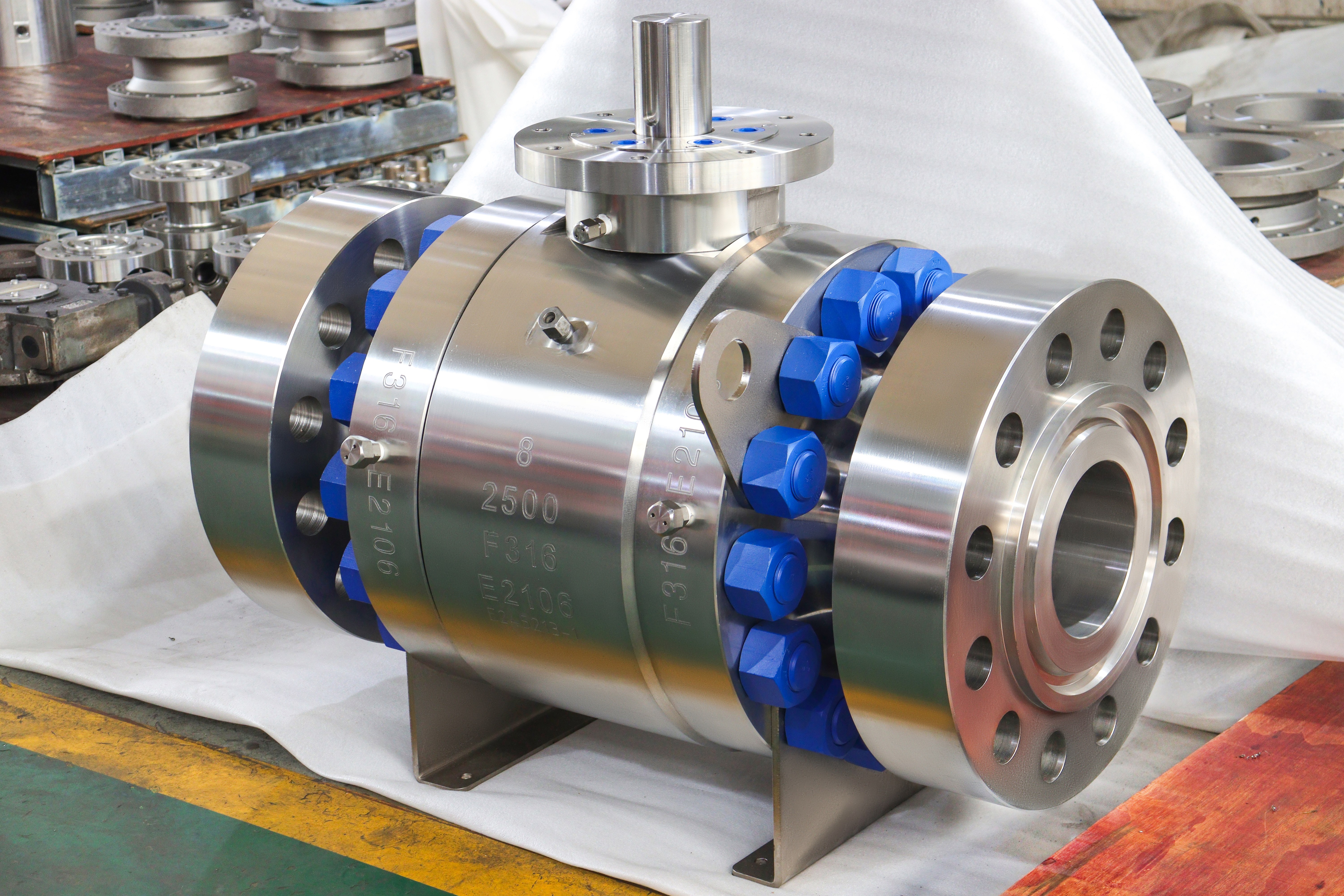
It is easy to read a stainless grade on a Class 2500 valve as a strength statement, and it is not one. The wall of the body comes out of the rating table, which takes the class and the material group as inputs, and the pressure the valve holds is set by that geometry. What the grade decides is what the metal will survive: chlorides, weak acids, a wet line, a medium that would corrode carbon steel. Those are different questions and they are answered by different lines on the order.
There is a second half to the same point, and it is the one that costs money. F316L is not a free substitution for F316 at this class. The low carbon grade sits in its own material group in the rating table with its own allowable stress, so swapping the L in after the quotation can change the wall the valve needs. That is worth stating before the order rather than after the drawing.
Design and Construction
Three piece means two body joints: the main body and two end caps, each with a flange on the outside and a gasket on the inside. The trim goes in through the joints, and the centre section can be lifted out with the pipe still in place, which at six inch is the reason the design exists. The price is two pressure boundaries to prove and two gaskets to renew, and at Class 2500 neither is a trivial joint.
The ball runs on upper and lower trunnions, so the pressure load goes into bearings and the operator only turns friction. That is what keeps a six inch 2500 valve operable by hand gear: a floating ball at this class would put the whole load on the seat and the stem, and the torque would rise with the pressure rather than staying roughly flat. The trunnions are the parts that make the difference, and they are 17-4PH rather than F316 for that reason.
The bore is full unless a reduced bore is ordered, and at this class the choice is visible in the ball and the body rather than in a machining step. The body is forged, so each of the three parts is machined from a forging, and the joints are machined faces that have to stay parallel through the shell test and through a decade of service.

Material Options
F316 is a forged austenitic stainless with molybdenum, and it is chosen where the medium would attack a carbon body: chlorides, weak acids, chemical service, and lines where a rusting bore is not acceptable. It is not chosen because it is stronger. In the rating table its allowable stress is lower than a carbon steel forging at moderate temperature, which is why a stainless Class 2500 body is a heavier casting of metal than the carbon steel one for the same class.
F316L is the low carbon version, and the L is a welding benefit rather than a pressure benefit. On a flanged valve the body has no weld of its own, so the L matters at the butt weld ends or wherever the customer welds nearby, and it comes with a lower allowable stress in the rating table. That is why it is a change of material group rather than a like for like substitution, and why it should be decided at the enquiry rather than during fabrication.
The trim is where the loads actually run. The stem and the trunnions are 17-4PH as standard, because they see the torque and the side load and they need a strength that an austenitic forging does not have. The ball is F316 with a deposit or an overlay, and the seat is a metal seat with graphite at this class, because the soft seat family does not reach the temperature and pressure this valve is bought for.
| Component | Standard Material | Optional Upgrade | Service Notes |
|---|---|---|---|
| Body and end caps | forged stainless, F316 | F316L or F321 on request | material group sets the wall |
| Ball | F316 with a deposit | alloy overlay | the sealing face is the deposit |
| Trunnion | 17-4PH | surface hardened | carries the side load |
| Stem | 17-4PH | on the order | carries the torque, anti blowout |
| Seat ring | metal with graphite | PEEK where the service allows | leakage judged as a rate |
| Body joints | two bolted joints with gaskets | gasket on the drawing | both are pressure boundaries |
| Bolting | A193 B8M or B7 with A194 nuts | grade on the order | torque from the drawing |
| Flange | ring type joint to ASME B16.5 | butt weld to ASME B16.25 | ring is a piping item |
Technical Specifications
The class is Class 2500, written PN 420 in the pressure code of API 6D, and the ends are ring type joint to ASME B16.5. At this class the ring joint is not a preference: a raised face with a soft gasket would be asked to hold a pressure that extrudes the gasket, and the joint is metal on metal by design. The consequence is that the groove and the ring have to be right, and the ring is normally a piping item ordered with the line.
Face to face follows the table for a flanged valve of this size and class, and the figure for the build ordered is dimensioned on the signed drawing. Weight is quoted rather than tabulated, because at this class the wall is thick enough that the body weight moves with the bore and the body style, and the lifting plan is made against the quoted figure rather than an estimate.
The operator is a gear as standard, with pneumatic, hydraulic or gas hydraulic actuation on request. On a valve of this class the gear is not there to make the valve easy to turn, it is there to make it possible to turn at all, and the handwheel force is quoted with the valve rather than left to be discovered on site. A gear sized on a catalogue torque for a smaller valve will not seat this ball.
| Item | Value |
|---|---|
| Nominal size | 6 inch (DN150) |
| Pressure class | Class 2500, the designation PN 420 in API 6D |
| Body style | three piece, two bolted body joints |
| Ball support | trunnion mounted |
| Bore | full bore as standard, reduced bore on order |
| Body material | forged stainless steel, F316 |
| Body options | F316L or F321 on request, and the group changes the wall |
| Ball material | F316 with a surface deposit |
| Trunnion material | 17-4PH |
| Stem material | 17-4PH, anti blowout |
| Seat material | metal seat with graphite |
| Seat option | PEEK where the service allows |
| Seat acceptance | a leakage rate, agreed at the order |
| Body joint gasket | named on the drawing, renewed at every break |
| Bolting | A193 B8M or B7 with A194 nuts |
| End connection | ring type joint flange to ASME B16.5 Class 2500 |
| End option | butt weld to ASME B16.25 |
| Face to face | dimension on the signed GA drawing |
| Design standard | ASME B16.34 and API 6D |
| Test standard | API 598 shell and seat test |
| Test pressure | shell 1.5 times and seat 1.1 times the class rating |
| Temperature range | minus 29 to plus 425 Celsius, metal temperature |
| Operation | gear as standard, actuator on request |
| Marking | size, class, body code, heat number |
| Documentation | EN 10204 3.1 on request |
| Weight | quoted with the drawing for the build |
Standards and Compliance
ASME B16.34 gives the rating and the minimum wall, and it does so per material group. That is the mechanism behind the point this page makes: the same class, in two material groups, gives two different allowable stresses and therefore two different walls. API 6D adds the pipeline requirements: functional tests, marking, cavity relief and documentation. The two documents meet at the wall, which is why a change of grade is a change of drawing rather than a line on an invoice.
API 598 sets the shell test at one and a half times the rating and the seat test at one and one tenth times. On a metal seat the seat test acceptance is a leakage rate rather than zero, and the rate has to be agreed at the order, because a metal seat judged against a soft seat criterion will be rejected for doing exactly what it was designed to do.
Where a fire safe design is required, the order names API 607, API 6FA or ISO 10497. The three are separate procedures and a certificate to one is not evidence for another. On a metal seated valve the test is still meaningful, because it checks that the seat and the ball still close after the seals have been destroyed, but it is a different claim from the one made on a soft seated valve.
| Requirement | Standard | What J-VALVES Supplies |
|---|---|---|
| Pressure boundary | ASME B16.34 | rating and minimum wall per material group |
| Pipeline valve | API 6D | functional tests, marking, cavity relief |
| Pressure code | API 6D clause 7.2 | Class 2500 is written PN 420 |
| Flange pattern | ASME B16.5 Class 2500 | ring type joint, six inch |
| Shell and seat test | API 598 | 1.5 times shell, 1.1 times seat |
| Seat acceptance | API 598 | metal seat judged as a rate, soft seat as no visible leak |
| Fire test | API 607, 6FA or ISO 10497 | named on the order |
| Marking | API 6D | size, class, body code, heat number |
| Documentation | EN 10204 3.1 | issued against the heat number |
Manufacturing Process
Each of the three body parts is machined from its own forging. The flanges are faced and grooved, the bore is machined through, and the joint faces are finished before the seat pockets are cut from them, so that each pocket stays square to the face the gasket will sit on. The ring grooves are cut in the same setup as the flange face, because a groove off centre loads the ring on one edge.
Assembly is done with the body supported, the three parts brought together on new gaskets, and the faces checked for parallel before any stud is torqued. At this class the studs are long and the torque is high, and a joint pulled down from one side will not straighten itself. The valve is stroked after assembly to confirm that the ball port lines up and that the gear turns without binding.

Quality Control and Testing
The forging certificate is written against the heat number stamped on the plate, and at this class the certificate is read for the material group as well as for the chemistry, because the group is what the rating was calculated on. Where the order asks for a positive material identification report or an ultrasonic examination, that is quoted with the order and issued against the same heat.
The shell test is run with the body assembled at one and a half times the Class 2500 rating, and both body joints, the packing and the wall are watched. The seat test follows in both directions at one and one tenth times with the cavity open, and the result on a metal seat is recorded as a rate. After testing the valve is stroked, the gear torque is recorded, and the plate is read against the certificate.
| Step | What Is Checked | Standard or Acceptance |
|---|---|---|
| Forging | heat number and certificate | read against the stamped code and the material group |
| Forging examination | ultrasonic or PMI | quoted when the order asks |
| Ring groove | cut in the same setup as the face | concentric with the bolt circle |
| Seat pocket | square to the joint face | cut from the finished face |
| Assembly | faces parallel before torque | body supported square |
| Shell test | wall and both joints at 1.5 times | API 598 duration |
| Seat test | both directions, cavity open | metal seat recorded as a rate |
| Marking | plate against the certificate | grade and group checked together |

Applications and Industry Service
This valve belongs on high pressure chemical and petrochemical service where the medium would corrode a carbon body, on injection and metering lines, on high pressure water and on any line where Class 2500 is set by the process and stainless is set by the medium. It is a valve bought for a combination of pressure and corrosion, and neither half of that is optional.
It is the wrong valve where the medium is not corrosive, because a carbon steel forging does the same job for less and with a lighter body. It is also the wrong valve for a line that is pigged if a reduced bore was ordered, and for a service where the metal seat leakage rate has not been agreed, because the valve will be judged against a number nobody wrote down.

Installation, Operation and Maintenance
The valve is supported under the body and not hung on the pipe, the flanges are brought parallel, and the ring is fitted dry into a clean groove before the studs are torqued in a cross pattern. A ring joint at this class is a joint that is made once; if it has to come apart, the ring is replaced rather than reused, and the groove is inspected before the new one goes in.
Maintenance is the two body joints and the seat. The line is isolated, the body drained and vented, and the end caps released so that the centre section can come out with lifting gear. The seat rings and the ball are inspected, the gaskets are replaced, and the joints are remade to the drawing torque. After reassembly the shell test is repeated, because a body that has been opened is a new pressure boundary and at this class it is cheaper to prove than to revisit.
How to Specify and Order
The order needs size, class, flange standard, body style, body code, bore, seat, gasket, bolting, operator and test standard. Write the grade as F316 or F316L deliberately rather than as a preference, because the two sit in different material groups and the wall follows the group. If the L is wanted for a welding reason, say so, and let the wall be calculated for it.
State the medium and the design temperature as well, because on a stainless Class 2500 valve the seat and the bolting are chosen from them and the corrosion answer is what justifies the grade at all. A valve ordered as stainless without a medium is a valve that has paid for corrosion resistance it may not need or may not be enough for, and either way the quotation cannot be checked against anything.
FAQ
Q: Does F316 make the valve stronger?
A: No. It makes it more corrosion resistant. The wall thickness is set by the rating table for the class and the material group, and a stainless forging has a lower allowable stress than a carbon steel one at moderate temperature, which is why the stainless body is heavier for the same class. Strength, in the sense of turning load, is carried by the 17-4PH stem and trunnions rather than by the body.
Q: Can F316L be substituted for F316?
A: Not as a free substitution. The low carbon grade sits in its own material group in the rating table with its own allowable stress, so a substitution can change the wall the valve needs and therefore the drawing. If the L is wanted for a welding reason, say so at the enquiry and let the wall be calculated for the grade that will actually be supplied.
Q: Why is the seat metal rather than PTFE?
A: Because at Class 2500 and at the temperatures this valve is bought for, the soft seat family is out of its range. A metal seat with graphite takes the temperature and does not creep. The cost is that it is judged on a leakage rate rather than on no visible leakage, and that rate has to be written on the order rather than assumed.
Q: Why three piece at this size?
A: Because it lets the centre section come out with the pipe in place, which is what a plant wants when a seat has to be changed and the line cannot be cut. The cost is a second body joint, and at Class 2500 a body joint is a pressure boundary that has to be proved and re-proved. The choice is between one joint and a lift, or two joints and a smaller lift.
Q: What does the gear do that a lever cannot?
A: It multiplies the torque enough to break out a seat that has been closed under pressure for a season, and it lets the ball be seated without shock. At this class the handwheel force is quoted with the valve, because a gear that is sized on a catalogue torque for a smaller valve will not move this one.
Q: What should be agreed before the order?
A: The medium, the design temperature, the design pressure, the leakage rate if the seat is metal, and the grade including whether the L is wanted. Those five lines decide the seat, the bolting, the wall and the test acceptance. Everything else on the valve is a description rather than a decision.


Hot Products


News
Ball Valves On A Bottom Loading Gantry: Creep, Dry Break And The Test That Proves Neither
A loading gantry cycles a ball valve far more than it is designed for and still cannot prove shut-off. Where creep starts, and what to specify.
Read More
Lined Ball Valves in Acid Service: The Liner Does Not Fail, The Steel Behind It Does
The valve came out of the line looking better than most valves that come out of a hydrochloric acid line. Three inch, PFA lined, cast body, Class 150, fourteen months in service on a 32 percent acid transfer duty at 55 to 60 degrees C, about forty open and close cycles a week. The paint was intact.
Read More
Ball Valves in Amine CO2 Capture: Heat Stable Salts, Rich Amine, And The Three Places The Body Thins
Rich amine at 110 C with heat stable salts is where capture plant ball valves fail. Materials, velocity limits, cavity gas and seat choice, with numbers.
Read More
Fail-Safe Ball Valve Actuators: Spring Return, Stored Air, And The Torque Nobody Checks
Spring return or stored air? The answer is a torque curve, not a datasheet box. Sizing, receiver volume, closing time and four silent failures.
Read More