


CHINA J-VALVES Offers Various High-quality I ndustrial Ball Valves
J-VALVES, a distinguished professional ball valve manufacturer rooted in China, takes pride in its extensive product portfolio. Our offerings span a wide range, including trunnion-mounted ball valves, floating ball valves, high-temperature ball valves, high-pressure ball valves, metal-sealed ball valves, ultra-low temperature ball valves, DBB ball valves, Three-way And Four-way Ball Valve, and fully welded ball valves. Each product is a testament to our commitment to precision engineering and reliable performance. Meticulously crafted, they are designed to not only meet but exceed the most stringent industrial demands, ensuring stable operation even under extreme conditions. This enables us to provide our clients with high-value services and makes our valves widely sought-after in industries.
Product Category
Contact Us


-
J-VALVES-Q347F
-
J-VALVES
Overview of the J-VALVES 16 Inch 300LB WCB CF8 Two Piece Flange Trunnion Mounted Ball Valve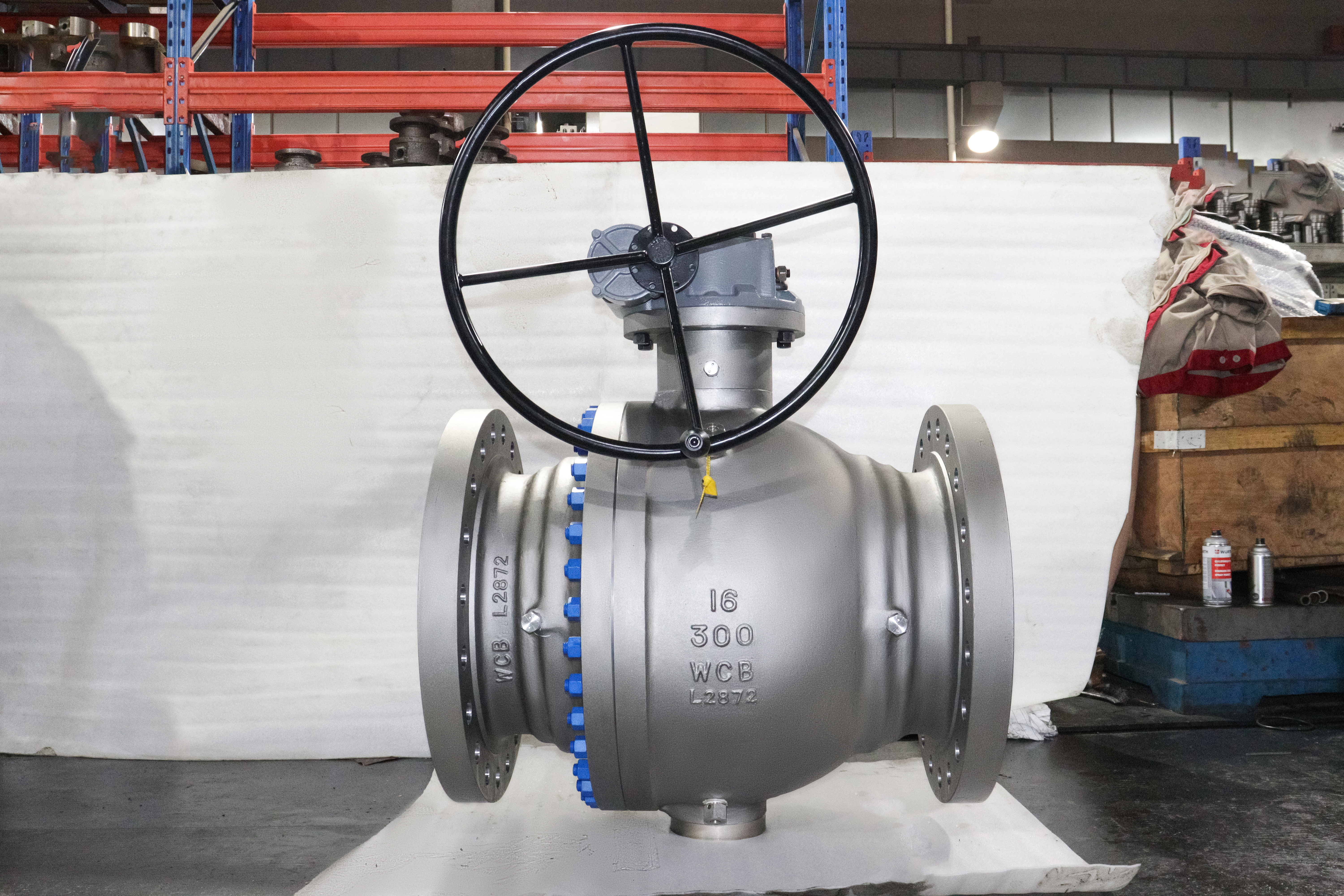
Read the name on this page carefully and it contains two castings. WCB is a carbon steel casting and CF8 is an austenitic stainless casting, and they are not two grades of the same material with a price between them. The product name, the address of the page and the file name of the product photograph each carry a slightly different combination of codes, and the specification block below the title lists only one. That is not a detail to be fixed later, because at sixteen inch the body is the single most expensive item on the valve and the casting is the one part nobody changes after the pattern is made.
So this page is about the choice rather than about a claim. It sets out what each casting is for, what changes downstream of the choice in the seat, the gasket and the temperature the valve can be used at, and why the order has to carry one code. It does not decide between them on the customer behalf, because the two castings do not have the same service and the same line, and a page that picks one for everybody would be wrong for half of the people reading it.
Design and Construction
Two piece means one bolted joint, and on this valve that joint sits between the main body and the end cap that carries one flange. Everything the valve is made of, the ball, the seats, the stem and the trunnions, goes in through that opening, and the joint is a pressure boundary that gets the same shell test as the body wall. Against a three piece body that is one fewer joint to prove and one fewer gasket to renew, which is the honest argument for the two piece design at a size where nobody wants to open the valve often.
The cost of that simplicity is at the other end. To reach the trim the end cap has to come off, and at sixteen inch the end cap is a large casting with a flange on it, so the operation needs lifting gear and a support under the body while the cap is off. A three piece body would let a smaller middle section out instead, but it would also add a second joint. The choice between them is a choice about which operation the plant would rather do once a decade.
The ball is carried on upper and lower trunnions rather than floating, and at DN400 that is not optional. A floating ball at this diameter would need the seat and the operator to resist the force of the whole bore area at the line pressure, and no lever or gearbox of a sensible size could do it. On trunnions the pressure goes into the bearings and the operator only turns friction, which is why a worm gear is the normal fitment and a lever is not offered as standard at this size.
Material Options
WCB is a carbon steel casting, used where the medium is not corrosive and the temperature is ordinary: water, oil, gas, steam up to the limit of the carbon steel rating. It is cheaper than an austenitic casting, it welds and it machines easily, and it is the default for a large body where nothing in the line attacks it. Its weakness is that it has no corrosion allowance worth the name against acids and chlorides, and that above its rated temperature the pressure it can hold falls away quickly.
CF8 is an austenitic stainless casting, used where the medium would attack carbon steel: water with chlorides at moderate level, weakly corrosive chemicals, and services where a clean non staining bore matters. It does not have a ductile to brittle transition to design around at low temperature, and it does not need a coating on the wetted side. Its weakness is cost at this size, and a lower allowable stress than carbon steel at moderate temperature, which shows up as a heavier wall for the same class.
Those two differences do not stay in the body. The seat material follows the temperature the body allows, the gasket follows the medium, and the bolting has to be matched to the body it pulls on, because a stainless body with carbon steel studs is a galvanic pair in wet service. That is why the order cannot carry both codes: one code decides the seat, the gasket, the bolting and the rating together, and two codes decide nothing. The certificate is written against the heat number under that one code.
| Component | Standard Material | Optional Upgrade | Service Notes |
|---|---|---|---|
| Body and end cap | cast steel, catalogue code as stamped | WCB carbon or CF8 austenitic, one code only | the largest single item on the valve |
| Ball | stainless or carbon with a surface deposit | matched to the body code | carried on trunnions |
| Trunnion | surface hardened or 17-4PH | named on the order | takes the pressure load |
| Stem | 17-4PH or equivalent | named on the order | through the body |
| Seat ring | PTFE | reinforced PTFE, PPL or metal | sets the temperature ceiling |
| Body joint | one gasketed studded joint | gasket type on the drawing | new gasket at every break |
| Bolting | matched to the body casting | grade written on the order | galvanic pair if mismatched |
| Operator | worm gear | pneumatic, electric or hydraulic | handle must clear the insulation |
Technical Specifications
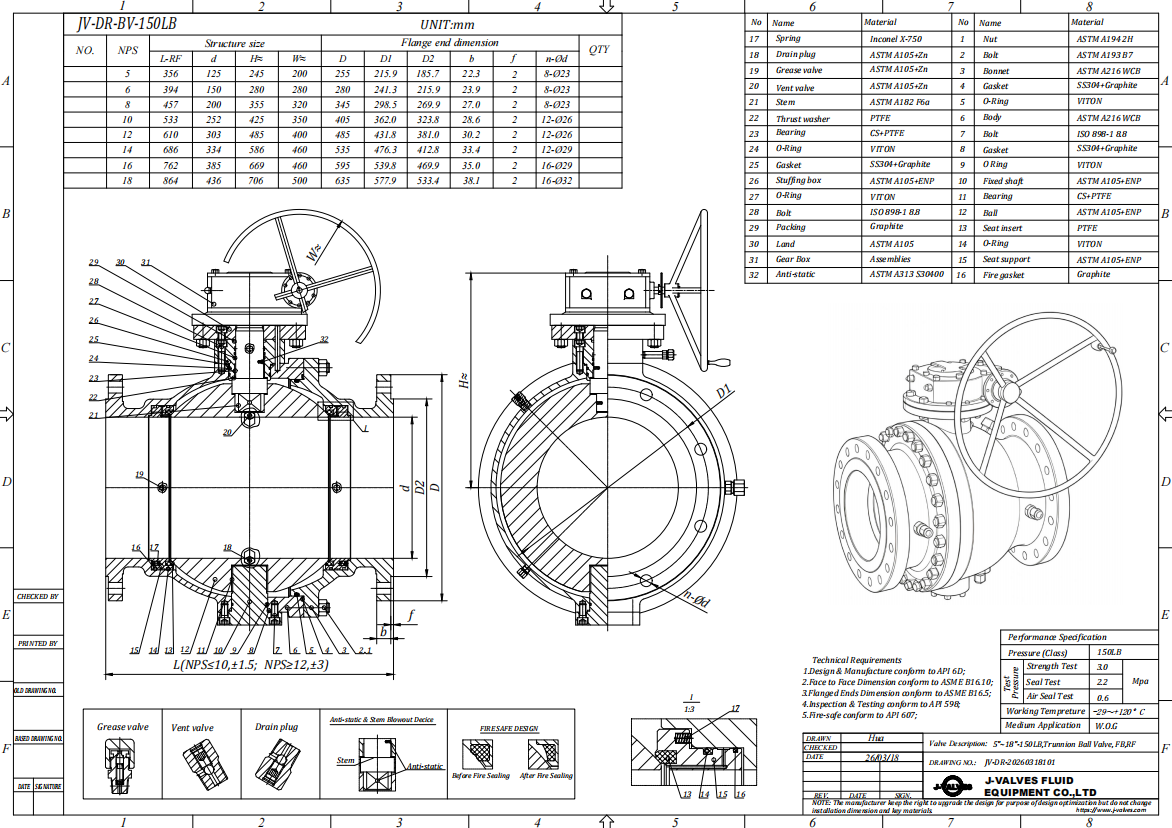
The flange is raised face to ASME B16.5 at Class 300, which API 6D designates PN 50 in the pressure code, so a valve marked either way is the same class. What the number does not say is which drilling table the flange was cut to, which is why the flange standard is written on the order separately from the class. Face to face follows ASME B16.10 for a flanged valve of this size and class, with the figure for a particular build dimensioned on the signed general arrangement drawing.
The bore is full unless a reduced bore is ordered, and at sixteen inch that matters for more than pressure drop: a full bore body carries a larger ball, a larger operator and more weight. A reduced bore is a different casting rather than a machining option, so it is a decision at the order and it changes the flange to flange length on some builds. The plate does not tell a reader which bore was ordered either, which is another reason the drawing travels with the valve.
The operator is a worm gear as standard, with pneumatic, electric or hydraulic actuation available where the line is remote or where the valve is part of an interlock. Weight is quoted with the drawing, because a sixteen inch cast body moves several hundred kilograms before the operator is fitted, and the handling plan has to be made against the real figure rather than an estimate.
| Item | Value |
|---|---|
| Nominal size | 16 inch (DN400) |
| Pressure class | Class 300 (PN 50, the API 6D pressure code) |
| Body style | two piece, one bolted body joint |
| Ball support | trunnion mounted |
| Bore | full bore as standard, reduced bore on order |
| Body material | cast steel, catalogue code as stamped, one code only |
| Body codes offered | WCB carbon steel casting or CF8 austenitic casting |
| Ball material | matched to the body code, with a surface deposit |
| Trunnion material | surface hardened or 17-4PH on order |
| Stem material | 17-4PH or equivalent, stated on the order |
| Seat material | PTFE as standard |
| Seat options | reinforced PTFE, PPL or a metal seat |
| Body joint gasket | named on the drawing, replaced at every break |
| Bolting | grade matched to the body casting, written on the order |
| End connection | raised face flange to ASME B16.5 Class 300 |
| Face to face | dimension on the signed GA drawing, held to ASME B16.10 |
| Design standard | ASME B16.34 and API 6D |
| Test standard | API 598 shell and seat test |
| Test pressure | shell 1.5 times and seat 1.1 times the class rating |
| Temperature range | minus 29 to plus 425 Celsius, metal temperature |
| Temperature ceiling | set by the casting and by the seat material, not by the class |
| Operation | worm gear as standard, actuator on request |
| Joint torque | stated on the drawing for the body joint |
| Marking | size, class, body code, heat number |
| Documentation | EN 10204 3.1 on request, casting records quoted |
| Weight | quoted with the drawing for the size and trim ordered |
Standards and Compliance
ASME B16.34 gives the pressure temperature ratings and the minimum wall for both castings, and the two castings do not sit in the same material group in that standard, which is why the same Class 300 valve has a different allowable pressure at the same temperature depending on which one was poured. API 6D adds the pipeline valve requirements on top: the functional tests, the marking, the documentation and the cavity relief. Neither document accepts a name with two materials in it, because both are written against a single specification.
API 598 sets the shell test at one and a half times the rating and the seat test at one and one tenth times, with no visible leakage accepted. On a sixteen inch valve that is a large volume of water at pressure and the test is a real event rather than a formality. Where a fire safe design is required, the standard has to be named on the order, because API 607, API 6FA and ISO 10497 are different tests and a certificate to one is not accepted in place of another.
| Requirement | Standard | What J-VALVES Supplies |
|---|---|---|
| Pressure boundary | ASME B16.34 | rating table and minimum wall for the casting group |
| Pipeline valve | API 6D | functional tests, marking, documentation, cavity relief |
| Shell and seat test | API 598 | 1.5 times the rating for the shell, 1.1 times for the seat |
| Flange pattern | ASME B16.5 Class 300 | raised face, sixteen inch |
| Face to face | ASME B16.10 | flanged valve length for the size and class |
| Pressure code | API 6D clause 7.2 | Class 300 is written PN 50 |
| Fire test | API 607, 6FA or ISO 10497 | named on the order, not interchangeable |
| Marking | API 6D | size, class, body code, heat number |
| Documentation | EN 10204 3.1 | issued against the heat number on request |
Manufacturing Process
The body and the end cap are cast from the same heat where the order specifies one casting code, and that is the practical reason the code has to be settled before the pattern is made. A pattern is cut for a casting and the casting is poured to a specification, so a change of code after the pattern exists is a new pattern, a new shrinkage allowance and a new set of castings. This is what makes the material choice on a sixteen inch valve different from the same choice on a two inch one.
Machining starts from the flange faces. The flange is faced and drilled, the bore is machined through, and the body joint face is cut and then the seat pocket is cut from it, so the pocket stays square to the face the gasket sits on. The end cap is machined the same way from its own joint face. Assembly brings the two together on a new gasket with the faces checked for parallel before any stud is torqued, because a large cast joint that is pulled down on one side will not straighten itself.

Quality Control and Testing
Casting records are the first item of quality control on this valve, and they are quoted with the certificate rather than assumed. The heat number on the nameplate is the link between the casting and the paper behind it, and where the order asks for a positive material identification report, that report is written against the same heat. The joint face is checked for flatness and finish, because it is the datum for the seat pocket as well as the sealing surface.
The shell test is run with the body joint assembled, at one and a half times the Class 300 rating for the duration API 598 sets, and the joint is watched along with the wall. The seat test follows in both directions at one and one tenth times the rating with the cavity open. After testing the valve is stroked, the gearbox torque is felt by hand, and the plate is read against the certificate before packing, because a sixteen inch valve is expensive to bring back.
| Step | What Is Checked | Standard or Acceptance |
|---|---|---|
| Casting | code, heat number, records | read against the stamped code |
| Casting change | pattern and shrinkage allowance | a code change is a new pattern |
| Joint face | flatness and finish | datum for the seat pocket |
| Seat pocket | square to the joint face | cut in the same setup as the face |
| Assembly | faces parallel before studs are torqued | one cross pattern, drawing torque |
| Shell test | body wall and the body joint | API 598 at 1.5 times the rating |
| Seat test | both directions, cavity open | API 598 at 1.1 times, no visible leak |
| Marking | plate data against the certificate | checked before packing |

Applications and Industry Service
In a carbon steel body this valve belongs on water, oil and gas lines at ordinary temperature where the medium is not corrosive and the size is the reason for the trunnion: transmission laterals, plant headers, cooling water mains, tank farm lines. In a stainless body the same valve goes into water with chlorides, into weak chemical service, and into plants where a rusting bore is not acceptable for product quality or for cleanliness. The size and the class are the same in both cases; the medium decides the casting.
It is the wrong valve where the line is pigged and a reduced bore was ordered, where the medium carries solids that settle in the cavity between the seats, and where the line has to be isolated and the valve opened on a regular basis, because a sixteen inch two piece body is not a frequent maintenance item. In those services a top entry body reaches the trim without breaking the body joint at all.

Installation, Operation and Maintenance
At this size the valve is supported under the body and not hung on the pipe, and the support is placed so that it does not carry the operator. The flanges are brought parallel before the studs are tightened, because a sixteen inch raised face will not pull itself square, and the studs are torqued in a cross pattern to the values in the flange standard. The gearbox needs access for a handwheel and for the indicator, and the handle or wheel has to clear the pipe insulation.
Maintenance is the one body joint: the line is isolated, the body is drained and vented, the end cap studs are released in a cross pattern, and the cap comes off with lifting gear. The gasket is replaced, the seat rings and the ball are inspected, and the joint is remade to the drawing torque. After reassembly the shell test is repeated, because a body that has been opened is a new pressure boundary and on a valve of this size it is cheaper to test than to re-open.
How to Specify and Order
The order line needs size, class, flange standard, body style, body code, bore, seat material, gasket, operator and test standard. The body code is the line to get right first, and it is written as one code with its casting specification behind it, not as two codes side by side. If the medium is not known at the time of enquiry, the enquiry should say so, because the answer changes the pattern rather than the price list.
The expensive mistake on this valve is caught at the pattern and nowhere else. Once a casting code is set, the pattern, the shrinkage allowance, the seat material, the gasket and the bolting all follow from it, so an enquiry that leaves the medium and the temperature open cannot be answered properly. State the medium, the design temperature and the design pressure, take the answer as one code with its specification named behind it, and hold the drawing to that code.
FAQ
Q: Is WCB a cheaper version of CF8?
A: No, they are different materials for different services rather than two grades of one material. WCB is a carbon steel casting for water, oil and gas at ordinary temperature where nothing in the line attacks it. CF8 is an austenitic stainless casting for media that would corrode carbon steel. CF8 costs more at this size and has a lower allowable stress at moderate temperature, so it is not simply the better of the two.
Q: Why does the name carry both codes if the valve has one body?
A: Because the name was assembled from keywords rather than from a specification. A valve has one body casting, poured to one specification, and the nameplate and the certificate carry that one code. A name with two codes cannot be quoted, because the seat, the gasket, the bolting and the pressure temperature rating all follow from the casting and two castings give two different answers to each of those questions.
Q: Which code should the order say?
A: The one that matches the medium and the temperature. If the line is water, oil or gas at ordinary temperature and nothing in it attacks carbon steel, WCB does the job and costs less. If the medium would corrode a carbon body, or the bore has to stay clean and non staining, CF8 is the material. Where the medium is not known at the enquiry, the enquiry should say so, because the answer changes the pattern rather than the price.
Q: Does the casting change the pressure rating?
A: It changes the allowable pressure at a given temperature. Both castings are rated under ASME B16.34 at Class 300, but they fall into different material groups in that standard and therefore have different allowable stresses, so the same nominal class gives different pressure at the same temperature. At the bottom of the temperature range the difference is small; it widens as the temperature rises, and that is where the choice of casting becomes a rating question rather than a corrosion question.
Q: What else follows from the body code?
A: The seat material, the gasket and the bolting. The seat has to suit the temperature the body allows, the gasket has to suit the medium, and the bolting has to be matched to the body it pulls on, because a stainless body with carbon steel studs is a galvanic pair in wet service. Each of those is a line on the order, and each of them is decided by the casting rather than negotiated separately from it.
Q: Why is a gear operator standard at this size?
A: Because at sixteen inch the operating torque is beyond what a lever can break out after the valve has sat closed for a season. The ball runs on trunnions, so the pressure load goes into the bearings rather than into the seat, but the seat friction and the stem friction at DN400 still need mechanical advantage. A gearbox also lets the ball be seated without shock, which matters for a seat that has to last.


Hot Products


News
Ball Valves in Amine CO2 Capture: Heat Stable Salts, Rich Amine, And The Three Places The Body Thins
Rich amine at 110 C with heat stable salts is where capture plant ball valves fail. Materials, velocity limits, cavity gas and seat choice, with numbers.
Read More
Fail-Safe Ball Valve Actuators: Spring Return, Stored Air, And The Torque Nobody Checks
Spring return or stored air? The answer is a torque curve, not a datasheet box. Sizing, receiver volume, closing time and four silent failures.
Read More
Ball Valve Stem Leak: The Gland, The Backseat And The Repair That Cannot Be Done Live
A stem leak on a quarter turn valve is four different failures. What gland tightening buys you, why the backseat is usually absent, and what needs a shutdown.
Read More
Ball Valves in A Kraft Pulp Mill: Black Liquor, Green Liquor And The Cost of Choosing The Alloy by Habit
White liquor at pH 14 cracks carbon steel welds, black liquor sets solid below 100 C, green liquor dregs grind seats: alloy choice and torque in a kraft mill.
Read More