


CHINA J-VALVES Offers Various High-quality I ndustrial Ball Valves
J-VALVES, a distinguished professional ball valve manufacturer rooted in China, takes pride in its extensive product portfolio. Our offerings span a wide range, including trunnion-mounted ball valves, floating ball valves, high-temperature ball valves, high-pressure ball valves, metal-sealed ball valves, ultra-low temperature ball valves, DBB ball valves, Three-way And Four-way Ball Valve, and fully welded ball valves. Each product is a testament to our commitment to precision engineering and reliable performance. Meticulously crafted, they are designed to not only meet but exceed the most stringent industrial demands, ensuring stable operation even under extreme conditions. This enables us to provide our clients with high-value services and makes our valves widely sought-after in industries.
Product Category
Contact Us

-
J-VALVES-Q347F
-
J-VALVES
Overview of the J-VALVES 12x10 Inch 2500LB Three Piece Forged Steel Flanged Trunnion Mounted Ball Valve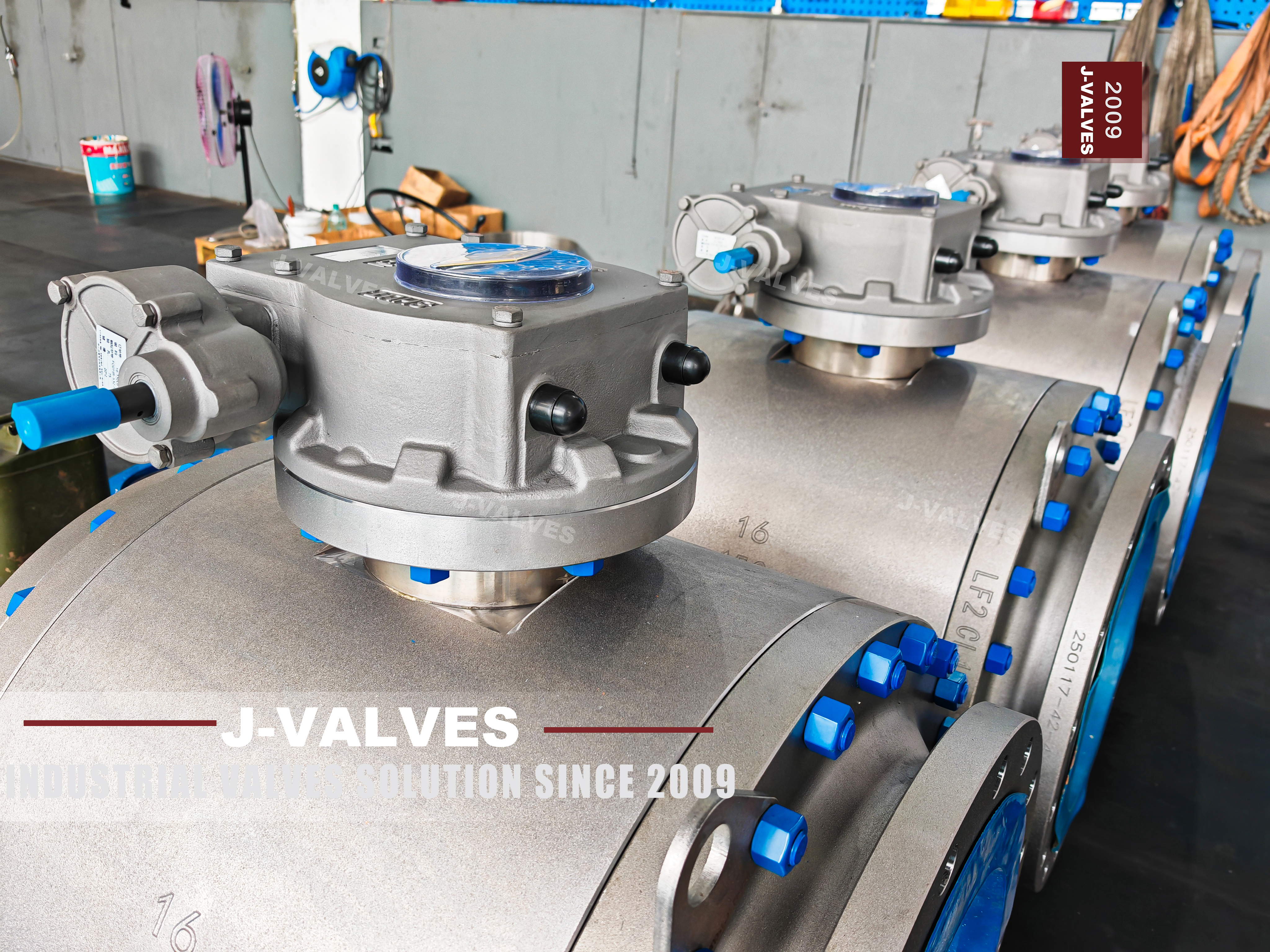
Count the joints on this valve before reading anything else about it. There are four: a ring joint flange at each end where the valve meets the line, and a bolted body joint at each side where the end sections meet the middle. At Class 2500 every one of them is a pressure boundary at PN420, and every one of them can leak. They are not equal in cost, though, because two of them can be opened on a bench and two of them have to be opened inside a piping system that was built around them.
That asymmetry is the reason a three piece body exists at this size and class. The trim, meaning the ball, both seats and the springs behind them, all comes out through the body joints in the middle, so a valve that needs a new seat does not need its two ring joint connections disturbed. On a two piece body the same trim comes out through one body joint, which is also fine, but the end cap that has to be moved is the heavy half of the valve and it is bolted to a line that may not want to move.
Design and Construction
The middle section carries the ball on two trunnions and holds both seat rings, which is what makes the body joint the service opening. Each end section is a forged piece with a ring joint flange machined on the outer face and a machined joint face on the inner one, and the joint faces are what the metal gasket sits between. Because the gasket is metal, the two faces have to be flat and parallel to a tolerance that a soft gasket would have absorbed without complaint, and the studs have to bring them together evenly.
The ball is trunnion mounted, which at Class 2500 is not a preference. A floating ball at this pressure would load the downstream seat with the full area of the bore multiplied by the rating, and no hand operator could turn it while that load was on the seat. On trunnions the ball only rotates, the seats carry the pressure, and the torque the gearbox sees is the friction of the seats and the stem rather than the hydraulic load. That is why the operator on this valve is a worm gear and not a lever.
The bore is reduced, ten inch through a twelve inch body, and that is a decision made upstream of this page: it keeps the ball, the seats and the operator inside a size that a gearbox can still turn at PN420. The consequence is that the passage is smaller than the line and a pig cannot pass, so the valve belongs on a line that is not pigged. That trade is argued on the reduced bore page; here it only explains why the valve is the size it is.

Material Options
The body code on this page is A105, a forged carbon steel, and the forging is what allows a twelve inch Class 2500 body to be made at all without a casting of that wall being radiographed for shrinkage. A forged section has a grain direction and a dense centre, so the wall that B16.34 asks for at PN420 is reached by working the metal rather than by pouring it. Low temperature A350 LF2, austenitic F304 and F316, and duplex F51 are the alternatives, and each of them is a different order rather than an upgrade.
The ball is a forging with an electroless nickel or hard chrome deposit, or a tungsten carbide overlay where the medium is abrasive. The trunnions and the stem are 17-4PH precipitation hardening stainless, which is chosen for its strength at the stem diameter rather than for corrosion. The seat is PEEK, or a metal seat with flexible graphite, or a tungsten carbide faced metal seat at the top of the range. The seat is what sets the temperature the valve can be used at, and that number is written next to the seat on the order.
| Component | Standard Material | Optional Upgrade | Service Notes |
|---|---|---|---|
| Body and end caps | A105 forged carbon steel, code as stamped | A350 LF2, F304, F316 or F51 on order | two body joints, one at each end section |
| Ball | forged with ENP or hard chrome | tungsten carbide overlay on order | carried on trunnions |
| Trunnion | 17-4PH precipitation hardening stainless | named on the order | absorbs the pressure load |
| Stem | 17-4PH precipitation hardening stainless | named on the order | through the bonnet |
| Seat ring | PEEK | metal with flexible graphite, or carbide faced metal | sets the temperature ceiling |
| Body joint gasket | metal ring gasket, octagonal or oval | profile fixed by the groove | one time item |
| Bolting | A193 B7 with A194 2H nuts | B8M with 8M nuts | grade and torque on the drawing |
| End facing | ring joint to ASME B16.5 | butt weld to ASME B16.25 | groove cut at the forge |
Technical Specifications
The ends are ring joint flanges to ASME B16.5 at Class 2500, and the ring groove is machined into the flange face at the forge, so a raised face version of the same valve is a different end section rather than a modification. Butt weld ends to ASME B16.25 are the alternative where the line is welded. Face to face follows ASME B16.10 for a flanged valve of this size and class, and the actual figure for a particular build is dimensioned on the signed general arrangement drawing rather than printed here.
The body joints take a metal ring gasket, octagonal or oval, and the drawing names which profile the joint is cut for. That gasket is a one time item: it deforms to seal and is replaced every time the joint is opened, and it is not re-usable even if it looks undisturbed. The studs are A193 B7 with A194 2H nuts as standard, or B8M with 8M nuts where the environment calls for stainless, and both the grade and the tightening sequence belong on the drawing rather than in a manual.
The operator is a worm gear as standard, with gas-hydraulic, electric or hydraulic actuation available where the valve is on a line break or an emergency shutdown function. Each of those is a separate package with its own mounting, and the mounting pad on the bonnet is what has to be agreed at the order. Weight is quoted with the drawing, because it moves with the end style and with the operator.
| Item | Value |
|---|---|
| Nominal size | 12x10 inch (DN300x250) |
| Bore | reduced bore, ten inch through a twelve inch body |
| Pressure class | Class 2500 (PN 420, the API 6D pressure code) |
| Body style | three piece, two bolted body joints |
| Ball support | trunnion mounted |
| Body material | A105 forged carbon steel, catalogue code as stamped |
| Body options | A350 LF2, F304, F316 or duplex F51 on order |
| Ball material | forging with ENP or hard chrome |
| Ball option | tungsten carbide overlay on order |
| Trunnion material | 17-4PH precipitation hardening stainless |
| Stem material | 17-4PH precipitation hardening stainless |
| Seat material | PEEK as standard |
| Seat options | metal with flexible graphite, or carbide faced metal |
| Body joint gasket | metal ring gasket, octagonal or oval |
| Bolting | A193 B7 with A194 2H nuts, or B8M with 8M nuts on order |
| End connection | ring joint flange to ASME B16.5 Class 2500 |
| End alternative | butt weld ends to ASME B16.25 |
| Face to face | dimension on the signed GA drawing, held to ASME B16.10 |
| Design standard | ASME B16.34 and API 6D, with API 608 |
| Test standard | API 598 shell and seat test |
| Test pressure | shell 1.5 times and seat 1.1 times the class rating |
| Temperature range | minus 29 to plus 425 Celsius, metal temperature |
| Temperature ceiling | set by the seat material, not by the body code |
| Operation | worm gear as standard, gas hydraulic or electric on order |
| Joint torque | stated on the drawing for both body joints |
| Marking | size, class, body code, heat number |
| Documentation | EN 10204 3.1 on request, including heat treatment |
| Weight | quoted with the drawing for the size and trim ordered |
Standards and Compliance
ASME B16.34 gives the pressure boundary and the temperature derating, API 6D gives the pipeline valve requirements, and API 608 sits alongside for the ball valve specific items; on this valve the three overlap without conflicting. The one thing none of them tabulates is the body joint of a three piece valve, because none of those standards was written around a split body. The joint is therefore proved the way any other boundary is proved, by the shell test, and its geometry comes from the drawing.
API 598 sets the shell test at one and a half times the rating and the seat test at one and one tenth times, with no visible leakage as the acceptance. On a Class 2500 valve that is a high test pressure and it is applied with the body joints in place, so a joint that was assembled with a twisted gasket shows up here rather than in service. Fire safe testing, where required, has to name API 607, API 6FA or ISO 10497, because the three are different tests and a certificate to the wrong one is refused.
| Requirement | Standard | What J-VALVES Supplies |
|---|---|---|
| Pressure boundary | ASME B16.34 | minimum wall and the Class 2500 rating at temperature |
| Pipeline valve | API 6D | design, testing, marking and documentation |
| Ball valve items | API 608 | shell and seat test, marking |
| Shell and seat test | API 598 | 1.5 times the rating for the shell, 1.1 times for the seat |
| Flange pattern | ASME B16.5 Class 2500 | ring joint facing, no raised face option on this end |
| Face to face | ASME B16.10 | flanged valve length for the size and class |
| Pressure code | API 6D clause 7.2 | Class 2500 is written PN 420 |
| Fire test | API 607, 6FA or ISO 10497 | named on the order, not interchangeable |
| Documentation | EN 10204 3.1 | issued against the heat number, including heat treatment |
Manufacturing Process
The end sections and the middle section are forged as separate pieces and machined separately, with the joint face as the datum on each. The ring groove is cut on the outer face first, then the joint face on the other side, then the bore is machined through and the seat pocket is cut from the joint face. On the middle section the two joint faces are cut in one setup so that they stay parallel to each other, which is the property the metal gasket depends on.
Assembly is the part of the job where this valve is made or lost. The middle section is set between the two end sections on new ring gaskets, brought down with the studs finger tight, and checked for gap on both joints before any stud is torqued. A metal gasket does not spread a load the way a soft one does, so a joint that is pulled down on one side first will hold on that side and weep on the other. The torque and the cross pattern come from the drawing, and the record shows what was applied.

Quality Control and Testing
The shell test is the joint test on this valve. The body is filled and held at one and a half times the Class 2500 rating for the duration API 598 sets, and both body joints are watched along with the wall. A joint that weeps here is disassembled, the gasket replaced and the faces checked, because a metal gasket that has been seated once will not re-seal in the same groove. The seat test follows in both directions at one and one tenth times the rating, with the cavity open so that a leak cannot be hidden.
Before and after the pressure tests the valve is stroked and the operating torque is felt by hand at the gearbox, which is the check that catches a seat that was pinched during assembly. The plate carries size, class, body code and heat number, and the certificate is written against that heat number rather than against the order. On a forged body the certificate is also the record of the forging and of any normalising that was specified, which is why the code on the plate has to match it exactly.
| Step | What Is Checked | Standard or Acceptance |
|---|---|---|
| Forged sections | code, heat number, heat treatment record | checked against the stamped code |
| Joint faces | flatness and parallelism on all four faces | the metal gasket depends on it |
| Ring groove | profile and finish | cut for one gasket shape only |
| Assembly | gap checked on both joints before torque | no stud torqued first on one side |
| Body joints | gasket batch, both torque values | cross pattern from the drawing |
| Shell test | body wall and both body joints | API 598 at 1.5 times the rating |
| Seat test | both directions, cavity open | API 598 at 1.1 times, no visible leak |
| Torque and mark | gearbox torque felt, plate data | read against the certificate |

Applications and Industry Service
This valve goes where a twelve inch line runs at Class 2500 and the medium is clean: high pressure process headers, letdown lines upstream of a pressure control station, injection lines and the discharge of high pressure pumps. In those services the valve is opened and closed occasionally and sits at one end of travel for long periods, and the reason to buy the three piece body is that the trim can be reached years later without cutting into a welded or heavily bolted line.
It is the wrong valve where the line is pigged, because the reduced bore stops the pig. It is also the wrong valve where the medium carries solids, because the cavity between the seats is a place for them to settle and the body joints are two more places to clean rather than one. And where the line has to be isolated to a very high standard, the seat arrangement has to be discussed at the order, because a standard self relieving seat and a double piston seat relieve in different directions.

Installation, Operation and Maintenance
At this size and class the valve should be supported under the body rather than hung from the pipe, and the support should not be attached to the operator. The two ring joint flanges are made up with new ring gaskets, brought together with the flange faces parallel, and torqued in a cross pattern to the values in the flange standard; a Class 2500 ring joint that is pulled up on one side will leak at the bottom of the groove and no amount of re-torquing will fix a damaged groove.
Opening the body joints is a bench job, not a line job, and it needs the middle section supported while it is out so that its faces are not set down on anything. Both ring gaskets are replaced, both joints are checked for flatness, and the studs are examined for stretch before re-use. After reassembly the shell test is repeated, because a body that has been opened is a new pressure boundary and on a Class 2500 valve that is not a formality.
How to Specify and Order
The order line needs size, class, body style, body code, bore, seat material, end connection, gasket profile, bolting grade, operator and test standard. Two of those are usually left out and both matter here: the gasket profile, octagonal or oval, because the groove is cut for one of them, and the bolting grade, because B7 and B8M behave differently at temperature and the certificate has to say which was fitted. The flange standard is written separately from the class.
What the purchaser signs off at the factory acceptance is a set of records that only make sense together: the forging certificate with its heat treatment line, the pressure test chart for the class, and the drawing with both joint torques on it. A valve can pass every test and still be the wrong valve if the gasket profile on the drawing is not the profile cut in the joint, so the check is a comparison rather than an inspection. Ask for the joint torque recorded against the serial number, not quoted in a manual.
FAQ
Q: Why buy a three piece body instead of a two piece at this size?
A: Because of the joints it leaves alone. A three piece body puts the trim behind two body joints that can be opened on a bench, so the two ring joint flanges to the line stay closed for the life of the valve. A two piece body reaches the same trim through one body joint, but the part that has to be moved is the heavy end cap, and it is bolted to a line that was built around the valve. At Class 2500 the difference is in what you are willing to remake.
Q: Can the body joint use a soft gasket instead?
A: Not on a valve built for a metal ring gasket. The joint faces and the groove are machined for a metal ring, and the flatness and finish that the metal gasket needs are tighter than a soft gasket needs, so a soft gasket in the same groove is not an improvement. The profile is decided when the joint is machined, and the order has to say octagonal or oval because the groove is cut for one of them and the other will not seat in it.
Q: Are the ring joint gaskets at the flanges reusable?
A: No. A ring gasket seals by being compressed into the groove and it takes a permanent set, so it is replaced every time the flange is broken. The same is true of the metal ring gaskets at the body joints. A gasket that looks undisturbed after a joint has been opened will not re-seal to the same tightness, and on a Class 2500 joint the leak that results is not one that can be nursed.
Q: Is Class 2500 the same as PN 420?
A: Yes for the rating. API 6D clause 7.2 lists PN 420 against Class 2500, so a valve marked either way is the same pressure class, and EN 1092-1 uses the same PN number. What the number does not tell you is which drilling table the flange was cut to, so the flange standard is written on the order separately from the class, and on this valve it is ASME B16.5 ring joint.
Q: Why is the operator a worm gear rather than a lever?
A: Because of what the torque is made of at this class. The ball is carried on trunnions, so the pressure does not push it into the seat and the turning load is the friction of the seats and the stem rather than the hydraulic force on the ball area. Even so, at twelve inch and PN420 that friction is beyond what a lever can be expected to break out after a long sit, and a gearbox also gives the mechanical advantage to seat the ball without shock.
Q: What has to be on the drawing for the two body joints?
A: The gasket profile, the stud grade, the torque value and the tightening sequence. All four belong on the general arrangement drawing, because the crew that opens the valve years later will have the drawing and will not have the manual. A metal gasket joint closed to a guessed torque, or closed on one side first, will weep at the shell test and there is no field adjustment that recovers it.


Hot Products


News
Ball Valves in Amine CO2 Capture: Heat Stable Salts, Rich Amine, And The Three Places The Body Thins
Rich amine at 110 C with heat stable salts is where capture plant ball valves fail. Materials, velocity limits, cavity gas and seat choice, with numbers.
Read More
Fail-Safe Ball Valve Actuators: Spring Return, Stored Air, And The Torque Nobody Checks
Spring return or stored air? The answer is a torque curve, not a datasheet box. Sizing, receiver volume, closing time and four silent failures.
Read More
Ball Valve Stem Leak: The Gland, The Backseat And The Repair That Cannot Be Done Live
A stem leak on a quarter turn valve is four different failures. What gland tightening buys you, why the backseat is usually absent, and what needs a shutdown.
Read More
Ball Valves in A Kraft Pulp Mill: Black Liquor, Green Liquor And The Cost of Choosing The Alloy by Habit
White liquor at pH 14 cracks carbon steel welds, black liquor sets solid below 100 C, green liquor dregs grind seats: alloy choice and torque in a kraft mill.
Read More