


CHINA J-VALVES Offers Various High-quality I ndustrial Ball Valves
J-VALVES, a distinguished professional ball valve manufacturer rooted in China, takes pride in its extensive product portfolio. Our offerings span a wide range, including trunnion-mounted ball valves, floating ball valves, high-temperature ball valves, high-pressure ball valves, metal-sealed ball valves, ultra-low temperature ball valves, DBB ball valves, Three-way And Four-way Ball Valve, and fully welded ball valves. Each product is a testament to our commitment to precision engineering and reliable performance. Meticulously crafted, they are designed to not only meet but exceed the most stringent industrial demands, ensuring stable operation even under extreme conditions. This enables us to provide our clients with high-value services and makes our valves widely sought-after in industries.
Product Category
Contact Us


-
J-VALVES-Q347F
-
J-VALVES
Overview of the J-VALVES API6D DN250 PN100 A105 Three Piece Trunnion Mounted Ball Valve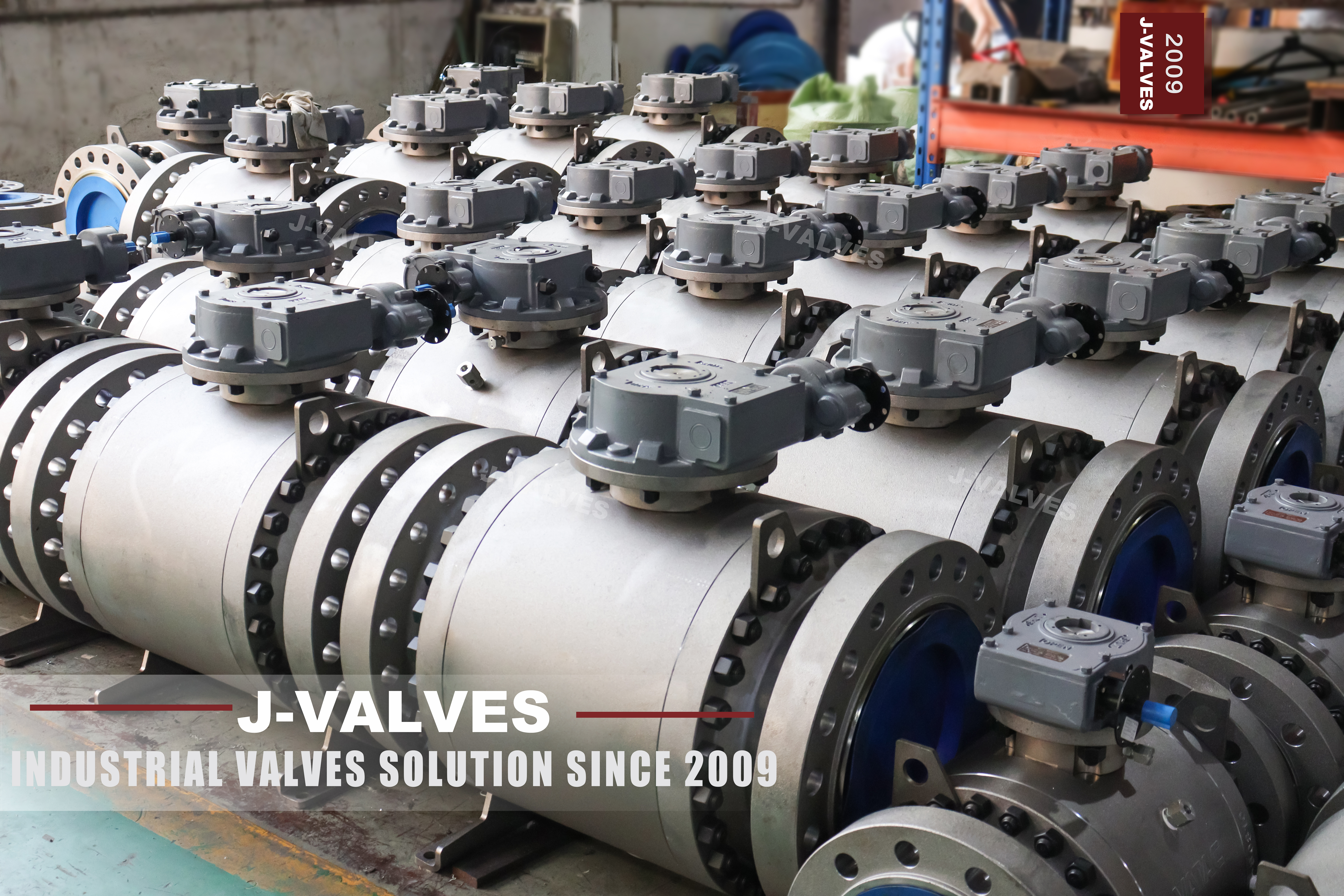
Three codes sit on this one title and each of them does a different job. DN250 is the size. API 6D is the standard the valve is built and marked to. PN 100 is a pressure code, and it is the one that causes trouble, because a buyer reading PN 100 assumes the flange question is answered when in fact it has just been opened. Two flange systems use that pressure step and they do not drill the same holes.
The mapping is in API 6D: PN 100 corresponds to Class 600. That is a statement about the pressure rating, not about the flange. EN 1092-1 PN 100 and ASME B16.5 Class 600 both exist at DN250, both are correct for a 600 pound class line, and a valve drilled to one will not bolt to a flange faced to the other. So the order needs the pressure code and the drilling standard, in two lines rather than one.
Design and Construction
The body is in three pieces with two gasketed joints and the ball is carried on trunnions rather than floating. At DN250 the trunnions take the side load that line pressure puts on a ten inch ball, and the bearings under them keep the operating torque inside what a worm gear can deliver by hand. The stem is therefore a drive shaft, not a structural member fighting pressure, which is why it can be a relatively slender part at this size.
The body joints are bolted, and the bolting is part of the pressure boundary rather than an accessory. This build lists high strength alloy steel bolting in the specification, which is normal for a carbon steel valve at this class and matters when the line is in a wet or coastal location: the studs are the first thing to corrode and the last thing anybody inspects.

Material Options
The body is forged carbon steel, supplied normalized or quenched and tempered depending on the section and the order, with the grade as stamped on the nameplate. Forged carbon steel at this size buys a homogeneous wall and no casting porosity in the seat pocket area, which is the reason it is common on a ten inch high pressure body. What it does not buy is corrosion resistance, and the coating is what stands between the body and the weather.
Trim is chosen per part and the choices are separate. The ball is carbon steel with hard chrome or nitriding, or stainless as an option. The stem is precipitation hardening stainless or a stainless grade. The seat is a soft compound for the low pressure band with a metal seat available for the primary seal. Bolting is alloy steel, and its grade belongs on the certificate as much as the body grade does.
| Component | Standard Material | Optional Upgrade | Service Notes |
|---|---|---|---|
| Body, end bodies, middle body | forged carbon steel, normalized or quenched and tempered | stainless grade on request | three pieces, two bolted joints |
| Ball | carbon steel with hard chrome or nitriding | stainless | runs in a metal seat |
| Stem | precipitation hardening stainless | stainless grade | drive shaft, not a pressure member |
| Seat | reinforced PTFE, PEEK or nylon | metal seat with hard facing | soft layer for the low pressure band |
| Packing | flexible graphite | PTFE on request | reached from the top in service |
| Bolting | alloy steel studs and nuts as listed | stainless for a corrosive site | part of the pressure boundary |
| Bearings | 440C with a self lubricating liner | not offered | takes the side load at DN250 |
| Ends | raised face or ring joint | ASME B16.5 Class 600 or EN 1092-1 PN 100 | drilling must be stated |
| Operator | worm gear | bevel gear or actuator | no pad stated on the page |
Technical Specifications
The flange is the whole point of this page. At PN 100 the metric pattern follows EN 1092-1, and at Class 600 the inch pattern follows ASME B16.5; the two are close in pressure terms and different in bolt circle, bolt count and gasket profile. Both raised face and ring joint are offered here, which multiplies the combinations: a metric flange with a ring joint facing is a different part from an inch flange with the same facing.
Face to face follows ASME B16.10 for a flanged valve at this size and class, and it does not change with the flange system, which is why the length is the one dimension that survives a change of drilling standard. The bore, the wall and the assembled height come from the size data sheet and the signed general arrangement drawing rather than from this page.
| Item | Value |
|---|---|
| Nominal size | 10 inch (DN250) |
| Pressure class | PN 100, which is Class 600 under the API 6D pressure code |
| Body style | three piece, two bolted gasketed joints |
| Ball support | trunnion, upper and lower shafts |
| Bore | full bore as listed for this size |
| Body material | forged carbon steel, normalized or quenched and tempered, grade as stamped |
| Ball material | carbon steel with hard chrome or nitriding, stainless optional |
| Stem | precipitation hardening stainless or a stainless grade |
| Seat | reinforced PTFE, PEEK or nylon; metal seat available |
| Packing | flexible graphite |
| Bolting | alloy steel studs and nuts as listed on the page |
| End connection | raised face or ring joint, ASME B16.5 Class 600 or EN 1092-1 PN 100 |
| Face to face | dimension on the signed GA drawing, held to ASME B16.10 |
| Design standard | API 6D, ASME B16.34 and API 608 |
| Test standard | API 598 and API 6D |
| Test pressure | shell 1.5 times and seat 1.1 times the Class 600 rating |
| Temperature range | minus 29 to plus 425 Celsius, metal temperature |
| Temperature limit | set by the seat compound where a soft seat is fitted |
| Pressure code | PN 100 equals Class 600 in API 6D 7.2 |
| Flange warning | EN 1092-1 and B16.5 are drilled differently at this size |
| Operation | worm gear; bevel gear or actuator on request |
| Fire test | not claimed on this page, API 6FA to be specified |
| Anti static device | not described on this page |
| Marking | size, both pressure codes, body grade, heat number |
| Documentation | EN 10204 3.1 on request |
| Weight | quoted with the drawing for the size and trim ordered |
Standards and Compliance
API 6D is the governing document here and it does more than design: it fixes the pressure code mapping used in the title, the marking on the nameplate, the material traceability and the test. ASME B16.34 supplies the minimum wall and the rating table for the material group. API 608 applies as the quarter turn product standard, and API 598 supplies the shell and seat acceptance numbers.
Because the title carries a pressure code rather than a class, the marking deserves a sentence. A valve marked PN 100 and tested as Class 600 is consistent, because the two are the same step; a valve marked PN 100 with a Class 300 test is not, and that mismatch is the kind of thing an inspector finds on the certificate rather than on the valve. The test sheet should name the class the pressure was derived from.
| Requirement | Standard | What J-VALVES Supplies |
|---|---|---|
| Pipeline valve design | API 6D | design, materials, marking, test, pressure code mapping |
| Pressure boundary | ASME B16.34 | minimum wall and rating for the forged carbon steel group |
| Quarter turn product | API 608 | applies as the product standard |
| Shell and seat test | API 598 | 1.5 times the rating for the shell, 1.1 times for the seat |
| Flange, inch pattern | ASME B16.5 Class 600 | raised face or ring joint, ten inch |
| Flange, metric pattern | EN 1092-1 PN 100 | different bolt circle from the inch pattern |
| Face to face | ASME B16.10 | unchanged when the drilling standard changes |
| Documentation | EN 10204 3.1 | issued against the heat number on request |
Manufacturing Process
A forged body at this size starts as a pierced blank and is machined all over, which is slower than casting and gives a wall with no internal voids. The seat pockets and the flange faces are cut in the same setup where the shop can hold it, because a ten inch body with offset pockets will not seal evenly however well the seats are made.
The body joints are the second manufacturing question. Each joint has a gasket, a stud set and a torque value, and the two joints are drawn up in sequence rather than together so that the middle section stays square to both end bodies. After assembly the valve is cycled, shell tested and seat tested, and the joint torques are recorded per serial number because they are the values the site will need if a joint is ever reopened.

Quality Control and Testing
Testing follows API 598 at Class 600: shell at one and a half times the rating, seat at one and one tenth times in both directions. At PN 100 the same numbers apply, because the two codes describe the same pressure step, and the test sheet should show which code the figure was taken from so that a reviewer is not left guessing. The acceptance criterion is no visible leakage in either direction, at either code.
Bolting and gaskets are checked as a set rather than one at a time. Stud grade, nut grade, lubricant and torque all affect what the joint does under pressure, and a joint assembled with the right studs and the wrong lubricant will be either under tightened or over tightened depending on which way the friction went. The record that matters is the torque actually applied, with the lubricant named beside it.
| Step | What Is Checked | Standard or Acceptance |
|---|---|---|
| Incoming forgings | grade, heat number, ultrasonic report | certificate against the stamped grade |
| Body machining | seat pockets, flange faces, bolt circle | gauged against the stated drilling standard |
| Bolting | stud and nut grade, lubricant named | certificate plus assembly record |
| Body joints | gasket batch, torque sequence | recorded per serial number |
| Shell test | no leakage at body, joints or flanges | API 598 at 1.5 times the rating |
| Seat test | no visible leakage, both directions | API 598 at 1.1 times the rating |
| Marking | PN 100 and Class 600 both shown | checked against the test sheet before dispatch |

Applications and Industry Service
This valve belongs on a ten inch process line where the pressure is around the 600 pound step and the plant is built to a mix of standards, which is the normal situation on a project with a European specification and an American valve package. It is a block valve: open for long periods, closed for maintenance, operated by gear because of the size rather than the torque.
It is the wrong valve where the line is pigged and the bore cannot step, where the medium attacks carbon steel, or where the flange system has not been settled before the enquiry. That last one is not a valve problem but it lands on the valve: a correct valve drilled to the wrong standard is scrap at the flange face, and the cost of the mistake is a re-machined body or a pair of adapter flanges nobody planned for.

Installation, Operation and Maintenance
Check the drilling against the mating flange before the valve is lifted into place, with a tape on the bolt circle rather than a glance at the drawing. At DN250 the two systems differ enough to be visible, and finding out after the studs are in is the expensive version. Bring the faces parallel, use new gaskets, and tighten in a cross pattern to the torque on the drawing.
Operation is a quarter turn through the gearbox. Maintenance splits into the two body joints, each of which needs a new gasket and a re-torque; the packing is reached from the top with the valve in service. Because the joints are bolted rather than welded, a joint can be reopened at site, which is also why the torque record from the factory is worth keeping with the valve rather than with the purchase file.
How to Specify and Order
Write the size, then the pressure as both codes if the project uses both, then the flange standard and facing, then the body grade as it will be stamped, the seat, the bolting grade and the operator. The single most useful line on the enquiry is the one that says which flange standard the mating flanges are drilled to, because everything else about this valve is settled by the pressure class and the trim.
Three documents should come with the quotation: the drawing with the flange drilling and the joint torques, the mill certificate behind the 3.1 documentation, and the test sheet with the class the pressures were derived from. A valve of this size is bought once and maintained for twenty years, and the paperwork is what the second owner of the plant will have to work from.
FAQ
Q: Is PN 100 the same as Class 600?
A: As a pressure step, yes: API 6D maps PN 100 onto Class 600, and the two describe the same rating. As a flange, no. EN 1092-1 PN 100 and ASME B16.5 Class 600 are drilled to different bolt circles with different bolt counts and gasket profiles, so a valve that is correct at PN 100 can still fail to bolt to a flange that is correct at Class 600.
Q: Which flange standard should the order specify?
A: The one the mating flanges are drilled to, which is a question about the plant rather than about the valve. A European specification normally means EN 1092-1, an American one B16.5, and a mixed project means somebody has to check both sides. Write the standard and the facing on the enquiry; leaving it open is how a correct valve arrives with the wrong bolt circle.
Q: Does the face to face length change with the flange standard?
A: No. Face to face follows ASME B16.10 for the size and class, and that dimension is about the valve, not about the drilling. It is the one dimension that survives a change of flange system, which makes it useful when an existing valve is being replaced and the piping gap is already fixed.
Q: Why is bolting listed separately on this valve?
A: Because at this size and class the body joints are bolted pressure boundaries, and the studs are part of that boundary rather than an accessory. The grade, the lubricant and the torque all change what the joint does, and on a wet or coastal site the studs are the first part to corrode. It belongs on the certificate with the body grade.
Q: Can this valve be used on a pigged line?
A: Only if the bore is full and the line is designed for it. API 6D allows both full and reduced bore, and a reduced bore valve will stop a pig at the step. The page does not print a bore figure, so the bore for the size ordered should be confirmed on the drawing before the valve is accepted for a pigged service.
Q: Are there other listings for this valve on the site?
A: Yes, at least two more at the same size and class with slightly different titles. They describe the same body under different naming, so one URL should be kept as the indexed page and the others redirected, otherwise three pages compete for the same DN250 600 pound query.


Hot Products


News
Ball Valves in A Kraft Pulp Mill: Black Liquor, Green Liquor And The Cost of Choosing The Alloy by Habit
White liquor at pH 14 cracks carbon steel welds, black liquor sets solid below 100 C, green liquor dregs grind seats: alloy choice and torque in a kraft mill.
Read More
Slug Flow And Ball Valves: What Actually Arrives At The Seat
A slug is liquid mass with momentum, not a pressure spike. What changes at the seat, in the cavity and at the actuator when liquid reaches a ball valve.
Read More
Ball Valves in Direct Lithium Extraction: PH 1 Eluate, Gypsum Scale And 438,000 Cycles in Twenty-Five Years
Direct lithium extraction swings valves from pH 1 eluate to pH 12 caustic, 48 column switches a day and gypsum scale. Materials, seats and torque.
Read More
Ball Valves in Geothermal Brine: Silica Scale, Chloride Cracking And The Cooling Trap
Why geothermal brine destroys ball valves: retrograde silica scale, calcite at the flash point, chloride cracking above 60 C and the 250 C seat limit.
Read More