


CHINA J-VALVES Offers Various High-quality I ndustrial Ball Valves
J-VALVES, a distinguished professional ball valve manufacturer rooted in China, takes pride in its extensive product portfolio. Our offerings span a wide range, including trunnion-mounted ball valves, floating ball valves, high-temperature ball valves, high-pressure ball valves, metal-sealed ball valves, ultra-low temperature ball valves, DBB ball valves, Three-way And Four-way Ball Valve, and fully welded ball valves. Each product is a testament to our commitment to precision engineering and reliable performance. Meticulously crafted, they are designed to not only meet but exceed the most stringent industrial demands, ensuring stable operation even under extreme conditions. This enables us to provide our clients with high-value services and makes our valves widely sought-after in industries.
Product Category
Contact Us


-
J-VALVES-Q347F
-
J-VALVES
Overview of the J-VALVES 8 Inch 2500LB F316 Three Piece Trunnion Ball Valve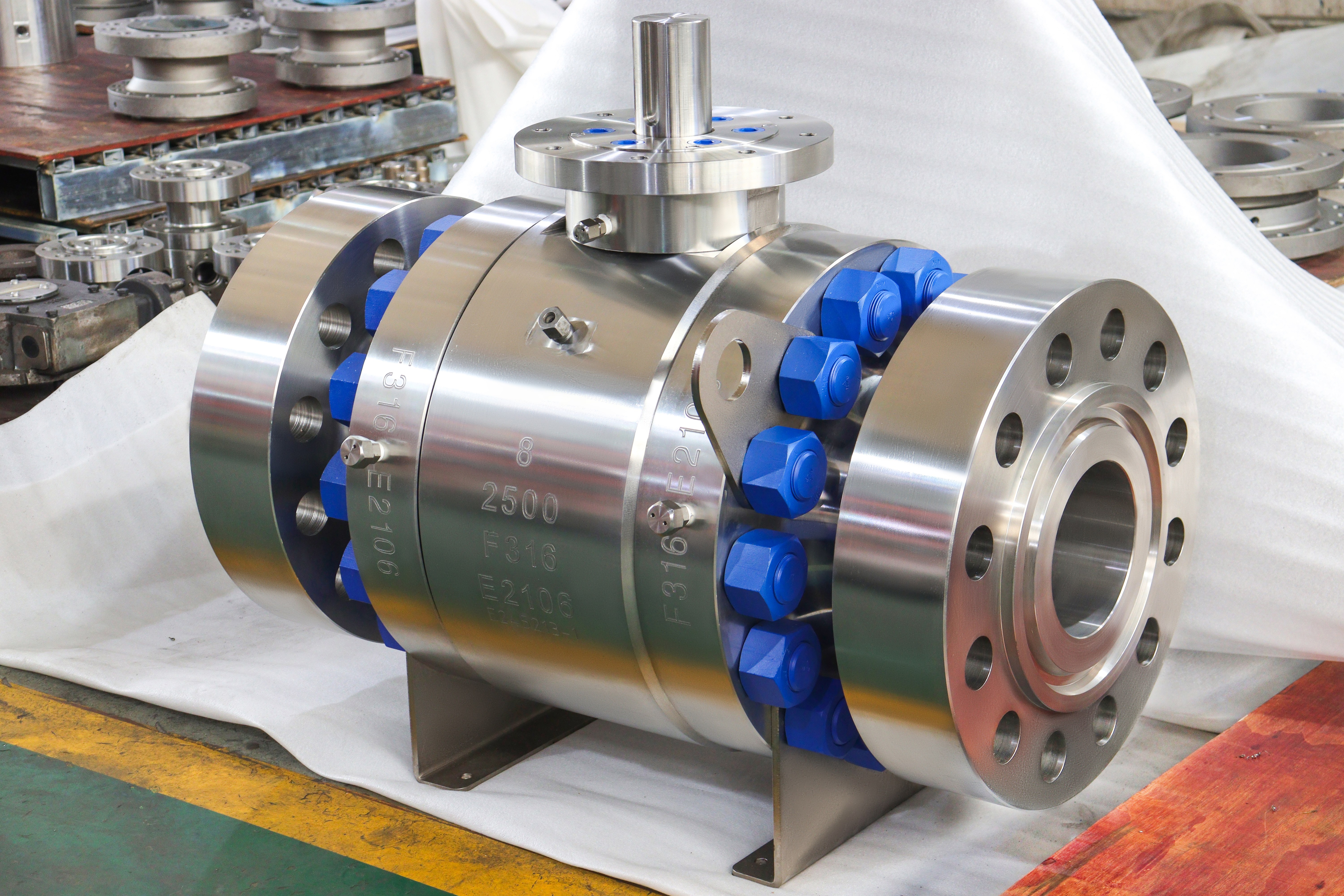
At eight inch and Class 2500 the wall, the flange and the bolting are settled by the standard before anybody argues about them. What is not settled is how many times the pressure boundary is opened up. This valve has a left body, a right body and a middle body, which means two gasketed joints instead of the single joint a two piece body would have. Each joint is a place where line pressure meets a gasket, and at this class each one is tested as a boundary in its own right.
That changes what the buyer is actually choosing. A two piece body splits at one end cover, so the ball and seats come out towards the pipe. A three piece body lifts the middle section out from between the two end bodies, so the trim can be reached without spreading the pipe run. The middle section is also the part that carries both seat pockets and the trunnion bores, which is why it is the most machined and most inspected piece on the valve.
Design and Construction
The ball is carried on an upper and a lower trunnion rather than floating between the seats. At this size the trunnions sit in two bearing blocks inside the body, and those blocks take the side load that line pressure puts on the ball. That is the reason a gear operator is normal here: the ball does not have to be pushed off its seat to turn, so the torque stays inside what a worm gear can handle by hand, and the stem is not asked to resist the pressure load as well as transmit rotation.
Sealing is arranged in two layers. The primary seat is metal, with a hard facing on the seating face, and behind it sits a soft seat in reinforced PTFE, PEEK or nylon for the medium and low pressure band where a metal seat alone would weep. Double piston effect is the standard arrangement, so both seats are pushed onto the ball by pressure from either side; single piston effect seats, which relieve trapped cavity pressure to the line, are available as an option and change what the cavity does.

Material Options
The body, the bonnet and the middle body are forged stainless, and the nameplate carries the catalogue code rather than a standard designation. That distinction matters more than it sounds: the code on the plate is what the mill certificate behind the 3.1 documentation is written against, and it is the only string that ties this valve to a heat. A buyer who converts the code into a standard grade in the purchase order has invented a requirement the supplier never quoted against.
Trim follows the same rule. The ball is the same stainless with hard chrome plating or a nitrided surface, and a low carbon variant is offered where welding or a heavier corrosion allowance is wanted. The stem is either precipitation hardening stainless or the body alloy. Bearings are 440C with a self lubricating liner. None of these are upgrades in the marketing sense; each one answers a specific wear or galling problem, and each has to be named on the order.
| Component | Standard Material | Optional Upgrade | Service Notes |
|---|---|---|---|
| Left and right body | forged stainless, code as stamped | the same alloy throughout | two ring joint flanges |
| Middle body | forged stainless, code as stamped | not offered in another alloy | carries both seat pockets |
| Ball | same stainless, hard chrome or nitrided | low carbon variant | runs in a metal seat |
| Stem | precipitation hardening stainless | body alloy | retained by the body cover |
| Primary seat | metal with hard facing | not optional at this class | sets the leakage class |
| Secondary seat | reinforced PTFE, PEEK or nylon | PEEK for higher temperature | soft layer behind the metal |
| Bearings | 440C with self lubricating liner | not offered | takes the side load |
| Body joints | two, gasketed | none | new gasket at every break |
| Operator | worm gear | bevel gear or actuator | no pad stated on the page |
Technical Specifications
Face to face follows ASME B16.10 for a flanged valve of this size and class, and the flange itself is a ring joint pattern to ASME B16.5 Class 2500. Neither dimension is printed here as a number, because the number belongs to those tables and quoting it from a page would make it look measured. What the size data sheet gives is the bore and the flange pattern; the assembled height, the gearbox envelope and the weight of a particular build are dimensioned on the signed general arrangement drawing.
Full bore at eight inch means the passage through the ball matches the pipe bore, so the valve is not the narrowest point in the run and a pig can pass. It also means the seat rings and the ball are large parts, and the middle body that houses them is the heaviest single piece on the valve. On a three piece body that weight has to be supported when the middle section comes out, which is a rigging question rather than a valve question.
| Item | Value |
|---|---|
| Nominal size | 8 inch (DN200) |
| Pressure class | Class 2500 (PN 420, the API 6D pressure code) |
| Body style | three piece, two gasketed pressure joints |
| Ball support | trunnion, upper and lower shafts in bearing blocks |
| Bore | full bore, DN200 through the ball |
| Body material | forged stainless, catalogue code as stamped |
| Ball material | same stainless with hard chrome or nitriding, low carbon variant optional |
| Stem | precipitation hardening stainless or the body alloy |
| Primary seat | metal seat with hard facing |
| Secondary seat | reinforced PTFE, PEEK or nylon |
| Stem packing | graphite |
| Bearings | 440C stainless with a self lubricating liner |
| End connection | ring joint flange, ASME B16.5 Class 2500 |
| Face to face | dimension on the signed GA drawing, held to ASME B16.10 |
| Design standard | ASME B16.34 and API 6D, with API 608 |
| Test standard | API 598 shell and seat test |
| Test pressure | shell 1.5 times and seat 1.1 times the class rating |
| Temperature range | minus 29 to plus 425 Celsius, metal temperature |
| Seat effect | double piston effect standard, single piston effect optional |
| Cavity relief | through single piston seats or an external relief device |
| Operation | worm gear; bevel gear or actuator on request |
| Fire test | not claimed on this page, API 607 or 6FA to be specified |
| Anti static device | not described on this page |
| Marking | size, class, body code, heat number |
| Documentation | EN 10204 3.1 on request |
| Weight | quoted with the drawing for the size and trim ordered |
Standards and Compliance
ASME B16.34 fixes the minimum wall and publishes the pressure temperature rating for the material group the body belongs to. API 6D is the pipeline valve document: it governs the design, the materials, the welding, the testing and the marking of a valve that goes into a transmission or process line. API 608 is the quarter turn product standard and applies here as well, but where the two overlap the pipeline document is the stricter one for this size and class.
API 598 supplies the acceptance numbers for the shell and seat tests, and it is where the one and a half and one and one tenth multipliers come from. Two things are deliberately not claimed on this page: no fire test certificate and no anti static device is described in the source specification. Both are commonly required on a hydrocarbon line, both are type tests on the design, and both have to be asked for by name if the project needs them.
| Requirement | Standard | What J-VALVES Supplies |
|---|---|---|
| Pressure boundary | ASME B16.34 | minimum wall and the rating for the alloy group at Class 2500 |
| Pipeline valve design | API 6D | design, materials, welding, testing, marking |
| Quarter turn product | API 608 | applies, but 6D is stricter at this class |
| Shell and seat test | API 598 | 1.5 times the rating for the shell, 1.1 times for the seat |
| Flange pattern | ASME B16.5 Class 2500 | ring joint facing, eight inch |
| Face to face | ASME B16.10 | flanged valve length for the size and class |
| Marking | API 6D and the order | size, class, body code, heat number |
| Fire test | not claimed on this page | API 607 or 6FA named on the order if required |
| Documentation | EN 10204 3.1 | issued against the heat number on request |
Manufacturing Process
The middle body is the piece that decides whether the valve works. Both seat pockets, the trunnion bores and the gasket face are machined from the same setup where the shop can hold it, so that the two seat pockets stay coaxial with each other. At Class 2500 a few hundredths of misalignment between the pockets is not a cosmetic issue: it shows up as a seat that holds at pressure and weeps at low pressure, or the other way round, and neither shows on a gauge.
Assembly is a sequence rather than a step. The ball goes into the middle body between the seats, the trunnions go into their bearing blocks, and then the two end bodies are drawn onto the middle section. The gaskets in those two joints are new every time, the studs are lubricated to a stated friction, and the torque is applied in a cross pattern until the joint faces are parallel. The unit is then cycled and tested before the nameplate goes on.

Quality Control and Testing
A three piece body can be tested in stages, and at this class that is worth doing. The middle section is shell tested with the ball and seats in place before the end bodies go on, so a leak at a seat pocket is found while the joint is still open. After assembly the complete valve gets the full shell test at one and a half times the rating, and the seat test in both directions at one and one tenth times. Both numbers are written in API 598 rather than set by the shop.
The joint is the second thing to watch. A gasketed joint at Class 2500 does not forgive a damaged face, a reused gasket or a stud torqued dry, and the failure normally appears during the shell test rather than years later, which is the good news. Records that travel with the valve are the heat number on the nameplate, the mill certificate behind the 3.1 documentation and the test sheet. If the buyer wants positive material identification, it is written into the order, not assumed.
| Step | What Is Checked | Standard or Acceptance |
|---|---|---|
| Incoming forgings | code, heat number, ultrasonic report | certificate against the stamped code |
| Middle body machining | seat pocket depth, coaxiality, trunnion bores | in process gauging against the drawing |
| Ball and seat | roundness, facing thickness, contact pattern | blue check before assembly |
| Middle section test | no leak at either seat pocket | API 598 shell test before end bodies go on |
| Final shell test | no leakage through any pressure boundary | API 598 at 1.5 times the rating |
| Seat test | no visible leakage, both directions | API 598 at 1.1 times the rating |
| Joint check | face condition, gasket batch, stud torque | recorded per valve before marking |

Applications and Industry Service
This is a high pressure pipeline valve, so it belongs where the line is designed around a class rather than around a flow. Typical duty is a process line or a transmission branch at a metering station, a slug catcher inlet, or an isolation point on a high pressure gas header, where the valve is either fully open for months or fully closed and locked. The three piece body is chosen in those places when the trim has to come out for inspection without cutting the pipe.
It is the wrong valve in three situations. A line that cycles often will wear the soft secondary seat and the stem packing on a schedule set by cycles, not by pressure. A medium carrying solids will damage a metal seat far faster than a soft seated valve would, because there is no compliant layer to swallow the particle. And a location where the body cannot be supported during trim removal turns the three piece advantage into a rigging problem nobody planned for.

Installation, Operation and Maintenance
Set the valve with the stem vertical or horizontal, never with the gearbox underneath, because the cavity has to drain and the packing has to stay wet. Leave room for the gearbox handwheel and for a wrench on both ring joint flanges; at this class the studs are long and the nuts are large, and a ring joint flange will not pull itself square. Bring the mating flanges parallel before the studs are tightened, and use a new ring gasket on every break.
Maintenance splits into two jobs with different access. Stem packing can be renewed from the top with the valve in service, because the stem is retained by the body cover and the gland can be lifted. Seat and ball work needs the middle section out, and that means new joint gaskets, a clean face on both sides and the torque pattern from the drawing. Reusing a joint gasket at this class is the single most common way a valve that passed the shell test starts weeping in the first month.
How to Specify and Order
The order line for this valve has more fields than the size and the class suggest. Bore, class, body code as it will be stamped, seat arrangement, cavity behaviour, end facing, operator and test standard all change the build, and two of them are easy to leave out: whether the seats are double or single piston effect, and what gasket is used in the two body joints. Both have a default, and the default may not be the one the line needs.
Three documents should be read against each other before the valve is accepted. The nameplate states size, class, body code and heat number. The mill certificate states what that heat was. The drawing states the face to face, the flange pattern and the joint torque. On a three piece valve the middle joint is the one that gets rebuilt in the field, so the drawing is the document that has to survive the first maintenance campaign, not just the purchase.
FAQ
Q: Why does the three piece body matter more at Class 2500 than at Class 150?
A: Because the number of pressure boundaries goes up without the wall going down. A three piece body has two gasketed joints, and at this class each joint has to hold the shell test on its own, with studs that are long and faces that do not forgive a burr. At Class 150 the same joint is far more tolerant, so the structure is chosen for access. Here it is chosen for access and then paid for in joint discipline.
Q: What is the difference between double and single piston effect seats?
A: With double piston effect, pressure from either side pushes the seat onto the ball, so the valve seals in both directions and the cavity cannot relieve itself through the seat. With single piston effect, pressure on the downstream side pulls the seat away, so trapped cavity pressure vents to the lower pressure side. Double is standard here; single is an option and has to be named, because it changes what the cavity does when the line heats up.
Q: Does the valve have a fire safe certificate?
A: None is claimed on this page. Fire safety for a quarter turn valve of this type is a type test on the design, carried out to API 607, API 6FA or ISO 10497, and those three are not interchangeable: one covers soft seated quarter turn valves, one covers pipeline valves to API 6D, and one is a test method. If the project requires it, the standard and the certificate have to be written on the order by name.
Q: Can the middle section be removed with the valve in the line?
A: Yes, and that is the reason to buy a three piece body. The two end bodies stay bolted to the pipe, the studs in the body joints come out, and the middle section with ball, seats and trunnions lifts away. What it needs is support for the middle section, a clean face on both sides, new gaskets and the torque pattern from the drawing. It is a planned maintenance job, not a field repair.
Q: What temperature can this valve be used at?
A: The page prints minus 29 to plus 425 Celsius, and that is a metal temperature for the body alloy, not a promise that the valve holds its class over the whole band. The rating for the alloy group falls as temperature rises, and the table that governs it is in ASME B16.34. The seat is a second, lower limit: a soft secondary seat sits behind the metal seat and has its own ceiling.
Q: Is this the same valve as the other eight inch 2500LB listing?
A: The site carries more than one URL for an eight inch Class 2500 three piece trunnion valve, with the same body, bore and end connection described under slightly different titles. Two pages for one valve compete for the same query and split their own link equity, so one of them should be kept as the indexed page and the others redirected to it.


Hot Products


News
Ball Valves in A Kraft Pulp Mill: Black Liquor, Green Liquor And The Cost of Choosing The Alloy by Habit
White liquor at pH 14 cracks carbon steel welds, black liquor sets solid below 100 C, green liquor dregs grind seats: alloy choice and torque in a kraft mill.
Read More
Slug Flow And Ball Valves: What Actually Arrives At The Seat
A slug is liquid mass with momentum, not a pressure spike. What changes at the seat, in the cavity and at the actuator when liquid reaches a ball valve.
Read More
Ball Valves in Direct Lithium Extraction: PH 1 Eluate, Gypsum Scale And 438,000 Cycles in Twenty-Five Years
Direct lithium extraction swings valves from pH 1 eluate to pH 12 caustic, 48 column switches a day and gypsum scale. Materials, seats and torque.
Read More
Ball Valves in Geothermal Brine: Silica Scale, Chloride Cracking And The Cooling Trap
Why geothermal brine destroys ball valves: retrograde silica scale, calcite at the flash point, chloride cracking above 60 C and the 250 C seat limit.
Read More