


CHINA J-VALVES Offers Various High-quality I ndustrial Ball Valves
J-VALVES, a distinguished professional ball valve manufacturer rooted in China, takes pride in its extensive product portfolio. Our offerings span a wide range, including trunnion-mounted ball valves, floating ball valves, high-temperature ball valves, high-pressure ball valves, metal-sealed ball valves, ultra-low temperature ball valves, DBB ball valves, Three-way And Four-way Ball Valve, and fully welded ball valves. Each product is a testament to our commitment to precision engineering and reliable performance. Meticulously crafted, they are designed to not only meet but exceed the most stringent industrial demands, ensuring stable operation even under extreme conditions. This enables us to provide our clients with high-value services and makes our valves widely sought-after in industries.
Product Category
Contact Us


-
J-VALVES-Q47F
-
J-VALVES
Overview of the J-VALVES ANSI 8 Inch 300LB WCB Two Piece Flange Trunnion Ball Valve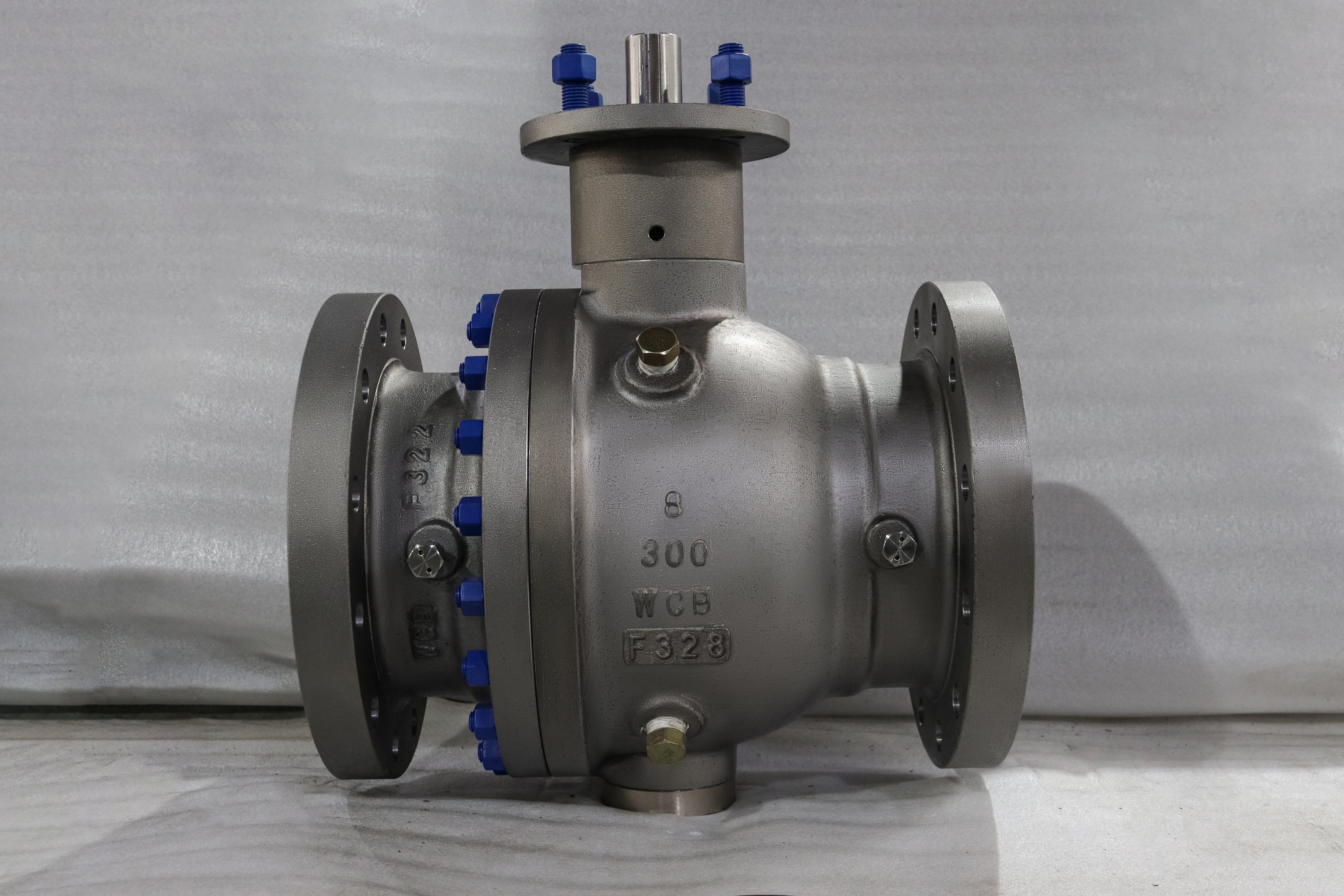
An ANSI eight inch Class 300 two piece trunnion ball valve with a cast WCB body. At this class the wall is not generous, so the quality of the casting decides how the valve behaves in service. Radiographic examination of the body, positive material identification and a recorded weld repair policy are what separate one supplier from another; the flange, the face to face and the pressure test are the same on every quotation.
That is the uncomfortable part of buying this product. At eight inch and Class 300 the valve is common enough that every quotation carries the same standard list, the same trim options and the same test, and the price difference between two offers is mostly the difference between two castings. A sound casting and a repaired one can look identical from the outside and both will pass a hydrostatic test, because a hydrostatic test proves the wall is not perforated, not that the wall is sound.
Design and Construction
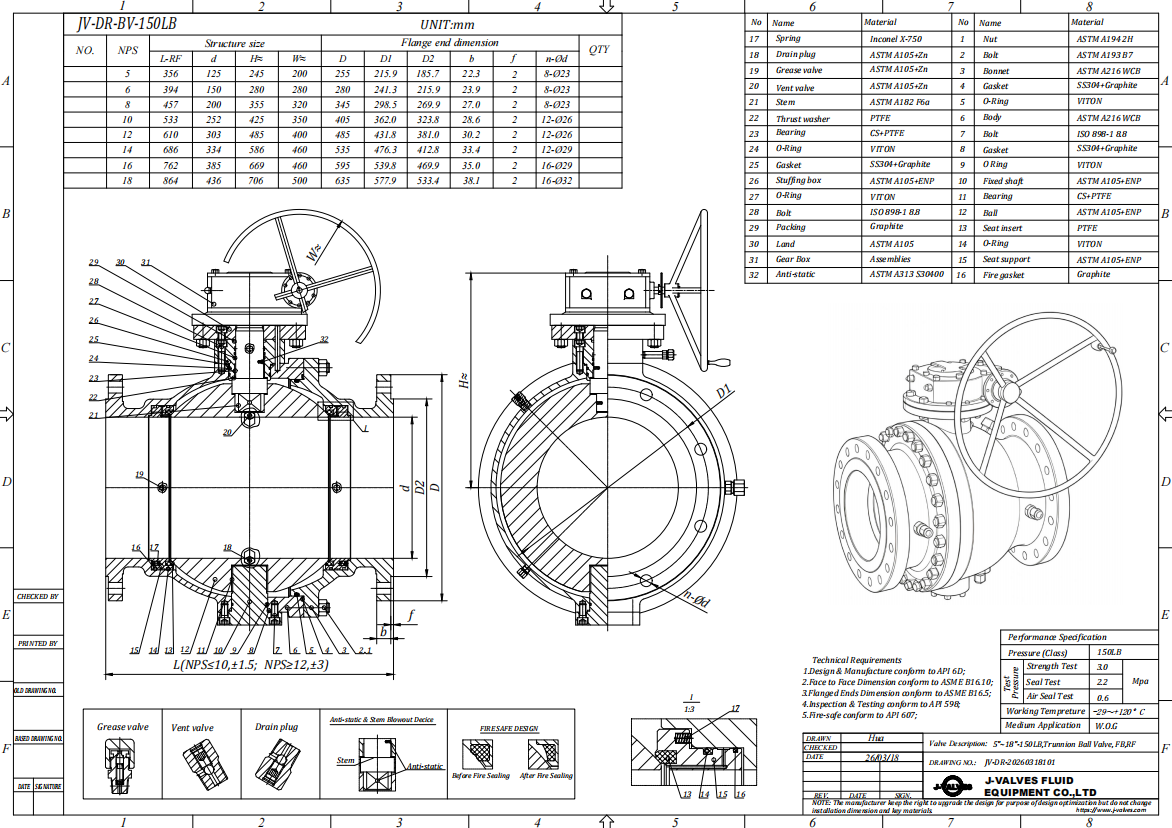
Two pieces: a main body carrying the ball, both seats and the stem, and one end body carrying the opposite flange. The two are bolted together through a gasket, so the ball and both seat rings come out by removing one end body while the main body stays on the line. The ball is carried on an upper and a lower trunnion in bearing blocks, which at eight inch keeps the pressure load out of the seats and the operating torque inside a gearbox.
Both seat rings are spring loaded against the ball and the cavity relieves through the seat. The stem is separate from the ball, retained by the body with an anti blowout shoulder, and the packing sits in an adjustable gland. The body itself is a single casting, which is the point of this page: the pressure boundary is one piece of cast steel with two flanged openings and a seat pocket at each end, and every one of those features is created in the mould before any machining starts.
Material Options
The body is WCB, the standard cast carbon steel for valve bodies, and it covers water, steam, oil and gas within its temperature band. At eight inch and Class 300 a casting is the economical choice, because a forging of that envelope would be a very large piece of press capacity for a valve that does not need forging quality. The trade is that a casting has to be examined rather than assumed, and that examination is what the rest of this page is about.
The trim is independent of the body and is where the medium is answered. The ball is A105N or WCB with hard chrome, or 304 or 316 where the product requires it. The seats are PTFE, RPTFE, PPL or nylon for the ordinary range, with a metal seat available for higher temperature or abrasive duty. The stem is 17-4PH or 316, and the bolting grade is written on the order rather than assumed at this class, because the body joint here is not where the specification gets tight. Bearings are 440C in self lubricating seats.
| Component | Standard Material | Optional Upgrade | Service Notes |
|---|---|---|---|
| Body and end body | WCB cast carbon steel | WCC, LCB for low temperature | two pieces, one bolted joint |
| Ball | A105N or WCB with hard chrome plating | 304, 316 stainless | carried on upper and lower trunnions |
| Seat | PTFE | RPTFE, PPL, nylon, metal seat | soft seat as standard at this class |
| Stem | 17-4PH | 316 stainless | retained by the body, blowout proof |
| Bolting | grade written on the order | higher grade where the design temperature needs it | body joint and flange studs |
| Bearing | 440C in self lubricating seats | nickel alloy | takes the trunnion side load |
| Body gasket | Spiral wound, graphite filled | PTFE envelope gasket | renewed at every opening |
| End connection | RF flanged to ASME B16.5 Class 300 | RTJ facing | facing stated on the order |
| Operator | Worm gear | pneumatic, electric, hydraulic | fitted after the pressure test |
Technical Specifications
The declared envelope is DN200 at Class 300: two piece cast WCB, full bore, raised face or ring joint facing to ASME B16.5, face to face to ASME B16.10, soft seat as standard with metal as the option, graphite packing, a worm gear operator and an API 598 test. Class 300 pairs with PN 50 in the designation table. All dimensions are drawing figures for the build ordered, and on a cast body the drawing is also where the examination areas are marked before the pattern is made.
Two specification fields on this product are not dimensional and are regularly left blank. The first is the examination requirement for the body casting: how much radiographic or ultrasonic examination, on which areas, and to what acceptance level. The second is the weld repair policy: whether repairs are permitted, who approves them, and what examination follows. Both belong in the enquiry, because a supplier who is not asked will supply to their own default, and that default is not the same everywhere.
| Item | Value |
|---|---|
| Nominal bore | 8 inch (DN200) |
| Pressure class | Class 300 (PN 50) |
| Body construction | two piece, cast, one bolted joint |
| Body | WCB cast carbon steel |
| Body options | WCC, A352 LCB for low temperature |
| Ball | A105N or WCB with hard chrome plating |
| Ball options | 304, 316 stainless |
| Seat | PTFE |
| Seat options | RPTFE, PPL, nylon, metal seat |
| Stem | 17-4PH |
| Stem option | 316 stainless |
| Bolting | grade written on the order |
| Bearing | 440C in self lubricating seats |
| Body gasket | spiral wound, graphite filled |
| End connection | RF flanged to ASME B16.5 Class 300 |
| End option | RTJ facing to ASME B16.5 |
| Face to face | ASME B16.10 for DN200 at Class 300 |
| Bore | full bore, DN200 |
| Casting examination | RT and NDT of the body, extent and acceptance level stated on the order |
| Weld repair policy | permitted only under a qualified procedure, recorded and re-examined |
| Material identification | positive identification on the body, every body or sample as ordered |
| Packing | graphite, adjustable gland |
| Operator | worm gear |
| Operator options | pneumatic, electric, hydraulic |
| Design standard | ASME B16.34, API 6D and API 608 |
| Pressure test | API 598, shell 1.5 times, seat 1.1 times |
| Fire test | API 607 where ordered |
| Material certificate | EN 10204 3.1 per heat |
| Marking | size, class, body grade, heat number, tag number |
| Temperature band | set by WCB under ASME B16.34; the valve does not extend it |
| Pig passage | full bore, piggable |
| Cavity relief | self relieving through the seat |
| Weight | quoted with the drawing for the build ordered |
Standards and Compliance
ASME B16.34 sets the wall and the rating for the cast carbon steel body and states the temperature band that goes with it. API 6D sets the functional requirements for a pipeline valve, including the examination of body castings, the pressure test, the marking and the documentation; API 608 is the general steel ball valve standard. ASME B16.5 sets the flange and the facing, ASME B16.10 the face to face, and API 598 the pressure test that most projects call for.
The documentation set is what makes the casting verifiable after the fact. A 3.1 certificate per heat ties the casting to a chemical analysis and a set of mechanical properties; a radiographic report ties the examined areas to a film and to an acceptance level; a weld repair record ties a repaired area to a qualified procedure and a re-examination. Ask for all three and the quotation becomes comparable. Ask for none and the only difference between two suppliers is the price and the delivery date.
| Requirement | Standard | What J-VALVES Supplies |
|---|---|---|
| Pressure boundary | ASME B16.34 | wall and rating for WCB, with its temperature band |
| Casting grade | ASTM A216 WCB | the grade the body casting is poured to, confirmed by PMI |
| Pipeline valve requirements | API 6D | examination of castings, test, marking, documentation |
| Ball valve requirements | API 608 | stem retention, marking, testing |
| Flanges and facing | ASME B16.5 | Class 300, raised face or ring joint |
| Face to face | ASME B16.10 | for DN200 at Class 300 |
| Pressure testing | API 598 | shell at 1.5 times, seat at 1.1 times |
| Material certificate | EN 10204 3.1 | per heat, with the grade and heat number |
| Impact testing where required | supplementary to the material standard | stated temperature and acceptance |
Manufacturing Process
The body is cast from a pattern, cleaned, heat treated and then machined. The casting stage is where the quality is decided: section changes, the seat pockets and the flange-to-body transitions are where shrinkage porosity forms, and no amount of machining removes a defect that sits below the surface. The casting is examined before machining, because finding a defect after the seat pockets are cut means scrapping the machining as well as the casting.
Where a defect is found and the repair is permitted, it is excavated, welded under a qualified procedure, heat treated as the procedure requires, and re-examined. The record of that repair travels with the valve. After machining, the body is assembled on new gaskets, the joint is torqued in a controlled sequence, and the valve is pressure tested before the gearbox is fitted, so that a fault found during test is never confused with an operator problem.

Quality Control and Testing
Testing on a cast body is two separate exercises that are often treated as one. The pressure test is the familiar part: shell at one and a half times the rating, seat at one point one times, run in both directions and judged to API 598. The examination of the casting is the part with no equivalent in that test, because it looks for internal soundness before the valve is ever filled with water, and a closed cavity behind an intact wall passes a hydrostatic test without difficulty.
The checks that matter on a cast body are the ones a hydrostatic test cannot make. Radiographic or ultrasonic examination looks for internal soundness at the section changes; positive material identification confirms that the casting is WCB and not a substitute grade; hardness checks catch a heat treatment that was missed; and dimensional checks confirm that the seat pockets are square to the bore and that both flange faces are parallel. Impact testing is added where the design temperature calls for it.
| Step | What Is Checked | Standard or Acceptance |
|---|---|---|
| Casting | chemical analysis, mechanical properties, heat treatment | 3.1 certificate against WCB |
| Radiographic examination | internal soundness at section changes and seat pockets | acceptance level stated on the order |
| Weld repair | excavation, qualified procedure, re-examination | recorded and approved before shipment |
| Machining | seat pockets square to the bore, flange faces parallel | drawing tolerance |
| Positive material identification | body confirmed as WCB | every body or sample, as ordered |
| Hardness | confirms the heat treatment was applied | within the material standard |
| Shell test | body and body joint at 1.5 times | API 598, no leak |
| Seat test | each seat in both directions at 1.1 times | API 598 |
| Flange facing | flatness, finish, groove profile where RTJ | ASME B16.5 |

Applications and Industry Service
The duty is isolation on large utility and process lines at moderate pressure: cooling water and raw water headers, plant and instrument air, oil and gas gathering and metering runs, tank farm and loading lines, fire protection mains where the valve is normally locked open, and general service in power and desalination plants. In most of those the valve is not cycled often, which is why a soft seat is usually the right choice and why the casting is the item that has to last.
It is the wrong valve above its temperature band, which for a carbon steel body ends well below the temperatures where a chrome moly or stainless body is needed; it is the wrong valve for a medium that attacks carbon steel; and it is the wrong valve where the line will be pigged through a reduced bore. It is also the wrong valve to buy on price alone, because the visible parts of the quotation are identical and the invisible part is the body.

Installation, Operation and Maintenance
Support the valve independently. At eight inch Class 300 the body is heavy enough that a valve hanging between two flanges will load the joint and the gasket in a way they were not designed for, and the pipe will usually be the thing that moves. Align the flanges without pulling them with the studs, fit a gasket suited to the facing, and tighten in a cross pattern in stages.
Operate a quarter turn, fully open or fully closed, and leave the gearbox locked where the line must not be moved. The gland can be adjusted in service, and the packing replaced with the valve isolated. Opening the body joint exposes the ball and both seats; the gaskets are renewed every time, and the joint is retightened in the same controlled sequence used at assembly rather than by feel.
How to Specify and Order
The order line carries the size, class, body material, bore, facing, trim, seat compound, packing, operator and standard set. A typical line reads: ANSI eight inch, Class 300, body WCB, full bore, RF flanged to ASME B16.5, face to face to ASME B16.10, RPTFE seat, graphite packing, worm gear operator, API 598. That line is complete on paper and still says nothing about the casting.
So the enquiry needs three more lines, and they are the ones that make quotations comparable: the radiographic or ultrasonic examination requirement for the body with its acceptance level, the weld repair policy including who approves a repair and what examination follows it, and whether positive material identification is required on every body or on a sample. Add the design temperature and the medium for the trim, and the specification is then complete in the sense that matters.
FAQ
Q: Why is the casting the important part of this valve?
A: Because everything else on the quotation is the same. At eight inch Class 300 the flange, the face to face, the trim options and the pressure test are common to every supplier, and the price difference is mostly the difference between two castings. A casting defect at a section change does not show on a hydrostatic test, so the examination requirement is what actually differentiates the product.
Q: What examination should be asked for on the body?
A: Radiographic examination of the seat pocket and flange-to-body transition areas, at an acceptance level stated on the order, is the usual request for this size and class. The extent and the level are the two variables, and both belong in the enquiry rather than being left to the supplier default, because defaults differ and the certificate will only report what was asked for.
Q: Are weld repairs allowed on the body?
A: They are permitted under a qualified procedure, with the defect excavated first, the repair heat treated as the procedure requires, and the area re-examined afterwards. What matters to a buyer is that the repair is recorded and approved rather than invisible, and that the policy is agreed before the casting is poured. A blanket prohibition is also a valid policy, if the duty justifies it.
Q: Why is this valve cast rather than forged?
A: At eight inch Class 300 a forging would need a very large piece of press capacity for a valve that does not need forging quality, so the casting is the economical answer. The trade is that a casting has to be examined rather than assumed, which is why the examination requirement, not the material grade, is the line that decides between two suppliers.
Q: Can the valve be used above the carbon steel temperature band?
A: No. The band belongs to WCB under ASME B16.34 and the valve does not extend it, whatever the seat compound is rated for. Above that band the answer is a different body material, chrome moly or stainless depending on the temperature and the medium, and the seat and packing follow. Changing the seat alone does not change the body rating.
Q: Does a hydrostatic test prove the casting is sound?
A: No. A hydrostatic test proves the pressure boundary is not perforated at the test pressure. It does not detect internal porosity or a shrinkage cavity that is closed off, and those are exactly the defects that grow under thermal cycling in service. That is why radiographic examination and a hydrostatic test are two different requirements, not two ways of doing the same thing.


Hot Products


News
Ball Valves in A Kraft Pulp Mill: Black Liquor, Green Liquor And The Cost of Choosing The Alloy by Habit
White liquor at pH 14 cracks carbon steel welds, black liquor sets solid below 100 C, green liquor dregs grind seats: alloy choice and torque in a kraft mill.
Read More
Slug Flow And Ball Valves: What Actually Arrives At The Seat
A slug is liquid mass with momentum, not a pressure spike. What changes at the seat, in the cavity and at the actuator when liquid reaches a ball valve.
Read More
Ball Valves in Direct Lithium Extraction: PH 1 Eluate, Gypsum Scale And 438,000 Cycles in Twenty-Five Years
Direct lithium extraction swings valves from pH 1 eluate to pH 12 caustic, 48 column switches a day and gypsum scale. Materials, seats and torque.
Read More
Ball Valves in Geothermal Brine: Silica Scale, Chloride Cracking And The Cooling Trap
Why geothermal brine destroys ball valves: retrograde silica scale, calcite at the flash point, chloride cracking above 60 C and the 250 C seat limit.
Read More