


CHINA J-VALVES Offers Various High-quality I ndustrial Ball Valves
J-VALVES, a distinguished professional ball valve manufacturer rooted in China, takes pride in its extensive product portfolio. Our offerings span a wide range, including trunnion-mounted ball valves, floating ball valves, high-temperature ball valves, high-pressure ball valves, metal-sealed ball valves, ultra-low temperature ball valves, DBB ball valves, Three-way And Four-way Ball Valve, and fully welded ball valves. Each product is a testament to our commitment to precision engineering and reliable performance. Meticulously crafted, they are designed to not only meet but exceed the most stringent industrial demands, ensuring stable operation even under extreme conditions. This enables us to provide our clients with high-value services and makes our valves widely sought-after in industries.
Product Category
Contact Us


-
J-VALVES-Q347F
-
J-VALVES
Overview of the J-VALVES 14 Inch Class 300 Two Piece Flange Trunnion Mounted Ball Valve
The 14 inch Class 300 trunnion mounted ball valve is a full bore pipeline valve built to API 6D for a 355.6 mm line. The end flanges are ASME B16.5 Class 300,

twenty 1-1/8 inch bolts on a 476.3 mm circle, the shell is a two piece bolted ASTM A216 WCB casting, and the bore is 334 mm, the API 6D Table 1 minimum for NPS 14. The ball runs on trunnions in metal backed bearings.
At this size the trunnion is
what makes the valve turnable. The 334 mm bore presents 876 square centimetres to line pressure, and at 51.1 bar and 38 C that is about 448 kN pushing the ball toward the downstream seat. A floating ball valve of the same bore would press that load onto one seat ring through a few square centimetres. The trunnions take it in compression and the stem carries torque only, so a valve this size is still turned by hand through a gearbox.
Design and Construction
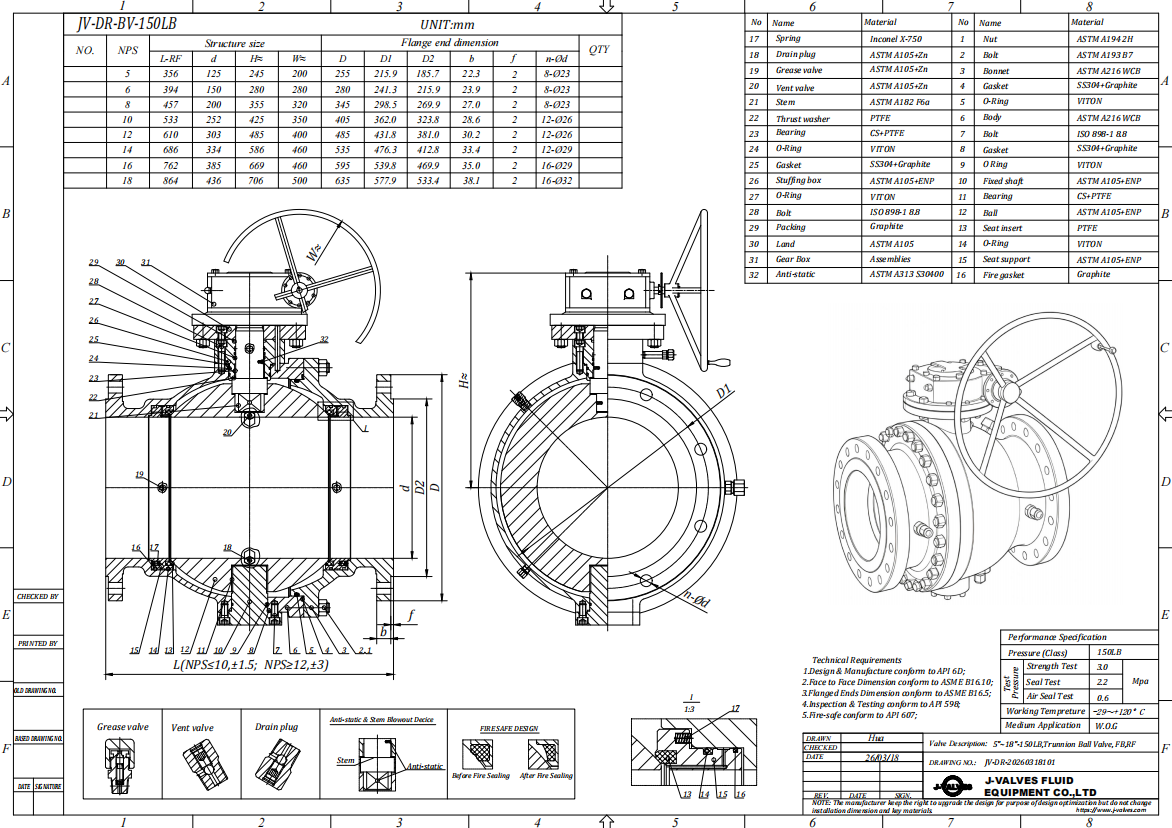
The body is a two piece bolted split: a main body carrying both trunnion bores, the stem bore and one end flange, and a closure carrying the second end flange, joined on a single machined face. That is the only pressure boundary beyond the flanges, the economic argument over three piece, which needs two such faces. The trade is access: with the closure off, the ball, both seats and both bearing blocks come out in one piece.
The ball is a WCB or A105 forging with electroless nickel or hard chrome on the sealing surface, machined to a sphere and ground. From NPS 6 upward the trunnions sit in bearing blocks bolted into the body rather than the casting, so the alignment is serviceable; each runs in a metal backed PTFE and graphite bush sized for the 448 kN load.
The seats are single piston effect as standard and double piston effect on request. A single piston effect seat is pushed onto the ball by upstream pressure and pulled off downstream, so anything trapped between the seats escapes to the low side without a relief device. A double piston effect seat is pushed on from both sides, giving double isolation and bleed both ways, but it traps the cavity, so liquid service needs an external relief: a cavity this size filled with liquid builds several bar from a few degrees of warming.
The stem is 17-4PH, retained by the body cover so pressure cannot eject it, with two O-rings and a graphite gasket above as a triple barrier, and the gland plate comes off to renew the upper O-ring in service. A spring plunger bridges ball to stem to body for static discharge, and the shell is fire safe to API 607 with a graphite secondary seal. An NPT drain and cavity vent allow double block and bleed.
Material Options
WCB is the standard shell because a Class 300 casting covers most station duty at this size, from -29 C to 425 C on the shell rating. The service limit is set by the seat insert and the secondary seals, a separate choice from the body grade, and where a 14 inch quotation is most often under specified.
| Component | Standard Material | Optional Upgrade | Service Notes |
|---|---|---|---|
| Body and closure | ASTM A216 WCB cast carbon steel | A105 forged, A350 LF2 | Group 1.1, -29 C to 425 C on the shell |
| Ball | A105 or WCB forging, ENP or hard chrome | F316 with ENP, duplex overlay | Sealing surface ground and lapped |
| Trunnion | A105 surface hardened, or 17-4PH | F316 | In separate bearing blocks from NPS 6 up |
| Stem | 17-4PH precipitation hardening stainless | A105 with ENP | Anti-blowout, retained by the body cover |
| Seat insert | RPTFE, -29 C to 180 C | PPL to 280 C, PEEK to 260 C, metal to 425 C | The seat, not the body, sets the range |
| Seat ring | A105 with ENP | F316, tungsten carbide faced | Piston area sets seat load at pressure |
| Trunnion bush | PTFE and graphite, metal backed | PEEK composite | Sized for the 448 kN end load |
| Body gasket | Flexible graphite spiral wound, 316L | Ring joint gasket | Renewed whenever the joint is opened |
| Body bolting | A193 B7 with A194 2H nuts | A193 B8M with A194 8M | Torque and sequence per the drawing |
| Stem packing | Graphite with Inconel wire reinforcement | PTFE V-ring | Triple barrier, ISO 15848-1 |
The seat table is the one to read at length. RPTFE at -29 to 180 C is the default for water, oil and most process liquids. PPL takes the same duty to 280 C and is the usual answer for hot oil and low pressure steam. PEEK reaches -60 to 260 C with better wear resistance but less conformability, so it wants clean service. Only a metal seat with a flexible graphite secondary reaches the 425 C the WCB shell is rated for, and it changes the acceptance criterion at test because it wears in rather than deforms. Calling a PTFE seated valve a 425 C valve is the common error.
Technical Specifications
The table describes the standard WCB build with an RPTFE seat and a worm gear operator. Bore, flange and face to face are fixed by the standards; mass and torque are reference values confirmed by the approved drawing.
| Item | Value |
|---|---|
| Nominal size | 14 inch, DN350 |
| Bore type | Full bore, 334 mm per API 6D Table 1 |
| Pressure class | ASME Class 300, PN 50 in API 6D designation |
| Body material | ASTM A216 WCB |
| Body style | Two piece, side entry, bolted split |
| End connection | ASME B16.5 Class 300, RF or RTJ |
| Flange outside diameter | 533.4 mm |
| Flange bolt circle | 476.3 mm, 20 bolts of 1-1/8 inch |
| Flange thickness | 52.4 mm to 54.0 mm reference |
| Raised face diameter | 412.7 mm for RF ends |
| Face to face length | 762 mm per ASME B16.10 |
| Pressure rating at 38 C | 51.1 bar |
| Pressure rating at 425 C | 38.0 bar, shell limit only |
| Temperature range as built | -29 C to 180 C, set by the RPTFE seat |
| Ball end load at rating | About 448 kN, carried by the trunnions |
| Seat design | Single piston effect standard, double optional |
| Breakaway torque | 3,000 to 6,000 N m reference, measured per valve |
| Operator | Worm gear with handwheel, ISO 5211 pad |
| Approximate mass | 600 kg to 900 kg reference, lifting points required |
| Anti-static | Spring plunger, ball to stem to body |
| Fire safe | API 607 and ISO 10497 |
| Design standard | API 6D with ASME B16.34 |
| Test standard | API 6D with API 598 acceptance |
Two rows deserve a second look. The WCB shell holds 38.0 bar at 425 C, but the RPTFE seat holds 180 C, so the valve as built is a 180 C valve. And the 762 mm face to face is fixed by ASME B16.10; it does not move with bore, seat or operator.
Standards and Compliance
The design basis is API 6D. Quoting API 608 beside it causes real damage: API 608 is the general industrial ball valve standard, with no bore table, no reduced opening rule and no pipeline test regime, so a valve built to it is a sound plant valve, not a pipeline one.
PN 50 needs care. API 6D itself designates Class 300 as PN 50, so a data sheet saying 14 inch PN 50 is not wrong, but treating it as an EN 1092-1 rating is, since EN 1092-1 has no PN 50 step and runs from PN 40 to PN 63. The consequence is at the mating flange: NPS 14 Class 300 takes twenty 1-1/8 inch bolts on a 476.3 mm circle, while PN 40 DN350 takes sixteen M30 on 460 mm.
| Requirement | Standard | Supplied |
|---|---|---|
| Design and pressure containment | API 6D with ASME B16.34 | Group 1.1 carbon steel |
| Full bore definition | API 6D Table 1 | 334 mm for NPS 14 at Class 300 |
| Face to face | ASME B16.10 | 762 mm |
| Flange dimensions | ASME B16.5 Class 300 | RF or RTJ, 20 bolt |
| Shell test | API 6D, 1.5 times rating | 76.7 bar hydrostatic |
| Seat test | API 6D, 1.1 times rating | 56.2 bar both directions |
| Fire safe | API 607 and ISO 10497 | Certified |
| Fugitive emission | ISO 15848-1 | Triple stem barrier |
| Sour service | NACE MR0175 and ISO 15156 | On request, hardness controlled |
| Marking | API 6D clause 12 and Table 11 | Body and nameplate |
| Material certification | EN 10204 3.1 | Included |
Marking is where a delivered valve can be checked in ten minutes. API 6D requires the manufacturer name, a unique serial number, the pressure class, the material with heat number, the nominal size and the minimum yield of the end material, stamped with a rounded die at 6 mm minimum.
The API monogram is the other distinction buyers miss. It is a licence issued by API to an audited plant, so a valve can be built to API 6D and sold as compliant without the mark, which is legitimate but not the same claim. J-VALVES holds API 6D, API 6DSS and API 600 licences, so the mark can be checked against the API composite list.
Manufacturing Process
Bodies and closures are cast to A216 WCB and machined at the J-VALVES plants in Wenzhou and Lishui, a 15,000 square metre base running 40 CNC lathes and 5 machining centres. At 533 mm across, the end flanges are faced in one setting, because facing half, rotating the casting and facing the rest leaves a step no gasket will follow. The trunnion bores are line bored as a pair; their spacing and squareness to the flange face decide whether the ball turns freely at pressure. The split face is finish machined, then body and closure are bolted together dry, since a mismatch of a few hundredths of a millimetre shows up as torque rather than as a leak.
Assembly is vertical. The main body is set on its lower trunnion bore, the bearing and ball lowered in, the seats fitted from each end, and the closure brought on with a new gasket and torqued in stages in a cross pattern. Breakaway torque is measured after the body bolts reach full torque, the only reading that reflects the shipped valve.

Quality Control and Testing
Every valve is hydrostatically tested, its seat leakage measured in both directions and its breakaway torque recorded before painting, and the records ship with the valve.
| Step | What Is Checked | Standard or Acceptance |
|---|---|---|
| Incoming material | Chemistry, mechanicals and heat number of the WCB castings | EN 10204 3.1 certificate |
| Dimensional | Bore, face to face, flange drilling, bolt circle, split face | Drawing, 762 mm face to face |
| Non destructive | Radiography or dye penetrant on body and closure castings | ASME B16.34 as ordered |
| Hydrostatic shell | Body, split joint and stem gland at 76.7 bar | No leakage, no permanent distortion |
| Seat test, one side | 56.2 bar on each seat in turn | Zero visible leakage, soft seat |
| Seat test, reverse | 56.2 bar with flow reversed | Zero visible leakage, soft seat |
| Cavity relief | Trapped pressure released through the seat or the vent | Vents to the low pressure side |
| Torque | Breakaway and running torque at rated pressure | Recorded against the torque sheet |
| Functional | Full open and close cycles, gear limit settings, drain and vent | No binding, handwheel force within limit |
| Final | Painting, marking, nameplate, packing | RAL 5015, bore plugged, serial stamped |
The seat test is where a valve of this size differs in kind. API 6D allows a seat to be accepted against ISO 5208 or EN 12266-1 rates A to D, and the rate must be named on the report, but the default for a soft seat is rate A, no visible leakage; a metal seated build is accepted against a drip rate instead.

Applications and Industry Service
The natural home for this valve is the station or terminal where a 14 inch line has to be isolated rather than modulated. Metering stations, pig traps, compressor headers and terminal block valves want the same three things: a bore that passes a pig, a body serviceable without cutting the line, and a length that matches the drawings.
The second group is transmission and gathering lines. Class 300 at NPS 14 appears where a Class 150 line has been uprated for a higher MAOP, or a Class 600 line relaxed by the surge analysis. Full bore matters because the line is pigged, and a reduced bore valve would be a permanent obstruction.
The third group is large bore water duty: raw water transmission, cooling water headers and pump station isolation. WCB suits it, an RPTFE seat suits the temperature, and the gearbox lets one person operate the valve. What it should not be given is throttling duty: a ball valve at part open is a poor control element at any size and a damaging one at 334 mm, where the jet off the seat edge erodes the ball within a season.
Installation, Operation and Maintenance
Before installation, confirm the 762 mm face to face against the spool, check the bolt pattern is twenty holes at 476.3 mm rather than the sixteen of EN PN 40 DN350, and cycle the valve on the bench. The gearbox belongs on the access side, the drain at the bottom. At 600 to 900 kg it needs its own support; hanging that mass on flange bolts is how a joint starts leaking.
Operation is a quarter turn between fully open and fully closed, nothing in between. Close the valve, open the cavity drain and confirm it drains and neither seat passes. A single piston effect cavity is self relieving, so trapped liquid cannot overpressure it. A double piston effect cavity can be, so it must never be left liquid filled and blocked in.
Seat replacement starts with isolation, venting and draining both sides and confirming the cavity is at zero pressure, because a cavity this size holds enough liquid to be dangerous when the joint opens. Break the body bolting in a cross pattern, lift the closure by its lugs, and renew both seats with the body gasket and stem seals.
How to Specify and Order
State the size as 14 inch or DN350, the class as ASME Class 300, the face to face as 762 mm and the drilling as twenty 1-1/8 inch holes on a 476.3 mm circle, and say whether the ends are raised face or ring joint. Say full bore and give the bore as 334 mm, because a supplier reading only the size may quote a reduced bore valve, and a 14 inch reduced bore drops to 305 mm or 254 mm.
Then name the seat separately from the body. Give the medium, design temperature and design pressure, and specify the seat insert that matches all three, with its acceptance criterion. For an actuated valve give the air or power supply and the torque available, so the actuator is sized to the measured breakaway torque.
J-VALVES supplies the EN 10204 3.1 certificates, the dimensional report and the shell and seat test record with individual torque figures. WCB builds ship in 2 to 4 weeks.
FAQ
Q: What does PN 50 mean on a 14 inch Class 300 valve?
A: PN 50 is the API 6D designation for Class 300 and is the correct way to write it on a valve data sheet. It is not an EN 1092-1 rating, because EN 1092-1 has no PN 50 step and runs from PN 40 to PN 63. Never buy EN PN 40 gaskets for this valve: NPS 14 Class 300 takes twenty 1-1/8 inch bolts on a 476.3 mm circle, while PN 40 DN350 takes sixteen M30 bolts on 460 mm, so the flange will not bolt up.
Q: Can this 14 inch valve be supplied reduced bore?
A: Yes, and API 6D clause 12.2 sets how it must be marked. A reduced bore valve is ordered and stamped either as NPS 16 (DN 400) x NPS 12 (DN 300) when the bore follows Table 1, or as NPS 16R (DN 400R) x 14.75 in (375 mm) when the actual bore is quoted. Crucially the 762 mm face to face does not change, because ASME B16.10 fixes it by the 14 inch size, not by the bore.
Q: Why does a 14 inch trunnion valve need a gearbox and its own support?
A: Because the loads are far beyond hand operation. The 334 mm bore presents 876 square centimetres to line pressure, which at the 51.1 bar rating is about 448 kN pushing the ball onto the downstream seat, and the valve weighs 600 to 900 kg as a reference. The trunnions take that thrust in compression so the stem sees torque only, but the breakaway torque still runs 3,000 to 6,000 N m, which is a worm gear and handwheel job, and the mass must hang on a pipe support, not on the flange bolts.
Q: Is the API monogram the same as being API 6D compliant?
A: No. The monogram is a licence API issues to an audited plant, so a valve can be built to API 6D and sold as compliant without the mark, which is legitimate but a different claim. J-VALVES holds API 6D, API 6DSS and API 600 licences, so the mark on a nameplate can be checked against the API composite list rather than accepted from a catalogue.


Hot Products


News
Ball Valves in A Kraft Pulp Mill: Black Liquor, Green Liquor And The Cost of Choosing The Alloy by Habit
White liquor at pH 14 cracks carbon steel welds, black liquor sets solid below 100 C, green liquor dregs grind seats: alloy choice and torque in a kraft mill.
Read More
Slug Flow And Ball Valves: What Actually Arrives At The Seat
A slug is liquid mass with momentum, not a pressure spike. What changes at the seat, in the cavity and at the actuator when liquid reaches a ball valve.
Read More
Ball Valves in Direct Lithium Extraction: PH 1 Eluate, Gypsum Scale And 438,000 Cycles in Twenty-Five Years
Direct lithium extraction swings valves from pH 1 eluate to pH 12 caustic, 48 column switches a day and gypsum scale. Materials, seats and torque.
Read More
Ball Valves in Geothermal Brine: Silica Scale, Chloride Cracking And The Cooling Trap
Why geothermal brine destroys ball valves: retrograde silica scale, calcite at the flash point, chloride cracking above 60 C and the 250 C seat limit.
Read More