

CHINA J-VALVES Offers Various High-quality I ndustrial Ball Valves
J-VALVES, a distinguished professional ball valve manufacturer rooted in China, takes pride in its extensive product portfolio. Our offerings span a wide range, including trunnion-mounted ball valves, floating ball valves, high-temperature ball valves, high-pressure ball valves, metal-sealed ball valves, ultra-low temperature ball valves, DBB ball valves, Three-way And Four-way Ball Valve, and fully welded ball valves. Each product is a testament to our commitment to precision engineering and reliable performance. Meticulously crafted, they are designed to not only meet but exceed the most stringent industrial demands, ensuring stable operation even under extreme conditions. This enables us to provide our clients with high-value services and makes our valves widely sought-after in industries.
Product Category
Contact Us


Pressure Class: ASME Class 150 to 2500 / PN20 to PN420
Design Standard: API 6D, ASME B16.34
Body Construction: Two piece and three piece side entry, bolted
Body Material: WCB, LCC, CF8M, CF3M, F316, F51, A350 LF2
Ball: F316 or CF8M, hard chrome or ENP plated
Seat: PTFE, RPTFE, PEEK, nylon, or metal seated
Seat Design: Single piston self-relieving, double piston DIB-1
Stem: F316 or 17-4PH, anti-blowout, anti-static
End Connection: Flanged RF/RTJ to B16.5 and B16.47, butt weld to B16.25
Face to Face: ASME B16.10, non-standard on drawing approval
Test Standard: API 6D, API 598, API 607, ISO 15848-1
Operation: Lever, gear, pneumatic, electric, gas over oil
-
Q347F-2500LB R(F316)
-
J-VALVES
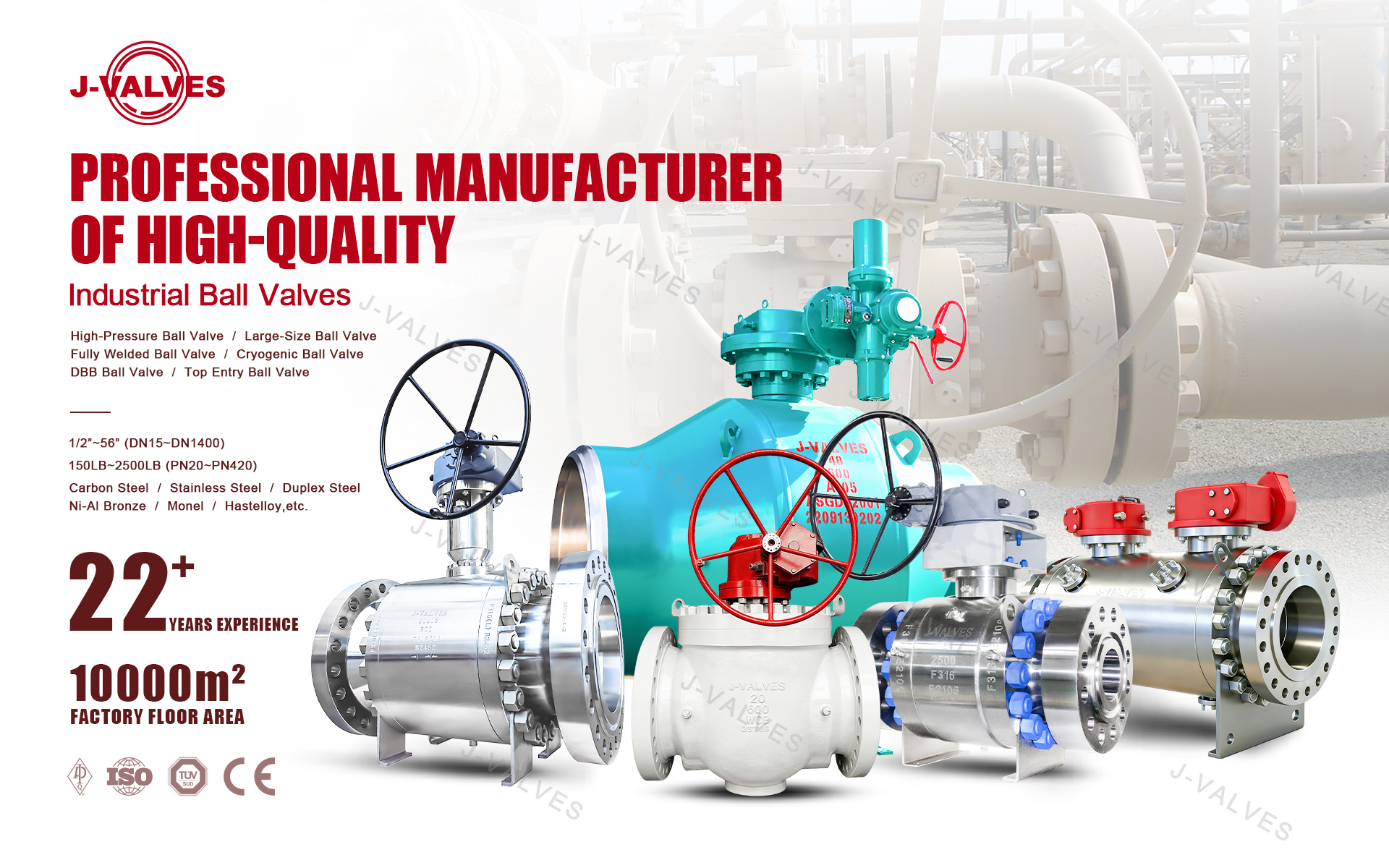
A trunnion mounted ball valve is a quarter-turn isolation valve in which the ball is carried on a top and a bottom shaft, the trunnion, so pressure thrust goes into two bearings fixed in the body and the seat is left with a sealing duty only. Seats are spring loaded and float against the ball, the body is bolted and side entry, and line pressure no longer drives the torque.
J-VALVES builds them in Wenzhou, Zhejiang, from 2 to 56 inch at ASME Class 150 to 2500, in WCB, LCC, CF8M, CF3M, F316, F51 and A350 LF2, with soft or metal seats and lever, gear or ISO 5211 mounting. Buyers are pipeline contractors, gas storage and metering packagers, refinery EPCs and water transmission projects.

What Trunnion Mounting Actually Changes
In a floating ball valve the ball is held by the two seats alone. Pressure on the closed ball pushes it downstream, the downstream seat absorbs the whole thrust and the upstream seat is pushed clear, so seat stress is a by-product of line pressure. At DN200 Class 600 that thrust is about 320 kN acting on a seat ring a few millimetres thick.
Trunnion mounting separates the two jobs. The ball sits on a bottom and a top shaft running in bearings fixed to the body, so radial thrust goes into the bearings and the seat needs only enough contact stress to close the leak path, typically 3 to 8 MPa on the sealing face. A spring supplies that stress at low pressure, before the piston effect can.
Characteristic | Floating ball | Trunnion mounted |
|---|---|---|
Load path | Through the ball into the downstream seat and the stem in bending | Into top and bottom bearings; seat carries seal stress only |
Seat stress source | Line pressure, so stress rises with pressure | Seat spring plus a small piston area |
Torque at DN200 Class 600 | 2500 to 3500 Nm, pressure dependent | 850 to 1100 Nm, weakly dependent |
Practical size at Class 600 | NPS 4 to 6 | NPS 2 to 56 |
Cavity volume | Small | Large, needs a relief design |
Relative cost, DN200-600 | 1.0 | 1.25 to 1.4 |
The trade is honest: taller, heavier, two bearings, two spring-loaded carriers, a gasketed bottom cover and a cavity that holds real liquid volume. Each is a failure path a floating valve does not have.
Floating or Trunnion: Where the Line Is
The decision is arithmetic. Thrust on a closed ball is seat bore area times differential pressure, F = (π/4) x d² x ΔP, with ΔP taken at the full cold working pressure. At DN200 Class 600, d is 0.2 m and ΔP is 10.2 MPa, so F = 0.0314 x 10.2 MPa, about 320 kN.
That figure grows with the square of the bore, which is why the boundary moves quickly. A floating ball must pass the whole thrust into a stem whose diameter can only grow as the cube root of the load inside a packing box that cannot, and into a seat ring that must follow the ball without extruding over its retaining gap. Above about 250 to 300 kN the floating design stops being sensible.
Size | Port area cm2 | Class 150 kN | Class 300 kN | Class 600 kN | Class 900 kN | Construction |
|---|---|---|---|---|---|---|
DN50 (2 in) | 19.6 | 3.8 | 10.0 | 20.0 | 30.0 | Floating to 1500 |
DN100 (4 in) | 78.5 | 15.4 | 40.1 | 80.2 | 120.3 | Floating to 600 |
DN150 (6 in) | 177 | 34.7 | 90.4 | 180.7 | 271.1 | Floating at 150 |
DN200 (8 in) | 314 | 61.6 | 160.5 | 320.6 | 481.0 | Boundary |
DN300 (12 in) | 707 | 138.6 | 361.3 | 721.8 | 1082.3 | Trunnion |
DN600 (24 in) | 2827 | 554.1 | 1444.6 | 2886.5 | 4329.1 | Trunnion, gear |
In practice the line sits near DN200 Class 600 on gas, where shut-off differential is the full class rating; on a pumped liquid line closing against less, a floating valve can go one size further. Past 300 kN the fixed ball valve stops being the expensive option and becomes the only practical one.

Body Construction: Two Piece and Three Piece Side Entry
Two piece and three piece are both side entry forms of the trunnion mounted ball valve. In a two piece body the main section carries one seat, the trunnion bores and both line flanges, and a single closure carries the second seat through one gasket joint. The ball goes in before the closure, so assembly runs bottom cover, ball, seats, stem from inside, closure. One joint, one leak path, a shorter valve: two piece covers most of 2 to 24 inch.
A three piece body splits into a centre section and two tail pieces, each bolted through its own gasket and each carrying one seat, with the ball clamped between them. Two gaskets to control, but each joint machines in one set-up and each casting is smaller. Above 24 inch that is decisive: a casting with both line flanges at DN600 Class 600 weighs tonnes and will not fit a normal machining centre.
Bolting and gasket decide the joint more than flange thickness does. A193 B7 with A194 2H nuts is standard, B7M held to 22 HRC for NACE MR0175, A320 L7 below -29 degrees C. The gasket is spiral wound 316L with a graphite filler to Class 600 and a ring joint from Class 900 up. Studs are torqued in three cross passes and the value is recorded by serial number.
Seat Design: Single Piston, Double Piston and Self-Relieving
Three arrangements cover almost every enquiry. A single piston seat has pressure on the sealing face only; cavity pressure acts on the back and lifts the seat off the ball, so the seat relieves an over-pressure into the bore while still sealing both ways. That is the default for liquid and general pipeline duty, and what most trunnion mounted ball valve datasheets assume.
A double piston seat has effective piston area on both faces, so cavity pressure adds to seat load instead of lifting the seat. The two seats then form two barriers, each testable through the bleed: the DIB-1 arrangement used for double block and bleed. Nothing relieves the cavity, so a liquid-full body needs an external relief valve.
Seat arrangement | Pressure acts on | Cavity relief | Where used |
|---|---|---|---|
Single piston, spring loaded | Sealing face only | Self-relieving to the bore | General pipeline duty |
Double piston (DIB-1) | Both faces of the seat | None, needs external relief | Metering, custody transfer, positive isolation |
DIB-2, one of each | Single one side, double other | Relief in one direction | One side only |
Metal seat, single piston | Sealing face plus metal stop | Self-relieving to the bore | Abrasive, high temperature |
Spring preload makes either arrangement work at low pressure. Disc springs behind the carrier give an equivalent contact stress of 0.5 to 1 MPa, enough to seal gas from 1 bar up. Without it, a valve that passes a 100 bar hydrostatic test can leak at 3 bar.
Trapped liquid is the other half of the choice. Water at 20 degrees C has a bulk modulus near 2.2 GPa and expands 2.1 x 10⁻⁴ per degree, so a liquid-full cavity gains about 0.45 MPa for every degree of warming. Ten degrees of solar gain is 4.5 MPa; a self-relieving seat lifts long before that, and a double piston seat does not.
Stem, Bearings and Anti-Blowout
The stem of a trunnion mounted ball valve carries torque, not thrust, so it is smaller than a floating valve stem of the same bore, but it still takes the side load of a gearbox and the bending of a misaligned pad. F316 is standard; 17-4PH (A564 grade 630) is used where torque is high or the stem must stay inside a small packing box at Class 1500.
Anti-blowout is a shape, not an accessory: an integral shoulder sits under the gland flange or a body counterbore, so the stem cannot be ejected with every packing ring removed and pressure in the line. API 6D requires the feature and it has to appear on the drawing, because a replacement stem without the shoulder passes a hydrostatic test and is still unsafe.
Bearings are PTFE-lined woven glass in a stainless shell, or bronze-backed PTFE on larger sizes. Allowable pressure falls with temperature: about 25 MPa at 20 degrees C, 15 MPa at 150 degrees C, 8 MPa at 200 degrees C, which is why the bottom trunnion of a 56 inch valve is a large journal rather than a short pin. Anti-static plungers hold stem-to-body resistance below 10 ohm, and ISO 5211 pads run F10 to F30 with a square or keyed drive.
Torque, Breakaway and Actuator Sizing
Torque tables are only comparable when the conditions are stated, so this one is defined: soft seated, clean water, 20 degrees C, differential equal to the full class rating, cycled within the week. A trunnion mounted ball valve that has stood closed for a year in a dirty line will exceed them.
Size | Class 150 Nm | Class 300 Nm | Class 600 Nm | Class 900 Nm |
|---|---|---|---|---|
2 in | 45 | 60 | 90 | 120 |
4 in | 110 | 160 | 260 | 340 |
6 in | 200 | 300 | 480 | 620 |
8 in | 350 | 620 | 950 | 1400 |
12 in | 700 | 1500 | 2400 | 3300 |
24 in | 2600 | 6000 | 10500 | 14500 |
36 in | 5200 | 13000 | 23000 | by calculation |
Multiply before selecting anything. Use 1.3 to 1.5 for normal seat and grease aging, 1.8 to 2.5 for a metal seat, 1.5 for slurry or a line that deposits solids, and 1.5 to 2.0 below -29 degrees C where grease stiffens and clearances tighten. Use the product of the factors, not the largest one.
A manual gear is sized on rim force: with 360 N as the practical limit, a DN200 Class 600 valve at 950 Nm needs about 9:1 on a 300 mm wheel, so a 12:1 gear leaves 260 N. Pneumatic cylinders are sized at minimum site air pressure, usually 5.5 bar, and a spring return unit is checked at the spring end of the stroke, where spring torque is lowest and valve load highest.
Materials and Service Limits
Body material follows the fluid and the design temperature; the seat follows the body. Carbon steel is the default for water, oil and gas, austenitic stainless for process and mild corrosives, duplex for chloride, and low temperature carbon steel below -29 degrees C. A trunnion mounted ball valve is usually ordered from a line class sheet rather than from material theory.
Grade | Standard | Service range | Typical duty |
|---|---|---|---|
WCB | ASTM A216 | -29 to 425 C | Water, oil, gas, steam |
LCC | ASTM A352 | -46 to 345 C | Cold carbon steel, LPG, refrigerated storage |
A350 LF2 | ASTM A350 | -46 to 343 C | Forged bodies, Class 900 and above |
CF8M | ASTM A351 | -196 to 538 C | Process, mild corrosive |
CF3M | ASTM A351 | -196 to 538 C | CF8M for welded pipe |
F316 | ASTM A182 | -196 to 538 C | Forged bodies, high class, thin sections |
F51 duplex | ASTM A182 | -29 to 300 C | Seawater, chloride, produced water |
Two limits catch buyers. The body grade does not set the valve limit, the seat does: CF8M is rated to 538 degrees C, yet PTFE stops near 200 degrees C, RPTFE near 220 degrees C and PEEK near 250 degrees C, and only a metal seat carries the valve to the body limit. And ratings fall with temperature: WCB Class 300 holds 51.1 bar at 38 degrees C but about 41.9 bar at 300 degrees C, per ASME B16.34.
F51 duplex answers seawater and chloride-bearing produced water, where 316 pits within months. It is limited to about 300 degrees C because sigma phase forms above that, and it is strong in chloride but only moderate in reducing acids. For sour duty, NACE MR0175 and ISO 15156 hold carbon and low alloy steel to 22 HRC, with bolting, stem and ball hardness controlled as well.

Testing to API 6D and API 598
Every trunnion mounted ball valve gets a shell test and a seat test, and the seat test runs on each seat separately with the cavity open, because a valve can pass on one seat, leak on the other and still look tight from outside.
Test | Basis | Pressure | Medium | Acceptance |
|---|---|---|---|---|
Shell | API 6D, API 598 | 1.5 x the 38 C rating | Water with inhibitor | No leak, no deformation |
Seat, each side | API 6D | 1.1 x the 38 C rating | Water, air or nitrogen | Rate A soft, rate D metal |
Low pressure seat | API 598 | 5.5 to 6.9 bar air | Air | No bubble in hold time |
Double block and bleed | API 6D | 1.1 x rating | Water | Seat tight, cavity bled |
Fire | API 607, API 6FA | 750 C for 30 min, then quench | Water | Within the leak limits |
Fugitive emission | ISO 15848-1 | Helium, 1.0 to 1.1 x | Helium | Class BH or CH |
Hold times follow API 598: 15 seconds to NPS 2, 60 seconds from 2 to 8, 120 seconds from 10 to 18 and 300 seconds at 20 and above, or longer where the specification says so. API 6D adds a seat test after the shell test, so a seat disturbed by body strain is caught at the works rather than in the plant.
Fire and emission tests are type tests. The valve is burned at 750 degrees C for 30 minutes, cooled and then pressured; what survives is graphite packing, a graphite or metal body gasket and a metal-to-metal secondary seat, and the acceptance is a defined leak, not zero. ISO 15848-1 works the same way, so the tightness class and cycle count must be quoted or the certificate proves little.

Sizes, Classes and Dimensions
The range is 2 to 56 inch and Class 150 to 2500, but construction and flange standard change across it. The split below is what quoting uses.
Size band | Construction | Usual classes | Flange and end standard |
|---|---|---|---|
2 to 6 in | Three piece forged or cast | 150 to 2500 | B16.5 RF/RTJ, B16.25 weld |
8 to 16 in | Two piece cast, gear | 150 to 900 | B16.5 up to 24 in |
18 to 24 in | Two piece cast, gear or actuator | 150 to 900 | B16.5 at 24 in, B16.47 above |
26 to 36 in | Three piece cast, geared | 150 to 600 | B16.47 Series A or B |
40 to 56 in | Three piece cast, actuator | 150 to 300 | B16.47 Series B |
Face-to-face comes from ASME B16.10 and is quoted with the class, not the size alone: DN200 measures 292 mm at Class 150 and 660 mm at Class 600, and DN600 measures 508 mm at Class 150. Class to PN equivalence runs 150 to PN20, 300 to PN50, 600 to PN100, 900 to PN150, 1500 to PN250 and 2500 to PN420, but it is an equivalence of rating only, and a PN50 flange will not bolt to a Class 300 flange. Butt weld ends follow B16.25, and non-standard dimensions are confirmed on a drawing before machining.
Four choices sit inside the range. Metal seated trunnion valves take duty above 250 degrees C, abrasive solids and fire-critical isolation. Top entry trunnion bodies are chosen where the valve must be repaired without breaking the line. Double block and bleed seats are chosen for positive isolation at a metering point. Full bore keeps a pig passage at higher cost; reduced bore saves weight and torque at the same face-to-face. A trunnion mounted ball valve is configured from these, not picked from a list.
What to Send with an Enquiry
A quote is a configuration, not a catalogue number, so the enquiry needs the ten items below. Missing data is usually resolved by assuming the cheapest option, which is rarely the right valve.
Size and ASME class, with the port bore if it is reduced.
Design pressure and the differential the valve closes against, not only the line pressure.
Fluid, including solids, chloride level and whether the duty is sour.
Design temperature, maximum and minimum, plus the ambient range for the actuator.
Body, ball, seat and stem material, or the line class sheet that defines them.
End connection: flanged RF or RTJ, butt weld, and the mating pipe schedule.
Face-to-face if it differs from B16.10, and any stem or bonnet extension.
Seat arrangement: single piston, double piston, and whether DBB or DIB-1 is required.
Operation: lever, gear, pneumatic, electric or gas over oil, with air pressure and fail position.
Tests and documents: API 6D, API 607, ISO 15848-1 class, NACE MR0175, EN 10204 3.1, witness.
Delivery is normally 4 to 8 weeks depending on configuration and material availability, and non-standard dimensions are drawn and approved before machining starts. A line class sheet, a P and ID and a data sheet shorten the review more than correspondence does.
Trunnion Mounted Ball Valve FAQ
How do I choose between a trunnion and a floating ball valve?
Calculate thrust as pi/4 times bore squared times differential pressure. Below about 100 kN a floating valve is simpler and cheaper. Above 250 kN the stem and seat of a floating design become impractical. As a working line: floating to NPS 6 at Class 150, to NPS 4 at Class 600, to NPS 2 at Class 1500 and Class 2500. Above those, a trunnion mounted valve is standard.
Is a double block and bleed seat arrangement mandatory?
No. API 6D does not require it, and a single piston self-relieving seat is the default for general service. DBB is a user requirement, normally written into a metering, custody transfer or pipeline isolation specification, and it needs double piston seats plus a bleed valve in the cavity. It also removes self-relief, so a liquid-full cavity then needs an external thermal relief valve.
Why must large valves be trunnion mounted?
Because seat thrust grows with the square of the bore. At DN600 Class 600 the shut-off thrust is about 2.9 MN, which no seat ring a few millimetres thick and no stem that fits a reasonable packing box can take in bending. A trunnion passes that load into two bearings sized for it, keeps the seat on a sealing duty only, and keeps torque within reach of a gearbox.
What is the difference between API 6D and API 608?
API 6D is a full specification for pipeline and manifold valves, covering design, materials, welding, testing, documentation and quality levels PSL 1 to PSL 4, in Class 150 to 2500. API 608 is a lighter ASME-based standard for flanged and butt weld ball valves in Class 150 to 1500, with fewer documentation and qualification requirements. A valve should not claim both unless it meets both in full.
Can a trunnion ball valve be buried underground?
It can, but the bolted body joints, the bottom cover and the stem become maintenance points nobody can reach. Buried service normally uses a fully welded body with an extended stem, so the only joints are welds and the operator stands above ground. Where a bolted body is buried, it needs a pit, a coating system and a documented access plan for the joint.
What information do you need to quote a trunnion ball valve?
Size, class, design pressure and shut-off differential, fluid and whether it is sour, temperature range, body and trim material, end connection and face-to-face, seat arrangement, operation with fail position, and the test and certification package. A line class sheet or data sheet covers most of it, and a drawing is issued for approval before machining on any non-standard dimension.
Hot Products


News
Ball Valves in Geothermal Brine: Silica Scale, Chloride Cracking And The Cooling Trap
Why geothermal brine destroys ball valves: retrograde silica scale, calcite at the flash point, chloride cracking above 60 C and the 250 C seat limit.
Read More
Ball Valve Face To Face Dimensions: Why A Correctly Ordered Replacement Still Does Not Fit
A 6 inch Class 150 ball valve can be 267 or 305 mm face to face and both are compliant. How B16.10, EN 558 and flange drilling decide whether it fits.
Read More
Ball Valve Stem Key And Keyway: What Gives Way First, And What The Handle Cannot Tell You
Between the handle and the ball there are four fits. Which one shears, which one cracks, and how a few degrees of lost motion hides a valve that never seated.
Read More
Ball Valve Datasheet: Six Blocks That Decide Whether Two Quotes Are Comparable
A ball valve datasheet only works when six blocks are fixed: pressure basis, bore, temperature ceiling, test, end connection, operator. How each is written.
Read More