

CHINA J-VALVES Offers Various High-quality I ndustrial Ball Valves
J-VALVES, a distinguished professional ball valve manufacturer rooted in China, takes pride in its extensive product portfolio. Our offerings span a wide range, including trunnion-mounted ball valves, floating ball valves, high-temperature ball valves, high-pressure ball valves, metal-sealed ball valves, ultra-low temperature ball valves, DBB ball valves, Three-way And Four-way Ball Valve, and fully welded ball valves. Each product is a testament to our commitment to precision engineering and reliable performance. Meticulously crafted, they are designed to not only meet but exceed the most stringent industrial demands, ensuring stable operation even under extreme conditions. This enables us to provide our clients with high-value services and makes our valves widely sought-after in industries.
Product Category
Contact Us


-
J-VALVES-Q647F
-
J-VALVES
Overview of the J-VALVES fire safe low emission trunnion ball valve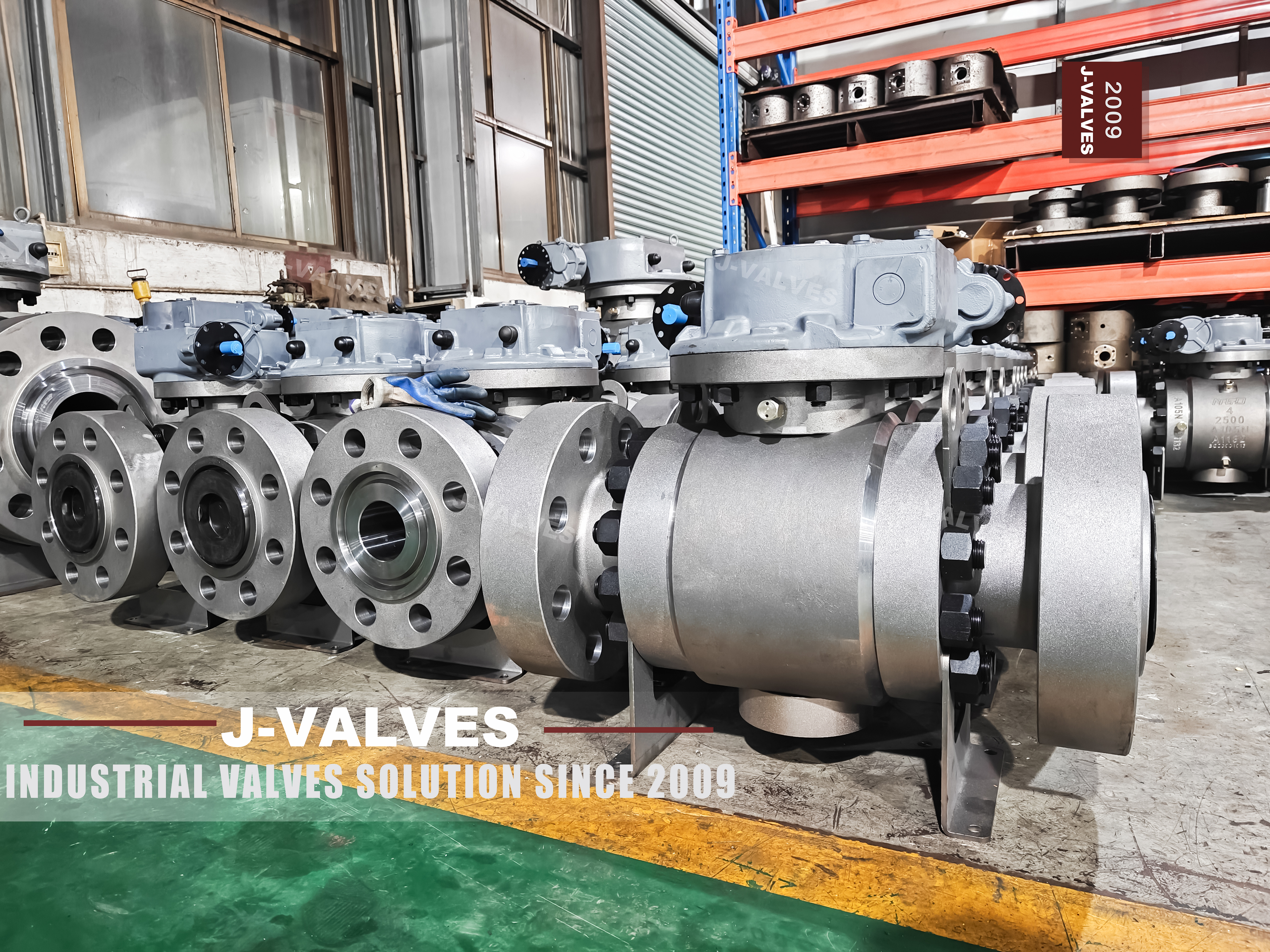
Three claims define this valve and each of them needs a document rather than an adjective. Fire safe means the valve was burned and then tested, low emission means the stem seal was measured against a class, and quick install means the end is a coupling rather than a flange or a weld. A page that makes the three claims without saying what each one costs is a page that has not been read by an engineer.
The size range on this valve is unusually wide, from half an inch to 60 inch, at Class 150 to 2500, with a body in WCB, CF8, CF8M, A105N, F304, F316, F11 or F22. That width is the point of a fire safe product: the same qualification is applied across a range so that a plant can standardise on one fire safe seat and packing arrangement for every isolation point it has, from a small drain to a 60 inch mainline valve.
There is one correction to make at the start because it is in the title of the source page. The standard is API 607. There is no AP1607, no API 1607 and no ISO 1607; the number 607 belongs to the fire test, and a search for the misspelling returns nothing. A buyer hunting for a fire safe valve will search 607, and the page has to be findable under the number that exists.
Design and Construction
The valve is trunnion mounted, so the ball is carried on upper and lower bearings and the seat load comes from a spring pack plus the pressure term rather than from the ball being pushed downstream. That matters for a fire safe design, because the fire safe behaviour depends on the seat being able to fall back onto a metal contact when the soft insert is destroyed, and a trunnion ball keeps its position while that happens.
The fire safe design itself is a set of small decisions rather than one feature. The seat has a metal back-up that contacts the ball when the soft insert is gone. The body joint gasket is graphite rather than a polymer. The stem packing is graphite, live loaded by springs so that it keeps sealing as the gland settles. The anti-static path is a spring and a pin, and it is there so that a flammable medium cannot accumulate a charge across an isolated ball.
The emission side is the packing arrangement. Three options appear on this valve: a live loaded graphite packing, a bellows seal, and a graphite packing reinforced with wire. The bellows is the one that removes the stem as a leak path entirely, because the medium is contained by a metal bellows rather than by a compressed ring, and the cost is a taller bonnet and a limit on how hot the bellows can run.
The quick install end is a clamped coupling, and it deserves its own paragraph because it is the claim most often taken for granted. A clamp end is not a flanged end and not a welded end; it is a mechanical coupling that grips a grooved or shouldered pipe end. The valve's pressure rating is proven on the valve, and the coupling's rating is a separate qualification that belongs to the coupling system, which is why the clamp should be specified with its own certificate rather than assumed to inherit the valve's.

Material Options
The body list is wide and it is not a menu to browse; it is a set of answers to specific questions. WCB and A105N are the carbon options and cover most refinery and terminal service. CF8 and F304 are the 304 family, CF8M and F316 the 316 family, and the difference between the cast and wrought versions is the product form rather than the corrosion behaviour. F11 and F22 are chrome molybdenum steels, and they are the answer when the temperature is high enough that carbon steel has lost too much of its rating.
| Component | Standard Material | Optional Upgrade | Service Notes |
|---|---|---|---|
| Body | ASTM A216 WCB casting | CF8, CF8M, A105N, F304, F316, F11 or F22 | F11 and F22 for high temperature service |
| Ball | F304 or F316 with cobalt based hard facing | Tungsten carbide coating | The hard facing is what survives the fire test |
| Seat | PTFE or reinforced PTFE | PPL; metal with cobalt or nickel based hard facing | The metal back-up is the fire safe element |
| Stem | F316 | 17-4PH; nickel based alloy | Blowout proof, anti-static |
| Packing | Live loaded graphite | Graphite with wire reinforcement; bellows seal | Bellows removes the stem as a leak path |
| Body joint gasket | Flexible graphite | Spiral wound with graphite filler | Graphite survives where a polymer does not |
| Bolting | A193 B7 with A194 2H nuts | B8M with 8M nuts | Stainless bolting on a stainless body |
| Ends | Flanged raised face or ring joint | Butt weld to ASME B16.25; clamped coupling | The clamp rating is qualified separately |
The chrome molybdenum options deserve a note because they are on the list for one reason only. F11 and F22 keep their strength at temperatures where carbon steel has lost most of its rating, which is why a refinery that runs hot specifies them for the fire safe isolation points as well as for the process valves. They also behave differently in the workshop: a chrome moly body needs preheat before welding and a post weld heat treatment afterwards, so a butt weld end on an F11 valve is a procedure rather than a joint.
Two of those lines carry the fire safe claim and both are about materials that survive heat rather than about a shape. Cobalt based hard facing on the ball and a metal seat back-up mean that after the soft insert has burned away there is still a metal pair that can shut. Graphite packing and a graphite body gasket mean the pressure boundary is still a pressure boundary at a temperature where PTFE has turned into something else.
Technical Specifications
The table fixes the range, the ends and the two certifications, and it stops short of the numbers that belong to a drawing. On a valve offered from half an inch to 60 inch, a single dimension table would be meaningless; what a buyer needs from this page is whether their size and class exist in the range and what documents come with them.
| Item | Value |
|---|---|
| Size range | Half inch to 60 inch, DN15 to DN1500 |
| Pressure class | Class 150 to 2500, recorded as PN 20 to PN 420 in API 6D clause 7.2 |
| Body style | Trunnion mounted ball, side entry |
| Body material | WCB as standard; CF8, CF8M, A105N, F304, F316, F11 or F22 on request |
| Ball | F304 or F316 with cobalt based hard facing |
| Seat | PTFE, reinforced PTFE, PPL, or metal with hard facing |
| Stem | F316 or 17-4PH, blowout proof, anti-static |
| Packing | Live loaded graphite, wire reinforced graphite, or a bellows seal |
| End connections | Flanged raised face or ring joint to ASME B16.5; butt weld to ASME B16.25; clamped coupling |
| Face to face | ASME B16.10 for the size and class, confirmed on the signed GA drawing |
| Temperature | Minus 29 to plus 425 C published for the range; the seat and packing set the working limit |
| Fire test | API 607, type test with a size and class scope |
| Emission test | ISO 15848, with a tightness class and an endurance class |
| Operator | Lever, worm gear, pneumatic, electric or hydraulic |
| Product standard | API 6D, and API 608 where the class is 600 or below |
Standards and Compliance
API 607 is the fire test and it is a type test. The valve is exposed to a flame, then cooled, then operated and pressure tested, and the acceptance is that it still closes and still holds after the fire. What the certificate covers is the size range, the class and the seat and packing arrangement that were actually tested. A valve outside that scope is not covered by the certificate, however similar it looks, and the scope line is the first thing to read.
API 6FA is not a second test to be listed alongside 607. It was folded into API 607, and ISO 10497 is the international equivalent of the same procedure. A certificate that names all three is naming one test three times, which is a habit worth noticing because it is usually a sign that the scope line has not been read either.
ISO 15848 is the emission standard and it has structure. The report names a tightness class for the stem seal, an endurance class for the number of cycles it was proved over, and a temperature band. Low emission without a class is a description of intent; the class is what the buyer can compare against a specification. The bellows option is different again, because a bellows removes the leak path rather than measuring it.
| Requirement | Standard | What J-VALVES Supplies |
|---|---|---|
| Fire test | API 607, with ISO 10497 as the equivalent | Type test certificate with its size and class scope |
| Low emission | ISO 15848 | Report naming the tightness class and the endurance class |
| Product standard | API 6D; API 608 up to Class 600 | Marking, documentation, cavity and drain provisions |
| Pressure testing | API 598 | Shell at 1.5 times, seat at 1.1 times the rating |
| Wall thickness and rating | ASME B16.34 | Design calculation against the material group |
| Flange dimensions | ASME B16.5 | Raised face or ring joint cut to the facing ordered |
| Clamped end | The coupling manufacturer's qualification | Coupling and certificate named on the order |
| Material certificate | EN 10204 3.1 | Body and trim, heat number matched to the marking |
Manufacturing Process
The fire safe character of the valve is built in during assembly rather than added afterwards, and the packing is where that shows most clearly. Graphite rings are fitted and the gland is loaded through springs so that the packing stays under pressure as it beds down and as the stem cycles. A packing that is tightened by hand and left will relax, and a relaxed packing is an emission source long before it is a leak.
The seat assembly is the second place. The soft insert sits in a metal carrier with a metal face behind it, and the clearance between that face and the ball is what decides whether the valve can still shut after the insert is gone. That clearance is a machining and assembly tolerance, not a material property, which is why two fire safe valves with the same certificate can behave differently after a fire.
Testing follows assembly: shell test, seat test, then the functional checks including anti-static continuity and, where a bellows is fitted, a bellows integrity test. The fire test and the emission test are not run on every valve; they are type tests run once on a representative sample, and the production valves are covered by the scope of that test rather than by repeating it.

Quality Control and Testing
Every valve is shell tested, seat tested and checked for the features the fire safe claim depends on. None of those checks is a fire test, and the distinction matters: a production valve is not burned, it is built so that the design that was burned is the design that ships.
| Step | What Is Checked | Standard or Acceptance |
|---|---|---|
| 1 Material | Heat number, chemistry, mechanical properties | Grade ordered, EN 10204 3.1 |
| 2 Identity | PMI on body, ball and stem when ordered | Reading matches the certificate |
| 3 Fire safe features | Metal seat back-up clearance, graphite gasket, graphite packing | Drawing and works standard |
| 4 Emission features | Packing type, spring load, bellows integrity where fitted | Drawing; bellows pressure test |
| 5 Dimensional | Flange facing, face to face, clamped end profile | ASME B16.5, B16.10, coupling drawing |
| 6 Shell test | Body and body joints at 1.5 times the rating | API 598, no leakage |
| 7 Seat test | Each seat at 1.1 times the rating, cavity vented | API 598; acceptance per seat type |
| 8 Final | Anti-static continuity, drain, dry, mask, paint, cap | Works standard |
The anti-static check is the one that gets skipped when nobody is looking, because it is invisible and it cannot be felt. A meter across the ball, the stem and the body is the only proof, and on a valve going into a flammable service it is the difference between a grounded ball and a capacitor.

Applications and Industry Service
The homes for this valve are refineries, gas processing and treating plants, product terminals, offshore platforms and any pipeline that runs close enough to people that a fire is a public event rather than an incident. In all of those the fire safe claim is written into the specification before the valve is ordered, and the certificate is part of the delivery rather than a bonus.
The emission claim has a different driver. Fugitive emission rules in Europe and North America put a limit on what a stem seal may leak, and valves are tested and tagged against that limit rather than being judged by eye. That is why the ISO 15848 class matters on this page: a specification that names a tightness class cannot be met by a valve whose report does not name one.
The quick install end is for the place where access is the problem: an offshore module, a skid on a truck, a line that cannot be shut down for a weld. The clamp makes the valve replaceable with hand tools, and the price is that the coupling has to be qualified as part of the joint rather than treated as a fitting that comes with the valve.
Installation, Operation and Maintenance
On a flanged end the routine is the usual one: gasket in place, faces brought together, studs tensioned in a cross pattern. On a ring joint the ring goes in dry and sets the gap. On a clamped end the pipe is prepared to the coupling's own specification, the seal is fitted, and the clamp is closed to the coupling manufacturer's instruction rather than to a feel, because the clamp is the joint and the joint is where the leak will be.
Operation is a quarter turn and the lever has a locking device. The stem is blowout proof and the packing can be adjusted under pressure, but on a live loaded graphite packing the adjustment is a spring load rather than a gland nut, and over-tightening it adds friction without adding sealing. Where a bellows is fitted the stem seal is not adjustable at all, and a bellows failure shows up as a leak at the tell-tale port rather than as a gland weep.
A clamped joint is less forgiving of misalignment than a flange, because there is no bolt circle to pull two faces into line; the pipe has to be aligned before the clamp is closed, and a clamp that is forced over an offset pipe loads the seal unevenly. That is a five minute check that decides whether the joint survives its first thermal cycle.
Maintenance follows the trunnion routine: isolate, vent, drain, relieve the cavity if the seat arrangement requires it, break the body joints, and replace the gaskets. The graphite packing is replaced rather than topped up, because mixing old and new rings in a live loaded stack gives an uneven load and a new leak path.
How to Specify and Order
The order fixes six things: size and class, body grade, seat, packing arrangement, end connection, certificates. The packing is the item unique to this page and the one most often left to the supplier, which is unfortunate because it is the item the emission claim depends on.
Three more questions concern the line: the medium, the temperature, and whether the joint is flanged, welded or clamped. The temperature decides the body grade at the top end, where F11 or F22 replaces carbon steel, and it decides whether a bellows is possible at all.
Documents should be named with their scope: the API 607 certificate with the size range and class it covers, the ISO 15848 report with its tightness and endurance class, the material certificates, the pressure test records, and the coupling certificate if a clamped end is ordered. A fire safe valve without a scope line on the certificate is a valve that has a claim rather than a qualification.
FAQ
Q: What does AP1607 mean?
A: Nothing. There is no AP1607 and no API 1607; the standard is API 607, which is the fire test for quarter turn valves. The spelling on the source page is a transcription error, and the valve is certified to API 607. If you arrived here searching AP1607, the number you want is 607.
Q: What does the API 607 certificate actually cover?
A: A size range, a pressure class and the seat and packing arrangement that were tested. The valve is exposed to a flame, cooled, then operated and pressure tested, and the acceptance is that it still closes and still holds. A valve outside the size, class or trim scope on the certificate is not covered by it, however similar the product looks, so the scope line is the part to read first.
Q: Is low emission the same as zero leakage?
A: No. ISO 15848 measures what the stem seal leaks and reports it against a tightness class, over an endurance class and within a temperature band. A valve described as low emission without a class has made a claim but not a measurement. If the specification names a class, ask for the report that names the same one; if the stem must not be a leak path at all, the answer is a bellows seal rather than a better packing.
Q: Is a clamped quick install end as strong as a flange?
A: The valve is, and the joint depends on the coupling. A clamped end is a mechanical coupling that grips a prepared pipe end, and its pressure qualification belongs to the coupling system rather than to the valve. Specify the coupling with its own certificate and its own rating, and treat the clamp as the joint it is rather than as an accessory that inherits the valve rating.
Q: Does fire safe mean the valve survives a fire and stays in service?
A: No. It means the valve still closes and still holds after the fire test, which is a very different promise. The soft seat is expected to be destroyed, the packing is expected to be damaged, and what is being proved is that the metal back-up and the graphite sealing still work long enough to isolate the line while the plant is shut down.


Hot Products


News
Stainless Steel Ball Valve Grades: 304, 316 And 316L, And What Actually Decides
Molybdenum is the difference that decides the duty, carbon is the difference that gets missed, and the chloride in the line matters more than the price.
Read More
Ball Valve Spare Parts for Overseas Projects: The Wear Part List, The Quantity Math, And Four Traps
Why isolation valves fail on calendar time, not cycles. Wear part lists, Poisson stock maths, seat kit traps and the clauses that decide year six.
Read More
Ball Valves On A Bottom Loading Gantry: Creep, Dry Break And The Test That Proves Neither
A loading gantry cycles a ball valve far more than it is designed for and still cannot prove shut-off. Where creep starts, and what to specify.
Read More
Lined Ball Valves in Acid Service: The Liner Does Not Fail, The Steel Behind It Does
The valve came out of the line looking better than most valves that come out of a hydrochloric acid line. Three inch, PFA lined, cast body, Class 150, fourteen months in service on a 32 percent acid transfer duty at 55 to 60 degrees C, about forty open and close cycles a week. The paint was intact.
Read More