


CHINA J-VALVES Offers Various High-quality I ndustrial Ball Valves
J-VALVES, a distinguished professional ball valve manufacturer rooted in China, takes pride in its extensive product portfolio. Our offerings span a wide range, including trunnion-mounted ball valves, floating ball valves, high-temperature ball valves, high-pressure ball valves, metal-sealed ball valves, ultra-low temperature ball valves, DBB ball valves, Three-way And Four-way Ball Valve, and fully welded ball valves. Each product is a testament to our commitment to precision engineering and reliable performance. Meticulously crafted, they are designed to not only meet but exceed the most stringent industrial demands, ensuring stable operation even under extreme conditions. This enables us to provide our clients with high-value services and makes our valves widely sought-after in industries.
Product Category
Contact Us


-
J-VALVES-Q347F
-
J-VALVES
Overview of the J-VALVES DN400 PN63 Low Alloy Trunnion Ball Valve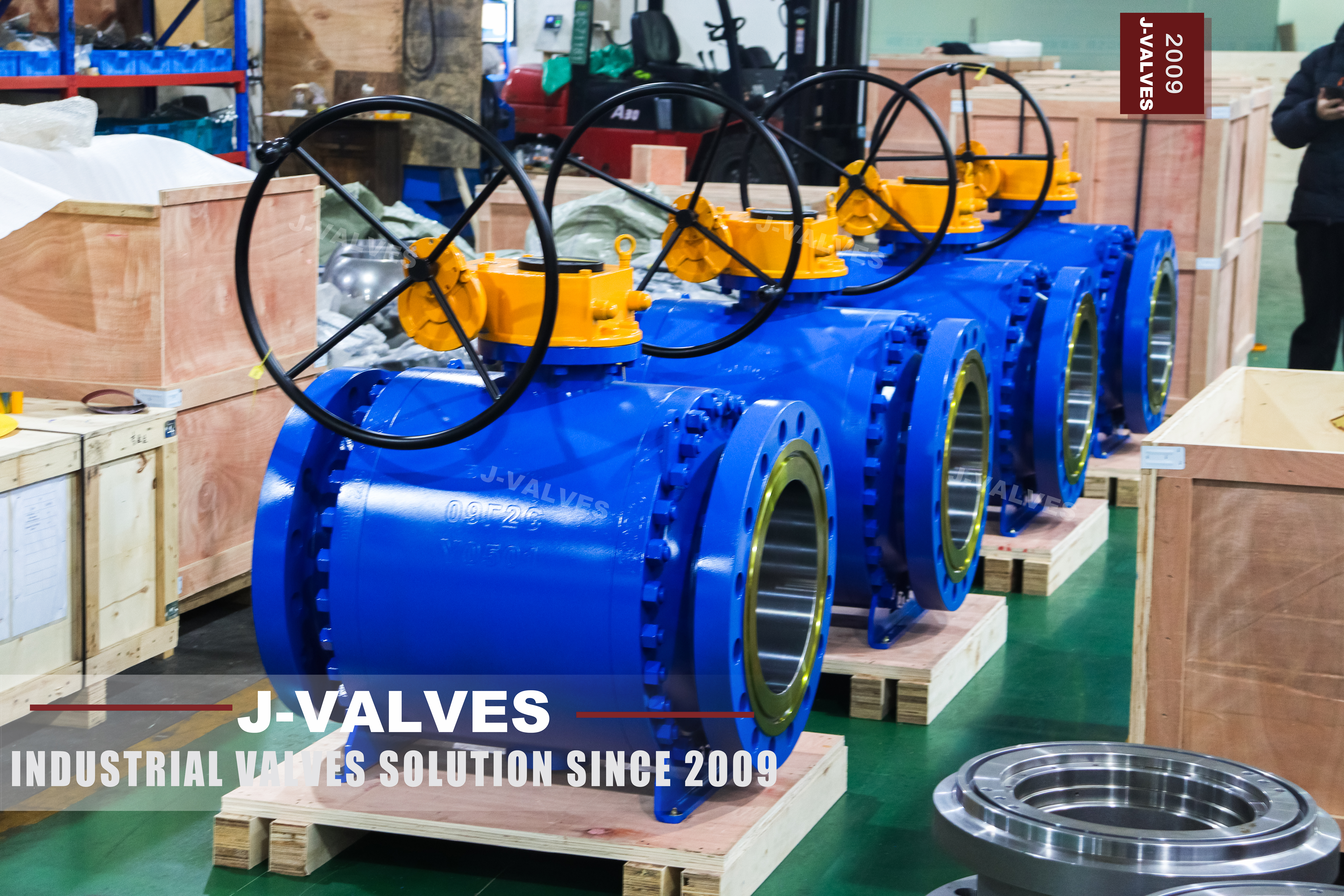
This is a sixteen inch, PN63, three piece trunnion mounted ball valve with a forged low alloy body. DN400 is the nominal size, PN63 is the pressure rating, and the body grade is one of four chrome molybdenum steels: A182 F11, F22, F91 or F92. The seat is metal as standard rather than a soft insert, the packing is graphite, and the ends are flanged to EN 1092-1 in raised face or ring joint form. It is built for hot hydrocarbon service, not for water at ambient temperature.
PN63 needs a sentence of its own because it is the number that causes the most confusion on an enquiry. It exists in EN 1092-1, where it is 6.3 MPa at the reference temperature, and it does not exist in the API 6D pressure code list, which runs PN20, 50, 64, 100, 150, 250 and 420. There is no PN63 row to look up on the ASME side, so a buyer who asks for the ASME equivalent of PN63 is asking for a conversion that no table supplies. This valve is ordered as PN63 because the plant it goes into is dimensioned in EN.
Design and Construction
The ball is carried on an upper and a lower trunnion, so the line pressure loads the bearings instead of the downstream seat. At DN400 and PN63 that is not a refinement, it is the only way the valve stays operable: a floating ball of this diameter would press onto the seat with a force that no reasonable gear could break away from. The seats are metal rings with a cobalt alloy face, spring loaded so they still touch the ball when the line is depressurised.
The three piece body is what makes the metal seat practical. A metal seat is lapped to the ball, and after a few thermal cycles it has to be re-lapped or replaced; with the centre section out between two joints, that work happens on a bench instead of on a scaffold. The body joint itself is the weak point of the design at this class, which is why the joint faces are machined in one setting and the gasket is a spiral wound graphite filled type rather than a flat sheet.

Material Options
The four grades are not interchangeable, they are a ladder. F11 is one and a quarter chrome half moly and is the entry point for moderate hot service. F22 is two and a quarter chrome one moly, the workhorse for refinery and petrochemical lines where hydrogen partial pressure is present. F91 is nine chrome one moly vanadium and F92 is nine chrome two tungsten, both chosen where the metal temperature is high enough that F22 would creep. The higher the chrome, the better the creep resistance and the more the welding and heat treatment have to be controlled.
The trim follows the same logic. The ball is F11, F22 or F91 with a cobalt alloy coating as standard, or tungsten carbide where the product is abrasive. The stem is F22, F91, 17-4PH or a nickel-chromium alloy where strength at temperature is the driver. The seat is F22 with cobalt alloy hardfacing as the standard metal seal, with an RPTFE insert available only for the low temperature build, which is a different valve in everything but the drawing number.
| Component | Standard Material | Optional Upgrade | Service Notes |
|---|---|---|---|
| Body and end caps | A182 F22 forged low alloy | A182 F11, F91, F92 | grade follows the metal temperature and the hydrogen partial pressure |
| Ball | F22 with cobalt alloy coating | F11, F91, tungsten carbide coating | tungsten carbide where the product is abrasive |
| Stem | F22 or F91 | 17-4PH, nickel-chromium alloy | strength at temperature decides the choice |
| Seat ring | F22 with cobalt alloy hardfacing | RPTFE insert for the low temperature build only | metal seat is standard at this class |
| Seat spring | Nickel alloy | Stainless for the low temperature build | holds the seat against the ball when depressurised |
| Body joint gasket | Spiral wound, graphite filled | Ring joint to ASME B16.20 on type E facing | replaced every time the body is opened |
| Stem packing | Flexible graphite | Graphite rings, wire reinforced graphite | the fire safe result rests on the graphite |
| Body bolting | High temperature stud and nut | Grade matched to the body for the design temperature | loses preload as the studs expand |
| Operator | Worm gear with handwheel | Pneumatic, electric, hydraulic | sized on measured torque at service temperature |
Technical Specifications
The declared envelope is DN400, PN63, three piece forged body, flanged to EN 1092-1 with a type B raised face or a type E ring joint facing, and a face to face length to EN 558 and ISO 5752. The size and the class are fixed by the line, and the figure that ships is the one confirmed on the signed general arrangement drawing rather than the nominal figure in a catalogue. Wall thickness follows ASME B16.34 for the class, and the flange dimensions follow EN 1092-1 rather than ASME B16.5.
That last point is the one that catches people out. A DN400 PN63 flange and a sixteen inch Class 300 flange are not the same flange: the outside diameter, the bolt circle and the bolt size differ, so a valve ordered to one will not bolt to pipe flanged to the other. On a replacement order, measure the existing bolt circle and the bolt hole diameter on site before quoting, because at DN400 neither a gasket nor a spool can absorb the difference and the valve will be returned.
| Item | Value |
|---|---|
| Nominal size | DN400 (16 inch) |
| Pressure rating | PN63 (6.3 MPa reference) |
| Pressure code family | EN 1092-1; no PN63 row exists in API 6D |
| Body construction | three piece, forged, bolted centre section |
| Body material | ASTM A182 F22 forged low alloy steel |
| Body options | A182 F11, A182 F91, A182 F92 |
| Ball | F22 with cobalt alloy coating |
| Ball options | F11, F91, tungsten carbide coating |
| Stem | F22 or F91 |
| Stem options | 17-4PH, nickel-chromium alloy |
| Seat | F22 with cobalt alloy hardfacing, metal to metal |
| Seat option | RPTFE insert for the low temperature build |
| Seat loading | spring loaded, self relieving |
| Packing | flexible graphite |
| Packing options | graphite rings, wire reinforced graphite |
| End connection | flanged to EN 1092-1 PN63, type B raised face |
| Alternative facing | type E ring joint to EN 1092-1 |
| Face to face | EN 558 / ISO 5752 |
| Wall thickness | ASME B16.34 |
| Ball support | upper and lower trunnion in bearings |
| Operator | worm gear with handwheel as standard |
| Operator options | pneumatic, electric, hydraulic |
| Body joint | bolted, spiral wound graphite filled gasket |
| Drain and vent | plugged port in the body cavity |
| Anti static | spring loaded path from body to stem to ball |
| Stem retention | blowout proof, retained by the body |
| Fire safe | API 607 / ISO 10497 where required |
| Sour service | NACE MR0175 / ISO 15156 on request |
| Marking | size, PN63, body grade and heat number on the nameplate |
| Documentation | EN 10204 3.1, hardness report, test report, GA drawing |
Standards and Compliance
The design follows API 6D for the pipeline requirements and API 608 for the ball valve specifics, with ASME B16.34 supplying the wall and the rating. The flange is the part where the two worlds part company: EN 1092-1 governs this valve, and its PN63 row is the one that applies, while ASME B16.5 has no PN63 flange at all. That is a documentation point as much as a dimensional one, because the inspector checks the flange against the standard named on the drawing.
On hot service two more standards decide whether the valve is acceptable. NACE MR0175 / ISO 15156 applies where the product contains wet H2S, and it constrains the hardness of the trim and the bolting rather than the body grade. API 607 or ISO 10497 applies where a fire safe certificate is required, and on a metal seated valve the fire test is passed on the seat and the graphite packing rather than on a soft insert that would be gone.
| Requirement | Standard | What J-VALVES Supplies |
|---|---|---|
| Pipeline valve requirements | API 6D | design document, GA drawing, pressure test record |
| Ball valve specifics | API 608 | anti static path, blowout proof stem, nameplate content |
| Wall thickness and rating | ASME B16.34 | wall calculation sheet for DN400 PN63 |
| Flange dimensions and facing | EN 1092-1 PN63 | type B raised face or type E ring joint as ordered |
| Face to face length | EN 558 / ISO 5752 | length confirmed on the drawing |
| Ring joint gasket where used | ASME B16.20 | gasket supplied with the valve where type E is ordered |
| Pressure testing | API 598 | shell at 1.5 times, seat at 1.1 times, both directions |
| Wet H2S service | NACE MR0175 / ISO 15156 | hardness control on the trim and the bolting |
| Fire safe where required | API 607 / ISO 10497 | certificate naming the metal seat and the graphite packing |
| Material traceability | EN 10204 3.1 | certificate per heat number with hardness readings |
Manufacturing Process
The body is forged in three sections, then machined so that the two joint faces stay parallel and square to the bore; on a PN63 body the joint is a pressure boundary and a mismatch there is a leak that no gasket compression will close. The seat pockets are machined and then hardfaced, and the hardfacing is ground and lapped against the ball, not against a gauge. Each ball and seat pair is matched, which is why a replacement seat is supplied with the ball it was lapped to.
Heat treatment is the part of the process that is specific to the grade. F22 needs a normalise and temper, F91 and F92 need controlled heating and cooling with a hardness check afterwards, and the welded areas get their own treatment. The result is recorded per heat number, and the hardness readings are part of the package that goes with the valve where NACE applies.

Quality Control and Testing
Every valve is shell tested at one and a half times the rating and seat tested at one point one times in both directions to API 598. On a metal seated valve the seat test is the one that decides acceptance, and it is done at the class pressure rather than at a low pressure that a metal seat would pass even when it is damaged. The test medium, the pressure and the hold time are recorded per valve rather than per batch.
The dimensional checks carry as much weight as the pressure test on this valve. The flange is gauged against EN 1092-1 for the PN63 row, the face to face length against EN 558, and the joint faces against each other for parallelism. Where the valve is ordered for a replacement, the measured face to face length is written on the drawing and the drawing goes out with the valve so the site can compare before lifting it into the spool.
| Step | What Is Checked | Standard or Acceptance |
|---|---|---|
| Incoming material | heat number against the mill certificate and the grade | EN 10204 3.1, no grade substitution |
| Forging | ultrasonic check on the pressure boundary sections | no indication above the acceptance level on the drawing |
| Body machining | parallelism of the two joint faces, wall at the seat pocket | drawing tolerance, checked on a surface plate |
| Hardfacing | bond and finished thickness on the metal seat | dye penetrant, no linear indication |
| Lapping | seat to ball contact band | continuous band, checked with marking compound |
| Shell test | body and both joints at 1.5 times PN63 | API 598, no leak, no permanent distortion |
| Seat test | each metal seat in both directions at 1.1 times | API 598, no visible leak at the class pressure |
| Flange gauge | outside diameter, bolt circle, bolt hole diameter and facing | EN 1092-1 PN63 row, gauged not measured by hand |
| Face to face | end to end length of the assembled valve | EN 558, recorded on the drawing |
| Heat treatment record | hardness after normalising and tempering | per grade requirement, reported with the certificate |

Applications and Industry Service
The service this valve is built for is hot hydrocarbon: refinery process lines, coker and hydrotreater isolation, petrochemical transfer headers, and steam or hot oil circuits at the pressure the PN63 rating covers. In those positions the metal seat is what makes the valve usable, because a soft seat at the temperature these lines run at would extrude or degrade within a few cycles, and the graphite packing is there for the same reason.
The three piece body also suits plants that plan to service rather than replace. Where a valve sits in a manifold that is opened every turnaround, the ability to lift the centre section out and re-lap the seats in a workshop is worth more than the cost difference against a welded body. Where the valve is buried or welded into a long line with no access, a fully welded body is the better answer and this page is the wrong product.

Installation, Operation and Maintenance
Install with the stem vertical or horizontal, support the pipe either side because a DN400 PN63 assembly is heavy, and leave room above the body to lift the centre section out. Hot lines need the valve insulated with the stem left exposed or an extended stem fitted, and the flange bolting has to be the high temperature grade with the correct torque sequence, because a PN63 joint on a hot line loses preload as the studs expand.
A worm gear is the standard operator at this size and a lever is not offered for the reason that a DN400 trunnion valve has a breakaway torque no lever can deliver. If the valve is motorised or actuated, the actuator is sized on the measured torque of the assembled valve at the service temperature, not on a catalogue figure, and on hot service the gear is specified with a high temperature grease rather than the standard fill.
How to Specify and Order
An order for this valve has to state size, class, body grade, ball and seat trim, flange standard and facing, face to face standard, and operator. For a DN400 PN63 line the order reads: DN400, PN63, three piece forged body in A182 F22, ball F22 with cobalt alloy coating, metal seat F22 hardfaced, EN 1092-1 type B raised face, face to face to EN 558, worm gear. The grade is a decision, not a default, so the design temperature and the presence of hydrogen or wet H2S belong on the enquiry.
Where the valve replaces an existing one, send the installed face to face length, the flange outside diameter, the bolt circle and the bolt hole diameter measured on site. Where the line is being designed rather than modified, send the design pressure, the design temperature, the fluid and whether NACE applies. Those four decide the grade and the seat, and getting them on the enquiry is what turns a three week quotation round into a two day one.
FAQ
Q: What is the ASME class equivalent of PN63?
A: There is no row for it. API 6D lists seven pressure codes, PN20, 50, 64, 100, 150, 250 and 420, and PN63 is not one of them; the ASME side simply does not have a PN63 rating. PN63 exists in EN 1092-1, where it is 6.3 MPa at the reference temperature, so a PN63 valve is ordered against the EN system. Anyone quoting an ASME class as a direct equivalent is converting, not referencing a table.
Q: Why is the seat metal rather than PTFE?
A: Because of the temperature. The four body grades on this page are chosen for hot service, and at those temperatures a soft seat extrudes, degrades or takes a permanent set, so the standard build is a metal seat with a cobalt alloy face. A soft seat is available only on the low temperature build, which is a different specification even though the outside of the valve looks the same.
Q: Which grade should I choose, F11, F22, F91 or F92?
A: The grade follows the metal temperature and, where it applies, the hydrogen partial pressure. F11 is the entry point for moderate hot service, F22 is the refinery workhorse, and F91 and F92 are chosen when the temperature is high enough that F22 would creep. The higher chrome grades also carry more demanding welding and heat treatment, so they cost more to make and to document.
Q: Will this bolt to my existing Class 300 flange?
A: Not without checking. A DN400 PN63 flange to EN 1092-1 and a sixteen inch Class 300 flange to ASME B16.5 differ in outside diameter, bolt circle and bolt size. Measure the existing bolt circle, the bolt hole diameter and the facing on site before ordering a replacement, because at this size no gasket or spool will absorb the difference.
Q: Is the body really three piece, and why does that matter here?
A: Yes, the centre section is bolted between two end caps. It matters because a metal seat is lapped to its ball and has to be re-lapped or replaced after thermal cycling; with the centre section out, that is workshop work rather than site work. It also means the seat and ball pair can be replaced without cutting the valve out of the line.
Q: What documentation comes with the valve?
A: A material certificate to EN 10204 3.1 per heat number, the hardness readings after heat treatment, the API 598 shell and seat test record, and the general arrangement drawing with the measured face to face length. Where NACE or a fire safe certificate applies, those reports are added to the same package rather than issued separately.


Hot Products


News
Ball Valves in A Kraft Pulp Mill: Black Liquor, Green Liquor And The Cost of Choosing The Alloy by Habit
White liquor at pH 14 cracks carbon steel welds, black liquor sets solid below 100 C, green liquor dregs grind seats: alloy choice and torque in a kraft mill.
Read More
Slug Flow And Ball Valves: What Actually Arrives At The Seat
A slug is liquid mass with momentum, not a pressure spike. What changes at the seat, in the cavity and at the actuator when liquid reaches a ball valve.
Read More
Ball Valves in Direct Lithium Extraction: PH 1 Eluate, Gypsum Scale And 438,000 Cycles in Twenty-Five Years
Direct lithium extraction swings valves from pH 1 eluate to pH 12 caustic, 48 column switches a day and gypsum scale. Materials, seats and torque.
Read More
Ball Valves in Geothermal Brine: Silica Scale, Chloride Cracking And The Cooling Trap
Why geothermal brine destroys ball valves: retrograde silica scale, calcite at the flash point, chloride cracking above 60 C and the 250 C seat limit.
Read More