


CHINA J-VALVES Offers Various High-quality I ndustrial Ball Valves
J-VALVES, a distinguished professional ball valve manufacturer rooted in China, takes pride in its extensive product portfolio. Our offerings span a wide range, including trunnion-mounted ball valves, floating ball valves, high-temperature ball valves, high-pressure ball valves, metal-sealed ball valves, ultra-low temperature ball valves, DBB ball valves, Three-way And Four-way Ball Valve, and fully welded ball valves. Each product is a testament to our commitment to precision engineering and reliable performance. Meticulously crafted, they are designed to not only meet but exceed the most stringent industrial demands, ensuring stable operation even under extreme conditions. This enables us to provide our clients with high-value services and makes our valves widely sought-after in industries.
Product Category
Contact Us


-
J-VALVES-Q347F
-
J-VALVES
Overview of the J-VALVES API 6D Three-Piece Trunnion Ball Valve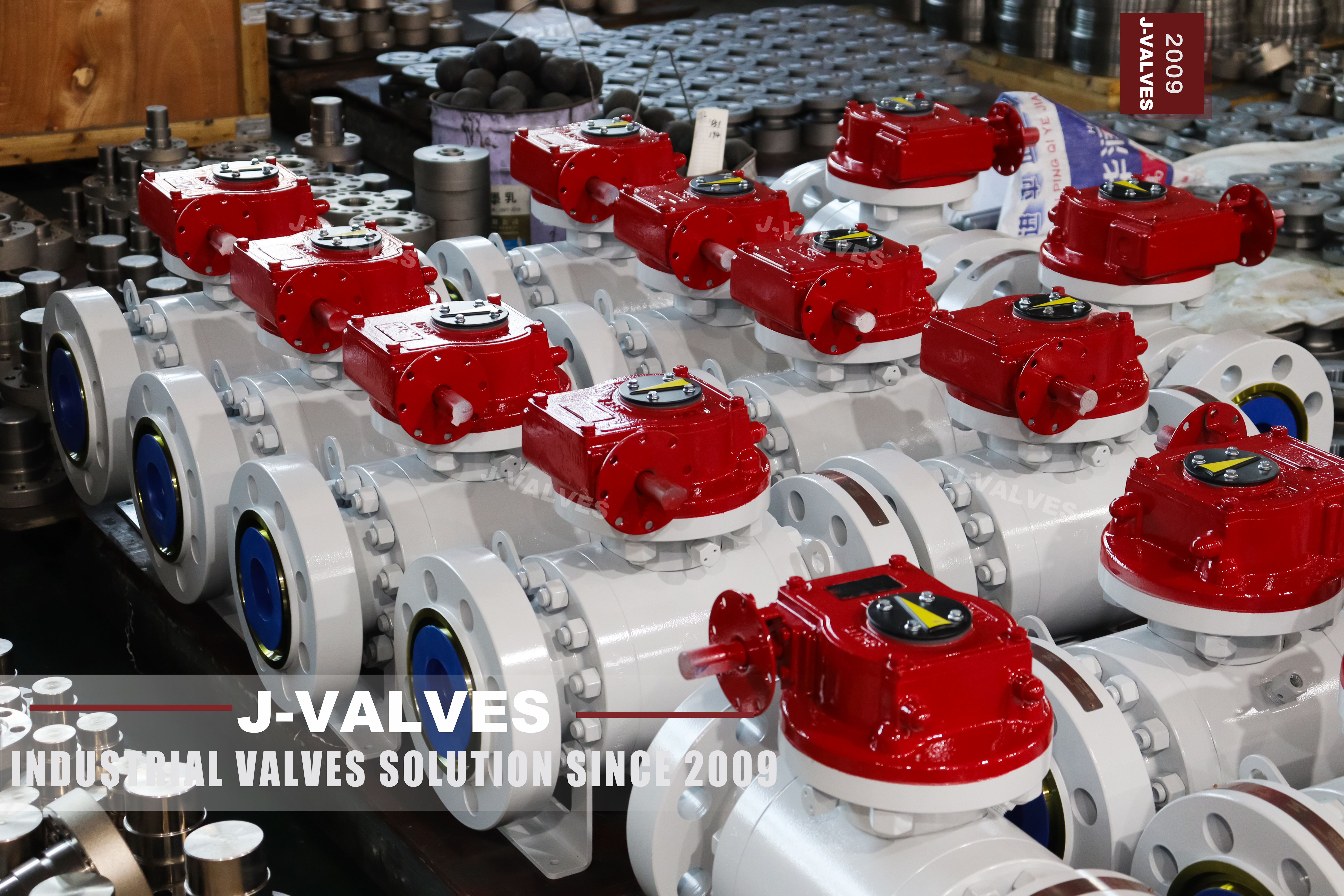
The J-VALVES API 6D three-piece trunnion ball valve is a forged steel side-entry isolation valve, built as a centre section closed by two bolted end caps. It is supplied from 1/2 to 56 inch, DN15 to DN1400, in Class 150 to 2500, with a carbon steel body rated to 425 C. The centre section carries the ball, both seats and the stem; each cap carries one flange face and one seat pocket.
The body style exists for one reason: a valve that has to come apart on site while the pipe stays where it is. The caps stay bolted to the line flanges and the assembled centre section lifts out between them, so nothing is cut, no flange is spread and no line gasket is broken. That is accessibility without disturbing the piping, not repair under pressure.
Duty is line isolation on gas gathering, meter runs, compressor headers, water injection and terminal piping, where the seats are looked at more than once in the valve's life. A range is a catalogue envelope and not a specification: an order fixes one size, one class, one bore and one seat arrangement, and the drawing is the only document that describes the valve that will arrive.
Design and Construction
The centre section is one forging machined on a single centre line, with seat pockets, trunnion bores and gasket grooves cut in the same set-up so the ball axis and flange axis stay coaxial. Each cap carries one flange face and one seat pocket and is drawn onto the centre section by a full bolt circle. Between them sits a spiral wound stainless gasket with graphite filler, or an octagonal or oval metal ring for RTJ.
Both of those joints are pressure boundary, and that sentence governs every maintenance claim made about this body style. To open either one, the line has to be isolated, the cavity vented through the drain plug and zero pressure confirmed; the gasket is then renewed rather than reused, and the bolts re-torqued diagonally in stages.
The name does not change with size, but the internals do. Up to 4 inch the ball is held by trunnions machined into the body itself. From 6 inch the trunnions sit in two separate bearing blocks made as a matched pair, because side load on the ball grows with the closed area and at that size it can deflect a bearing seat cut straight into the body wall. A deflected bearing shows up as rising torque and eventually as stem seal leakage. The blocks are replaced as a pair, and a drawing that shows trunnions in the body for a 6 inch valve is a drawing for a different valve.
Trunnion mounting changes where the load goes. In a floating valve the ball is pushed downstream and seats on the downstream seat, so the seat carries the full thrust. Here the ball is held by its journals and does not travel, the seats are pushed onto it by springs plus line pressure, and the stem carries torque only. Torque therefore stays low and predictable as size and class rise, and seat load is set by spring rate rather than accepted as a consequence of pressure. The load is bore area times differential pressure, a figure the maker can state for a given size and class, and it is that figure rather than the nominal size that decides where floating stops being sensible.
Three seat arrangements are built on this body, and they differ in what happens to the cavity. Single piston effect seats seal one way and are self-relieving: trapped pressure pushes the upstream seat off the ball and vents back into the line. Double piston effect seats seal both ways, so cavity pressure pushes both seats harder onto the ball and relief must be external. One of each gives double isolation with relief in one direction, and leaving this line blank is the most common cause of a cavity overpressure.
Against the other side-entry styles, this one trades gasket count for pipe work. A two-piece body has one insert, and the main body must travel along the pipe axis before the insert clears, so the line is opened. A top-entry body reaches the ball through a single bonnet and needs no pipe work. The three-piece body also needs none, but it is the hardest on gasket count: two joints, two gasket sets and two bolt circles every time.

Material Options
A105 and A216 WCB sit in the same ASME B16.34 group, group 1.1, and their ratings are identical point for point; A350 LF2 is in that group as well. A forging therefore does not buy a higher class, and a quotation implying that it does is trading on a misunderstanding. What it buys is metallurgical: refined grain flow, no shrinkage porosity, a sounder seat pocket and gasket groove, better fatigue performance and fewer radiography rejects, which shows at the fifth reassembly rather than the first.
Grade does change the rating once it leaves carbon steel. Stainless and duplex fall into their own groups with their own curves, usually lower at temperature, so a move from A105 to F316 is a rating decision as well as a corrosion decision. Below minus 29 C the answer is A350 LF2.
| Component | Standard Material | Optional Upgrade | Service Notes |
|---|---|---|---|
| Body and caps | Forged A105 | A350 LF2, A182 F304 or F316, F51 or F53 duplex, Inconel | LF2 below minus 29 C; duplex for chloride duty |
| Ball | A105 with ENP | Hard chrome, HVOF tungsten carbide, Stellite overlay | ENP general service, carbide for abrasive or high cycle duty |
| Stem | 17-4PH | A105 with ENP, F316 | F316 where the medium attacks copper bearing alloys |
| Seat | PTFE or RPTFE | PPL, PEEK, metal with flexible graphite | Soft seat for bubble tight shutoff, metal where temperature rules it out |
| Gasket | Spiral wound, graphite filler | RTJ metal ring, octagonal or oval | One set per pressure joint, renewed at every opening |
| Bolting | A193 B7 with A194 2H | B7M, B8 or B8M | B7M for sour service, stainless for stainless bodies |
Technical Specifications
| Item | Value |
|---|---|
| Size range | 1/2 to 56 inch (DN15 to DN1400) |
| Pressure class | Class 150 to 2500 |
| Temperature | Minus 29 to 425 C body; seat material sets the real limit |
| Body material | Forged A105 standard; A350 LF2, F304, F316, F51 or F53 on request |
| Bore | Full or reduced, per API 6D Table 1 |
| End connection | RF or RTJ to ASME B16.5; B16.47 above NPS 24; butt weld to B16.25 |
| Design and test | API 6D, API 608, ASME B16.34; tested to API 598 |
| Fire safe | API 607, API 6FA, ISO 10497 |
| Operation | Lever, worm gear, pneumatic, electric or gas over oil |
Flanged ends are the default, raised face or ring joint to ASME B16.5 up to NPS 24 and B16.47 above, with butt weld to B16.25 and hub ends to customer drawings. The metric abbreviations travel badly: a PN number that API 6D lists as a class equivalent is not automatically a flange size in EN 1092-1, so the flange standard governs the bolt circle.
Bore is full or reduced per API 6D Table 1, which sets a minimum for each size and class rather than a match to pipe, so a full bore valve can sit slightly under the inside diameter of Schedule 40 pipe and still be compliant.
Face-to-face follows API 6D and ASME B16.10 and varies with size, class and pattern, so a catalogue dimension without the pattern named is not a dimension. Ask for the general arrangement drawing.
Standards and Compliance
Group 1.1 is tabulated from minus 29 C to 425 C, and the standard warns that above roughly 425 C the carbide phase in carbon steel can graphitise. That ceiling belongs to the body, not to the valve. The seats arrive first: PTFE is good to about 180 C, PPL to 280 C, PEEK to 260 C, and a metal seat is offered to 650 C as a seat capability. The real limit is the intersection, so a soft seated A105 valve is a 180 C valve.
The 650 C figure is true of the seat and false of an A105 body. That duty needs an F304 or F316 body, or a chrome-moly grade such as WC6 or WC9, and the seat claim and the body claim have to be made in one sentence. A class is also a curve, not a number: Class 900 in group 1.1 allows 153.2 bar at 38 C and 86.3 bar at 425 C, and buying a class without reading the temperature row is how a line ends up over-rated on paper.
| Requirement | Standard | What J-VALVES Supplies |
|---|---|---|
| Design and rating | ASME B16.34, API 6D, API 608 | Body, wall thickness and bolting rated per group 1.1 |
| Fire safe | API 607, ISO 10497, API 6FA | Certificate per size and seat type, graphite secondary seal |
| Pressure testing | API 598 | Shell at 1.5 times the rating, seat at 1.1 times, both recorded |
| Face to face | ASME B16.10 | Long or short pattern per the size and class ordered |
| Flange dimensions | ASME B16.5, B16.47 | RF or RTJ drilled to the standard named on the order |
| Marking | MSS SP-25, API 6D | Nameplate with class, size, heat number and seat code |
| Material certificates | EN 10204 3.1 | Mill certificates traceable to heat number |
| Fugitive emissions | ISO 15848-1 | Graphite packing qualified where the project requires it |
Manufacturing Process
Bodies and caps start as cut billet, are heated and forged close to the finished profile, then normalised before any metal is cut. Forging keeps the grain flow following the contour of the body and closes the porosity that would otherwise sit behind the seat pocket. Each heat is recorded against the mill certificate and the blanks are batch marked, so a finished valve traces back to the ingot it came from.
Machining is where a three-piece body earns or loses its reputation. The centre section and its two caps are machined as a set: gasket grooves, seat pockets and bolt holes are cut with the parts bolted together in final orientation, then match marked before separation. Machining them independently is what produces a body that has to be forced onto its gasket, and a forced gasket is a leak path. The ball is machined oversize, ground, lapped against a master seat and plated, then measured across several diameters, because a ball that is out of round leaks at low pressure even when it passes a high pressure test.

Quality Control and Testing
Every valve passes the eight checks below before packing. Records travel with the valve as a test book, and any step can be witnessed by a third party inspector.
| Step | What Is Checked | Standard or Acceptance |
|---|---|---|
| 1 Chemical and PMI | Body, ball and stem alloy content against certificate | ASTM A105 or A182, PMI on alloy trim |
| 2 Forging inspection | Surface and sub-surface defects, wall thickness | Visual plus PT on flange and joint areas |
| 3 Dimensional | Flange drilling, bore, stem height, joint alignment | ASME B16.5 and B16.10, tolerance per drawing |
| 4 Shell test | Body and both cap joints under water | 1.5 times the rating, held for the API 598 duration, no leakage or sweating |
| 5 Seat test both directions | Bubble count at each seat with the ball closed | 1.1 times the rating, zero bubbles soft seat, API 598 rate metal seat |
| 6 Torque and operation | Breakaway and running torque, 90 degree travel | Within recorded limit, full travel by lever or gear |
| 7 Anti-static | Resistance between ball, stem and body | Within the limit API 6D sets for the assembly |
| 8 Paint and marking | Dry film thickness, nameplate data, tag number | Coating to project specification, MSS SP-25 marking |
Anti-static continuity is measured rather than assumed, and low emission stem sealing to ISO 15848 and NACE MR0175 for sour service are available on request. What should arrive with the valve is the material certificates to EN 10204 3.1, the pressure test record with gauge readings and hold times, a dimensional report against the general arrangement drawing, and fire test certification. If a supplier cannot produce the dimensional report for the size actually shipped, the range was wider on the website than on the shop floor.

Applications and Industry Service
The body is chosen where the pipe cannot be opened and the valve will be serviced in place: gas gathering and wellpad manifolds, custody transfer and meter runs, compressor headers, water injection distribution, terminal and tank farm piping, and the isolation points either side of a filter or regulator.
Size and class follow the line. Large bore and high class is where this style is most often specified, because that is where a two-piece body becomes difficult to move and where breaking a line flange costs most. Smaller sizes in moderate classes are better served by a two-piece or a floating design, and above a certain size the operator stops being a lever, and actuation is sized from the breakaway torque the maker calculates for that size, class and seat arrangement.
Installation, Operation and Maintenance
The valve can be installed in any orientation the piping allows, but the stem should not point downwards, because packing and stem seal are easier to inspect from the side or from above. Large sizes need support under the body rather than hanging on the flange bolts, and pipe flanges are brought to the valve rather than pulled into line with the bolts.
In service it is an isolation device, not a control device, and it is designed to sit fully open or fully closed; throttling on a partly open ball puts seat and ball in the erosion path of the medium. A valve that stays in one position for long periods should be exercised on a schedule, and gear operators checked for end stop position after any actuator work.
Maintenance is where the earlier warning pays off. Isolate, vent the cavity through the drain plug, confirm zero pressure, and only then loosen a cap joint. The gasket is replaced rather than reused, the seat pocket and ball are inspected for scoring, and the bolts go back in diagonal passes. Packing can be adjusted and the stem O-ring renewed once the valve is depressurised. A valve opened every month belongs in a top-entry design.
How to Specify and Order
The enquiry that gets a correct quotation names six things: size and class, bore, seat configuration including whether relief is external, body grade, end connection with the flange standard, and face-to-face pattern if the valve goes into an existing gap. Three more prevent a second round: the medium and whether NACE applies, the test witnesses and certificate package, and whether an existing gap has to be matched.
What comes back should be a quotation with a general arrangement drawing attached, not a catalogue page. The drawing carries the dimensions that matter for installation. Operator type follows from the breakaway torque, which the maker calculates from seat and bearing data rather than guessing, and the figure should come back with the drawing.
FAQ
Q: What is the difference between a three-piece and a two-piece trunnion ball valve?
A: The number of body joints and where the bearing sits. A three-piece valve has a centre section with two bolted end caps: both caps stay on the pipe flanges and the centre section, carrying the ball, seats and stem, lifts out between them, so no spool is cut and no pipe is spread. A two-piece valve has one removable insert, and the body has to travel along the pipe axis before the insert clears. The trade is two pressure joints and two gasket sets instead of one.
Q: Can a three-piece trunnion ball valve be serviced with the line under pressure?
A: No. The body joints are pressure boundary, not a cover, so the line must be isolated, the cavity vented through the drain plug and zero pressure confirmed before either joint is broken. What the design gives is accessibility without disturbing the piping, which is a different thing from online repair. Stem packing can be adjusted and the upper stem O-ring renewed with the valve in service and the cavity vented, and that is the only work possible without isolation.
Q: What is the maximum temperature of a forged A105 trunnion ball valve?
A: 425 C for the body, but the seat sets the real limit. A105 sits in ASME B16.34 material group 1.1, tabulated from minus 29 C to 425 C, and the standard warns that above roughly 425 C the carbide phase can graphitise. The rating falls across that span: Class 900 allows 153.2 bar at 38 C and 86.3 bar at 425 C. PTFE seats stop near 180 C, PPL near 280 C and PEEK near 260 C, so a soft seated valve is a 180 C valve even though the body is rated higher. For 650 C the body has to change to an F304 or F316 forging, or to a chrome-moly grade such as WC6.
Q: What is the difference between SPE, DPE and combined seats?
A: SPE, single piston effect, seals in one direction and is self-relieving: cavity pressure from thermal expansion pushes the upstream seat off the ball and vents back to line, so no external relief is needed. DPE, double piston effect, seals in both directions and cannot self-relieve, so the cavity needs an external relief device; this is the DIB-1 configuration. Combined seating puts one of each in the same valve, giving bidirectional sealing with self-relief in one preferred direction, which is DIB-2.


Hot Products


News
Ball Valves in A Kraft Pulp Mill: Black Liquor, Green Liquor And The Cost of Choosing The Alloy by Habit
White liquor at pH 14 cracks carbon steel welds, black liquor sets solid below 100 C, green liquor dregs grind seats: alloy choice and torque in a kraft mill.
Read More
Slug Flow And Ball Valves: What Actually Arrives At The Seat
A slug is liquid mass with momentum, not a pressure spike. What changes at the seat, in the cavity and at the actuator when liquid reaches a ball valve.
Read More
Ball Valves in Direct Lithium Extraction: PH 1 Eluate, Gypsum Scale And 438,000 Cycles in Twenty-Five Years
Direct lithium extraction swings valves from pH 1 eluate to pH 12 caustic, 48 column switches a day and gypsum scale. Materials, seats and torque.
Read More
Ball Valves in Geothermal Brine: Silica Scale, Chloride Cracking And The Cooling Trap
Why geothermal brine destroys ball valves: retrograde silica scale, calcite at the flash point, chloride cracking above 60 C and the 250 C seat limit.
Read More