
CHINA J-VALVES Offers Various High-quality I ndustrial Ball Valves
J-VALVES, a distinguished professional ball valve manufacturer rooted in China, takes pride in its extensive product portfolio. Our offerings span a wide range, including trunnion-mounted ball valves, floating ball valves, high-temperature ball valves, high-pressure ball valves, metal-sealed ball valves, ultra-low temperature ball valves, DBB ball valves, Three-way And Four-way Ball Valve, and fully welded ball valves. Each product is a testament to our commitment to precision engineering and reliable performance. Meticulously crafted, they are designed to not only meet but exceed the most stringent industrial demands, ensuring stable operation even under extreme conditions. This enables us to provide our clients with high-value services and makes our valves widely sought-after in industries.
Product Category
Contact Us

Pressure Class: ASME Class 150 to 2500 (PN20 to PN420)
Temperature Range: -46°C to +200°C, material dependent
Body Material: A105, A350 LF2, F304, F316, A216 WCB
Ball: Hardened stainless or alloy steel, ENP or hard chrome
Seat:PTFE, RPTFE, PEEK or metal seated, spring loaded
Stem: F316 or 17-4PH, anti blowout, separate from ball
Body Style: One piece body, bolted top entry bonnet
End Connection: Flanged RF / RTJ to ASME B16.5 and B16.47, butt weld
Design Standard: API 6D, ASME B16.34, API 608
Test Standard: API 598, API 6D
Fire Safe: API 607 / ISO 10497
Emission: ISO 15848-1, graphite stem seal
Operation: Handwheel, gear, pneumatic, electric
-
SQ347H
-
J-VALVES
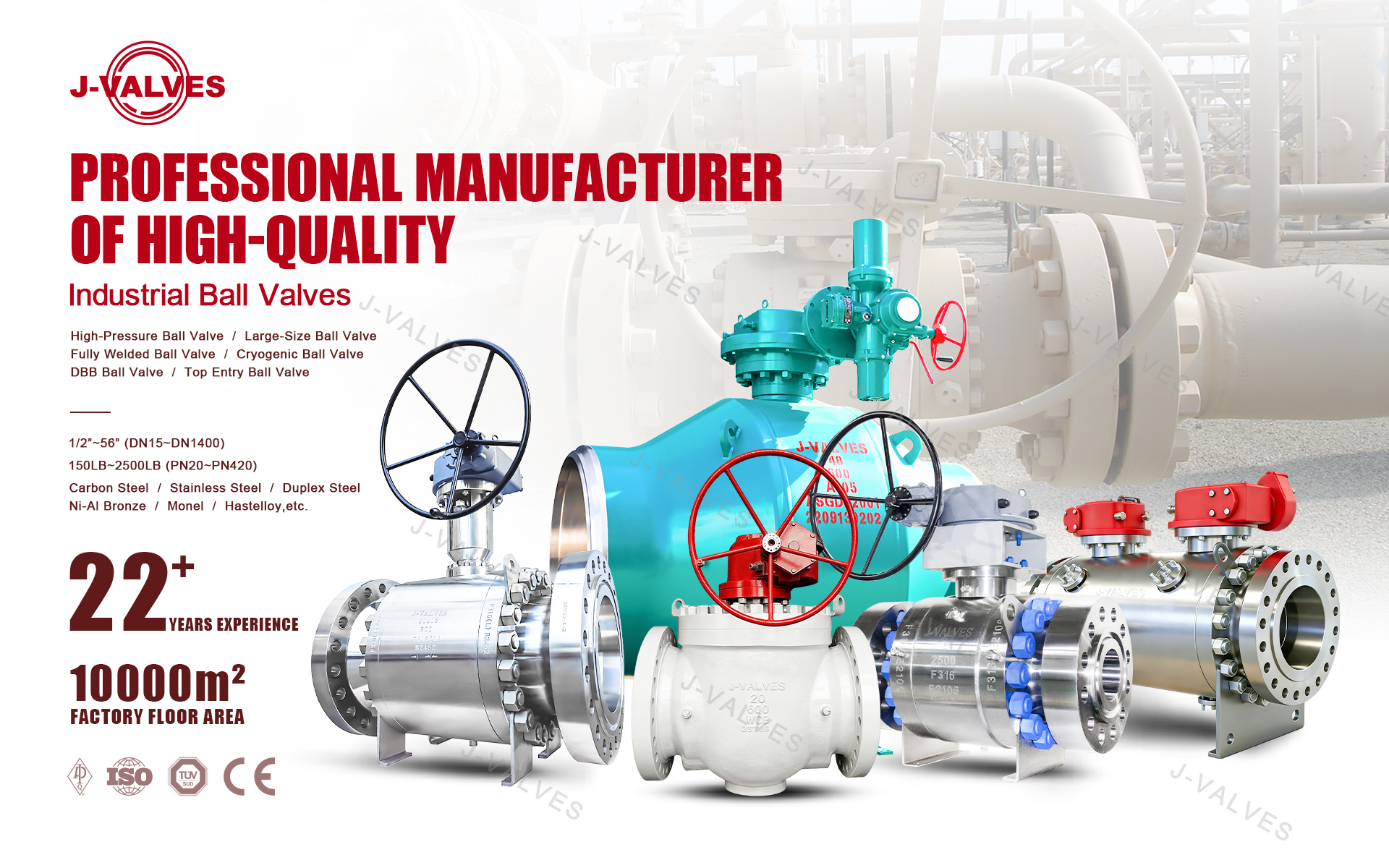
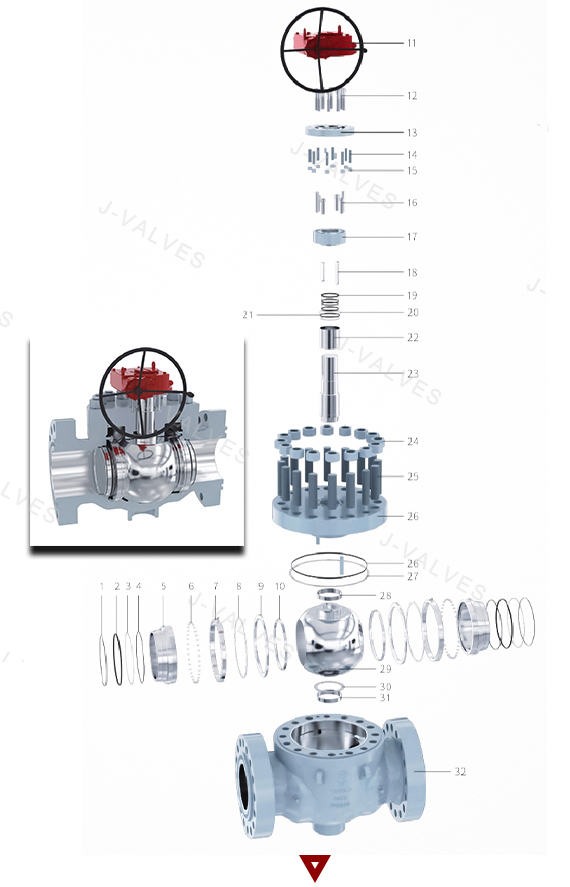
A top entry ball valve is a ball valve whose body has no side joint: the ball, both seats and the stem go in through a flanged bonnet on top of the body. On a 20 inch Class 900 line that means the internals can be replaced with the valve still welded or bolted in place, in one shift, without cutting pipe and without a crane large enough to lift the whole valve out of the rack.
J-VALVES supplies this design from 2 inch to 56 inch (DN50 to DN1400) in Class 150 to 2500, trunnion mounted above 6 inch, with forged A105, F304, F316 or LF2 bodies and flanged RF or RTJ ends. It is the standard choice for pipeline stations, tank farms, gas gathering manifolds and any location where the maintenance cost of removing a valve exceeds the price difference against a side entry body.

Top Entry Versus Side Entry: The Cost That Decides It
A side entry valve is cheaper to buy. A top entry valve is cheaper to own, and the crossover is earlier than most specifications assume. Removing a 24 inch Class 600 side entry valve from a manifold means isolating the section, draining it, unbolting two flanges, lifting 1.8 tonnes, breaking the body joint on a bench, and reversing all of it. The same repair on a top entry valve is a bonnet lift, with the line still full on one side.
Item | Side entry (2 or 3 piece) | Top entry |
|---|---|---|
Body joints exposed to line pressure | One or two, each with a gasket and bolting | One bonnet joint, above the seat plane |
Internal access | Remove valve from line, split body | Remove bonnet, no pipe work disturbed |
Typical downtime, 20 inch | 2 to 4 days including crane and scaffold | 6 to 10 hours, one shift |
Weight at 24 inch Class 600 | Lower by 8 to 15 percent | Higher, because the body is a single casting or forging |
Suitable for buried or welded line | No | Yes, with an extended stem or a pit |
Purchase price | Baseline | 5 to 18 percent higher |
How the Bonnet Joint Is Sealed
Everything about a top entry valve depends on one joint, and it is a joint that is opened in the field, often by a crew that has never seen the valve before. The seal is normally a metal to metal shoulder with a confined graphite gasket, backed by an O ring on the outer diameter. The shoulder takes the pressure load, the gasket takes the leak path, and the O ring is a second barrier against weather rather than against process.
At Class 900 and above the bonnet is usually a ring joint or a lens ring, and the bolting is B16 or B7 with a controlled preload. The preload is the part that fails in service: bolting that was tightened to a torque rather than to a calculated stress relaxes after two or three thermal cycles and the joint weeps. Every top entry valve we ship carries a bolting stress calculation and a torque table, because the crew that re-assembles it in five years will not have the original drawing.
Size Range and What Changes Across It
Size | Body construction | Ball support | Typical use |
|---|---|---|---|
2 to 4 inch | Forged, one piece body with bolted bonnet | Floating or trunnion | Metering runs, small manifolds, vent and drain |
6 to 12 inch | Cast or forged, top entry | Trunnion, bearings in body | Station isolation, pig traps, tank nozzles |
14 to 24 inch | Cast WCB or CF8M, top entry | Trunnion, bearing blocks | Pipeline stations, compressor yard, custody transfer |
26 to 56 inch | Cast or fabricated, top entry | Trunnion, large diameter bearings | Terminal manifolds, mainline block valves |
The 26 inch and above sizes are where top entry stops being a convenience and becomes a requirement. A 48 inch Class 600 side entry valve weighs in the range of 9 to 12 tonnes, needs a 30 tonne crane to remove, and has a body joint with a gasket circumference of more than 11 metres. No maintenance planner wants that joint opened in the field, and no operator wants to carry a spare valve of that size in stock.
Seat Options and the Double Block and Bleed Question
Both seats are independent, spring loaded and bidirectional, so the valve seals from either side and can be installed in either orientation. Single piston effect seats relieve trapped cavity pressure to the lower pressure side automatically; double piston effect seats hold pressure from both directions and need an external relief on the cavity. For a pipeline station where the valve may be used as a positive barrier, DPE with a vented cavity is the usual specification.
Double block and bleed is available in every seat configuration, and it is the reason many top entry valves are bought. With the ball closed, open the cavity drain, and the reading tells you whether the upstream seat, the downstream seat or both are passing. That diagnostic takes ten minutes and can be done from the operator station, and it is the single feature that turns a valve into an instrument for its own condition.
Stem, Bearings and Torque at Large Size
The stem is separate from the ball and carries no side load, which is what keeps torque predictable as the valve ages. It is retained by the bonnet, so it cannot be blown out, and the upper stem seal can be replaced with the valve in service and the cavity vented. Two O rings plus a graphite gasket give the triple barrier that ISO 15848 testing is applied to.
Torque rises faster than size. A 12 inch Class 600 trunnion valve runs at roughly 900 to 1400 Nm break to open with a soft seat; at 36 inch Class 600 the figure is several times that and a gear operator with a 3:1 or 5:1 reduction becomes mandatory. Seat load, bearing friction and packing friction each contribute, and only the first scales exactly with pressure, which is why a torque figure from a similar but not identical valve is worthless for actuator sizing.

Testing and Documentation
Shell test at 1.5 times the 38°C rating, seat test at 1.1 times, both to API 598, with the seat result reported as a rate. For a top entry valve there is one extra test that matters: a bonnet joint leak test after the bonnet has been removed and refitted, because that is the operation the valve will see in service. We do it on every valve above 12 inch and record the bolting torque used.
The document package is a material certificate to EN 10204 3.1, impact test results for the body and the ball, a dimensional report including face to face and bonnet height, the hydrostatic and seat records, and the bolting torque table. NACE MR0175 and API 607 are available on request; both should be named at enquiry rather than after the order, because they change the material selection.

Specifying a Top Entry Valve
Size, class, and whether the face to face dimension has to match an existing valve.
End connection: RF, RTJ, or welded ends with transition pieces.
Whether the valve will be buried, in a pit, or under insulation, because this sets the stem extension.
Seat type and whether the cavity must be vented or self relieving.
Actuation, and whether the actuator has to be removable with the line in service.
Bonnet clearance above the valve, which is the dimension most often missed in a revamp.
Test standard, leakage rate and whether a bonnet re-make test is required.
Spare parts: seat set, gasket, stem seals, and whether these should be stocked on site.
Top Entry Ball Valve FAQ
What is a top entry ball valve?
It is a ball valve with a single body and a bolted bonnet on top, through which the ball, seats and stem are installed and removed. There is no side body joint, so the internals can be serviced with the valve still in the pipeline. It is used mainly from 2 inch upward where removing a valve from the line is expensive.
What is the difference between a top entry and a side entry ball valve?
A side entry valve splits at a body flange next to the ball, so the valve has to come out of the line for a seat change. A top entry valve opens at the bonnet, so the same job is done from above with the line in place. Side entry is cheaper to buy, top entry is cheaper to maintain, and the crossover comes earlier as size and class rise.
Why are top entry ball valves used for large diameters?
Because the maintenance cost of a large valve dominates its ownership cost. A 36 inch side entry valve needs a heavy crane, a long isolation and a body joint with metres of gasket to reseal. A top entry valve of the same size is serviced from the top, which is why most mainline block valves above 24 inch are top entry.
Can a top entry ball valve be buried?
Only with an extended stem and a sealed extension housing, or in a valve pit with access to the bonnet. The bonnet joint must remain accessible, because it is the joint that will need attention first. A buried top entry valve without an extension is a maintenance liability.
What is the maximum size available?
2 inch to 56 inch in this range, Class 150 to 2500. Above 36 inch the body is normally cast or fabricated to order, and the bonnet bolting and lifting arrangement are engineered per project rather than taken from a standard table.
How long does a seat replacement take on site?
On a 20 inch Class 600 valve, a trained crew replaces both seats and the bonnet gasket in six to ten hours, including isolation, cavity drain, bonnet lift and the re-make test. The same job on a side entry valve is two to four days once crane and scaffold are counted.
Hot Products


News
Ball Valves in A Kraft Pulp Mill: Black Liquor, Green Liquor And The Cost of Choosing The Alloy by Habit
White liquor at pH 14 cracks carbon steel welds, black liquor sets solid below 100 C, green liquor dregs grind seats: alloy choice and torque in a kraft mill.
Read More
Slug Flow And Ball Valves: What Actually Arrives At The Seat
A slug is liquid mass with momentum, not a pressure spike. What changes at the seat, in the cavity and at the actuator when liquid reaches a ball valve.
Read More
Ball Valves in Direct Lithium Extraction: PH 1 Eluate, Gypsum Scale And 438,000 Cycles in Twenty-Five Years
Direct lithium extraction swings valves from pH 1 eluate to pH 12 caustic, 48 column switches a day and gypsum scale. Materials, seats and torque.
Read More
Ball Valves in Geothermal Brine: Silica Scale, Chloride Cracking And The Cooling Trap
Why geothermal brine destroys ball valves: retrograde silica scale, calcite at the flash point, chloride cracking above 60 C and the 250 C seat limit.
Read More