


CHINA J-VALVES Offers Various High-quality I ndustrial Ball Valves
J-VALVES, a distinguished professional ball valve manufacturer rooted in China, takes pride in its extensive product portfolio. Our offerings span a wide range, including trunnion-mounted ball valves, floating ball valves, high-temperature ball valves, high-pressure ball valves, metal-sealed ball valves, ultra-low temperature ball valves, DBB ball valves, Three-way And Four-way Ball Valve, and fully welded ball valves. Each product is a testament to our commitment to precision engineering and reliable performance. Meticulously crafted, they are designed to not only meet but exceed the most stringent industrial demands, ensuring stable operation even under extreme conditions. This enables us to provide our clients with high-value services and makes our valves widely sought-after in industries.
Product Category
Contact Us


-
J-VALVES-Q347F
-
J-VALVES
Overview of the J-VALVES 10 Inch 300LB CF8M Trunnion Mounted Top Entry Ball Valve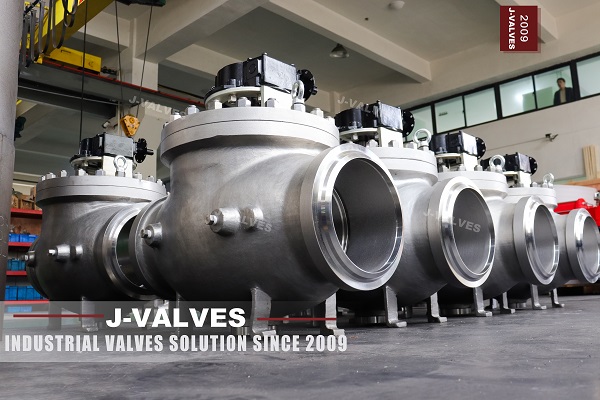
Top entry describes where the internals come out, not how many pieces the body has. The body is one casting with a large bolted cover on top, and the ball, both seats and the trunnion bearings are lifted out vertically through that opening. Neither flange joint is touched, so the valve stays in the line and the pipe does not have to be cooled, drained or cut. That is the whole proposition, and everything else about the design follows from it.
At ten inch Class 300 the valve is full bore, trunnion mounted and gear operated. Full bore keeps the passage at the pipe diameter so a pig passes and the pressure drop stays low; the trunnion carries the thrust of a large ball so the seats only have to seal; the gearbox is there because a DN250 ball at this class cannot be turned by hand. Cast CF8M is the standard body grade, with a metal seat available where the medium or the temperature rules out polymers.
Design and Construction
The cover is the design. It is a flat or domed plate on a wide gasket face, held down by a full ring of studs, and it has to seal against the same pressure as the body wall while being removable. That makes it the largest single sealing face on the valve, and it is the one joint that is opened in service rather than in the workshop. The body around it has to be stiff enough that the cover face does not distort when the studs are tensioned, which is why a top entry body is heavier than the equivalent two piece body.
Inside, the ball sits on upper and lower trunnion bearings carried in the body itself rather than in a removable centre section. That is a real difference from a three piece valve: there is no centre section to lift, so the bearings are set directly into the body bore and stay aligned with it for the life of the valve. The seats are retained in the body on both sides, and the whole assembly comes out as a stack when the cover is lifted.
Material Options
CF8M is the cast austenitic stainless grade in the 316 family, and it is named here as a casting because the body is cast. At ten inch there is no practical alternative: a forging of that size and shape would be a special order with a long lead time, and the industry casts these bodies. The consequence is that casting quality is part of the specification. Wall thickness, soundness and the repair record are what separate one foundry from another, and none of them is visible on a data sheet.
The ball is the same cast grade with hard chrome plating, or a low carbon wrought grade as an option. The stem is 316 or a precipitation hardening stainless. Seats are reinforced PTFE, PEEK or PPL as an auxiliary seal, with a metal seat available as the primary seal where temperature or abrasive service rules polymers out. As with the body, the grades belong on the nameplate and the certificate, and a proprietary hard facing alloy belongs on the order as a requirement rather than as a trade name.
| Component | Standard Material | Optional Upgrade | Service Notes |
|---|---|---|---|
| Body | CF8M cast austenitic stainless, one piece | no split alternative on this design | cover bolted on top |
| Cover | same cast grade as the body | as the drawing states | the largest pressure boundary on the valve |
| Ball | CF8M with hard chrome plating | low carbon wrought grade | carried on upper and lower trunnion bearings |
| Stem | 316 or precipitation hardening stainless | higher strength grade | anti static bonding to body |
| Seat | reinforced PTFE, PEEK or PPL | metal seat as primary seal | auxiliary seal standard, metal optional |
| Packing | flexible graphite | PTFE | gland adjustable |
| Cover gasket | spiral wound or graphite | as the drawing states | replaced every time the cover is opened |
Technical Specifications
The size sheet gives the bore, the face to face and the flange dimensions for the DN250 pattern at Class 300. The face to face follows the ASME valve standard for this size and class, so the valve will fit where that dimension is expected, but the overall height does not: a top entry valve is taller than a side entry valve of the same size because the cover and its studs sit above the body. That height has to be checked against the space available before the valve is ordered, not after.
Full bore at ten inch means the passage matches the pipe internal diameter and a pig will pass. The cavity around the ball is correspondingly large, and it is the volume that has to be vented before the cover is opened. Weight is another number that does not come from a table: it depends on the body pattern, the operator and the facing, so it is quoted with the drawing for the size and trim ordered rather than printed as a fixed figure.
| Item | Value |
|---|---|
| Nominal size | 10 inch (DN250) |
| Pressure class | Class 300 (PN 50) |
| Body construction | one piece body with a bolted top cover |
| Ball support | trunnion mounted, bearings set in the body |
| Bore | full bore |
| Body material | CF8M cast austenitic stainless |
| Ball material | CF8M with hard chrome plating, low carbon wrought grade optional |
| Stem | 316 or precipitation hardening stainless |
| Seat | reinforced PTFE, PEEK or PPL; metal seat optional as primary seal |
| Seat arrangement | double piston effect standard, self relieving optional |
| Cover gasket | spiral wound or graphite, replaced at every opening |
| End connection | raised face or ring joint, ASME B16.5 Class 300 |
| Face to face | to the ASME valve standard for this size and class |
| Overall height | on the signed GA drawing, taller than a side entry valve |
| Design standards | ASME B16.34 and API 6D |
| Test standards | API 598 and API 6D |
| Test pressure | shell 1.5 times and seat 1.1 times the class rating |
| Cover stud torque | recorded at assembly and shipped with the valve |
| Anti static | bonding between ball, stem and body per API 6D |
| Operation | worm gear or bevel gear with bearings; pneumatic, electric or hydraulic optional |
| Temperature range | minus 29 to plus 425 Celsius, metal temperature |
| Marking | size, class, body code, heat number |
| Documentation | EN 10204 3.1 plus the API 6D record package |
| Weight | quoted with the drawing for the size and trim ordered |
| Country of manufacture | China |
Standards and Compliance
ASME B16.34 sets the pressure boundary: minimum wall against bore and class, and the pressure temperature rating the valve may work to. API 6D is the pipeline valve specification and it is the one that brings the functional requirements, including double block and bleed, cavity relief, anti static bonding and a documentation package. API 608 is the general industrial ball valve standard. For a ten inch Class 300 valve in a process line, 6D is usually the standard the buyer actually cares about.
One point about top entry is worth stating plainly because it is often glossed over: the cover joint is a pressure boundary, so it must be included in the shell test and it must be made up to a controlled torque in service. A valve that passes its works shell test with the cover correctly tightened can still leak at that joint after a field service if the studs are pulled down unevenly or the gasket is reused. The test proves the design; the assembly procedure is what keeps it true.
| Requirement | Standard | What J-VALVES Supplies |
|---|---|---|
| Pressure boundary | ASME B16.34 | wall thickness and the rating table at Class 300 |
| Pipeline valve specification | API 6D | DBB, cavity relief, anti static, marking, documentation |
| Ball valve design | API 608 | general industrial requirements |
| Shell and seat test | API 598 and API 6D | 1.5 times the rating for the shell, 1.1 times for the seat |
| Cover joint | included in the shell test | production gasket and production stud torque |
| Non destructive examination | to the order | radiography or penetrant on stated areas |
| Marking | API 6D and the order | size, class, body code, heat number |
Manufacturing Process
The body is cast, cleaned, inspected and then machined. The critical operations are the body bore, the two seat pockets and the cover face, and the cover face has to be square to the bore or the cover will not seat evenly however much torque is applied. The cover itself is machined on both sides, with the gasket groove or the flat face finished to the drawing. Seat pockets are checked for coaxiality because a seat that is out of line will leak on one side and drag on the other.
Assembly is a vertical stack: lower trunnion bearing, ball, upper bearing, seats, then the cover with its gasket. The cover studs are tightened in a cross pattern in stages to the specified torque, and the ball is cycled between stages to check that nothing has shifted. The valve is then shell tested with the cover in place, seat tested in both directions, and marked. Because the cover is opened in service, the assembly torque is recorded and shipped with the valve.

Quality Control and Testing
Shell and seat tests follow API 598 and, where the order says so, the additional checks in API 6D. For a top entry valve the shell test is also the only proof that the cover joint is sound, so it has to be done with the production gasket and the production stud torque rather than with a shop substitute. The seat test is run in both directions, and on a double piston effect seat each seat is checked separately with the cavity vented, which is the double block and bleed behaviour in practice.
Casting quality is checked separately and cannot be inferred from a pressure test. A hydrostatic test will find a through wall defect; it will not find porosity that is closed at the test pressure and opens under thermal cycling. Radiography on stated areas, dye penetrant on the cover face and the seat pockets, a weld repair record if any repair was made, and positive material identification on the finished body are the checks that cover it, and they are worth naming on the order for a valve this size.
| Step | What Is Checked | Standard or Acceptance |
|---|---|---|
| Casting | grade, heat number, soundness | certificate plus penetrant or radiograph where ordered |
| Cover face | squareness to the bore, flatness | checked before assembly |
| Seat pockets | coaxiality with the ball | in process gauging |
| Cover studs | cross pattern, staged torque | recorded and shipped with the valve |
| Shell test | no leakage through body or cover joint | API 598 at 1.5 times the rating |
| Seat test | each seat separately, cavity vented | API 598 at 1.1 times the rating |
| Anti static | continuity between ball, stem and body | per API 6D where ordered |

Applications and Industry Service
Top entry is bought where the line cannot be broken. That means buried and underground installations, long welded runs with no flanged spool nearby, manifolds and headers where the space around the valve is taken up by other pipe, and offshore or skid mounted packages where removing a ten inch valve means cutting steel. In all of those cases the value is not the valve, it is the fact that a seat change can be done with the body left in place and the pipe left full.
It is the wrong choice where headroom is short, because the cover needs clearance above the valve to lift the stack out, and where the line is small enough that a two piece valve is cheaper and just as serviceable. It is also wrong where the medium is dirty enough that the cover gasket face will be damaged every time it is opened, because a scored cover face turns a routine seat change into a body replacement. Clean service is where this design pays for itself.

Installation, Operation and Maintenance
Install with the cover accessible and enough headroom to lift the internals clear. On a ten inch valve the stack is heavy, so plan the lift before the line is opened rather than after. Support the body; do not let it hang on the flanges. Leave the vent and drain plugs reachable, and record the cover stud torque from the nameplate or the drawing so that the next person to open it has a number to work to instead of a guess.
To service it, isolate the valve, release cavity pressure through the vent, cycle the ball to open, and then release the cover studs in a cross pattern in stages. Lift the cover, then the stack. The gasket is replaced every time the cover comes off; a compressed gasket will not reseal a second time. On reassembly the studs go down in stages to the recorded torque, with the ball cycled between passes, and the valve is leak tested at the cover before the line is put back.
How to Specify and Order
The order needs the size, the class, top entry stated explicitly, the body grade, the bore, the facing, the seat material, the operator and the standard. Top entry has to be written as a structural requirement rather than left to a product name, because a supplier who reads only the size and class may quote a two piece valve that fits the same space and costs less. The cover stud torque and the gasket material should also be called out, since they are what the maintenance procedure will depend on.
Before shipment the nameplate, the certificate and the drawing should be checked against each other, with one addition for this design: the as-built cover stud torque should be recorded and shipped with the valve. On a two piece valve that number matters only in the workshop; on a top entry valve it matters every time the cover is opened in the field, and a valve that arrives without it hands the maintenance team a problem that will not show up until the first seat change.
FAQ
Q: What does top entry mean on a ball valve?
A: It means the internals come out through a bolted cover on top of the body rather than through a body joint at the side. The body is one casting and stays bolted to the pipe, so the ball, both seats and the trunnion bearings can be lifted out vertically with neither flange disturbed. It is a different structure from a two or three piece valve, not another name for one, and the body is not split at all on this design.
Q: Is this valve a three piece valve?
A: No. The page original carried a line reading two to three piece body in its feature list, and that line is a template leftover rather than a description of this valve. A top entry body is one piece with a cover; there is no centre section and no side joint. If a quotation describes this valve as three piece, it is describing a different product, and the drawing should be checked before the order is placed.
Q: Why is a top entry valve taller than a side entry one?
A: Because the cover and its ring of studs sit above the body, and the stack inside has to be lifted clear of them. That extra height is the price of not breaking the line. It matters in two places: in a skid or a pipe rack where the space above the valve is limited, and in any installation where something else is mounted directly overhead. The overall height is on the drawing and should be checked against the space before ordering.
Q: What is the largest sealing face on this valve?
A: The cover joint. It has to hold the same pressure as the body wall while remaining removable, and its studs are the ones that get disturbed in service. That is why the assembly torque is recorded and shipped with the valve, and why the gasket is replaced every time the cover comes off. A reused gasket or an unevenly tensioned cover is the most likely source of a leak on a top entry valve after maintenance.
Q: Can the seats be changed without removing the valve from the line?
A: Yes, that is the point of the design. Isolate the valve, release the cavity pressure through the vent, put the ball in the open position, and release the cover studs in stages. The cover and the internal stack then lift out and the seats can be replaced with the body still bolted between the flanges. It still requires the line to be out of service, but it does not require the pipe to be cut, drained and re-made.
Q: Is CF8M suitable for seawater?
A: Only with care. CF8M is the cast 316 family grade and it resists chloride attack better than the 304 family, but it is still an austenitic stainless and it is vulnerable to pitting and crevice corrosion in warm seawater, and to stress corrosion cracking where chlorides concentrate. For continuous seawater service a duplex or a nickel aluminium bronze body is usually the better answer, and the choice belongs in the material selection rather than in the valve specification.


Hot Products


News
Ball Valves in A Kraft Pulp Mill: Black Liquor, Green Liquor And The Cost of Choosing The Alloy by Habit
White liquor at pH 14 cracks carbon steel welds, black liquor sets solid below 100 C, green liquor dregs grind seats: alloy choice and torque in a kraft mill.
Read More
Slug Flow And Ball Valves: What Actually Arrives At The Seat
A slug is liquid mass with momentum, not a pressure spike. What changes at the seat, in the cavity and at the actuator when liquid reaches a ball valve.
Read More
Ball Valves in Direct Lithium Extraction: PH 1 Eluate, Gypsum Scale And 438,000 Cycles in Twenty-Five Years
Direct lithium extraction swings valves from pH 1 eluate to pH 12 caustic, 48 column switches a day and gypsum scale. Materials, seats and torque.
Read More
Ball Valves in Geothermal Brine: Silica Scale, Chloride Cracking And The Cooling Trap
Why geothermal brine destroys ball valves: retrograde silica scale, calcite at the flash point, chloride cracking above 60 C and the 250 C seat limit.
Read More