

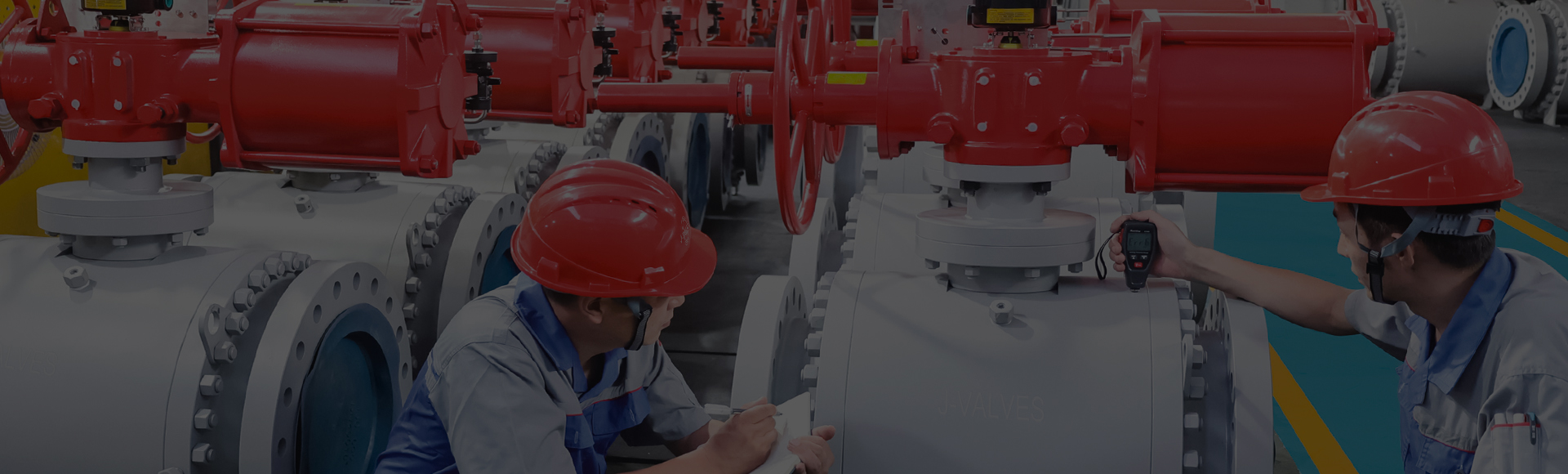
CHINA J-VALVES Offers Various High-quality I ndustrial Ball Valves
J-VALVES, a distinguished professional ball valve manufacturer rooted in China, takes pride in its extensive product portfolio. Our offerings span a wide range, including trunnion-mounted ball valves, floating ball valves, high-temperature ball valves, high-pressure ball valves, metal-sealed ball valves, ultra-low temperature ball valves, DBB ball valves, Three-way And Four-way Ball Valve, and fully welded ball valves. Each product is a testament to our commitment to precision engineering and reliable performance. Meticulously crafted, they are designed to not only meet but exceed the most stringent industrial demands, ensuring stable operation even under extreme conditions. This enables us to provide our clients with high-value services and makes our valves widely sought-after in industries.
Product Category
Contact Us


-
J-VALVES-Q41F
-
J-VALVES
Overview of the J-VALVES 3 Inch Class 150 C95800 Top Entry Floating Ball Valve
The J-VALVES 3 inch (DN80) Class 150 top entry floating ball valve is a full bore isolation valve cast in C95800 nickel aluminum bronze, with ASME B16.5 raised face flanges and a 203 mm face to face length to ASME B16.10. It is built to ASME B16.34 and API 608, rated under ASME B16.24, and tested to API 598.
Two decisions shape it. The shell is a single casting closed by a bolted bonnet, so the ball and both seats come out vertically once the line is isolated: no cutting, no flange joint broken, and the valve stays in the rack. The material is C95800, a cast nickel aluminum bronze with 4 to 5 percent nickel and 3.5 to 4.5 percent iron, which resists dealuminization and forms a self healing oxide film in chloride service.That combination suits seawater cooling circuits, desalination and offshore firewater rings, tank farm and loading isolation, and petrochemical transfer lines carrying chlorides or brackish water. It is also chosen where a non magnetic body is needed, since the permeability of C95800 stays below 1.05.
Design and Construction
The body is one piece with a large top opening closed by a bolted bonnet. Both flange faces are integral with the shell, so the pressure envelope carries one main bolted joint, the bonnet gasket, instead of the body to adapter joints a split valve needs. Fewer joints means fewer places to re-torque and fewer leak paths, at the cost of overhead clearance.
The bonnet is drawn onto a spiral wound gasket, a stainless steel winding with a graphite filler, which holds through thermal cycling and gives a fire safe barrier if the soft parts are destroyed. Bolting is A193 B7 with A194 2H nuts, and A320 L7 for cold duty.
The ball is a C95800 casting, hard chrome or electroless nickel plated where the seat contact load calls for a harder running surface. It floats: no trunnion, no stem support, so line pressure pushes the ball onto the downstream seat and the sealing force rises with pressure. Both seat rings sit in the body, loaded by that pressure plus a controlled initial interference.
The stem is retained by the bonnet and cannot be ejected if the gland is opened, and a spring keeps the path from ball to stem to body at 10 ohm or less as API 608 requires. The lever has open and closed stops and turns clockwise to close. Seat grade sets the temperature ceiling, and the body rating sets the pressure ceiling.

Material Options
Body, ball and stem are all one alloy, which removes the galvanic couple a mixed trim would create in seawater. Seat grade is the variable: PTFE for general service and the lowest torque, RPTFE where contact stress and cycle count climb, and PEEK where pressure and temperature rise together. The same pattern can also be poured in CF8M, CF3M, duplex or a nickel alloy.
Gasket and stem seal matter as much as the body here, because the bonnet joint is the one pressure boundary the valve opens for maintenance. A graphite filled spiral wound gasket and a graphite or PTFE packing set are chosen by temperature, with a low emission set to ISO 15848-1 where the site limits fugitive emissions.
| Component | Standard Material | Optional Upgrade | Service Notes |
|---|---|---|---|
| Body | C95800 nickel aluminum bronze to ASTM B148 | CF8M, CF3M, duplex, nickel alloy | One piece top entry shell, rated under ASME B16.24 |
| Ball | C95800 with hard chrome or ENP finish | Stellite faced for abrasive service | Floating, loaded by line pressure |
| Stem | C95800 | Hard chrome at the packing area | Blow-out proof, retained by the bonnet, anti-static connected |
| Seat | PTFE | RPTFE, PEEK, metal to metal | Seat grade sets the temperature limit of the valve |
| Bonnet gasket | Spiral wound SS316 with graphite filler | PTFE coated | The single main pressure boundary joint |
| Stem seal | Graphite or PTFE packing set | Low emission set to ISO 15848-1 | Graphite above 200 C |
| Bolting | A193 B7 / A194 2H | A320 L7, or B8M for marine atmospheres | Bonnet and flange bolting |
| Operator | Lever with open and close stops | Gear, pneumatic, electric | Clockwise to close |
Technical Specifications
The table covers the standard build. Values move when the seat grade, the surface finish or the operator is changed on the order.
| Item | Value |
|---|---|
| Nominal size | 3 inch (DN80) |
| Bore | 76 mm full bore; API 6D minimum is 74.0 mm |
| Pressure class | ASME Class 150 |
| Body style | Top entry, one piece body with bolted bonnet |
| Body material | C95800 nickel aluminum bronze, ASTM B148 |
| Ball and stem | C95800, hard chrome or ENP option |
| Seat material | PTFE, RPTFE, PEEK or metal to metal |
| End connection | ASME B16.5 Class 150 raised face, 190.5 mm OD, 152.4 mm bolt circle, 4 x 5/8 inch bolts |
| Face to face | 203 mm to ASME B16.10 |
| Operation | Lever, 180 degree travel, clockwise to close |
| Pressure rating | 19.0 bar (275 psi) at 38 C, ASME B16.24 Table 3.1-4 |
| Temperature range | -20 C to 200 C with PTFE; PEEK seat to 260 C, body ceiling 204 C |
| Shell test | API 598, 1.5 x rated, 28.5 bar |
| Seat test | API 598, 1.1 x rated, 20.9 bar |
| Operating torque | 55 to 85 N m reference, measured on each valve |
| Anti-static | API 608, resistance 10 ohm or less |
| Fire safe | API 607 / ISO 10497 |
Standards and Compliance
The design basis is ASME B16.34 and API 608, with ASME B16.24 governing the copper alloy. That matters: ASME B16.24-2021 added a pressure temperature table for C95800, Table 3.1-4, rating a Class 150 valve at 19.0 bar (275 psi) at 38 C with a 204 C ceiling. A carbon steel Class 150 body is rated 19.6 bar at 38 C and runs to 425 C, so bronze buys corrosion resistance with temperature headroom.
API 598 sets the shell test at 1.5 times the 38 C rating and the seat test at 1.1 times it, which against 19.0 bar is 28.5 bar and 20.9 bar. Suppliers often quote the nominal Class 150 figures of 30 bar and 22 bar, which assume a 20 bar class rating rather than the 19.0 bar that applies here. A soft seated valve must show zero visible leakage, the equivalent of ISO 5208 rate A.
Fire safe behaviour follows API 607 and ISO 10497: a 750 C to 800 C flame for 30 minutes, cooling, then a repeat seat leak test. The metal seat backing carries the seal after the soft seat is gone. That is a containment claim, not a promise of operability afterwards.
Wet H2S service needs care. The alloy is not automatically acceptable to NACE MR0175 / ISO 15156; acceptability depends on partial pressure, temperature and hardness, and must be qualified for the duty rather than assumed from corrosion data. Low emission stem sealing to ISO 15848-1 and PED 2014/68/EU documentation are available.
| Requirement | Standard | Supplied |
|---|---|---|
| Ball valve design | API 608 | Yes |
| Pressure rating and wall thickness | ASME B16.34 | Yes |
| Copper alloy pressure temperature rating | ASME B16.24 | Yes |
| Face to face length | ASME B16.10 | Yes |
| Raised face flange | ASME B16.5 | Yes |
| Shell and seat test | API 598 | Yes |
| Fire safe test | API 607 / ISO 10497 | Yes |
| Fugitive emission | ISO 15848-1 | Optional |
| Sour service material | NACE MR0175 / ISO 15156 | On qualification |
| Material certificate | EN 10204 3.1 | Yes |
Manufacturing Process
Made in house at the Wenzhou and Lishui plants, which cover a 15000 square metre manufacturing base. Bronze castings are poured to a controlled chemistry, because the iron and nickel content governs seawater performance and a lean heat will not deliver it. Seat pockets, the stem bore and both flange faces are machined on CNC lathes and machining centres against drawings, with 40 CNC lathes, 5 machining centres and 8 drilling machines holding the 76 mm bore and the 203 mm face to face length.
Assembly then fits the seats, the plated ball, the anti-static spring and the bonnet, each joint torqued to a controlled procedure. Every valve is pressure tested on the bench, the lever torque recorded and electrical continuity checked before coating, heat number tagging and packing. Third party inspection can be arranged at any stage.

Quality Control and Testing
Each valve follows an eight step sequence from incoming material to packed valve, with every measurement tied to the heat number so the certificates and the test report form one package.
| Step | What Is Checked | Standard or Acceptance |
|---|---|---|
| Incoming material | Heat number, chemistry, mill certificate | EN 10204 3.1 |
| PMI before machining | Alloy identity of the C95800 casting | 100 percent on the heat |
| Machining dimension | 76 mm bore, seat pocket, 203 mm face to face | ASME B16.10, drawing |
| Non-magnetic check | Permeability of the bronze body | Below 1.05 where specified |
| Assembly and function | Lever travel, stop position, free movement | Smooth, no bind |
| Shell strength test | Body and bonnet joint at 1.5 x rated | API 598, 28.5 bar, no leak |
| Seat test | Both seats at 1.1 x rated, both directions | API 598, 20.9 bar, zero visible leak |
| Coating, marking, documents | Film thickness, heat number tag, certificate set | Spec, EN 10204 3.1 set |
Shell testing holds the assembled valve at 28.5 bar with water while the bonnet joint and both flange faces are checked for weeping. Seat testing applies 20.9 bar to each seat in turn in both directions, and a soft seated valve is rejected on any visible leakage. Positive material identification runs before machining, so a wrong heat cannot reach the machine shop.

Applications and Industry Service
Typical duties are petrochemical transfer and loading lines, tank farm and manifold isolation, seawater cooling circuits, desalination pipework, offshore firewater and deluge rings, and shipboard seawater systems. The common thread is chloride. A carbon steel body pits, and a pit under a gasket is a leak waiting for the next shutdown. The bronze body does not have that failure mode to the same degree.
Top entry suits the same service for a second reason. Seawater and brackish lines are usually welded spools in tight racks, and a valve that strips from above is worth more than one that has to be cut out of the line. Where the piping must also be non magnetic, for instrumentation or a magnetic survey, the C95800 casting satisfies that without a special alloy.
The boundary is pressure and size. At DN80 the differential at 19.0 bar puts roughly 8.6 kN on the seat face, which a 350 mm lever handles inside the 360 N manual input limit of API 608. At DN200 in Class 600 the same floating geometry puts about 330 kN on the seat, which no lever moves reliably, and a trunnion mounted valve takes over.
Installation, Operation and Maintenance
Before installation, clean the flange faces, the bore and the seat area, cycle the valve once by hand, and check the bonnet bolts for tightness. The valve is bidirectional so it fits either way round, but the lever should finish within reach of an operator, and enough vertical space must be left for the bonnet and the ball to be lifted clear.
In service the seats are the sacrificial items. When one starts to pass, isolate the line, vent both sides and the body cavity, then open the valve to the mid position so trapped cavity pressure is released. Release the bonnet bolts in stages, lift the bonnet, then lift out the ball and the seats. Inspect the ball for scoring and the seats for swelling or embedded solids, replace the seats as a pair, renew the gasket and refit.
Two points are specific to this design. Top entry gives access, not online repair, because the pressure envelope is opened and the line must be isolated and vented before the bonnet is touched. Bronze also galls easily, so bolt threads and seat pockets stay clean, the bonnet is re-torqued in a cross pattern, and the valve is retested at 1.1 times the rated pressure before returning to service.
How to Specify and Order
Give the size and class, body and trim material, seat grade, end connection and operator. State the design standard, ASME B16.34 and API 608, the copper alloy rating reference, ASME B16.24, and the test standard, API 598. Where the line carries chlorides or a sour medium, give the fluid, temperature and pressure so seat grade and material qualification can be settled.
Standard builds are accepted from one piece, with 2 to 4 weeks for the standard configuration and 4 to 8 weeks for a custom build. Every order ships with an EN 10204 3.1 material certificate, a dimensional report, a pressure test report, a coating report and a packing list. OEM supply is available, and export packing is a wooden case with the bore plugged.
FAQ
Q: What is C95800 nickel aluminum bronze, and why use it in a ball valve?
A: C95800 is a cast copper alloy to ASTM B148, also written CuAl10Ni5Fe4, EN 1982 CC333G or BS 1400 AB2. Its 4 to 5 percent nickel content and 3.5 to 4.5 percent iron stop dealuminization, and the alloy forms a self healing aluminium oxide film, so it resists pitting and crevice attack in aerated seawater where carbon steel fails. It also resists cavitation better than 316 stainless, keeps marine growth off because of the copper content, and stays non magnetic with a permeability below 1.05. That combination is why it is specified for seawater, desalination and chloride service rather than as a general replacement for steel.
Q: What pressure is a Class 150 C95800 ball valve rated for?
A: ASME B16.24-2021 rates a Class 150 C95800 valve at 19.0 bar (275 psi) at 38 C, with a maximum service temperature of 204 C. A carbon steel Class 150 body is rated 19.6 bar at 38 C and runs to 425 C, so bronze trades temperature headroom for corrosion resistance and the two are not interchangeable on a hot line. API 598 then sets the shell test at 1.5 times that rating, 28.5 bar, and the seat test at 1.1 times, 20.9 bar.
Q: How does a top entry ball valve allow in line maintenance?
A: Once the line is isolated and depressurised, the bonnet bolts are released in stages and the bonnet is lifted. The ball and both seat rings then come straight out through the top opening, without breaking either flange joint and without cutting the valve out of the pipe. That is the reason top entry is chosen on welded spools and in tight racks. The limit has to be stated plainly: top entry gives access, not online repair, because the pressure envelope is opened and the line must be vented before the bonnet is touched.
Q: What is the face to face length of a 3 inch Class 150 flanged ball valve?
A: ASME B16.10 fixes it at 203 mm, and at Class 150 the short pattern and long pattern figures are the same, so a replacement drops into an existing spool. The matching flange is ASME B16.5 Class 150 raised face, 190.5 mm outside diameter, 127 mm raised face, 152.4 mm bolt circle and 4 bolts of 5/8 inch, so a bronze valve bolts straight onto a steel Class 150 flange without an adapter.


Hot Products


News
Trunnion Mounted Ball Valves: Spring-Loaded Seats, Low Torque And Double Block Design
Trunnion ball valves hold the ball on bearings so pressure never loads the seats. Compare spring seats, low torque, DBB and body styles for large lines.
Read More
Ball Valve End Connections: Flanged, Butt Weld, Socket Weld And Threaded
Flanged, butt weld, socket weld or threaded ends change installation, leak risk and cost. Compare ball valve end connections and how to choose.
Read More
Cryogenic Ball Valve Design: Bonnet Length, Materials and Cold Testing
Cryogenic ball valve design for LNG: extended bonnet length, CF8M impact testing, PCTFE seats, cavity relief and the -196°C test that proves it.
Read More
Full Port Vs Reduced Port Ball Valves: Flow And Cost Trade-off
Full port and reduced port ball valves compared on Cv, pressure drop, pig passage and torque, with the numbers that decide the bore in a purchase order.
Read More