


CHINA J-VALVES Offers Various High-quality I ndustrial Ball Valves
J-VALVES, a distinguished professional ball valve manufacturer rooted in China, takes pride in its extensive product portfolio. Our offerings span a wide range, including trunnion-mounted ball valves, floating ball valves, high-temperature ball valves, high-pressure ball valves, metal-sealed ball valves, ultra-low temperature ball valves, DBB ball valves, Three-way And Four-way Ball Valve, and fully welded ball valves. Each product is a testament to our commitment to precision engineering and reliable performance. Meticulously crafted, they are designed to not only meet but exceed the most stringent industrial demands, ensuring stable operation even under extreme conditions. This enables us to provide our clients with high-value services and makes our valves widely sought-after in industries.
Product Category
Contact Us


Pressure Rating:1000 psi WOG (68.9 bar at 38 °C)
Body Construction:One piece, end entry, screwed seat retainer
Body Material:Stainless steel CF8M, CF8; carbon steel WCB
Ball:CF8M or F316, mirror polished
Port:Reduced port (catalogue variant: reduce port), bore one size below nominal
Seat:PTFE, RPTFE
Stem:F316, blowout proof
Thread:NPT to ASME B1.20.1, BSPT to ISO 7-1, BSPP to ISO 228-1
Design Standard:ASME B16.34, MSS SP-110
Test Standard:API 598, 100 % tested
Temperature Range:-20 to 180 °C
Operation:Lever, locking lever optional
-
Q11F
-
J-VALVES
Size:
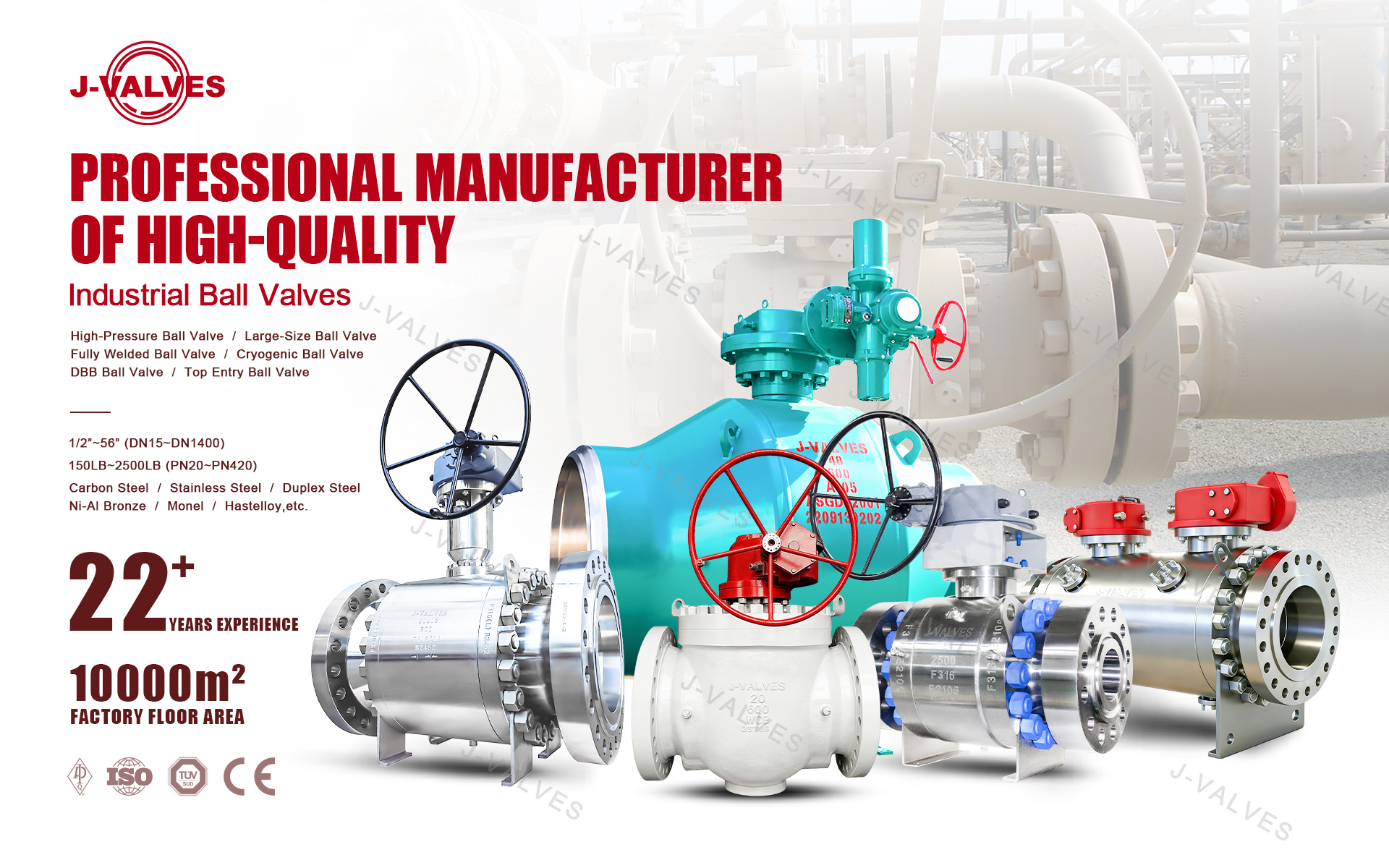
A one piece ball valve is a valve whose body is a single casting with no body joint. The ball, seats and stem go in through one end, and a seat retainer screwed into the body holds them there. The port is normally reduced, one nominal size below the pipe, because the retainer and the body wall need the material.
J-VALVES builds the type from 1/4 inch to 4 inch at 1000 psi WOG, in CF8M, CF8 and WCB, with NPT, BSPT and BSPP threads. It is the cheapest ball valve in the range and, on the right line, the most reliable, because there is nothing to come loose. This page is about the two things that decide whether it is the right choice: what the reduced port costs you, and what "not repairable" means in money.
Why the Single Body Works
A pressure boundary with no joint cannot leak at a joint. There is no gasket to relax, no body bolts to lose preload, and no differential expansion between an end cap and a body. On a small valve that is cycled or thermally cycled, that is worth more than it sounds, because most of the leaks on small screwed valves in plants are at the body joint rather than at the seat.
The design also removes the body bolts and the second casting, which is most of the cost difference. A one piece valve is shorter, lighter and cheaper to make, and it has one fewer component to stock.
The trade is exact and unavoidable: the same absence of a joint that removes a leak path also removes the way in. The ball cannot come out without disturbing a threaded pressure boundary that was never designed to be opened in the field.
What a Reduced Port Actually Costs
The bore is one nominal size down, so a 1 inch valve has a bore close to a 3/4 inch pipe. The pressure drop rises roughly with the fourth power of the diameter, so this is not a cosmetic difference.
| Nominal size | Typical full port Cv | Typical reduced port Cv | Loss |
|---|---|---|---|
| 1/2 inch | 7.5 | 4.6 | 39 % |
| 3/4 inch | 13 | 8 | 38 % |
| 1 inch | 22 | 14 | 36 % |
| 1-1/2 inch | 50 | 32 | 36 % |
| 2 inch | 78 | 50 | 36 % |
The figures are typical rather than exact, and the pattern is what matters: about a third of the capacity, consistently. On a branch with 3 bar upstream and 1 bar of downstream loss elsewhere, a third of the Cv through a short valve is invisible. On a gravity drain, a pump suction, or a long header where every fitting is counted, it is the fitting that decides whether the line works.
Two cases should never take a reduced port regardless of price. A pump suction, where the reduced bore adds NPSH loss at the worst possible place. And a line that will be pigged or rodded, where the bore has to pass the tool.

Cost Over Life, Not at the Counter
| Body style | Purchase | Repair | Downtime per seat change | Best for |
|---|---|---|---|---|
| One piece | Lowest | None: replace the valve | Cut and remake the joint | Set-and-leave utility lines |
| Two piece | Mid | Seat kit, bench rebuild | One joint to break | The general workhorse |
| Three piece | Highest | Seat kit, in line | Centre out, pipe untouched | Welded pipe, frequent service |
The arithmetic that matters is not the unit price, it is how many times the line will be opened in ten years. If the answer is zero, buy the one piece and put the saving into a spare on the shelf. If the answer is more than two, the one piece is scrap metal at the first leak and the two piece has already paid for itself.

Three Failures That Come Back
The seat retainer thread weeps. It is a threaded pressure boundary, sealed by an O-ring or by the thread itself depending on the pattern, and on a valve that has been overheated or over-tightened it is the first thing to leak. It cannot be retightened in service because the retainer sits behind the seat and the ball.
The seat extrudes into the bore. A one piece body has less room behind the seat than a two piece, so the anti-extrusion clearance is smaller and the seat is less tolerant of over-pressure at temperature. The symptom is a valve that holds cold and drips hot.
The ball is scored and cannot be reached. Debris trapped at the seat scores the ball on every cycle, and because the body cannot be opened, the score cannot be polished out. A strainer upstream is the only real protection.

When It Is the Right Answer
Utility water branches, instrument air drops, gauge isolation, packaged skids where the valve is inside a cabinet and will never be serviced, and any manifold where twenty valves are set at commissioning and left for years. In those places the one piece is cheaper, tighter and lighter, and the absence of a joint is a real advantage rather than a limitation.
It is the wrong answer on process lines with a maintenance schedule, on anything abrasive, on pump suctions, on pigged lines, and wherever the specification says the trim must be replaceable. That is a shorter list than most catalogues suggest, and it is the list that decides the purchase.
One Piece Ball Valve FAQ
Can a one piece ball valve be repaired?
Not in any practical sense. The ball goes in through one end and is held by a seat retainer screwed into the body, so to reach the seat you have to unscrew that retainer, and on a valve that has been in service it is usually seized or damaged in the attempt. There is no body joint to open and no spare part that can be fitted without machining. The economic decision is replacement, which is why the design is bought for lines where the valve is cheap relative to the labour of touching it.
How much flow does a reduced port cost?
Roughly 30 to 40 percent of the Cv at the same nominal size. A typical 1 inch reduced port valve has a Cv near 14 against about 22 for the full port version; at 2 inch the figures are around 50 against 78. On a short branch with pressure to spare that is irrelevant. On a gravity line, a pump suction, or a long run where the valve is a significant part of the total pressure drop, it is the difference between working and not working.
Why is a one piece body stronger than a two piece?
It has one continuous pressure boundary with no gasket and no body bolts, so there is no joint to relax under thermal cycling and no bolt preload to lose. That is a genuine advantage and it is why the design is used on small high pressure and high purity lines. The weakness moves to the seat retainer thread, which is a threaded pressure boundary that depends on thread quality and cannot be inspected from outside.
Where should a one piece valve not be used?
On slurry and on anything with solids, because there is no way to open the body and clean the cavity. On lines that are cycled frequently, because the seat cannot be replaced and the whole valve is scrap at the first leak. On pigged lines, because a reduced bore blocks the pig. And on any duty where the specification calls for repairable trim, which rules it out of most process plants and leaves it where it belongs: utility water, air, and packaged equipment.
Does the handle come off so the valve can go into a panel?
On most patterns yes, the handle nut is removed and the lever lifts off, leaving the stem and the stop. The body then mounts through a panel with a lock nut on the thread. Check the stem length before ordering, because a panel-mount valve needs a longer stem than a line-mounted one and the two are different part numbers.
Is a one piece valve cheaper over its life?
Only if it is never touched. A one piece valve costs less to buy and nothing to repair, because it cannot be repaired; a two or three piece costs more and can be rebuilt with a seat kit. On a line that is opened twice a year the two piece wins on the second rebuild. On a manifold of twenty valves that is set at commissioning and left, the one piece wins by a wide margin.
Hot Products


News
Stainless Steel Ball Valve Grades: 304, 316 And 316L, And What Actually Decides
Molybdenum is the difference that decides the duty, carbon is the difference that gets missed, and the chloride in the line matters more than the price.
Read More
Ball Valve Spare Parts for Overseas Projects: The Wear Part List, The Quantity Math, And Four Traps
Why isolation valves fail on calendar time, not cycles. Wear part lists, Poisson stock maths, seat kit traps and the clauses that decide year six.
Read More
Ball Valves On A Bottom Loading Gantry: Creep, Dry Break And The Test That Proves Neither
A loading gantry cycles a ball valve far more than it is designed for and still cannot prove shut-off. Where creep starts, and what to specify.
Read More
Lined Ball Valves in Acid Service: The Liner Does Not Fail, The Steel Behind It Does
The valve came out of the line looking better than most valves that come out of a hydrochloric acid line. Three inch, PFA lined, cast body, Class 150, fourteen months in service on a 32 percent acid transfer duty at 55 to 60 degrees C, about forty open and close cycles a week. The paint was intact.
Read More