

CHINA J-VALVES Offers Various High-quality I ndustrial Ball Valves
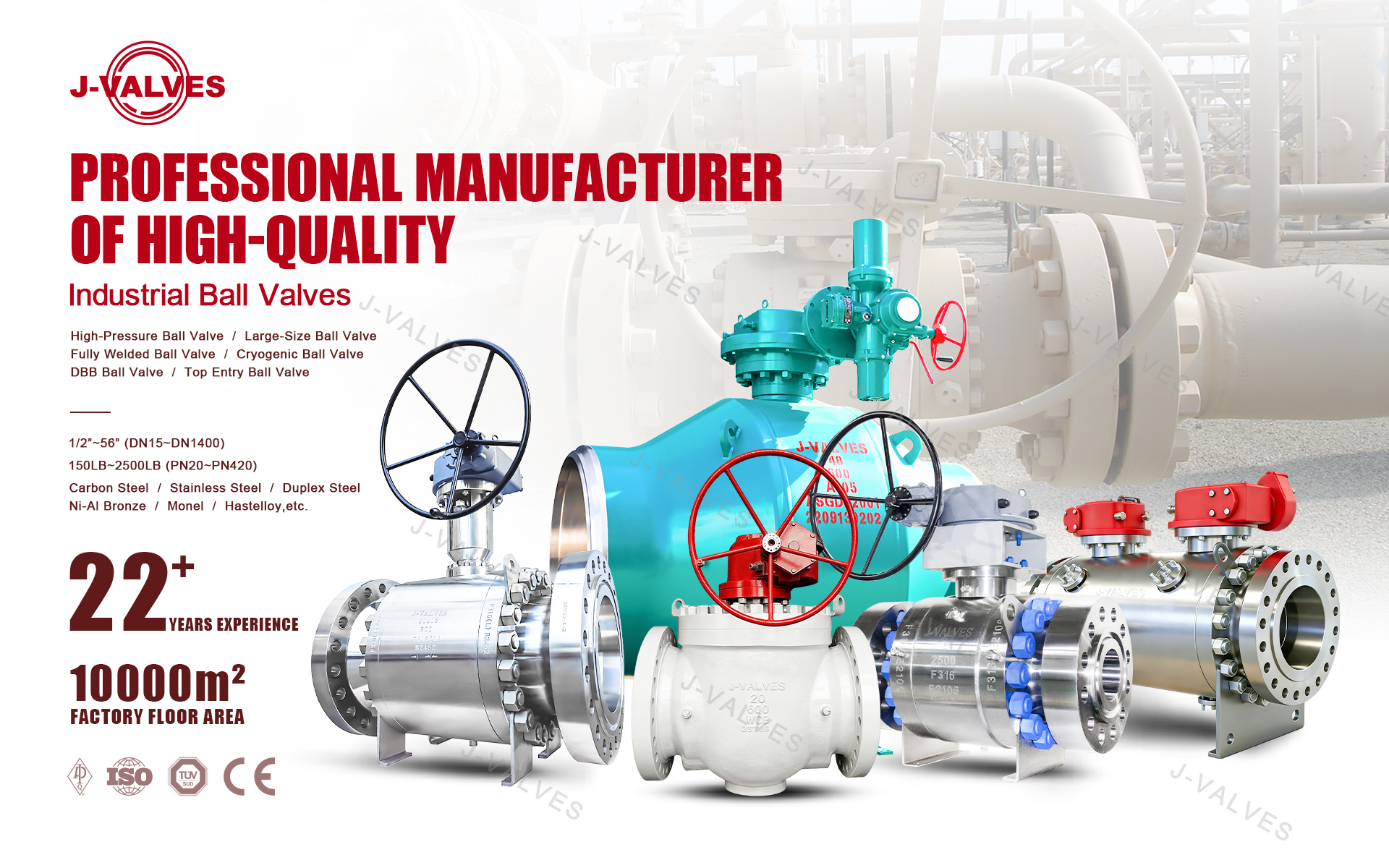
J-VALVES, a distinguished professional ball valve manufacturer rooted in China, takes pride in its extensive product portfolio. Our offerings span a wide range, including trunnion-mounted ball valves, floating ball valves, high-temperature ball valves, high-pressure ball valves, metal-sealed ball valves, ultra-low temperature ball valves, DBB ball valves, Three-way And Four-way Ball Valve, and fully welded ball valves. Each product is a testament to our commitment to precision engineering and reliable performance. Meticulously crafted, they are designed to not only meet but exceed the most stringent industrial demands, ensuring stable operation even under extreme conditions. This enables us to provide our clients with high-value services and makes our valves widely sought-after in industries.
Product Category
Contact Us

Pressure Class: ASME Class 2500 (PN420), about 42 MPa at 38°C
Temperature Range: -29°C to +425°C
Body Material: A216 WCB, A217 WC6 / WC9, A351 CF8M, A182 F316
Ball: F304 / F316 / F11 / F22 / F91, HVOF tungsten carbide or Stellite 6, 68 HRC min
Seat: Stellite 6, Inconel 718 or tungsten carbide hardfacing, spring loaded
Stem: F316, 17-4PH or Inconel 718, anti blowout
Packing: Flexible graphite, Inconel wire reinforced
Body Style: Three piece, side entry, trunnion mounted
End Connection: Flanged RF / RTJ to ASME B16.5
Design Standard: API 6D, API 608, ASME B16.34
Test Standard: API 598 shell and seat, API 6D
Fire Safe: API 607 / ISO 10497
Operation: Gearbox, pneumatic, electric, hydraulic
-
Q947Y
-
J-VALVES
A metal seated trunnion ball valve seals metal against metal: the ball and both seat rings carry a hardfacing, a spring keeps the seat pressed against the ball, and no polymer sits in the sealing path. That single change is what lets the valve hold at 425°C, tolerate catalyst fines and coke particles, and keep sealing after a fire has destroyed every soft part of a soft seated valve.
J-VALVES builds this valve in 2-1/2 inch (DN65) Class 2500 as a three piece flanged body, with WCB, WC6, WC9 or CF8M as the body grade and a seat pair in Stellite 6, Inconel 718 or tungsten carbide. The buyers are refineries, coke drum units, catalyst handling lines, and high temperature steam headers where a PTFE seat is either extruded, carbonised or worn through within weeks.
Why a Soft Seat Fails Before the Metal Does
A soft seat does not fail because it is weak. It fails because three things happen at once above about 200°C. The polymer creeps under seat load and loses the interference that created the seal. It expands about ten times more than stainless, so the pocket either crushes it or lets it relax. And any particle that reaches the sealing line is pressed into the polymer and stays there, holding the seat off the ball by its own thickness.
Criterion | Soft seated (RPTFE / PEEK) | Metal seated |
|---|---|---|
Continuous temperature | 200°C for RPTFE, 260°C for PEEK | 425°C, and 590°C with a WC6 body and graphite packing |
Leakage class | API 598 rate A, bubble tight | API 598 rate V or VI, ISO 5208 rate D to E |
Particle in the sealing line | Embedded, seat leaks until cleaned | Scraped off by the seat edge, no embedding |
Fire | Seat destroyed, relies on a secondary metal seat | No polymer to burn, seal is the design seal |
Operating torque | Low | 1.6 to 2.5 times the soft seated figure |
Cost at Class 2500 | Lower | Higher, because of hardfacing and lapping hours |
What Class 2500 Changes in the Seat Design
At Class 2500 the rating for A216 WCB is about 42 MPa at 38°C, and the seat does not see pressure as a number, it sees it as thrust. Seat thrust is line pressure times the annular area of the seat ring, and at 42 MPa a 2-1/2 inch seat ring carries a closing force in the order of tens of kilonewtons. A floating ball cannot react that force without bending the stem, which is why this size is trunnion mounted even though it is small.
The trunnions take the pressure load into the body through two bearings, so the stem only transmits torque. That is the difference that makes a 2-1/2 inch Class 2500 valve turn with a 300 mm lever instead of a gearbox the size of a suitcase. The bearings are metal backed and self lubricating, because grease at 425°C is already a vapour.
The spring behind each seat has to do one job: keep sealing stress positive when the body grows away from the ball. From 20°C to 425°C a 200 mm stainless body section grows about 1.3 mm, while the ball grows less because it is smaller. The disc spring stack is selected for that travel and for the relaxation of the seat ring itself, and it is the part most often missing from a competitor drawing.
Hardfacing: Tungsten Carbide, Stellite 6 or Inconel 718
Coating | Hardness | Process | Best for | Watch out for |
|---|---|---|---|---|
WC-Co-Cr | 68 to 72 HRC | HVOF sprayed, 0.15 to 0.30 mm | Abrasive slurry, catalyst fines, coke | Brittle in impact; needs a smooth substrate |
Stellite 6 | 38 to 45 HRC | PTA or oxy-acetylene overlay | High temperature, galling resistance, thermal cycling | Lower hardness, so it wears in heavily abrasive duty |
Inconel 718 | about 35 HRC | Weld overlay | Galling at 400°C and above, sour service | Not a wear coating, it is a galling coating |
Nitrided stainless | about 1100 HV case | Gas nitriding | Clean non abrasive media, cost sensitive | Case depth thin, not repairable |
The rule that decides the pair is differential hardness. Ball and seat should differ by at least 8 to 10 HRC, otherwise the two surfaces polish each other, friction rises and the seat starts to gall. In practice the ball gets the harder coating and the seat gets the tougher one, which is why a WC-Co-Cr ball running against a Stellite 6 seat is more common than two identical coatings.
The Scraper Ring and Why It Sits in Front of the Seat
A metal seat has no compliance, so anything on the ball surface becomes a leak path the moment the valve closes. The scraper is a hardened ring in front of the seat that rides on the ball with a slight interference and pushes deposits off the sealing band before the seat arrives. On a coke line the deposit is carbon and it is soft; on a catalyst line it is alumina and it is not.
The scraper only works if the valve is cycled. A valve that sits closed for a year will collect a deposit ring that the scraper cannot cut on the first quarter turn, and the seat will leak until the valve has been cycled two or three times. That is an operational fact worth stating in the manual rather than discovering at startup.
Temperature, Bonnet and Gland at 425°C
At 425°C the packing is flexible graphite, the gasket at the body joints is spiral wound 316L with a graphite filler or a ring joint, and the bolting is B16 studs with a grade that will not relax. Graphite is used because it has no plasticiser to boil off, and because it tolerates a stem that grows 0.9 mm over a 600 mm length between cold and hot.
The stem is normally extended by 100 to 150 mm so the gland sits away from the hot bonnet, and the extension is fitted with a gearbox and a handwheel or a chainwheel. Live loading on the gland studs is worth specifying: it keeps packing stress constant through thermal cycling and is the cheapest way to avoid a weep at the first heat up.

How a Metal Seated Valve Is Tested
The shell test is 1.5 times the 38°C rating with water, held long enough to inspect every joint. The seat test is 1.1 times the rating, and the result is reported as a rate, not as a pass. A metal seated valve should be quoted at API 598 rate V for liquid service or rate VI for gas, and ISO 5208 rate D or E; a supplier who offers rate A on a metal seat at Class 2500 is either measuring something else or not measuring.
Two extra records matter on this product. The first is a torque trace, break to open and running, measured at the test pressure, because that number sizes the actuator and predicts whether a gearbox will survive. The second is a cycle test, typically 100 open and close cycles with a seat test at the end, which is what separates a lapped pair that works cold from one that only worked on the bench.

Specification Checklist for a Class 2500 Metal Seated Valve
Size, class and face to face dimension, or the line class sheet if there is one.
Design temperature and whether 425°C is continuous or a upset condition.
Fluid, solids content, particle size and hardness, because this decides the coating pair.
Body grade: WCB for clean high temperature, WC6 or WC9 above 450°C, CF8M for corrosive.
Seat type: single piston effect for cavity self relief, double piston effect for double block and bleed.
Leakage class required, stated as an API 598 or ISO 5208 rate.
Actuation and the torque margin the actuator supplier is allowed to assume.
Certification: EN 10204 3.1, NACE MR0175 if sour, API 607 fire certificate.
Delivery on this configuration is typically 6 to 9 weeks, longer for WC9 bodies and for Inconel 718 seats. Drawings are released for approval before hardfacing, because the seat pocket geometry and the scraper clearance are the two dimensions that cannot be corrected after coating.
Metal Seated Ball Valve FAQ
What is the difference between a metal seated and a soft seated ball valve?
A soft seated valve uses a polymer seat ring, usually RPTFE, PEEK or PCTFE, pressed against the ball, and it seals bubble tight at moderate temperature. A metal seated valve uses a hardfaced seat ring and a hardfaced ball, with a spring maintaining contact, and it seals at a defined leakage rate rather than bubble tight. The metal version is chosen for temperature above about 200°C, for abrasive particles and for fire survival.
What leakage class can a metal seated ball valve reach?
API 598 rate V for liquid service and rate VI for gas service, which corresponds to ISO 5208 rate D and E. Rate A, the bubble tight class, belongs to soft seated valves. A supplier quoting rate A on a metal seat at Class 2500 should be asked which test standard and which test pressure produced the number.
Can a metal seated ball valve be used at 425°C?
Yes, with the right body grade and packing. WCB is used to 425°C, WC6 and WC9 to about 593°C, and the packing must be flexible graphite rather than PTFE. Above 425°C the limiting items become the bolting and the seat coating rather than the body.
Why is a scraper ring fitted in front of the seat?
Because a metal seat has no compliance to absorb a particle. The scraper is a hardened ring that rides on the ball and removes coke, catalyst or scale from the sealing band before the seat contacts it. It works only when the valve is cycled, so a valve that stays closed for long periods may need two or three cycles before it seals.
What torque should I expect from a 2-1/2 inch Class 2500 metal seated valve?
Typically 1.6 to 2.5 times the torque of the same size soft seated valve, and it rises further after thermal cycling as the seat beds in. Always size the actuator on a measured cold torque with a margin of at least 1.5, and ask for the break to open figure at the test pressure rather than a catalogue average.
What information do you need to quote this valve?
Size, class, face to face dimension, design temperature and whether it is continuous, fluid and solids content, body grade, seat type, leakage class, actuation, and certification. A line class sheet or a marked up drawing shortens the review, and the solids data is the item that most often changes the coating recommendation.
Hot Products


News
Ball Valves in A Kraft Pulp Mill: Black Liquor, Green Liquor And The Cost of Choosing The Alloy by Habit
White liquor at pH 14 cracks carbon steel welds, black liquor sets solid below 100 C, green liquor dregs grind seats: alloy choice and torque in a kraft mill.
Read More
Slug Flow And Ball Valves: What Actually Arrives At The Seat
A slug is liquid mass with momentum, not a pressure spike. What changes at the seat, in the cavity and at the actuator when liquid reaches a ball valve.
Read More
Ball Valves in Direct Lithium Extraction: PH 1 Eluate, Gypsum Scale And 438,000 Cycles in Twenty-Five Years
Direct lithium extraction swings valves from pH 1 eluate to pH 12 caustic, 48 column switches a day and gypsum scale. Materials, seats and torque.
Read More
Ball Valves in Geothermal Brine: Silica Scale, Chloride Cracking And The Cooling Trap
Why geothermal brine destroys ball valves: retrograde silica scale, calcite at the flash point, chloride cracking above 60 C and the 250 C seat limit.
Read More