


CHINA J-VALVES Offers Various High-quality I ndustrial Ball Valves
J-VALVES, a distinguished professional ball valve manufacturer rooted in China, takes pride in its extensive product portfolio. Our offerings span a wide range, including trunnion-mounted ball valves, floating ball valves, high-temperature ball valves, high-pressure ball valves, metal-sealed ball valves, ultra-low temperature ball valves, DBB ball valves, Three-way And Four-way Ball Valve, and fully welded ball valves. Each product is a testament to our commitment to precision engineering and reliable performance. Meticulously crafted, they are designed to not only meet but exceed the most stringent industrial demands, ensuring stable operation even under extreme conditions. This enables us to provide our clients with high-value services and makes our valves widely sought-after in industries.
Product Category
Contact Us


-
J-VALVES-Q47F
-
J-VALVES
Overview of the J-VALVES 8 inch Class 2500 F316 Trunnion Mounted Ball Valve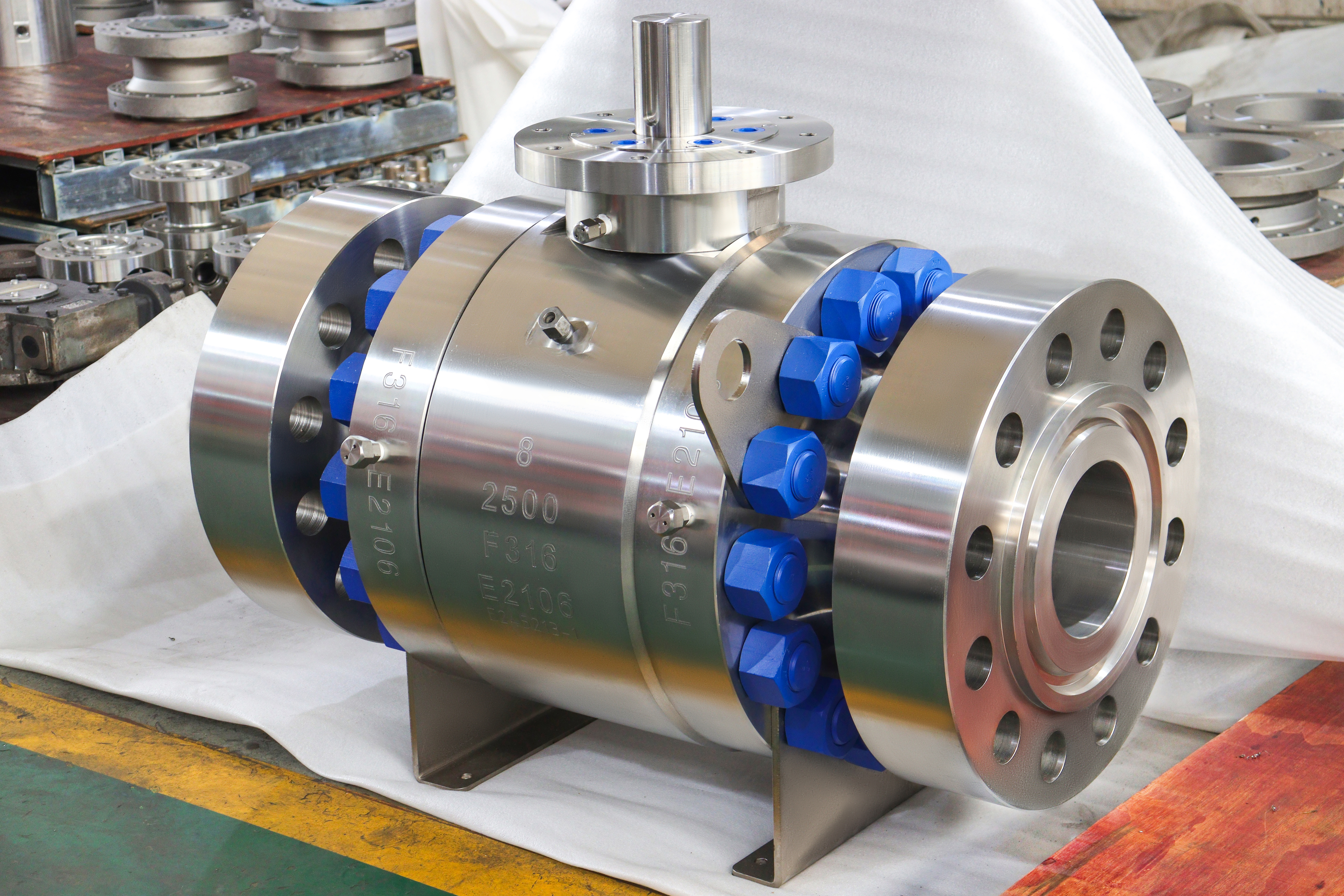
This is an 8 inch Class 2500 trunnion mounted ball valve, full bore, forged F316 stainless, in a three piece side entry body. The body carries four markings worth reading: the size 8, the class 2500, the grade F316, and a heat number beside them. Everything else about the valve has to come from the drawing and the certificate.
At DN200 and Class 2500 a ball valve stops being something a person opens by hand. The gearbox in the photograph is not an accessory; it is how the valve is operated, and the handwheel on it is for the case where the actuator is not there yet or has failed. That single fact reorganises the whole page: weight, lifting, mounting and maintenance access all follow from the size and the class together.
The seat is the part most readers misread. The primary seal is metal, a Stellite faced F316 seat ring against the ball, and the polymer insert behind it is a secondary seal that only does work at low differential. The original sheet lists RPTFE, PEEK and nylon first and the metal seat second, which reads like a soft seated valve with a metal upgrade. It is the other way round, and the difference decides the leakage class you are allowed to promise.
Four things it is not. Not a floating ball valve, so no seat is asked to hold the whole line thrust. Not a soft seated valve, so zero visible leakage is not the acceptance criterion. Not a top entry valve, so in-line service means opening a body joint rather than lifting a bonnet. And not a wellhead or subsea valve, whatever the licences block on the original page says.
Design and Construction
Three pieces means a middle body between two end caps, with the ball, both seat rings and the trunnion bearings carried in the middle body. Two bolted joints, each one a pressure boundary with its own gasket and its own stud set, and each one a place where the bore has to line up. The reason to build it this way is service: with the line isolated and the cavity drained, the middle body can be split out and the seats replaced without cutting the valve out of the pipe.
The ball is held between an upper and a lower trunnion, and at 8 inch those trunnions run in bearing blocks rather than in the body itself. That is the mechanical definition of trunnion mounted, and it has consequences worth stating plainly. Line pressure pushes the ball downstream; the trunnions and their bearings take that push, so the seats are not asked to carry it, the stem does not see it as a side load, and the operating torque does not climb with pressure the way a floating ball valve's does.
The seat works in two stages. Springs push the metal ring against the ball, so contact exists before there is pressure in the line; as differential arrives it acts on the seat ring and adds to that contact, and the metal seal tightens as the pressure rises. Metal on metal is what makes Class 2500 possible at all, because no polymer survives this class as a primary seal. The insert does the opposite job: at low differential the metal contact alone passes a little liquid, because a metal seal needs load and there is very little of it, so the insert closes that gap. That is why the sheet offers RPTFE, PEEK or nylon for medium and low pressure rather than as a general claim, and why the valve seals metal at pressure and polymer at nothing.
Full bore means the passage matches the pipe, so a pig passes and the pressure drop belongs to the pipe. It also makes the middle body the heaviest part of the assembly, so in-line service is a lifting job, and the two support brackets in the photograph exist because at this size the valve is not carried by the pipe alone.

Material Options
F316 here is a real designation, not a house code: ASTM A182 F316, forged austenitic stainless, UNS S31600. The body stamp and the mill certificate say the same thing, which is the point of stamping a grade rather than an internal number. A buyer can read the body, order a certificate, and check that the two agree without asking anyone to translate.
Molybdenum is the reason this valve is 316 and not 304: the addition is what resists chlorides and the acidic condensate that turns up in gas service, which is usually why the valve is stainless at all. It also means 316 is not automatically better in every duty, since in clean low chloride water the two behave alike and the money buys margin.
The body is F316 and the ball may be F316L, which looks inconsistent until you follow the load path. The L grade carries a lower allowable stress in the ASME code tables, so a pressure boundary in F316L needs more wall than the same boundary in F316, and at Class 2500 that is weight and cost. The ball contains no pressure, so it can take the L grade without thickening anything.
The stem is 17-4PH, a precipitation hardening martensitic stainless, and that is a strength decision rather than a corrosion one: a stem under a gearbox sees torque and bending, and 17-4PH carries both at a size where F316 would have to be much larger. On a sour line the question changes shape, because NACE MR0175 acceptance is a condition on heat treatment and hardness rather than a label on a grade, so sour service is declared at inquiry.
| Component | Standard Material | Optional | Service Notes |
|---|---|---|---|
| Body, end caps and middle body | ASTM A182 F316 forging | Other austenitic grades on request | Stamped on the body with the heat number |
| Ball | F316, hard chrome plated or nitrided | F316L | The ball is not a pressure part, so L is usable here |
| Seat ring | F316 with Stellite hardfacing, metal to metal | Soft insert as secondary seal | Metal is the primary seal at this class |
| Seat insert | RPTFE | PEEK, nylon | Works at low differential only |
| Stem | 17-4PH | F316 with ENP, Inconel 718 | Chosen for torque and bending, not for corrosion |
| Trunnion and bearings | Hardened F316 or 17-4PH, 440C bearings | Inconel bushings | Bearing blocks separate from the end caps |
| Body joint gasket | Spiral wound, graphite filler | Ring joint at the pipe flange | One gasket per joint, never reused |
| Packing | Flexible graphite | Low emission set to ISO 15848 | Graphite is the fire safe path |
| Body studs | A193 B7 with A194 2H nuts | B8M for stainless | Lubricant and torque figures come with the drawing |
| Operator | Worm gear with handwheel | Pneumatic, electric or gas over oil | Mounting to ISO 5211 |
Technical Specifications
The class is a cold rating. Class 2500 in the austenitic group of ASME B16.34 reads 6000 psi at 100 F, and it falls from there as the temperature rises; nothing in the table is a working pressure at 400 C. That is why a valve ordered for a hot line should be selected against the rated pressure at the design temperature, not against the number on the nameplate.
| Item | Value |
|---|---|
| Nominal size | 8 inch, DN200 |
| Bore | Full bore, matching the pipe internal diameter |
| Pressure class | Class 2500, recorded as PN420 in API 6D clause 7.2 |
| Rating at 100 F | 6000 psi, austenitic group 2.2 of ASME B16.34 |
| Body material | ASTM A182 F316 forging, stamped on the body |
| Body style | Three piece, middle body between two bolted end caps |
| Ball support | Upper and lower trunnion in bearing blocks |
| Seat | Metal primary, polymer insert as secondary |
| End connection | RTJ flange to ASME B16.5 Class 2500, ring groove to B16.20 |
| Face to face | Per ASME B16.10 and the signed general arrangement drawing |
| Stem sealing | Two O-rings plus graphite, with an anti blowout shoulder |
| Temperature, body | Austenitic group 2.2, flange ratings listed to 1000 F |
| Temperature, seat | The governing figure, and lower than the body figure |
The sheet's minus 29 to plus 425 C is true of one configuration only. With the insert fitted, the insert decides: RPTFE to about 200 C, PEEK to about 260 C, nylon below both. Above that the insert is gone and the valve is metal seated, still sealing, but at the metal acceptance rate. So 425 C is a metal seat figure, and a row offering RPTFE and 425 C together is offering two valves.
Standards and Compliance
The sheet names three design documents; the first job is deciding which governs. For a Class 2500 flanged trunnion valve it is API 6D, which is written for pipeline valves and fixes the bore table, cavity relief, anti static and fire test. API 608 is the general service ball valve standard, and where the two disagree the order has to name one rather than both.
ASME B16.34 supplies wall thickness and pressure temperature ratings, and reaches Class 2500 without a size problem. ASME B16.5 runs to NPS 24, so an 8 inch Class 2500 flange is inside the table rather than needing B16.47. The groove is a B16.20 detail, and the ring that sits in it is a separate purchase item.
API 598 sets the test pressures, shell at 1.5 times the rating and seat at 1.1 times, and leaves acceptance to the seat type: zero visible leakage for a soft seat, a rate by size for a metal one. That is the configuration this valve runs in at temperature, so an order asking for a metal seat and zero leakage is asking for two valves.
Fire testing is API 607 with ISO 10497 as the equivalent, and it matters here because the metal seat is what survives a fire. Anti static continuity is a construction requirement rather than a test result, checked across ball, stem and body. NACE MR0175 enters on a sour line, and ISO 5211 fixes the actuator mounting.
| Requirement | Standard | What J-VALVES Supplies |
|---|---|---|
| Pressure and temperature rating | ASME B16.34, group 2.2 | 6000 psi at 100 F, falling with temperature |
| Product standard | API 6D, named on the order | Bore table, cavity relief, marking |
| Flanges | ASME B16.5 Class 2500 | RTJ facing, groove per B16.20 |
| Face to face | ASME B16.10 | Confirmed on the general arrangement drawing |
| Shell test | API 598 | 1.5 times the rating, no leakage |
| Seat test | API 598 | 1.1 times, acceptance by seat type |
| Fire test | API 607 and ISO 10497 | Certificate covering the size supplied |
| Sour service | NACE MR0175 | Declared at inquiry, qualified on the certificate |
| Material certificate | EN 10204 3.1 | Heat numbers for body, ball and stem |
Manufacturing Process
The body parts start as forgings, not castings, because at Class 2500 a forging has no internal porosity to find at the shell test. The middle body carries the trunnions, the seat pockets and the bore, so most machining hours sit there: the seat pocket and the trunnion bore have to be square to each other and to the flange face.
The end caps are machined with the middle body they will be bolted to and match marked as a set. A cap swapped between bodies joins two faces that were never lapped together, which on a joint at this class is not cosmetic.
Hardfacing comes before lapping. The Stellite overlay goes onto the seat ring, is machined back to profile and lapped against the ball that will actually be fitted, so the contact band is set by the pair rather than by a nominal diameter. Lapping after coating also avoids grinding through the overlay at the contact line, where a hardfaced seat starts to leak.
Assembly ends with ball and seats in the middle body, the caps closed to the marked position, the stem packed with two O-rings and graphite, and the gearbox mounted and stroked. The valve is shell tested, seat tested both ways, drained, capped and crated with the supports taking the load.

Quality Control and Testing
Material identification deserves its own paragraph, because 316 and 316L defeat the usual check. A handheld XRF gun reads the alloy family and calls both 316; carbon is invisible to it, and carbon is the only thing separating the grades. So identification proves the body is 316 family and not 304 or duplex, while the carbon figure comes from the mill certificate or a combustion analysis.
| Step | What Is Checked | Standard or Acceptance |
|---|---|---|
| Incoming material | Heat number against the 3.1 certificate | EN 10204 3.1 |
| Alloy identification | Body, ball and stem by XRF | 316 family, no 304 substitution |
| Carbon level | Mill certificate or laboratory analysis | Separate 316 from 316L |
| Hardfacing | Overlay thickness, bond and profile | Drawing, no porosity at the contact band |
| Machining | Seat pocket, trunnion bores, flange groove | General arrangement drawing |
| Ring groove | Profile and finish of the RTJ groove | B16.20 ring fits without rocking |
| Shell test | Body, joints, stem sealing | API 598, 1.5 times, no leakage |
| Seat test | Both seats, both directions | API 598, 1.1 times, by seat type |
| Function | Gear operation, handwheel, stops, vent and drain | Drawing and order |
| Marking and paperwork | Body stamp, nameplate, 3.1 file, NACE if sour | API 6D marking |
The ring groove check is the one that gets skipped. A scored or oval groove passes a visual inspection and then leaks at the joint, because a ring joint relies on the ring being confined by the groove walls rather than on bolt load alone.

Applications and Industry Service
High pressure gas gathering and injection headers are the natural home. The medium is dry, the pressure is high, and the valve has to isolate a section for maintenance without a leak path; a metal seat is the only seat that survives the differential, and full bore keeps the pig runs possible.
Pressure letdown stations use it for isolation around control valves, where the upstream side sits at Class 2500 and the downstream does not; the valve sees full differential closed and none open, which is the cycle a metal seat handles.
Test benches and hydrostatic stands are the application where the honest leakage rate matters most: a bench that measures leakage cannot use a valve that hides it. Refinery lines in chloride bearing or acidic service take the 316 body for the molybdenum, with the caveat that 316 is not a universal answer to every acid.
Three duties belong elsewhere. Cryogenic service takes a valve with an extended bonnet and a long stem. Subsea and wellhead work takes API 6DSS or 6A equipment, whatever the licence list suggests. And a line needing zero visible leakage should buy a soft seated valve at a class where one exists.
Installation, Operation and Maintenance
The ring joint gasket is a single use item: it deforms to fit the groove, so keep a spare on site rather than reuse the old one, and keep the groove covered until the joint is closed. Bolts get lubricated and tightened in a crossing pattern in stages, because at this class bolt load is what keeps the ring confined.
The valve stands on its supports, not on its flanges. At 8 inch and Class 2500 the assembly is heavy enough that pipe alone should not carry it, and a valve hung on its flanges puts the bending into the body joints. Stem up is normal, and if the line will not allow it, say so at order.
Operation is a quarter turn through the gearbox, and the gearbox is not a device for opening the valve against a blocked line. If the handwheel needs a bar, the problem is upstream of the gearbox. The cavity drain and vent prove the seats and empty the cavity before a joint is opened.
Maintenance splits in two. Packing and stem seals are reachable from the top with the valve closed and the cavity vented, which is why the stem has an anti blowout shoulder and two O-rings above the graphite. Seats and ball need the line isolated and a body joint opened, which is a planned lift with the middle body supported.
How to Specify and Order
Five answers make the quotation exact. The standard, API 6D or API 608, named rather than assumed. The seat configuration, single piston effect, double piston effect or combined, because that decides whether the cavity relieves itself or needs an external device. The bore, full or reduced, and the face to face dimension if the line already has a valve in it. The ring material for the RTJ joint, since the ring is not part of the valve. And the operator, with the actuator mounting face and the torque requirement stated.
Two more answers change the paperwork rather than the valve. Whether the service is sour, which brings NACE MR0175 into the material qualification and changes heat treatment rather than grade. And whether the seat insert is wanted at all: a metal only seat is a different valve from a metal seat with a polymer insert, with a different temperature ceiling and a different acceptance rate, and the two are easy to confuse on a data sheet that lists both.
Ask for the 3.1 certificate with heat numbers for body, ball and stem, the shell and seat test records, the fire certificate with its size range, the hardfacing procedure, and the general arrangement drawing that fixes the face to face dimension and the support positions. The drawing is the document that defines this valve; every other document describes a family it belongs to.
FAQ
Q: If the seat is metal, can the valve still be sold as zero leakage?
A: No, and this is the first thing to settle before the order. API 598 gives a metal seat an acceptance rate that depends on size, while a soft seat is zero visible leakage. This valve is metal first: the Stellite faced ring is what holds Class 2500, and the RPTFE or PEEK insert only closes the low differential gap. So the leakage class of the valve is the metal class, and a specification that asks for a bubble tight 2500 LB valve is asking for something that does not exist at this class.
Q: Why may the ball be F316L when the body must be F316?
A: Because the body contains pressure and the ball does not. F316L carries a lower allowable stress in the ASME code tables, so a pressure boundary in the L grade needs more wall than the same boundary in F316, and at Class 2500 that is weight and cost on every part that holds pressure. The ball sits inside that boundary carrying no differential of its own, so the L grade can be used there without adding a millimetre anywhere.
Q: Can the ring gasket be reused if the joint is opened once?
A: No. A ring joint seals because the metal ring is confined by the groove and deformed into contact, so a ring that has already been compressed will not seat the second time. Keep a spare on site, order the ring as its own line item because it does not ship with the valve, and keep the groove covered until the joint is closed. The ring material also follows the medium, so it is a separate decision from the valve body.
Q: What does the 425 C figure actually apply to?
A: Only to the metal only configuration. With the polymer insert fitted the insert decides: RPTFE is offered to about 200 C, PEEK to about 260 C, and nylon below both. Above those figures the insert is gone and the valve is metal seated, which still seals but at the metal acceptance rate. The 425 C on the original sheet is the body figure, not the valve figure, and the two should never sit in one row without the seat material beside them.


Hot Products


News
Ball Valves in A Kraft Pulp Mill: Black Liquor, Green Liquor And The Cost of Choosing The Alloy by Habit
White liquor at pH 14 cracks carbon steel welds, black liquor sets solid below 100 C, green liquor dregs grind seats: alloy choice and torque in a kraft mill.
Read More
Slug Flow And Ball Valves: What Actually Arrives At The Seat
A slug is liquid mass with momentum, not a pressure spike. What changes at the seat, in the cavity and at the actuator when liquid reaches a ball valve.
Read More
Ball Valves in Direct Lithium Extraction: PH 1 Eluate, Gypsum Scale And 438,000 Cycles in Twenty-Five Years
Direct lithium extraction swings valves from pH 1 eluate to pH 12 caustic, 48 column switches a day and gypsum scale. Materials, seats and torque.
Read More
Ball Valves in Geothermal Brine: Silica Scale, Chloride Cracking And The Cooling Trap
Why geothermal brine destroys ball valves: retrograde silica scale, calcite at the flash point, chloride cracking above 60 C and the 250 C seat limit.
Read More