
CHINA J-VALVES Offers Various High-quality I ndustrial Ball Valves
J-VALVES, a distinguished professional ball valve manufacturer rooted in China, takes pride in its extensive product portfolio. Our offerings span a wide range, including trunnion-mounted ball valves, floating ball valves, high-temperature ball valves, high-pressure ball valves, metal-sealed ball valves, ultra-low temperature ball valves, DBB ball valves, Three-way And Four-way Ball Valve, and fully welded ball valves. Each product is a testament to our commitment to precision engineering and reliable performance. Meticulously crafted, they are designed to not only meet but exceed the most stringent industrial demands, ensuring stable operation even under extreme conditions. This enables us to provide our clients with high-value services and makes our valves widely sought-after in industries.
Product Category
Contact Us

Pressure Class: ASME Class 600 (PN100)
Temperature Rang:e -29°C to +425°C
Body Material: A105, A350 LF2, F304, F316, F51 duplex, F53 super duplex
Body Style: Fully welded, no body joint
Ball: F304 / F316 / F51 / F53, HVOF tungsten carbide or Stellite
Seat: RPTFE, Devlon, Vespel, or metal seat with Inconel or Stellite
Stem: F6a, F304, F316, 17-4PH, Inconel 718
Packing: Pure graphite, Inconel wire reinforced, low emission composite
End Connection: Butt weld to ASME B16.25, flanged transition optional
Actuator: Electric, IP68, Ex d IIB T4, 50 to 300000 Nm range
Handwheel: Mechanical override, clutch, torque limiter, padlockable
Design Standard: API 6D, ASME B16.34
Test Standard: API 6D, API 598, NDT on all body welds
-
Q967H / Y
-
J-VALVES
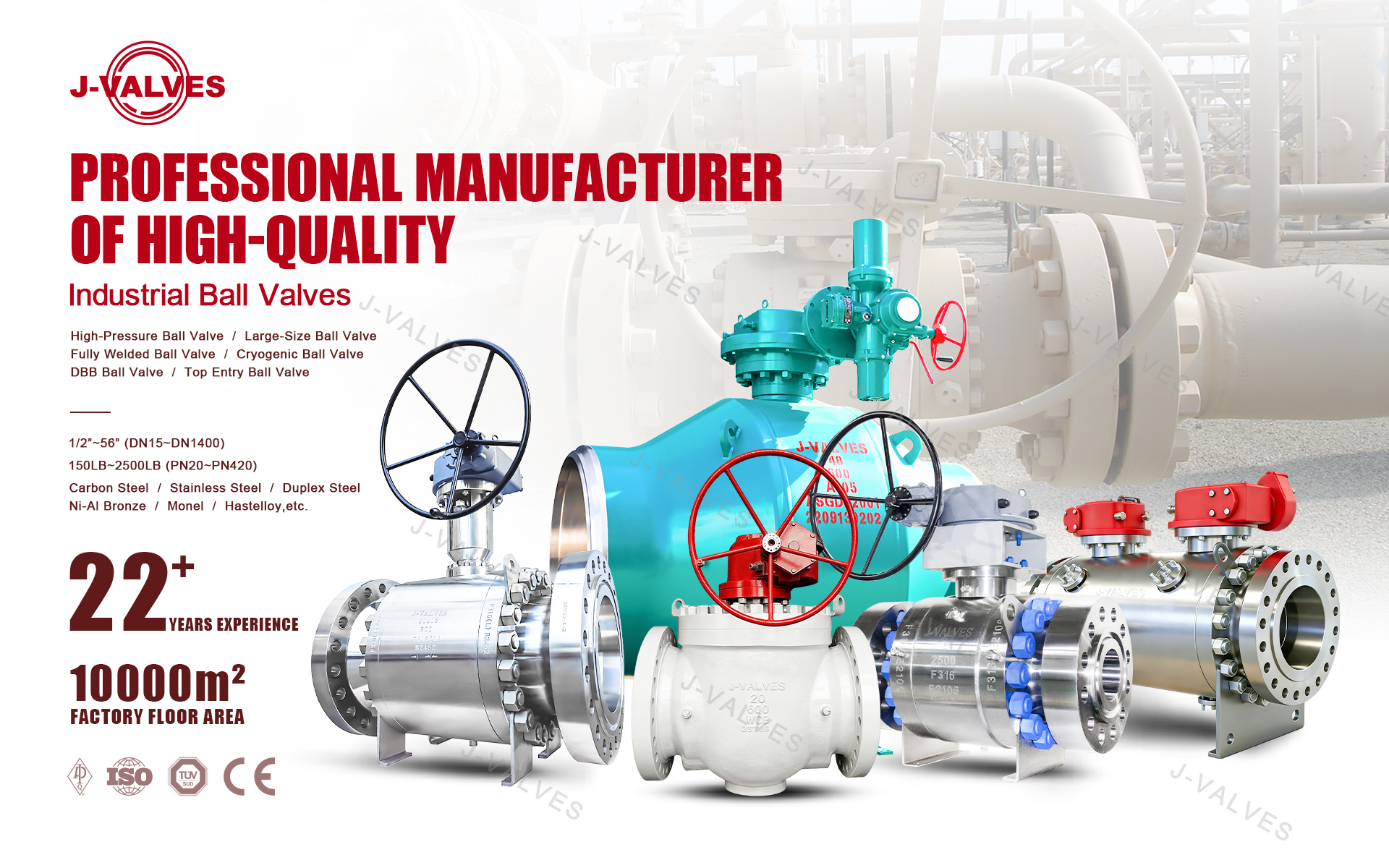
A fully welded ball valve has no body joint at all: the body is welded from pipe sections and forgings, so the only leak paths left are the stem seal and the two end welds. At 48 inch Class 600 that removes a gasketed flange with a circumference of nearly four metres from the pressure boundary, which is why this design is the default for buried transmission lines and district heating mains.
This page covers the 48 inch (DN1200) Class 600 build with an electric actuator and a mechanical handwheel override. The body is A105 or LF2 carbon steel, or F304, F316, F51 duplex and F53 super duplex where the water chemistry demands it, and the ends are butt weld to ASME B16.25 with an optional flanged transition piece.

What Welding the Body Actually Buys
A bolted body joint is a controlled leak path. It has a gasket, a set of studs and a preload that relaxes over twenty years of thermal cycling. It also has to be accessible, which is why a buried side entry valve needs a pit, and a pit is a place where water collects and corrosion starts. Welding the body removes the joint, removes the pit, and removes the inspection liability that comes with both.
Criterion | Bolted body | Fully welded body |
|---|---|---|
Pressure boundary joints | One or two gasketed body joints | None, only stem seal and end welds |
Buried installation | Needs a pit or a chamber | Directly buried, no chamber |
Design life | 20 to 30 years with joint maintenance | 30 to 50 years, matched to the pipe |
Internal access | Split the body in place | Cut the valve out of the line |
External corrosion | Joint, studs and gasket faces are vulnerable | One continuous painted or coated surface |
Weight at 48 inch Class 600 | Higher, because of flanges and bolting | Lower by roughly 10 to 15 percent |
Why 48 Inch Class 600 Is an Actuator Problem Before It Is a Valve Problem
At 48 inch the seat circumference is about 3.8 metres and the seat load at Class 600 test pressure is measured in hundreds of kilonewtons. The valve still turns a quarter turn, but the torque needed to do it is beyond a gear operator that one person can wind, and beyond most handwheels that fit inside a compound. That is why the size is normally supplied actuated, with the handwheel present as a fallback rather than as the primary operator.
Actuator sizing on this size has to start from a measured torque, not a calculated one. The calculation gives the seat and bearing contribution reasonably well, but packing friction after two years in a wet pit does not follow the formula. We quote the break to open torque measured at the test pressure, and we recommend a minimum safety factor of 1.5 for electric and 2.0 for pneumatic, because a stalled actuator on a buried mainline valve is an excavation, not a service call.
The Handwheel Override: Clutch, Torque Limit and Lock
A handwheel on a 48 inch valve is not there to be used often. It is there for the case where the power is off, the actuator has failed, and the line has to be isolated. That changes the design brief: the override has to engage without tools, it has to be operable by one person within a stated torque, and it must not be possible to leave the clutch in a position that damages the motor when power returns.
Declutching lever or automatic clutch that disengages the motor whenever the handwheel is turned.
Handwheel rim effort limited to about 360 N, achieved with a ratio rather than a longer lever.
Mechanical torque limiter on the manual path, set below the yield of the stem and the seat.
Dial and pointer showing position to within 5 degrees, readable from the platform.
Padlockable handwheel in any position, for lock out tag out during maintenance.
Epoxy coated handwheel and stainless fasteners, because the valve may be in a flooded pit.
The stroke time for on off service is normally set between 60 and 120 seconds at this size. Faster than that and the water hammer at the end of travel becomes the design case for the pipe, not the valve. Modulating duty needs a different actuator frame and a positioner, and the duty cycle has to be stated, because an S2 15 minute motor asked to modulate will fail in months.
Body Materials for Water, Steam and Brine
Carbon steel A105 or LF2 covers most district heating and transmission water, with the caveat that the internal surface needs a coating or a corrosion allowance. F304 and F316 are used where chlorides are low but purity matters, and duplex F51 or super duplex F53 where chloride content, velocity or sulphate reducing bacteria make 316 a poor bet.
Grade | Chloride limit, indicative | Typical service | Note |
|---|---|---|---|
A105 / LF2 | Not applicable, carbon steel | Treated water, district heating, oil | Internal epoxy or cement lining recommended |
F304 | Up to about 200 mg/L at ambient | Demineralised water, low chloride systems | Not for seawater or brackish water |
F316 | Up to about 500 mg/L at ambient | Cooling water, moderate chloride | Risk of crevice attack under deposits |
F51 duplex | Up to about 1000 mg/L | Brackish water, produced water | Higher strength, good erosion resistance |
F53 super duplex | Above 1000 mg/L | Seawater, high velocity brine | Needs qualified welding procedure |

Welding, NDT and the End Connection
The body is welded with submerged arc for the longitudinal and circumferential seams and gas tungsten arc for the root. All body welds are 100 percent radiographed or ultrasonically tested, and the procedure and welders are qualified to ASME IX. After welding the body is stress relieved where the material and thickness require it, then hydrotested at 1.5 times the rating.
Ends are butt weld to ASME B16.25 with a machined bevel matching the line pipe wall. Where the valve wall and the pipe wall differ by more than 1.5 to 1, a transition piece is welded on at the works so the field weld is a simple pipe to pipe joint. That single detail removes most of the field fit up problems on a 48 inch tie in, and it is worth specifying explicitly.

Installation and Corrosion Protection
A buried fully welded valve needs three things done correctly. The coating has to be continuous and compatible with the line coating, with a heat shrink sleeve at each field weld. The stem extension has to bring the operator above grade or into a small chamber, with the extension housing sealed against groundwater. And the cathodic protection has to be bonded across the valve, because an isolated valve body in a protected line becomes the anode.
For above ground installation the same valve is used on district heating mains in plant rooms and trenches, where the absence of a body joint matters less but the absence of a gasket fire load still does. The valve is certified fire safe to API 607, and the graphite stem seal is the reason it can make that claim without a soft secondary seal.
Fully Welded Ball Valve FAQ
What is a fully welded ball valve?
It is a ball valve whose body is welded from pipe and forged sections, with no bolted body joint. The only pressure boundary joints are the stem seal and the two end welds, which is why it is used for buried lines where a gasketed joint could not be inspected or maintained.
Can a fully welded ball valve be repaired?
The stem seal can be replaced with the valve in service, because the stem is retained by the bonnet and the upper seal is accessible. Seat or ball damage requires cutting the valve out of the line and either replacing it or returning it to the works. That is why the design is specified with a design life matched to the pipeline rather than to a maintenance interval.
Why does a 48 inch valve need an actuator and a handwheel?
The torque at 48 inch Class 600 is beyond what a person can apply through a normal gear operator, so an actuator is the primary operator. The handwheel is a fallback for loss of power or actuator failure, with a clutch that disengages the motor and a torque limiter that protects the stem.
What is the maximum handwheel effort on this valve?
About 360 N at the rim, which one person can sustain for a short duration. It is achieved through gear reduction rather than a longer lever, and the manual path has a mechanical torque limiter set below the stem yield strength.
Which material should be used for a buried water line?
Carbon steel A105 or LF2 with an internal coating for treated water and district heating, F316 for low chloride cooling water, and duplex F51 or super duplex F53 for brackish water, seawater or high velocity brine. Chloride content and velocity decide the grade more than pressure does.
How is the valve protected against corrosion when buried?
A continuous external coating compatible with the pipeline coating, heat shrink sleeves over the field welds, a sealed stem extension housing, and cathodic protection bonded across the valve so the body does not become an anode. The coating is normally specified together with the pipeline coating system rather than separately.
Hot Products


News
Ball Valves in A Kraft Pulp Mill: Black Liquor, Green Liquor And The Cost of Choosing The Alloy by Habit
White liquor at pH 14 cracks carbon steel welds, black liquor sets solid below 100 C, green liquor dregs grind seats: alloy choice and torque in a kraft mill.
Read More
Slug Flow And Ball Valves: What Actually Arrives At The Seat
A slug is liquid mass with momentum, not a pressure spike. What changes at the seat, in the cavity and at the actuator when liquid reaches a ball valve.
Read More
Ball Valves in Direct Lithium Extraction: PH 1 Eluate, Gypsum Scale And 438,000 Cycles in Twenty-Five Years
Direct lithium extraction swings valves from pH 1 eluate to pH 12 caustic, 48 column switches a day and gypsum scale. Materials, seats and torque.
Read More
Ball Valves in Geothermal Brine: Silica Scale, Chloride Cracking And The Cooling Trap
Why geothermal brine destroys ball valves: retrograde silica scale, calcite at the flash point, chloride cracking above 60 C and the 250 C seat limit.
Read More