CHINA J-VALVES Offers Various High-quality I ndustrial Ball Valves
J-VALVES, a distinguished professional ball valve manufacturer rooted in China, takes pride in its extensive product portfolio. Our offerings span a wide range, including trunnion-mounted ball valves, floating ball valves, high-temperature ball valves, high-pressure ball valves, metal-sealed ball valves, ultra-low temperature ball valves, DBB ball valves, Three-way And Four-way Ball Valve, and fully welded ball valves. Each product is a testament to our commitment to precision engineering and reliable performance. Meticulously crafted, they are designed to not only meet but exceed the most stringent industrial demands, ensuring stable operation even under extreme conditions. This enables us to provide our clients with high-value services and makes our valves widely sought-after in industries.
Product Category
Contact Us


Pressure Class: ASME Class 2500 (PN420), about 42 MPa at 38°C
Temperature Range: -29°C to +425°C
Body Material: ASTM A182 F316 forged stainless steel
Ball: F316, HVOF tungsten carbide or Stellite, 68 HRC min
Seat: Devlon, PEEK, or metal seat with Inconel or Stellite
Stem: F316, 17-4PH or Inconel 718, anti blowout
Bolting: B8M Class 2 or Inconel 718, hydrogen embrittlement resistant
Bearing: Metal backed, Stellite or tungsten carbide, self lubricating
Body Style: Three piece forged body, trunnion mounted, reduced bore
End Connection: Flanged RTJ or RF to ASME B16.5, butt weld optional
Design Standard: API 6D, ASME B16.34, API 608
Test Standard: API 6D, API 598, shell at 1.5 times rating
Operation: Gear with extension stem, pneumatic, electric, hydraulic, ESD
-
Q347H/Y
-
J-VALVES
Class 2500 is the top of the ASME B16.34 rating ladder, about 42 MPa at 38°C, and at 6 inch it produces a valve that is less about flow and more about containing a pressure that will cut steel. This page covers the 6x5 inch build in forged F316, trunnion mounted, with double piston effect seats, for gas gathering, hydrocracking and supercritical steam where the line pressure is the design case and the fluid is an afterthought.
The valve is a three piece forged body in A182 F316, with an F316 ball at 68 HRC or harder by HVOF coating, 17-4PH or Inconel 718 stem, metal backed bearings, B8M Class 2 bolting and RTJ or RF flanges. At this rating the wall thickness, the bolting and the seat preload are all engineered rather than selected from a table.

What 42 MPa Actually Changes
At Class 2500 the body wall on a 6 inch valve is roughly 40 to 50 mm thick, the valve weighs in the order of 700 to 1000 kg, and the bonnet bolting carries a preload measured in meganewtons. Nothing about the valve is scaled up from a Class 600 pattern, which is why a supplier who offers the same casting across the range should be asked for the wall thickness calculation.
Class | Rating at 38°C | Wall on a 6 inch body | Typical use |
|---|---|---|---|
Class 600 | 10.2 MPa (102 bar) | About 18 mm | Process isolation, general hydrocarbon |
Class 900 | 15.3 MPa (153 bar) | About 25 mm | High pressure gas, wellhead downstream |
Class 1500 | 25.5 MPa (255 bar) | About 32 mm | Gas gathering, high pressure steam |
Class 2500 | 42.0 MPa (420 bar) | About 40 to 50 mm | Ultra high pressure gas, hydrocracking, supercritical steam |
Those wall figures are indicative for a cast or forged carbon steel body and will move with material and design method, but the ratio is what matters: Class 2500 carries roughly four times the pressure of Class 600 and roughly 2.5 times the wall. That extra metal is also extra heat capacity, which matters if the valve is ever expected to reach a new temperature quickly.
Why 6x5 Is Not a Full Port Valve
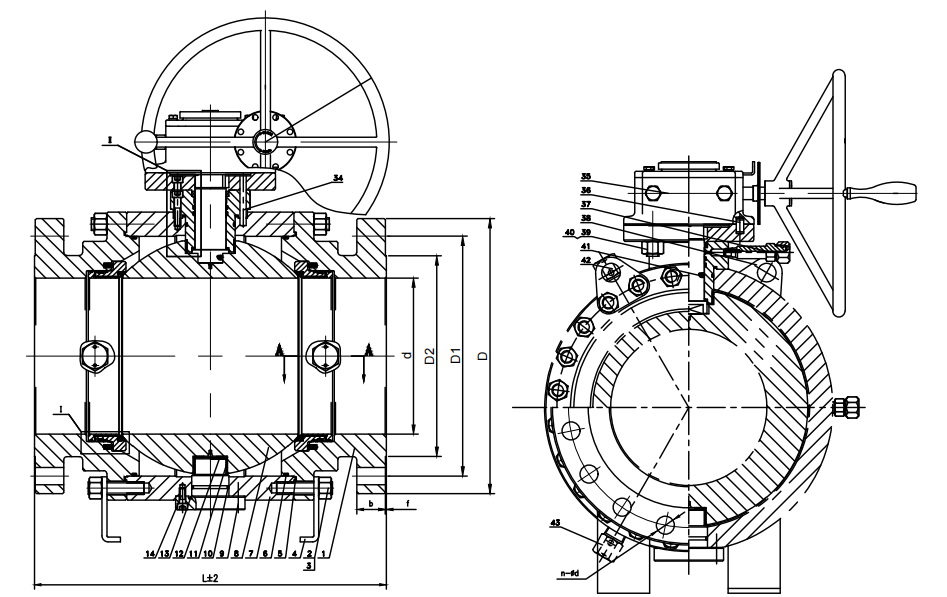
A 6x5 valve has a 6 inch body and a 5 inch bore. The bore matches a 5 inch line, so relative to a DN125 pipe it is full port, but relative to the 6 inch flange it connects to it is a reduced bore. Calling it full bore, as some catalogues do, is a description of the bore against a different pipe size and it confuses every engineer who reads it.
The reason the combination exists is practical. A 6 inch Class 2500 full port valve has a bore of about 152 mm, a ball of about 230 mm, and a body large enough that the forging becomes expensive and the weight becomes a handling problem. Reducing the bore to 5 inch cuts the ball diameter, the seat circumference and the torque, while keeping the flanges that match the line. On a high pressure gas line the flow is usually limited by the compressor, not the valve.
Forged F316: Where Casting Stops
At Class 2500 and 6 inch the body is forged, not cast. A casting of that section thickness is difficult to radiograph reliably and the consequence of a shrinkage defect at 42 MPa is not a weep, it is a rupture. Forging gives a dense, directionally worked structure with no shrinkage porosity, and the subsequent machining removes the surfaces that carry the least soundness.
Property | A182 F316 forged | A351 CF8M cast |
|---|---|---|
Tensile strength | 515 MPa minimum | 485 MPa minimum |
Yield strength | 205 MPa minimum | 205 MPa minimum |
Elongation | 30 percent minimum | 30 percent minimum |
Soundness | No shrinkage porosity, verified by UT | Requires RT or UT of critical sections |
Cost at 6 inch Class 2500 | Higher, more machining | Lower if the casting is sound |
Typical use at this class | Standard choice | Rare above Class 900 |
F316 rather than F304 is chosen for the molybdenum, which is what gives resistance to chloride pitting and to the reducing acids that appear in sour or wet gas service. At 42 MPa the material is not working near its yield, so the choice is about corrosion and about toughness, not strength.
The Seat at 42 MPa: Double Piston Effect and Cavity Relief
At this pressure a single piston effect seat relieves cavity overpressure automatically to the low pressure side, which is convenient but means the upstream seat is not a barrier in both directions. A double piston effect seat seals from both sides and gives a genuine double barrier, at the cost of requiring an external relief device on the body cavity.
Seat design | Seals both directions | Cavity self relieving | Double barrier | Where used |
|---|---|---|---|---|
Single piston effect, SPE | Yes | Yes | No | General isolation, thermal cycling duty |
Double piston effect, DPE / DIB 1 | Yes | No, needs external relief | Yes | High pressure gas, critical isolation |
Combination DIB 2 | Yes, preferred direction | Yes | Yes in one direction | Where both features are required |
Whichever is chosen, the cavity relief has to be engineered, not assumed. A trapped liquid volume at 42 MPa that warms by 20 K will try to expand by a few percent, and because liquid is nearly incompressible the resulting pressure spike can exceed the body rating within minutes. That is why a DPE valve needs a relief valve or a vent on the cavity, and why the vent must not be plugged by a well meaning operator.
Bolting, Hydrogen and Sour Service
The bolting is B8M Class 2, the molybdenum bearing stainless, because it matches the body thermally and does not galvanically couple badly to it. In hydrogen service the choice narrows: high strength martensitic bolts are avoided because of hydrogen embrittlement, and Inconel 718 or a controlled hardness B8M is used instead, with the hardness verified on the certificate rather than assumed.
For sour service, NACE MR0175 limits the hardness of the trim and the bolting and requires the seat and ball hardness to be stated. At Class 2500 this is not a paperwork exercise: a hardfaced ball at 68 HRC is acceptable because it is a coating, but a through hardened 17-4PH stem at the same hardness is not. The specification has to distinguish between the two.
RTJ or RF at This Pressure
Above Class 900 the ring type joint becomes the default, because a metal ring confined in a groove cannot be extruded by pressure the way a soft gasket can, and the joint is not sensitive to bolt relaxation in the same way. RF flanges are still used where the mating equipment is RF, but they need a spiral wound gasket with an outer ring and a controlled bolt preload.
The practical detail is that an RTJ joint has to be made up dry and clean, with the ring and the groove free of grease, and torqued in a crossing pattern to a calculated value. A joint made up by feel at 42 MPa will pass the hydrostatic test and weep in service, and the weep will be attributed to the valve rather than to the joint.

Testing at 42 MPa
The shell test is at 1.5 times the rating, which at Class 2500 means about 63 MPa, and the seat test at 1.1 times, about 46 MPa. Both are done with water, with a hold time long enough to inspect every joint, and the test pressure is recorded on the certificate with the gauge number. At this pressure the test itself is a hazard, and the enclosure and the exclusion zone are part of the procedure.
The additional records worth having are the body wall thickness measurements at the critical sections, the ultrasonic examination of the forging, the bolting preload calculation and the measured operating torque. At this size the torque is large enough that a gearbox selection based on a catalogue figure will be wrong, and the error shows up as a sheared gearbox key rather than a slow valve.

Specifying a Class 2500 Valve
Size, class and whether 6x5 or 6x6 is actually required, because the two are not interchangeable in flow terms.
Design pressure and the maximum ambient plus process temperature, since the rating falls with temperature.
Fluid, including hydrogen partial pressure or H2S content, which changes the bolting and the trim.
Seat design: SPE for self relieving cavity, DPE for double barrier with external relief.
End connection and gasket type, RTJ against RF, and the mating flange standard.
Actuation and the measured torque on which the actuator is sized.
NDE requirements for the forging, and whether the buyer witnesses the shell test.
Documentation: 3.1 certificate, hardness survey, bolting preload calculation, torque record.
Class 2500 Trunnion Ball Valve FAQ
What pressure is Class 2500?
About 42 MPa, or 420 bar, at 38°C for carbon and stainless steel bodies to ASME B16.34. The rating falls as temperature rises, so the design temperature has to be stated when the class is chosen.
What does 6x5 mean on a ball valve?
A 6 inch body and flange with a 5 inch bore. It is full port relative to a 5 inch line but reduced bore relative to the 6 inch flanges it connects to, which is why describing it simply as full bore is misleading.
Why is the body forged rather than cast at Class 2500?
Because a casting of that wall thickness is difficult to verify and a shrinkage defect at 42 MPa can rupture rather than weep. A forging has no shrinkage porosity and can be ultrasonically examined with confidence, which is why forged bodies are standard above Class 900 at this size.
What is the difference between SPE and DPE seats?
A single piston effect seat relieves trapped cavity pressure to the lower pressure side automatically, so the cavity is self relieving but the valve is a single barrier in one direction. A double piston effect seat seals from both sides and gives a double barrier, but the cavity must have an external relief device.
Can this valve be used in hydrogen service?
Yes, with the bolting and trim specified for it. High strength martensitic bolting is avoided because of hydrogen embrittlement, and Inconel 718 or a controlled hardness B8M is used, with hardness verified on the material certificate. The requirement should be stated at enquiry.
Why is RTJ used instead of RF at Class 2500?
A ring type joint uses a confined metal ring that cannot be extruded by pressure, and it is less sensitive to bolt relaxation than a soft gasket. RF flanges can be used at this class, but they need a spiral wound gasket with an outer ring and a calculated bolt preload.
Hot Products


News
Ball Valves in A Kraft Pulp Mill: Black Liquor, Green Liquor And The Cost of Choosing The Alloy by Habit
White liquor at pH 14 cracks carbon steel welds, black liquor sets solid below 100 C, green liquor dregs grind seats: alloy choice and torque in a kraft mill.
Read More
Slug Flow And Ball Valves: What Actually Arrives At The Seat
A slug is liquid mass with momentum, not a pressure spike. What changes at the seat, in the cavity and at the actuator when liquid reaches a ball valve.
Read More
Ball Valves in Direct Lithium Extraction: PH 1 Eluate, Gypsum Scale And 438,000 Cycles in Twenty-Five Years
Direct lithium extraction swings valves from pH 1 eluate to pH 12 caustic, 48 column switches a day and gypsum scale. Materials, seats and torque.
Read More
Ball Valves in Geothermal Brine: Silica Scale, Chloride Cracking And The Cooling Trap
Why geothermal brine destroys ball valves: retrograde silica scale, calcite at the flash point, chloride cracking above 60 C and the 250 C seat limit.
Read More