CHINA J-VALVES Offers Various High-quality I ndustrial Ball Valves
J-VALVES, a distinguished professional ball valve manufacturer rooted in China, takes pride in its extensive product portfolio. Our offerings span a wide range, including trunnion-mounted ball valves, floating ball valves, high-temperature ball valves, high-pressure ball valves, metal-sealed ball valves, ultra-low temperature ball valves, DBB ball valves, Three-way And Four-way Ball Valve, and fully welded ball valves. Each product is a testament to our commitment to precision engineering and reliable performance. Meticulously crafted, they are designed to not only meet but exceed the most stringent industrial demands, ensuring stable operation even under extreme conditions. This enables us to provide our clients with high-value services and makes our valves widely sought-after in industries.
Product Category
Contact Us


Bore: 3 inch reduced bore
Pressure Class: ASME Class 900 / PN150
Rating at 38°C: 153.2 bar
Body Material: Forged ASTM A105N, normalised
Ball: A105N with hard chrome, or F316 on request
Seat: PEEK standard, metal seated on request
Stem: 13% chrome or F6a, blowout proof
Mounting: Trunnion mounted, spring loaded seats
End Connection: RTJ to ASME B16.5, butt weld to B16.25
Design Standard: API 6D, ASME B16.34, ASME B16.10
Sour Service: NACE MR0175 / ISO 15156, 22 HRC maximum
Test: Shell 230 bar, seat 168 bar, API 598
Operation: Gear or pneumatic actuator
-
Q47F
-
J-VALVES
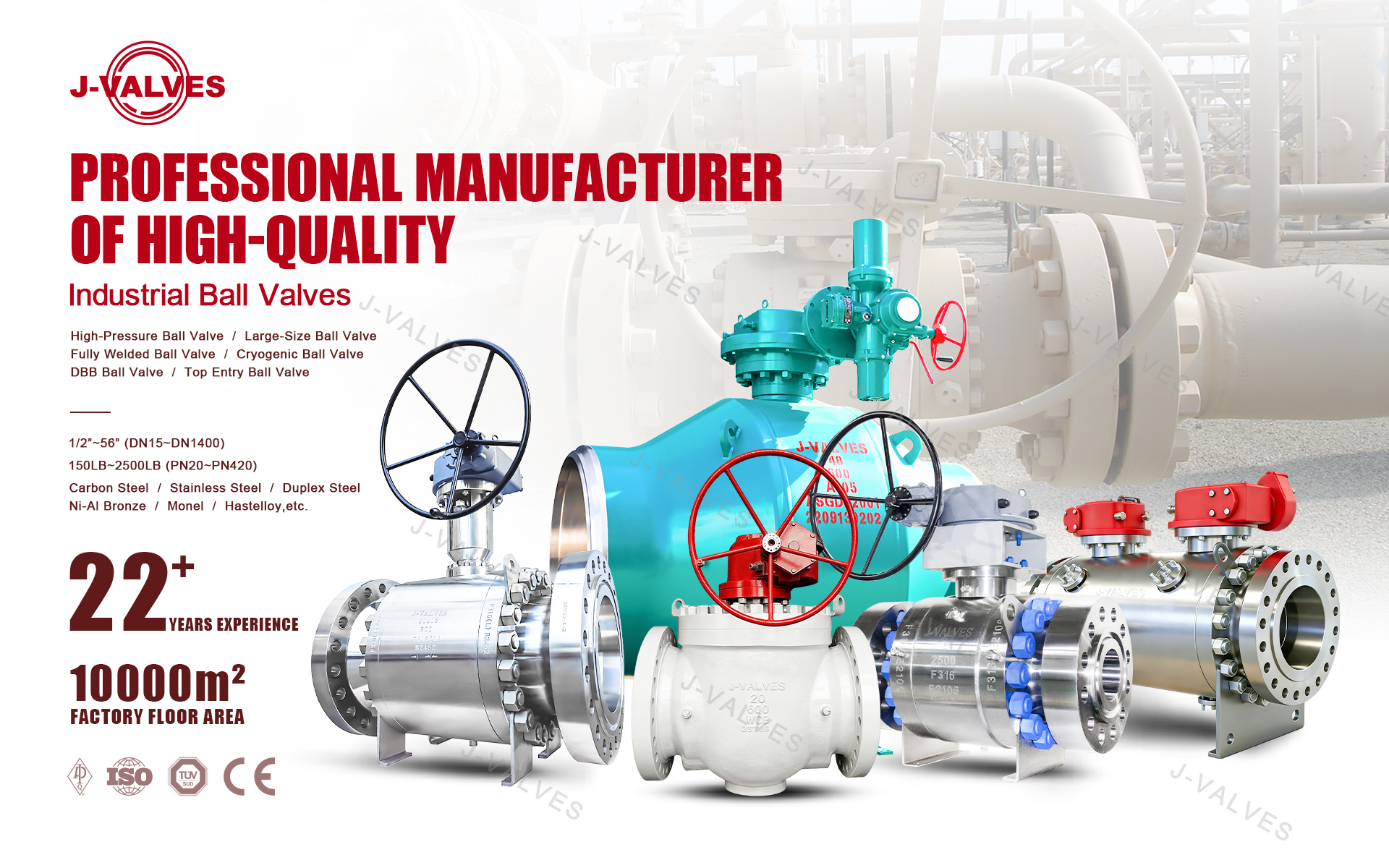
A 4x3 900LB trunnion ball valve is a reduced bore valve with a 4 inch body and end connections and a 3 inch bore through the ball, forged in ASTM A105N carbon steel and rated 153.2 bar at 38°C. The notation describes the body size first and the bore second, and the arrangement exists because pipeline flanges and spools are standardised at 4 inch while 3 inch is enough bore to pass the design flow, so the operator gets the connection he needs and the pressure drop he can accept without paying for a full bore 4 inch ball, seat and actuator.
J-VALVES forges this valve from 2x1.5 up to 12x10 in Class 600, 900 and 1500, in A105N, LF2, F316 and F51, with RTJ or butt weld ends, trunnion mounting from 4 inch upward, and PEEK or metal seats. The buyers are pipeline and manifold contractors working to a line class sheet where the valve size is fixed by the flange and the bore is fixed by hydraulics. This page deals with the three things that decide whether the reducing bore is the right call: the load at 153 bar, what normalising does to A105, and the one duty where a reduced bore valve cannot be used at all.

The One Hard Limit: Pigging
A reduced bore ball valve has a step in the bore. A pig driven by product cannot pass that step, so any line that is pigged for cleaning, for inspection or for product separation must have full bore valves throughout. This is not a preference, it is a hard constraint, and it is discovered late in projects more often than any other detail on this valve.
The distinction matters because the two duties look identical on a datasheet. A gathering line that is pigged annually needs full bore. A station manifold, a meter run bypass, a launcher trap drain or a short crossover that is never pigged can use reduced bore without any consequence. If the line class sheet does not say, the question to ask is not "full bore or reduced bore" but "will anything ever be pushed through this line". A sphere, a pig or an inspection tool will not pass, and a foam pig will pass but will not clean the step.
The second consequence of the step is erosion. At 153 bar and a high velocity, the expansion at the downstream step is where droplets and solids impinge, and a reduced bore valve in severe service will show wear at the step before anywhere else. In clean dry gas this is irrelevant; in wet gas or in a line carrying sand, it argues for full bore or for a hard faced bore.

What 153 Bar Does to a 3 Inch Ball
The bore is 80 mm, so the area is 0.00503 square metres. At 153.2 bar, or 15.32 MPa, the axial load on the ball is about 77 kN, roughly eight tonnes. That is the load the trunnion journals and the body ribs carry, and it is the reason this valve is trunnion mounted rather than floating even though the bore is only 3 inch: at Class 900 the floating design would put 77 kN into the seat and stem on every closure, and the seat would take a set within a few hundred cycles.
Configuration | Bore area | Load at 153.2 bar | Mounting |
|---|---|---|---|
3 inch full bore, Class 900 | 0.00503 m² | 77 kN | Trunnion preferred, floating marginal |
4x3 reduced bore, Class 900 | 0.00503 m² | 77 kN | Trunnion, same as 3 inch full bore |
4 inch full bore, Class 900 | 0.00811 m² | 124 kN | Trunnion |
Note what the table shows: a 4x3 valve carries the same ball load as a 3 inch valve, not the load of a 4 inch valve. The body and the flanges are 4 inch, but the pressure-containing internals are 3 inch. That is the whole economic argument for the pattern, and it is also why the actuator is sized like a 3 inch valve and the weight is closer to a 4 inch one.
A105 and A105N: Why the N Matters
ASTM A105 is a forged carbon steel for ambient and moderate temperature service, with 0.35% maximum carbon, 250 MPa minimum yield and 485 MPa minimum tensile. The N suffix means the forging has been normalised: heated above the critical temperature and cooled in air, which refines the grain and makes the mechanical properties uniform through the section.
For a Class 900 body the difference is not cosmetic. A large forging that is not normalised can have a coarse grain structure and inconsistent toughness from the surface to the centre, and at 153 bar with a 77 kN internal load, toughness is what stops a small defect from becoming a fast fracture. Normalising also improves Charpy performance, which is what allows an A105N valve to be offered at -29°C with test results rather than by assertion.
A105N still has a hard low temperature limit of about -29°C. Below that, A350 LF2 is the correct carbon steel, at about -46°C, and below -46°C the body has to be austenitic. A supplier offering an A105N body at -40°C is outside the material's qualification, and the Charpy results will not support it.
For sour service, NACE MR0175 and ISO 15156 require hardness control, typically 22 HRC maximum on the body and welds, and restrict weld repairs. A105N is acceptable when the hardness and the chemistry are controlled and documented; the certificate has to show the hardness survey, not just the heat number.
Seats at Class 900
At 153 bar the seat is the part most likely to be got wrong. A plain PTFE seat will extrude at this pressure, particularly at the small clearance between the seat carrier and the ball, and the symptom is a valve that seals when new and passes after a few cycles. The workable options are a PEEK seat, a PTFE seat with a close-fitting anti-extrusion backup ring, or a metal seat.
PEEK is the usual choice for clean service up to about 260°C: it has the compressive strength to hold the seat load at 153 bar and does not creep like PTFE. A metal seat is chosen for abrasive duty, for fire survival without relying on a soft insert, or for temperatures above the polymer limit, and the leak rate is then agreed to ISO 5208 rather than assumed to be zero. The ball in a metal seated valve is lapped to the seat and the pair is matched, which means the ball and seat are not interchangeable between valves.

Ends, Testing and the Documentation That Matters
At Class 900 the standard end is a ring joint to ASME B16.5, and butt weld ends to ASME B16.25 are common on new pipeline construction where the valve is welded in. Face-to-face follows ASME B16.10. The shell test is at 1.5 times the rating, 230 bar, and the seat test at 1.1 times, 168 bar, with the leak rate to API 598 or API 6D.
The documentation package for a forged pipeline valve is the part that carries the risk. It should contain the forging certificate with the heat number matched to the body stamping, the heat treatment record showing normalising, the hardness survey for sour service, the Charpy results at the specified temperature, non-destructive examination reports, PMI, and the shell and seat test records. On a Class 900 valve in a manifold, an incomplete package is a construction hold point, and it is much easier to fix before shipment than after.

What to Put on the Enquiry
Body size and bore, class, forging grade and whether normalised, whether the line will be pigged, seat material, design and minimum temperature, fluid and whether sour, end connection and ring joint number, face-to-face, actuation, and the NDE and documentation requirements. The pigging question is the one that changes the product, so it belongs in the first line of the enquiry rather than in a later clarification.
Frequently Asked Questions
What does 4x3 mean on a ball valve?
A 4 inch body with a 3 inch bore. The end connections and the body are sized for 4 inch pipe, and the bore through the ball is 3 inch, so the valve costs less, weighs less and needs a smaller actuator than a full bore 4 inch valve, at the price of a pressure drop and a step in the bore.
Can a reduced bore valve be pigged?
No. The step in the bore stops any pig, sphere or inspection tool, and a foam pig will pass but will not clean the step. Any line that is pigged for cleaning, inspection or product separation must use full bore valves throughout. Reduced bore is fine on manifolds, bypasses and crossovers that are never pigged.
What is the difference between A105 and A105N?
A105N is the normalised version of A105. Normalising refines the grain and makes the mechanical properties uniform through a thick forging, which improves toughness and Charpy performance. For a Class 900 body that matters, and it is what allows the valve to be offered at -29°C with test results rather than by assertion.
Why is a 4x3 Class 900 valve trunnion mounted?
Because the ball load at 153.2 bar is about 77 kN even with a 3 inch bore, and that load is the same as a 3 inch valve rather than a 4 inch one. On a floating design the load lands on the seat and stem and the seat takes a permanent set within a few hundred cycles. Trunnion mounting puts the load into journals and body ribs.
What seat material is used at Class 900?
PEEK is the usual choice for clean service up to about 260°C, because it holds the seat load at 153 bar without creeping. A PTFE seat needs a close-fitting anti-extrusion backup ring at this pressure. Metal seats are used for abrasive duty, for fire survival without a soft insert, or above the polymer temperature limit.
Hot Products


News
Ball Valves in A Kraft Pulp Mill: Black Liquor, Green Liquor And The Cost of Choosing The Alloy by Habit
White liquor at pH 14 cracks carbon steel welds, black liquor sets solid below 100 C, green liquor dregs grind seats: alloy choice and torque in a kraft mill.
Read More
Slug Flow And Ball Valves: What Actually Arrives At The Seat
A slug is liquid mass with momentum, not a pressure spike. What changes at the seat, in the cavity and at the actuator when liquid reaches a ball valve.
Read More
Ball Valves in Direct Lithium Extraction: PH 1 Eluate, Gypsum Scale And 438,000 Cycles in Twenty-Five Years
Direct lithium extraction swings valves from pH 1 eluate to pH 12 caustic, 48 column switches a day and gypsum scale. Materials, seats and torque.
Read More
Ball Valves in Geothermal Brine: Silica Scale, Chloride Cracking And The Cooling Trap
Why geothermal brine destroys ball valves: retrograde silica scale, calcite at the flash point, chloride cracking above 60 C and the 250 C seat limit.
Read More