


CHINA J-VALVES Offers Various High-quality I ndustrial Ball Valves
J-VALVES, a distinguished professional ball valve manufacturer rooted in China, takes pride in its extensive product portfolio. Our offerings span a wide range, including trunnion-mounted ball valves, floating ball valves, high-temperature ball valves, high-pressure ball valves, metal-sealed ball valves, ultra-low temperature ball valves, DBB ball valves, Three-way And Four-way Ball Valve, and fully welded ball valves. Each product is a testament to our commitment to precision engineering and reliable performance. Meticulously crafted, they are designed to not only meet but exceed the most stringent industrial demands, ensuring stable operation even under extreme conditions. This enables us to provide our clients with high-value services and makes our valves widely sought-after in industries.
Product Category
Contact Us


-
J-VALVES-Q41F
-
J-VALVES
Overview of the J-VALVES F304L three piece floating ball valve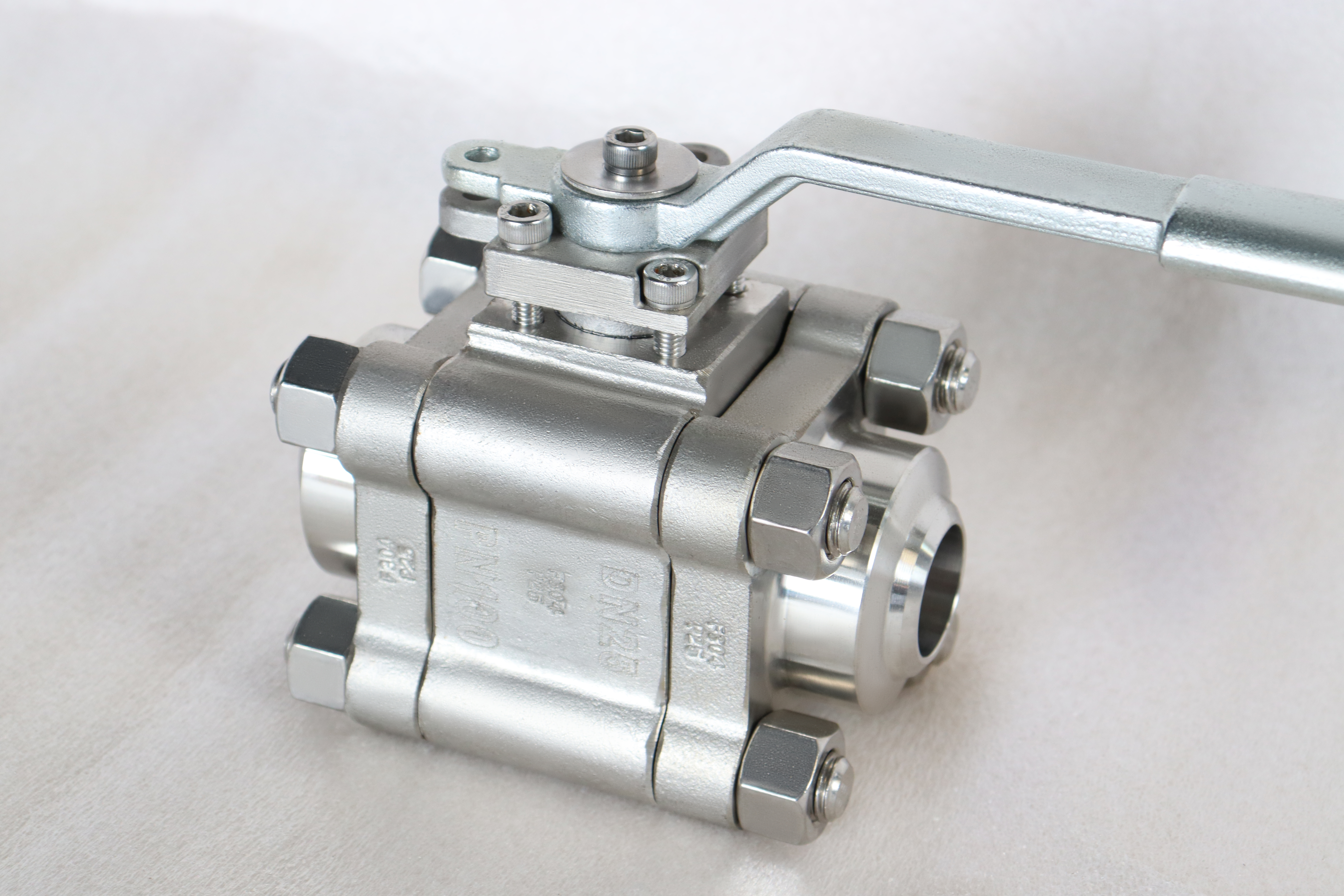
The body of this valve is stamped F304L on all three parts, with a lot number under the grade, and the stem plate is stamped F316. Look at the studs and a second grade appears: the bolting is stamped B7, with 2H nuts. Those two facts are the page. The grade chosen for the body does not travel automatically to the fasteners, and on a stainless valve the fasteners are usually the first thing to corrode.
It is a three piece body with threaded ends, a floating ball and a bolted stem with a top plate. The photographs show the small end of the range: hex studs, four to a cap, a female threaded bore, and the centre section bored for the ball. The data sheet covers half inch to twelve inch at Class 600 to 2500, which is a family rather than one valve, and the pattern in the photographs is the one that gets ordered most.
F304L is the low carbon version of 304, with carbon held under three hundredths of a percent. Its purpose is welding: a low carbon body does not sensitise in the heat affected zone, so the chromium stays in solution and the grain boundaries keep their corrosion resistance after a weld. On a threaded valve that is never welded, the grade is bought for the medium and for the certificate rather than for a weld that will never happen.
The service it fits is small bore stainless lines at moderate to high pressure: chemical dosing, instrument and sample lines, small bore manifolds, and welded or threaded pipework in plants where a carbon body would stain the medium or fail the specification. The threaded ends make it a valve that can be fitted without hot work, which is often the real reason it is chosen.
Design and Construction
Three pieces: a centre section, and an end cap on each side, each closed by four studs on this size. The centre carries the ball and both seats, the caps carry the threaded ends, and the whole thing comes apart with one spanner. That is the design's selling point and its weakness in one sentence: everything is reachable, and everything that is reachable has a joint that can leak.
The stem is packed and bolted down through a top plate rather than screwed into a bonnet. The plate carries two studs, the gland follower sits on the packing, and the stem is retained by the body so it cannot be blown out. On a valve this small that arrangement is what allows the packing to be adjusted or replaced with the line still under pressure, which is the maintenance operation most often needed on a threaded valve.
The ends are female threaded, which fixes more about the valve than the connection type suggests. A thread is cut into the end cap wall, so the wall at that point has to carry both the pressure and the thread load, and the fitting that screws into it has to be rated for the same class. Threaded ends are a small bore and moderate class solution; they are not how a large valve at high class is joined to a pipe.

Material Options
F304L and F304 are the same alloy with different carbon, and the difference has a price in the rating table. F304 sits in group 2.1 of ASME B16.34 and F304L sits in group 2.3, and group 2.3 is rated lower: at Class 300 and 38 C the tables read 720 psi for group 2.1 and 600 psi for group 2.3. The low carbon grade is bought for weldability and for intergranular corrosion resistance, and it pays for both with a small amount of pressure rating.
Where the body is welded, that trade is obviously worth making, because the alternative is a sensitised heat affected zone that will corrode at the grain boundaries in a wet environment. Where the body is threaded and the pipe is welded elsewhere, the trade is less obviously worth making, and the honest answer is that either grade works and the certificate should say which one arrived.
The bolting is the part that deserves its own line. B7 is a chromium molybdenum alloy steel, it is stronger than a stainless stud, and it is the default because it is cheap and it holds torque. It is also the part of a stainless valve that rusts first in a wet or coastal atmosphere, and the fix is to order B8M studs with 8M nuts, which match the body and give up some strength for that match.
| Component | Standard Material | Optional Upgrade | Service Notes |
|---|---|---|---|
| Body and end caps | ASTM A182 F304L forging, group 2.3 | F304 for group 2.1 rating; F316L for chloride service | Grade and lot number stamped on all three parts |
| Ball | F304L with optional hard facing | F316L; cobalt based hard facing for abrasive service | Matches the body grade or upgrades it |
| Stem | F316 as stamped | 17-4PH precipitation hardening stainless | Blowout proof, packed gland under a two stud plate |
| Seat | PTFE, reinforced PTFE or PPL | Metal seat with hard facing | The seat sets the temperature, not the body |
| Packing | PTFE or flexible graphite | Braided graphite with alloy wire reinforcement | Graphite for the hot end |
| Body joint gasket | Spiral wound, flexible graphite filled | PTFE envelope for clean cold service | Two joints, one gasket each |
| Bolting | A193 B7 studs with A194 2H nuts as photographed | B8M studs with 8M nuts to match the body | The corrosion weak point unless it is ordered otherwise |
| Ends | Female threaded as photographed | Socket weld, butt weld, flanged raised face or ring joint | Thread class and standard to be named on the order |
Technical Specifications
What a standard fixes, the table below fixes as well: the size band, the class band, the body grade with its group, the end connections offered, the test regime and the documents. It is all checkable against the certificate that arrives with the valve.
What belongs to a drawing stays on the drawing. Wall thickness is calculated from ASME B16.34 against the class and the material group and lives on the design record. Face to face is tabulated in ASME B16.10 by size and class and confirmed on the signed general arrangement drawing. Neither belongs on a product page as a number.
| Item | Value |
|---|---|
| Size range | 1/2 inch to 12 inch, DN15 to DN300 |
| Pressure class | Class 600 to Class 2500; recorded as PN 100, PN 150, PN 250 and PN 420 in API 6D clause 7.2 |
| Body style | Three piece forged body, floating ball |
| Body material | ASTM A182 F304L forging, ASME B16.34 group 2.3 |
| Class to PN mapping | Class 600 is PN 100, Class 900 is PN 150, Class 1500 is PN 250, Class 2500 is PN 420 |
| Ends as photographed | Female threaded; socket weld, butt weld and flanged on request |
| Flange option | ASME B16.5 raised face or ring joint when flanged ends are ordered |
| Face to face | ASME B16.10 for the size and class ordered, confirmed on the signed drawing |
| Temperature | Minus 29 to plus 425 C as stated on the data sheet; the seat sets the working limit below that |
| Seat temperature | About 200 C for PTFE, 280 C for PPL, metal seat for higher |
| Sealing principle | Floating ball; the downstream seat is the barrier and load rises with pressure |
| Product standard | API 608 up to Class 600; API 6D above it |
Standards and Compliance
ASME B16.34 does two things for this valve. It sets the minimum wall thickness against the class and the material group, and it supplies the rating table that turns a class into a pressure at a temperature. Group 2.3 is the group the low carbon austenitics sit in, and it reads below group 2.1 and 2.2 at every temperature, which is the reason a low carbon body is never the way to get a higher rating.
The product standards split by class across this family, and that split is worth knowing before a purchase order is written. API 608 covers flange sizes DN 15 to DN 600 at classes 150 to 600, so a Class 600 valve is inside its scope and a Class 900 valve of the same size is not. Above Class 600 the valve is an API 6D product, and the documents change with it.
One figure on the data sheet needs correcting wherever it is copied from: Class 1500 is PN 250, not PN 260. The API 6D clause 7.2 list runs PN 20, 50, 64, 100, 150, 250 and 420 against Class 150, 300, 400, 600, 900, 1500 and 2500, and EN 1092-1 uses the same PN 250. A 260 appears in no table on either side, and a purchase order that carries it will be queried.
| Requirement | Standard | What J-VALVES Supplies |
|---|---|---|
| Wall thickness and rating | ASME B16.34 group 2.3 | Design calculation for the class ordered |
| Product standard, up to Class 600 | API 608 | Applies within its size and class scope |
| Product standard, above Class 600 | API 6D | Marking, documentation, cavity and drain provisions |
| Pressure testing | API 598 | Shell at 1.5 times, seat at 1.1 times the rating |
| Fire test | API 607, or ISO 10497 as the equivalent | Type test with a size and class scope on the certificate |
| Threaded ends | ASME B1.20.1 for NPT, or the thread named on the order | Thread gauge checked at final inspection |
| Flange option | ASME B16.5 | Raised face or ring joint, cut to the series ordered |
| Material certificate | EN 10204 3.1 | Body and trim, heat number matched to the marking |
Manufacturing Process
One thing about the photographs needs saying, because it is a paperwork trap. The surface in the pictures is a cast surface, while the material stamped on the body, F304L, is the wrought designation from ASTM A182. The cast equivalent of the same alloy is A351 CF3, and the two are not interchangeable on a certificate even though the chemistry is close: if the drawing calls for a casting, the grade to write on the order and to read on the certificate is CF3. A body marked F304L should arrive with an A182 certificate, and a buyer who finds an A351 certificate against a forging designation has a question worth asking.
The three parts are machined as a set so that the seat pockets land concentric with the ball when the valve is assembled. The threaded ends are cut after the joint faces, and the thread is checked with a gauge rather than by eye, because a thread that is cut a little tight will gall on assembly and a thread that is cut a little loose will leak at the joint rather than at the seat.
Assembly is quick on a valve this size and the discipline is in the two joints. Seats and ball into the centre, caps on, studs brought up in a cross pattern in stages, then the stem packing and the top plate. The threaded bores are plugged and the flange faces masked before painting, because paint inside a thread is a leak that the fitter will be blamed for.

Quality Control and Testing
Identity is where a low carbon grade needs care, and the usual test does not work. A hand held X-ray analyser does not see carbon at all, so F304 and F304L read identically on the screen; the difference between them is three hundredths of a percent of an element the instrument cannot measure. The L grade is therefore proved by the mill certificate and, where it matters, by a laboratory carbon analysis, not by a positive material identification reading.
| Step | What Is Checked | Standard or Acceptance |
|---|---|---|
| 1 Material | Heat number against the mill certificate; carbon content for the L grade | ASTM A182 F304L, EN 10204 3.1 |
| 2 Identity | Positive material identification on body and trim when ordered | Grade family match; carbon by certificate only |
| 3 Thread | Thread gauge on both ends | ASME B1.20.1, or the thread named on the order |
| 4 Dimensional | Joint face flatness, seat pocket concentricity, end to end | Drawing tolerance |
| 5 Shell test | Body and both body joints at 1.5 times the rating | API 598, no leakage |
| 6 Seat test | Seat at 1.1 times the rating, cavity vented | API 598; zero visible leakage on soft seats |
| 7 Function | Quarter turn operation, packing adjusted | Works standard |
| 8 Final | Cavity drained, bore dried, threads plugged, caps fitted | Works standard |
The shell test on a three piece body puts both joints under full pressure at once, which is why it is the step that separates a careful build from an ordinary one. A joint that weeps at one and a half times the rating is a machining or a torque fault and the test bay is where it should be found, not a plant shutdown three months later.
The seat test is run with the cavity vented so the result is a reading about the seat rather than about trapped pressure. On a soft seated build the acceptance is no visible leakage. On a metal seated build the acceptance is the leakage rate the standard tabulates for that size, and a buyer who needs zero leakage on a metal seat is asking for something the standard does not promise.

Applications and Industry Service
The natural homes are small bore stainless lines where the medium has to stay clean: chemical dosing and injection, sample and instrument lines, small manifolds, and pharmaceutical or food adjacent service where a carbon body would fail the specification before it failed mechanically. Threaded ends make it installable without hot work, which matters in a live plant.
It also appears as a welded valve, with socket weld or butt weld ends, and there the low carbon grade is doing exactly the job it was designed for. The heat affected zone of a weld in F304 can sensitise; in F304L it does not, and the pipe joint keeps its corrosion resistance without a solution anneal that nobody is going to perform on a small bore line.
It is not the right valve for large bore or for the top of the class range at the same time. A floating ball carries the seat load that the line pressure puts on it, and that load grows with the bore and with the class, so the reliable window for this design narrows as either one climbs. Large bore at high class is a trunnion valve, and the two should not be sold against the same size and class table.

Installation, Operation and Maintenance
Threads need a sealant that suits the service and a thread engagement that is neither short nor forced. A stainless thread galls easily against stainless, so a compatible lubricant or sealant is not optional, and a fitting that has been over-tightened to stop a weep has usually damaged the thread that caused the weep. Support small bore pipe runs so the valve body is not carrying the weight of the pipe on two threads.
Operate the valve through a quarter turn and leave the lever where the position shows. The stem is retained by the body, so packing can be adjusted under pressure by easing the gland follower; if the packing has to be replaced, vent the cavity first through the plug. Neither body joint can be opened under pressure, and on a threaded valve the pipe joint on each side must come apart before the caps do.
For maintenance the caps come off and the ball and seats come out, which is the reason to buy three piece rather than two piece at this size. What has to be accepted is that two joints were opened: both need new gaskets and both need to be re-torqued in a cross pattern, and a joint that is re-used without a new gasket is a leak waiting for the next pressure test.
How to Specify and Order
Seven things decide the valve: size, class, body grade with the certificate requirement, end connection with its thread standard, seat material, bolting grade, and the operator. The two most often missing from a first enquiry are the thread standard and the bolting, and both are cheap to fix at the order stage and expensive to fix afterwards.
Four questions are about the line: the medium, the design and operating temperature, the design pressure, and whether the pipe will be welded. The medium decides the grade, the temperature decides the seat, the pressure decides the class, and the welding question decides whether the low carbon grade is earning its place or just costing a little rating.
Documents should be named on the order: EN 10204 3.1 for body and trim with the carbon content stated, the hydro test record, the dimensional report, and the fire test certificate with its size and class scope. If the L grade matters to the specification, ask for the carbon figure in writing on the certificate, because the bench test will not tell you.
FAQ
Q: How can I tell F304L from F304?
A: Not with a hand held analyser. An X-ray fluorescence gun does not measure carbon, and the two grades differ only in carbon, at three hundredths against eight hundredths of a percent. The grade is proved by the mill certificate and, where it matters, by a laboratory carbon analysis.
Q: Is F304L weaker than F304?
A: It is rated lower. F304 is in group 2.1 of ASME B16.34 and F304L in group 2.3, and at Class 300 and 38 C the tables read 720 psi against 600 psi. The low carbon grade trades a little rating for weldability and for intergranular corrosion resistance.
Q: Why are the studs B7 on a stainless valve?
A: Because B7 is stronger and cheaper and it is the default. It is also alloy steel, so in a wet or coastal atmosphere it corrodes before the body does. B8M studs with 8M nuts match the body and are the fix, and they have to be asked for on the order.
Q: Is Class 1500 PN 250 or PN 260?
A: PN 250. The API 6D clause 7.2 list runs PN 20, 50, 64, 100, 150, 250 and 420 against Class 150, 300, 400, 600, 900, 1500 and 2500, and EN 1092-1 also uses PN 250. A 260 does not appear in either table.
Q: Can a floating ball valve be used at 12 inch and Class 2500?
A: Not sensibly. The floating ball is loaded by the line pressure and the seat load grows with the bore and with the class, so the reliable window narrows as either one climbs. Large bore at high class is a trunnion valve, and the two should not be sold off the same table.


Hot Products


News
Stainless Steel Ball Valve Grades: 304, 316 And 316L, And What Actually Decides
Molybdenum is the difference that decides the duty, carbon is the difference that gets missed, and the chloride in the line matters more than the price.
Read More
Ball Valve Spare Parts for Overseas Projects: The Wear Part List, The Quantity Math, And Four Traps
Why isolation valves fail on calendar time, not cycles. Wear part lists, Poisson stock maths, seat kit traps and the clauses that decide year six.
Read More
Ball Valves On A Bottom Loading Gantry: Creep, Dry Break And The Test That Proves Neither
A loading gantry cycles a ball valve far more than it is designed for and still cannot prove shut-off. Where creep starts, and what to specify.
Read More
Lined Ball Valves in Acid Service: The Liner Does Not Fail, The Steel Behind It Does
The valve came out of the line looking better than most valves that come out of a hydrochloric acid line. Three inch, PFA lined, cast body, Class 150, fourteen months in service on a 32 percent acid transfer duty at 55 to 60 degrees C, about forty open and close cycles a week. The paint was intact.
Read More