


CHINA J-VALVES Offers Various High-quality I ndustrial Ball Valves
J-VALVES, a distinguished professional ball valve manufacturer rooted in China, takes pride in its extensive product portfolio. Our offerings span a wide range, including trunnion-mounted ball valves, floating ball valves, high-temperature ball valves, high-pressure ball valves, metal-sealed ball valves, ultra-low temperature ball valves, DBB ball valves, Three-way And Four-way Ball Valve, and fully welded ball valves. Each product is a testament to our commitment to precision engineering and reliable performance. Meticulously crafted, they are designed to not only meet but exceed the most stringent industrial demands, ensuring stable operation even under extreme conditions. This enables us to provide our clients with high-value services and makes our valves widely sought-after in industries.
Product Category
Contact Us


-
J-VALVES-Q41F
-
J-VALVES
Overview of the J-VALVES 3 inch 600LB WCB two piece floating ball valve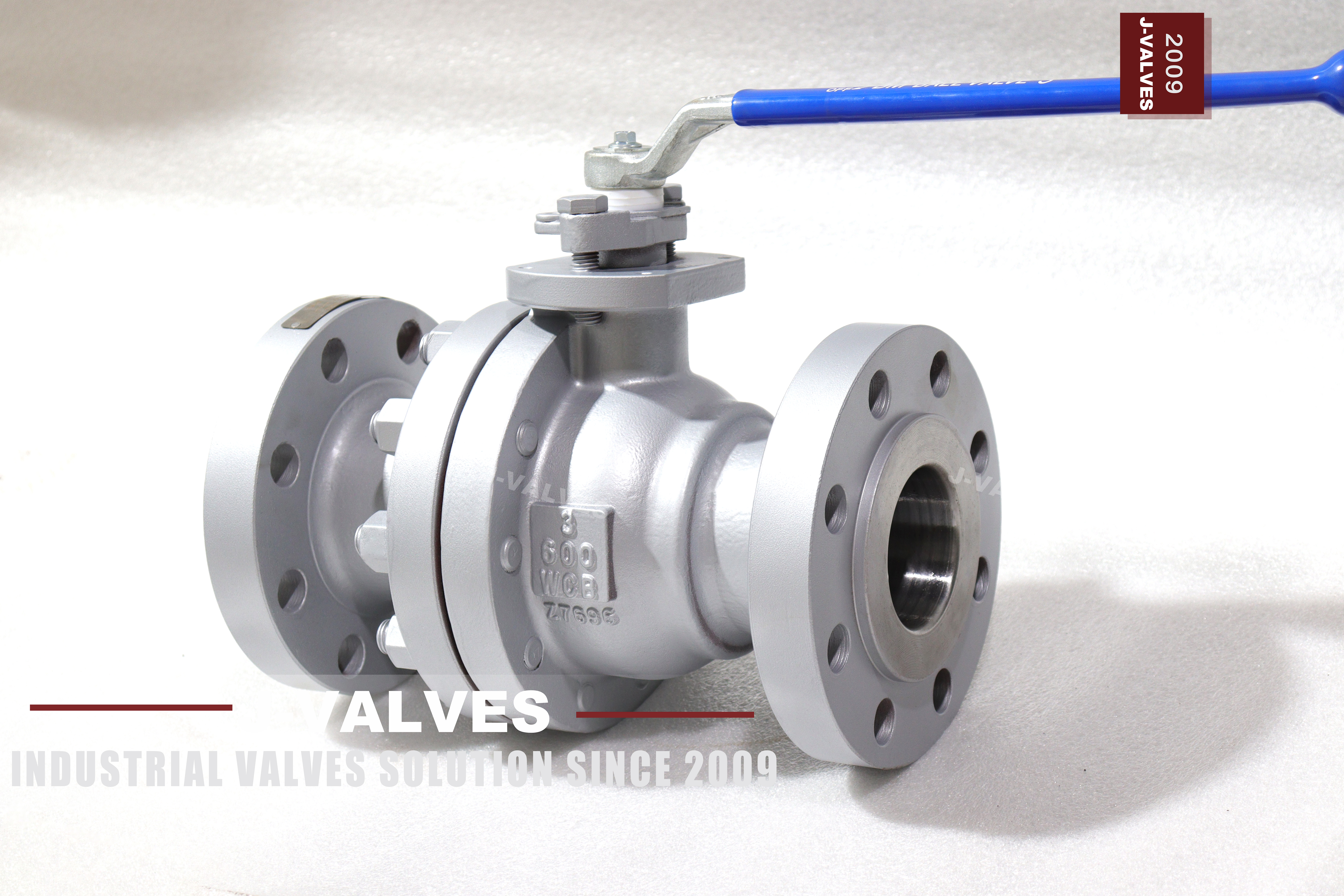
Class 600 is the point on the carbon steel ladder where the numbers start to matter. A three inch body cast in ASTM A216 WCB sits in group 1.1 of ASME B16.34, where Class 600 reads 1480 psi at 38 C, and the same class is recorded as PN 100 in API 6D clause 7.2. Cast carbon at this class is still the economic answer; one class higher, forged bodies start to take over.
The valve is a two piece bolted body with a floating ball, full port, raised face flanges to ASME B16.5 and a lever. Two pieces means a main body and one end cap, so there is one joint to close and one gasket to get right instead of two. That is the whole commercial case for this body style and it is also the whole maintenance case against it.
The number that needs explaining is the temperature. The data sheet says minus 29 to plus 425 C, and 425 C is not a seat limit or a packing limit in the first instance: it is the ceiling carbon steel carries in process piping codes, where the concern above roughly 427 C is graphitisation of the steel itself. Below that ceiling the seat is the part that quits first, usually a long way below it.
The service this fits is the middle of the plant: utility headers, cooling water, steam and condensate at moderate pressure, fuel gas, and non aggressive process lines where carbon steel is acceptable and stainless would be an unnecessary purchase. Three inch at 600 class is a line with real pressure in it and a flow that a full port bore passes without argument.
Design and Construction
The two piece body is a main body and one end cap, closed by a ring of studs and a single gasket. The joint runs around the full circle at the cap side, so it holds full line pressure whenever the valve is pressurised, and there is only one of it. That single joint is the strongest argument for this body style and the weakest thing about it at the same time: fewer places to leak, but each one is loaded all the time.
The ball floats. It is not carried on trunnions, so line pressure pushes the ball downstream until it seats, and the seat load rises with the pressure instead of being set by a spring pack. That is why a floating design seals more tightly as pressure climbs, and why the size at which floating stops being sensible is a question of seat area rather than of body strength.
At the upstream seat the pressure pushes the seat away from the ball while it pushes the ball into the downstream seat, so only one seat is doing barrier duty at a time. The cavity between the two seats fills with whatever the line carries, which is why the body has a plug at the bottom: it is the opening that lets the cavity be vented and checked, and on a floating valve the check tells you about the one seat that is sealing rather than about two.

Material Options
WCB is cast carbon steel with a modest manganese content, and its virtues are strength, weldability and price rather than corrosion resistance. It is the wrong body for a chloride line, for dilute acid, and for anything that will sit wet, which is why the same valve is offered in stainless when the medium asks for it. On the services this class and size usually serve, dry gas, treated water, steam and hydrocarbons, the carbon body is the correct engineering answer.
The ball is a separate question from the body. A cast carbon body with a stainless ball is normal on this design, because a stainless ball takes the seat contact and the erosion without rusting in the bore; where the medium is clean and the duty light, a carbon ball with electroless nickel plating does the same job more cheaply. Mixing the two is not a compromise, it is how the valve is normally built.
| Component | Standard Material | Optional Upgrade | Service Notes |
|---|---|---|---|
| Body and end cap | ASTM A216 WCB cast carbon steel | A105 forging; A350 LF2 for low temperature | Group 1.1, Class 600 reads 1480 psi at 38 C |
| Ball | ASTM A351 CF8 or CF8M stainless | WCB ball with electroless nickel or hard chrome | Stainless ball in a carbon body is the normal build |
| Stem | 316 stainless | 17-4PH precipitation hardening stainless | Blowout proof, packed gland with adjustable follower |
| Seat | PTFE, reinforced PTFE or PPL | Metal seat with cobalt based hard facing | The seat sets the valve temperature, well below the body ceiling |
| Packing | PTFE or flexible graphite | Braided graphite with an alloy wire reinforcement | Graphite for the hot end, PTFE for the clean cold end |
| Body joint gasket | Spiral wound, flexible graphite filled | Metal ring joint gasket | One joint, one gasket, full line pressure on it |
| Bolting | A193 B7 studs with A194 2H nuts | B8M studs with 8M nuts | B7 is standard on a carbon body and matches it |
| Anti-static | Spring or wire between ball, stem and body | — | Electrical continuity for flammable service |
Technical Specifications
The specification table fixes what a standard fixes: size, class, grade of body, flange standard and facing, the test regime and the documents. None of it depends on a drawing that has not been issued, which is why it can be published and checked.
The dimensional numbers stay on the drawing. Minimum wall thickness at Class 600 is a calculation from ASME B16.34 and appears on the design record, not on the data sheet. Face to face is tabulated in ASME B16.10 and confirmed on the signed general arrangement drawing. A valve page that quotes either without a drawing behind it is quoting a figure nobody has verified.
| Item | Value |
|---|---|
| Size | 3 inch, DN80 |
| Pressure class | Class 600, recorded as PN 100 in API 6D clause 7.2 |
| Body style | Two piece cast body, floating ball |
| Body material | ASTM A216 WCB cast carbon steel, ASME B16.34 group 1.1 |
| Rating | Group 1.1 at Class 600 reads 1480 psi at 38 C |
| Flange | ASME B16.5 Class 600, raised face |
| Bore | Full port as photographed; reduced port on request |
| Face to face | ASME B16.10 for NPS 3 Class 600, confirmed on the signed drawing |
| Temperature | Minus 29 to plus 425 C as stated on the data sheet; the 425 C figure is the carbon steel ceiling in process codes |
| Seat temperature | About 200 C for PTFE, 280 C for PPL, metal seat for higher |
| Operator | Lever with locking device as photographed; gear or actuator on request |
| Seat barrier | Downstream seat only; the ball moves with pressure |
| Product standard | API 608 and API 6D both apply at this class and size |
Standards and Compliance
This is a valve where two product standards apply at once, and that is worth stating plainly because the same is not true one class higher. API 608 covers flange sizes DN 15 to DN 600 at classes 150 to 600, so a three inch Class 600 valve sits inside its scope; API 6D covers pipeline valves and is the standard the marking and documentation usually follow. On a 900 class valve of the same size, only the second one applies.
ASME B16.34 is the parent document behind both. It sets the wall thickness against the class and the material group, and it supplies the rating table that turns a class into a pressure at a temperature. Group 1.1 at Class 600 reads 1480 psi at 38 C, and the same table reads 805 psi at 538 C, which is the shape of every class rating: flat at the bottom, then falling away as the temperature climbs.
The temperature ceiling on the data sheet needs one clarification. Carbon steel in process piping is conventionally limited to about 427 C because of graphitisation, and the 425 C printed on this valve is that limit expressed conservatively. It is not a statement that a PTFE seat will survive to 425 C, because it will not; the seat, the packing and the gasket each have their own ceiling and the lowest one governs the valve.
| Requirement | Standard | What J-VALVES Supplies |
|---|---|---|
| Wall thickness and rating | ASME B16.34 group 1.1 | Design calculation; 1480 psi at 38 C |
| Product standard, small sizes | API 608 | Applies: DN 80 is inside the size and class scope |
| Pipeline valve requirements | API 6D | Marking, documentation, cavity and drain provisions |
| Pressure testing | API 598 | Shell at 1.5 times, seat at 1.1 times the rating |
| Fire test | API 607, or ISO 10497 as the equivalent | Type test with a size and class scope on the certificate |
| Flange dimensions | ASME B16.5 | Raised face, drilled on the Class 600 circle |
| Face to face length | ASME B16.10 | Confirmed on the signed general arrangement drawing |
| Material certificate | EN 10204 3.1 | Body and trim, heat number matched to the marking |
Manufacturing Process
A cast body starts with a pattern. Sand is packed around it, the pattern is drawn, the two halves of the mould are closed and the metal is poured, and the result is a shape close to the finished body with a skin on it that has to be cleaned, cut and machined away at every sealing surface. That is why the body in the photographs looks painted and slightly textured while the flange faces look turned.
The casting route is cheaper than forging at this size and it brings its own quality question, which is soundness. Shrinkage porosity, gas holes and inclusions all live inside a casting and none of them are visible from outside, so the wall is verified by calculation against the B16.34 minimum and by examination when the order asks for it. Radiography and ultrasonic examination are both available; neither is in the default delivery.
Machining follows casting. The flange faces, the joint face, the seat pockets and the stem bore are all cut after the casting has been normalised, because a casting that is machined before it has settled will move afterwards. The assembly and the stud torque sequence then decide whether the single body joint holds at test pressure, and that is where a two piece body earns or loses its reputation.

Quality Control and Testing
Identity is the first check: the heat number raised on the body is matched to the mill certificate, and where the order asks for it a positive material identification reading confirms the body is WCB and not a substitute grade. On a carbon body this is less dramatic than on a stainless one, but a mixed part is still a mixed part.
| Step | What Is Checked | Standard or Acceptance |
|---|---|---|
| 1 Material | Heat number against the mill certificate; chemistry and tensile | ASTM A216 WCB, EN 10204 3.1 |
| 2 Identity | Positive material identification when ordered | Grade match, no mixed parts |
| 3 Dimensional | Flange facing, bolt circle, face to face | ASME B16.5 and B16.10, or the signed drawing |
| 4 Casting | Radiography or ultrasonic examination when ordered | Report issued with the certificate |
| 5 Machining | Seat pocket concentricity, joint face flatness | Drawing tolerance |
| 6 Shell test | Body and the single body joint at 1.5 times the rating | API 598, no leakage |
| 7 Seat test | Seat at 1.1 times the rating, cavity vented | API 598; zero visible leakage on soft seats |
| 8 Final | Cavity drained, bore dried, faces masked, paint, caps | Works standard |
The shell test on a two piece body is a single question: does the one joint hold at one and a half times the rating with the studs brought up in the specified sequence. If it does, the design is doing what it should; if it does not, the answer is a machining or a torque problem rather than a gasket problem, and the right place to find it is the test bay.
The seat test is run with the cavity vented so that the reading is about the seat and not about trapped pressure. On a soft seated build the acceptance is no visible leakage, which is what a PTFE or PPL seat can promise. Buyers who need a tighter number than the standard for a metal seat should say so at enquiry, because the standard's allowance for a metal seat is a leakage rate rather than zero.

Applications and Industry Service
The ordinary homes are utility and process lines in the middle of the pressure range: plant and instrument air, cooling water, steam and condensate, fuel gas, and hydrocarbon lines where the medium is dry and the carbon body is acceptable. Three inch at Class 600 is a common size and class on a plant that has been built to a mix of ANSI and metric standards, and a valve that fits both the flange and the gap is worth having on the shelf.
It is also a maintenance valve rather than a permanent block. The lever invites operation, the two piece body allows the seats and the ball to be reached, and the cost is low enough that plants keep spares rather than repair in place. That is a different duty from a trunnion valve sitting closed for years, and the two should not be specified by the same logic.
Where the medium is corrosive, or where the line will sit wet, this is the wrong body and the answer is a stainless one. Where the class climbs past 600 the forged route takes over for good reasons, because a casting at higher class needs a heavier wall and more examination until the price advantage disappears.

Installation, Operation and Maintenance
Check the flange facing before the joint is closed. A raised face with a burr, a scratch or a spot of paint will leak at test pressure and the gasket will take the blame; the face should be clean, dry and flat, and the gasket should be new. Studs go in with lubricated threads and are brought up in a cross pattern in stages, which matters more on a single joint body than on a three piece one because there is no second joint to share the load.
Operate the lever through its quarter turn and leave it where the position tells you it is. The lever carries a locking device so the valve can be held open or closed against vibration or tampering, and the stem is blowout proof and retained by the body, which allows the packing to be adjusted while the valve is under pressure. Nothing on the body joint can be opened under pressure.
For maintenance the cap comes off, the seats and the ball are reached through the open end, and the line has to be isolated and drained first. The valve does not have to leave the pipe for a seat change, but it does have to be opened, and the joint that was opened has to be re-gasketed and re-torqued before the line goes back into service.
How to Specify and Order
Six things decide the valve: size and class, body material with the certificate requirement, flange facing, port type, seat material, and the operator. Three of those are usually missing from a first enquiry and the one most often missing is the seat, which is also the part that decides the temperature the valve can actually be used at.
Four questions are about the line rather than the valve: the medium, the design and operating temperature, the design pressure, and whether the valve will be operated regularly or left alone. The medium decides whether carbon is acceptable at all, the temperature decides the seat, the pressure decides the class, and the duty decides whether a lever is enough.
Documents should be named on the order: EN 10204 3.1 for body and trim, the hydro test record, the dimensional report, the fire test certificate with its size and class scope, and radiography or ultrasonic examination of the casting if soundness has to be demonstrated. All of them can be supplied; the default delivery does not include them, so the order is the only place to ask.
FAQ
Q: Why is the temperature limit 425 C on a carbon steel valve?
A: It is the ceiling carbon steel carries in process piping codes, where the concern above roughly 427 C is graphitisation of the steel itself. It is not a seat rating: the seat inside this valve quits well below that, at about 200 C for PTFE and 280 C for PPL, and the lowest limit governs the valve.
Q: Is a Class 600 valve covered by API 608?
A: Yes, at this size. API 608 covers flange sizes DN 15 to DN 600 at classes 150 to 600, so a three inch Class 600 valve is inside its scope. The same valve at Class 900 would not be, and would be an API 6D product instead.
Q: What pressure is Class 600?
A: In group 1.1 of ASME B16.34, Class 600 reads 1480 psi at 38 C, and API 6D records the same class as PN 100. The figure falls as temperature rises, so the table has to be read at the design temperature rather than at ambient.
Q: Can the ball be replaced without removing the valve from the line?
A: The seats and the ball are reached by taking off the single end cap, with the line isolated and drained. The valve stays in the pipe, but the joint that was opened needs a new gasket and fresh torque before the line goes back into service.
Q: Why is the ball stainless in a carbon steel body?
A: Because the ball takes the seat contact and the erosion and has to stay clean in the bore, while the body only has to carry pressure. A carbon ball with electroless nickel does the same job on a clean light duty, so both builds are normal.


Hot Products


News
Stainless Steel Ball Valve Grades: 304, 316 And 316L, And What Actually Decides
Molybdenum is the difference that decides the duty, carbon is the difference that gets missed, and the chloride in the line matters more than the price.
Read More
Ball Valve Spare Parts for Overseas Projects: The Wear Part List, The Quantity Math, And Four Traps
Why isolation valves fail on calendar time, not cycles. Wear part lists, Poisson stock maths, seat kit traps and the clauses that decide year six.
Read More
Ball Valves On A Bottom Loading Gantry: Creep, Dry Break And The Test That Proves Neither
A loading gantry cycles a ball valve far more than it is designed for and still cannot prove shut-off. Where creep starts, and what to specify.
Read More
Lined Ball Valves in Acid Service: The Liner Does Not Fail, The Steel Behind It Does
The valve came out of the line looking better than most valves that come out of a hydrochloric acid line. Three inch, PFA lined, cast body, Class 150, fourteen months in service on a 32 percent acid transfer duty at 55 to 60 degrees C, about forty open and close cycles a week. The paint was intact.
Read More