


CHINA J-VALVES Offers Various High-quality I ndustrial Ball Valves
J-VALVES, a distinguished professional ball valve manufacturer rooted in China, takes pride in its extensive product portfolio. Our offerings span a wide range, including trunnion-mounted ball valves, floating ball valves, high-temperature ball valves, high-pressure ball valves, metal-sealed ball valves, ultra-low temperature ball valves, DBB ball valves, Three-way And Four-way Ball Valve, and fully welded ball valves. Each product is a testament to our commitment to precision engineering and reliable performance. Meticulously crafted, they are designed to not only meet but exceed the most stringent industrial demands, ensuring stable operation even under extreme conditions. This enables us to provide our clients with high-value services and makes our valves widely sought-after in industries.
Product Category
Contact Us


-
J-VALVES-Q41F
-
J-VALVES
Overview of the J-VALVES half inch Class 300 F688 floating ball valve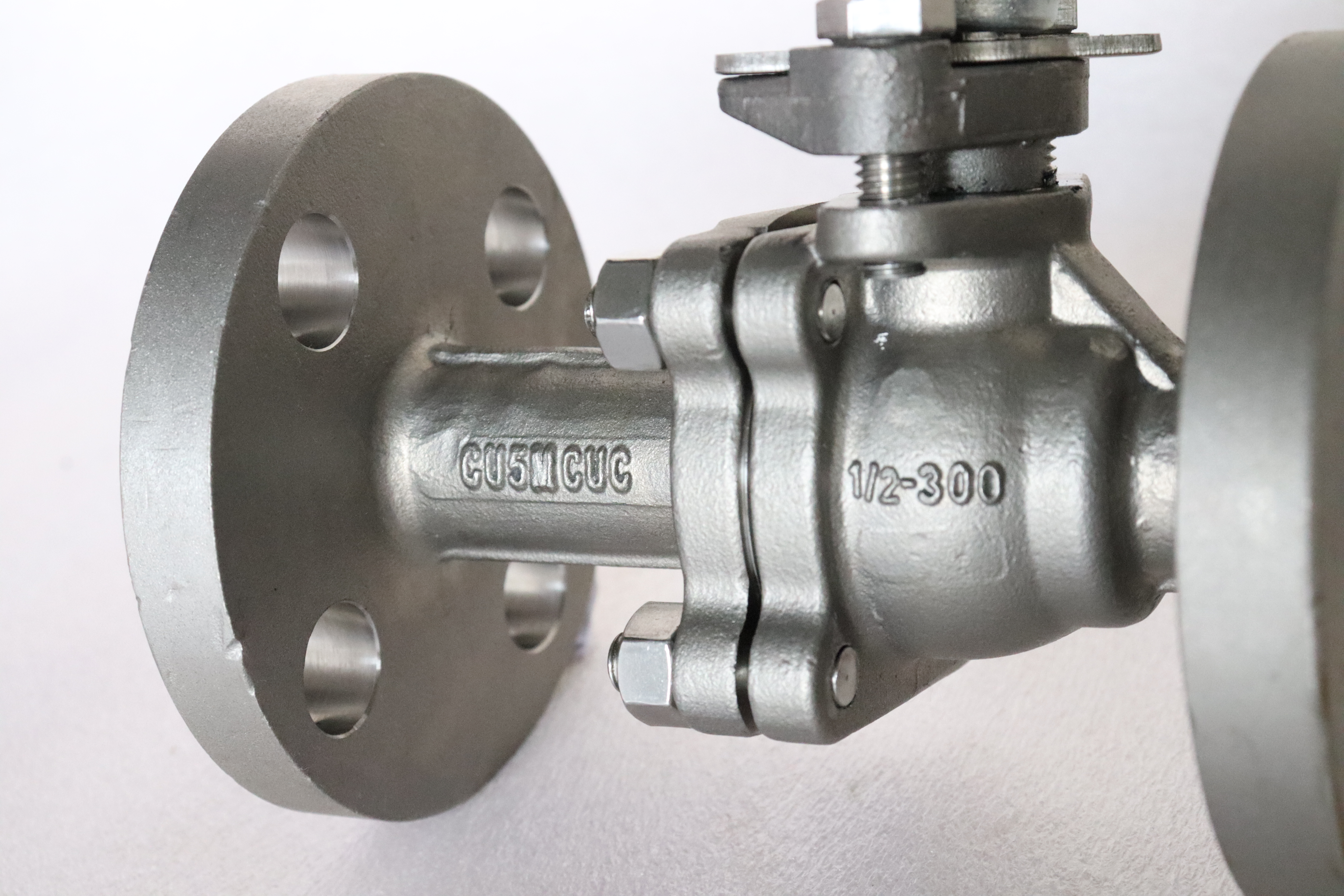
Half an inch, Class 300, a floating ball and a body that ends in a thread, a socket or a weld preparation rather than a flange. That combination is not a small version of a pipeline valve; it is a different animal with a different set of rules, and the rules are what this page is about. DN15 is the smallest size in the ball valve catalogue and it is also the size where most of the catalogue text stops being true.
The valve is used where a line has to be shut off and the line is small: instrument and impulse lines, sample points, drain and vent connections, chemical dosing, small utilities and the isolation point in front of a gauge or a transmitter. In those places nobody wants a flanged body, because there is no room for two flange sets and no reason to create two more joints. What is wanted is a body that screws or welds straight onto the tube or pipe and holds Class 300 pressure while doing it.
Two things on this page are worth reading before the specification table. The first is the material code: F688 is stamped on the body and it is not a grade that can be looked up in ASTM A182, so the certificate rather than the number is what defines the steel. The second is the standard: at DN15 and Class 300 this valve is inside the scope of API 608, which is the opposite of the position on the large forged trunnion pages and the reason the document set differs.
Design and Construction
A floating ball is the simplest seal in the catalogue. The ball is not carried on trunnions; it sits between two seats with a little freedom to move, and line pressure pushes it downstream into the seat on the low pressure side. That is the whole mechanism. The higher the pressure, the harder the ball is pressed into the seat, which is why the design is called self-energised and why it works so well at small sizes where the force on the ball is small enough for the seat to take.
The consequence is that the upstream seat does not seal the way a trunnion valve's upstream seat does. On a floating ball the upstream seat is a guide and a back-up, and the barrier is the downstream seat plus the ball. That single fact decides what this valve can and cannot be sold as: it is a reliable isolation valve, and it is not a double block and bleed device, however the seat is shaped.
The stem is the second pressure boundary and on a valve this size it is a plain shaft through a packed gland with a shoulder underneath, so that pressure cannot blow it out. Anti-static continuity between ball, stem and body is a spring and a pin, and on a small valve it is easy to leave out and hard to notice afterwards. It matters wherever the medium is flammable, which is most of the places a half inch isolation valve is installed.
The ends are where this valve differs most from everything else on the site. A female NPT thread to ASME B1.20.1 makes up on tape or sealant and seals on the thread flanks; a socket weld to ASME B16.11 is a fillet weld on the outside of the socket; a butt weld to ASME B16.25 is a full penetration weld. Three different joints, three different failure modes, and only one of them can be taken apart.
At this size the body is not offered with a cavity bleed port or a seat injection fitting, and that is proportion rather than saving: an opening large enough to be useful would sit badly on a DN15 body, and there is nowhere on the casting to put it. What the valve gives instead is a straight bore, a lapped ball, and a seat that can be replaced by taking the body apart on the bench.

Material Options
F688 is the grade on the nameplate and the honest way to read it is as a code rather than a standard designation. It is not one of the forging grades listed in ASTM A182, and it does not appear in the UNS column of a material certificate, so a buyer cannot look it up and derive a chemistry from it. The source page describes it as a titanium stabilised austenitic stainless of the 321 family, and that description is exactly what the EN 10204 3.1 certificate has to confirm before the valve is accepted.
Titanium stabilisation is an argument about carbon. Titanium combines with carbon in the steel so that chromium carbides do not form at the grain boundaries during welding, which is what intergranular corrosion feeds on. On a valve with a butt weld end that argument is real, because the weld is the heat cycle that would sensitise the steel. On a threaded valve it is much weaker, because there is no weld; the code is then being bought for its high temperature strength rather than for its weldability.
| Component | Standard Material | Optional Upgrade | Service Notes |
|---|---|---|---|
| Body | F688 forging, code as stamped | F304; F316 for chlorides; F347 niobium stabilised | Chemistry declared on the EN 10204 3.1 certificate |
| Ball | Solid F688 | F688 with electroless nickel plating; hard chrome | Lapped against its own seat, not interchangeable |
| Stem | F688 | F316; 17-4PH for higher strength | Shoulder under the gland, blowout proof |
| Seat | PTFE | Reinforced PTFE; PPL; PEEK; metal with flexible graphite | The seat sets the working temperature of the valve |
| Packing | PTFE V rings | Flexible graphite with a wire reinforcement | Graphite for the high temperature end |
| Bolting | A193 B8 with A194 8 nuts | B8M with 8M nuts | Stainless bolting throughout, no carbon steel in the joint |
| Body joint gasket | Flexible graphite spiral wound | Metal ring gasket | Only on builds where the body comes apart |
| End connections | Female NPT to ASME B1.20.1 | Socket weld to ASME B16.11; butt weld to ASME B16.25 | The joint type is part of the order, not an accessory |
The alternatives follow the same logic as everywhere else in the range. F304 is the general purpose grade and is adequate for water, air and most neutral services. F316 adds molybdenum and is the grade to specify when there are chlorides, which in small bore work usually means seawater, brine or a chemical dosing line. F347 stabilises with niobium instead of titanium and is the choice where the weld is going to be stress relieved, because titanium stabilisation is less reliable after a long heat soak.
What none of them changes is the class. A Class 300 valve is a Class 300 valve in any of these grades, and the pressure comes from the material group column in ASME B16.34 rather than from the alloy content. The upgrade is bought for the medium and for the certificate, and on a half inch valve the difference in cost between grades is small enough that the choice should be made on the medium alone.
Technical Specifications
The table below is short because the valve is short. What it does not contain is as deliberate as what it does: there is no face to face in millimetres, no weight, and no wall thickness, because on a threaded valve the length is a manufacturer dimension and the wall is a calculation. The dimension that matters to the installer is the end to end length of the body pattern ordered, and that comes off the drawing rather than off a standard.
It is worth being explicit about one line that appears on almost every page in this catalogue and does not belong on this one. ASME B16.10 gives face to face and end to end dimensions for flanged and welding end valves. A valve with a female thread at each end is outside it, so quoting B16.10 here would be quoting a standard that has nothing to say about the product.
| Item | Value |
|---|---|
| Size | Half inch, DN15 |
| Pressure class | Class 300, recorded as PN 50 in the API 6D designation |
| Body style | Forged body, floating ball, side entry |
| Body material | F688 as stamped, declared on the EN 10204 3.1 certificate |
| Ball | Solid F688, floating, lapped to its seat |
| Stem | F688, blowout proof, anti-static |
| Seat | PTFE as standard; reinforced PTFE, PPL, PEEK or metal on request |
| End connections | Female NPT to ASME B1.20.1; socket weld to ASME B16.11; butt weld to ASME B16.25 |
| Bore | Full bore as standard, reduced bore on request |
| Length | Manufacturer dimension for the body pattern, confirmed on the drawing |
| Temperature | Minus 29 to plus 425 C published for the body; the seat sets the working limit |
| Operator | Lever or wrench with a locking device; small pneumatic or electric actuator on request |
| Design standard | ASME B16.34 and API 608 |
| Test standard | API 598, shell at 1.5 times and seat at 1.1 times the rating |
Standards and Compliance
This is the page in the catalogue where API 608 is the right standard to quote. Its scope runs from DN 15 to DN 600 and from Class 150 to Class 600, and a half inch Class 300 valve sits inside both limits with room to spare. The standard then governs the things that matter on a small valve: the seat test, the shell test, the marking, and the requirement that the ball be able to be turned after the shell test without the seat leaking.
ASME B16.34 does the pressure side. Class 300 is a class number, and the number becomes a pressure only when it is read against a material group and a temperature; the same class gives a different allowable on a carbon body and on an austenitic one. The group is the reason a stainless valve is not automatically a stronger valve, and on a half inch body the point is easy to miss because nobody worries about the pressure in a DN15 line until the line is a 300 class one.
API 607 is the fire test, and it is a type test rather than a per valve test. What that means in practice is that the certificate covers a size range and a class, that the test was run on a representative valve, and that a valve outside the tested scope is not covered even if it looks identical. Buyers who need fire safe documentation should ask for the certificate and read the scope line rather than accept the word fire safe in a data sheet.
| Requirement | Standard | What J-VALVES Supplies |
|---|---|---|
| Pressure boundary and rating | ASME B16.34 | Design calculation and the rating from the material group |
| Product standard | API 608, DN15 to DN600 and Class 150 to 600 | Applies in full at this size and class |
| Pressure testing | API 598 | Shell at 1.5 times, seat at 1.1 times the rating |
| Fire test | API 607 | Type test certificate with its size and class scope |
| Thread | ASME B1.20.1 | Female NPT, gauge checked |
| Socket weld | ASME B16.11 | Socket bore and depth to the fitting standard |
| Butt weld | ASME B16.25 | Weld preparation cut to the standard, not to a sketch |
| Material certificate | EN 10204 3.1 | Chemistry and mechanical properties for the stamped code |
Manufacturing Process
The body starts as a small forging and is machined in a single set-up wherever the shape allows, because on a DN15 part every re-clamp is a chance to lose concentricity between the two ends. The bore, both thread or weld preparations and the seat pockets are cut from the same datum, which is why a half inch valve that has been made properly feels different in the hand from one that has not: the ball sits square and the handle turns without a tight spot.
The ball is lapped against its own seat rather than against a gauge. That is a small sentence with a large consequence, because the pair is matched: a replacement ball dropped into an old seat will not seal the way the original did, and a replacement seat on an old ball is the same problem. It is also why the spare parts list for this size is a matched set rather than two separate items.
Assembly is by hand at this size. Seat, ball, seat, body closed, gland packed, stem fitted, then the valve is cycled and tested before it is cleaned and capped. The cleaning step matters more than it looks, because a stainless valve in a chemical dosing line arrives at a plant where the line will be flushed anyway; what does not get flushed is the swarf that was left inside the body cavity during machining.

Quality Control and Testing
Every valve is shell tested and seat tested, and both tests are recorded against the serial number. On a valve this size the shell test is quick and the seat test is the one that finds problems, because the seat is the only seal and a leak shows up immediately on the low pressure side.
| Step | What Is Checked | Standard or Acceptance |
|---|---|---|
| 1 Material | Chemistry and mechanical properties against the stamped code | EN 10204 3.1, grade as ordered |
| 2 Identity | PMI on body, ball and stem when ordered | No mixed parts |
| 3 Thread or weld end | Thread gauge; socket bore and depth; weld bevel angle | ASME B1.20.1, B16.11 or B16.25 |
| 4 Machining | Bore, seat pocket, body length, port alignment | Drawing tolerance |
| 5 Shell test | Body at 1.5 times the rating | API 598, no leakage |
| 6 Seat test | Each seat at 1.1 times the rating, both directions | API 598, zero visible leakage |
| 7 Function | Quarter turn, handle stop, anti-static continuity | Works standard |
| 8 Final | Drained, cleaned, capped, marked, packed | Works standard |
The seat test on a floating ball is run in both directions, and the result is not symmetric. Pressure from one side pushes the ball into the far seat and seals it; pressure from the other side does the same in reverse. A valve that holds in one direction and weeps in the other has a damaged seat face or a ball that is out of round, and neither can be fixed by tightening anything.

Applications and Industry Service
The valve belongs on small lines that need to be shut off positively and cheaply. Instrument and impulse lines, gauge and transmitter isolation, sample points, drain and vent connections, chemical dosing skids, small water and air headers, and the isolation point at the inlet of a small package. In most of those places the valve is operated rarely and is expected to hold absolutely when it is, which is the duty a soft seated floating ball does best.
It is not a pipeline valve and should not be sold as one. It is not a double block and bleed device either, because the barrier is a single seat and there is no cavity port to prove it with. There is no trunnion, so the seat takes the whole force the pressure puts on the ball. And there is no extended bonnet, so it is not a cryogenic or a high temperature valve even when a metal seat is fitted.
The end connection decides where it can go. A threaded valve can be removed and refitted with hand tools, which is right for a utility line and wrong for a line that must not be broken into. A socket weld valve is permanent and cheap and cannot be inspected from inside. A butt weld valve is the one to specify where the joint has to be radiographed, and it is also the one where the stabilised grade earns its place.

Installation, Operation and Maintenance
Thread tape is the most common cause of a leaking half inch valve, and the mechanism is always the same: a strand of tape is carried into the body on make-up, wraps itself around the ball and holds the seat off its face. Paste sealant applied to the male thread only, leaving the first two threads bare, avoids it. The valve should be in the open position when the joint is made up so that anything that does get in has a straight path through.
On a socket weld the heat input is the risk. The socket is thin, the seat is close, and a weld that is run too hot will distort the body enough to bind the ball. The usual discipline is to weld with the valve open and partly disassembled where the design allows, to keep the arc away from the body, and to let the joint cool before the valve is cycled. On a butt weld the preparation is cut to ASME B16.25 and the root is the part that decides whether the joint passes a radiograph.
In service the valve turns a quarter turn and the handle position is the indication. The gland can be tightened while the valve is under pressure because the stem is retained by the body, but on a valve this size the gland nut is small and easy to over-tighten, which is how a stem starts to bind. If the seat leaks, the answer is a new valve or a bench rebuild rather than a sealant injection, because this size does not carry an injection fitting.
How to Specify and Order
Five things decide the valve: the size and class, the stamped code with its certificate requirement, the end connection, the seat material, and the operator. The end connection is the one that gets left off an enquiry most often, and the three options are not interchangeable: a threaded valve cannot be welded and a socket weld valve cannot be unscrewed.
Three more questions are about the line: the medium, the temperature and the pressure. The medium decides whether F688 is enough or whether F316 is needed for chlorides; the temperature decides whether PTFE is enough or whether the seat has to be PPL or PEEK; the pressure decides the class, and at DN15 the class is usually set by the pipe rather than by the valve.
Documents should be named on the order. EN 10204 3.1 for body, ball and stem, the shell and seat test records, the dimensional report, and the fire test certificate with its scope if fire safe is being claimed. On this size the certificate carries more weight than usual, because the stamped code cannot be looked up in a standard and the paper is the only place the chemistry is written down.
FAQ
Q: Why is the body marked F688 and not 316?
A: F688 is the code stamped on the body, and it is not one of the forging grades listed in ASTM A182, so it cannot be looked up and turned into a chemistry. The description that goes with it on the source page is a titanium stabilised austenitic of the 321 family, and the EN 10204 3.1 certificate is where that has to be confirmed. If the certificate does not declare it, the code on its own proves nothing.
Q: Does API 608 apply to a half inch Class 300 valve?
A: Yes, and this is one of the few pages in the catalogue where it does in full. API 608 covers flange sizes DN 15 to DN 600 and classes 150 to 600; DN15 at Class 300 is inside both limits. The standard then governs the shell test, the seat test, marking and documentation, and the test regime in this page follows it.
Q: Can it be used as a double block and bleed valve?
A: No. On a floating ball the barrier is the downstream seat, and there is no cavity port on a body this size to bleed or to prove it with. A double block and bleed function needs two independently sealing seats and a cavity connection, which is a trunnion valve with the right seat arrangement rather than a small floating valve.
Q: Which end connection should be specified?
A: Threaded where the valve has to be removed with hand tools, socket weld where it is permanent and the line is small and thin walled, butt weld where the joint has to be radiographed or the service is severe. The three are not interchangeable: a threaded body cannot be welded in and a socket weld body cannot be unscrewed.
Q: What actually limits the temperature, the body or the seat?
A: The seat, in almost every case. The body range is published as minus 29 to plus 425 C, but PTFE sits far below that ceiling and only PPL, PEEK or a metal seat gets near the top of it. The temperature written on the order should be the one the seat can take, not the one the body can survive.


Hot Products


News
Stainless Steel Ball Valve Grades: 304, 316 And 316L, And What Actually Decides
Molybdenum is the difference that decides the duty, carbon is the difference that gets missed, and the chloride in the line matters more than the price.
Read More
Ball Valve Spare Parts for Overseas Projects: The Wear Part List, The Quantity Math, And Four Traps
Why isolation valves fail on calendar time, not cycles. Wear part lists, Poisson stock maths, seat kit traps and the clauses that decide year six.
Read More
Ball Valves On A Bottom Loading Gantry: Creep, Dry Break And The Test That Proves Neither
A loading gantry cycles a ball valve far more than it is designed for and still cannot prove shut-off. Where creep starts, and what to specify.
Read More
Lined Ball Valves in Acid Service: The Liner Does Not Fail, The Steel Behind It Does
The valve came out of the line looking better than most valves that come out of a hydrochloric acid line. Three inch, PFA lined, cast body, Class 150, fourteen months in service on a 32 percent acid transfer duty at 55 to 60 degrees C, about forty open and close cycles a week. The paint was intact.
Read More