

CHINA J-VALVES Offers Various High-quality I ndustrial Ball Valves
J-VALVES, a distinguished professional ball valve manufacturer rooted in China, takes pride in its extensive product portfolio. Our offerings span a wide range, including trunnion-mounted ball valves, floating ball valves, high-temperature ball valves, high-pressure ball valves, metal-sealed ball valves, ultra-low temperature ball valves, DBB ball valves, Three-way And Four-way Ball Valve, and fully welded ball valves. Each product is a testament to our commitment to precision engineering and reliable performance. Meticulously crafted, they are designed to not only meet but exceed the most stringent industrial demands, ensuring stable operation even under extreme conditions. This enables us to provide our clients with high-value services and makes our valves widely sought-after in industries.
Product Category
Contact Us


-
J-VALVES-Q41F
-
J-VALVES
Overview of the J-VALVES DIN DN100 Stainless Steel Floating Ball Valve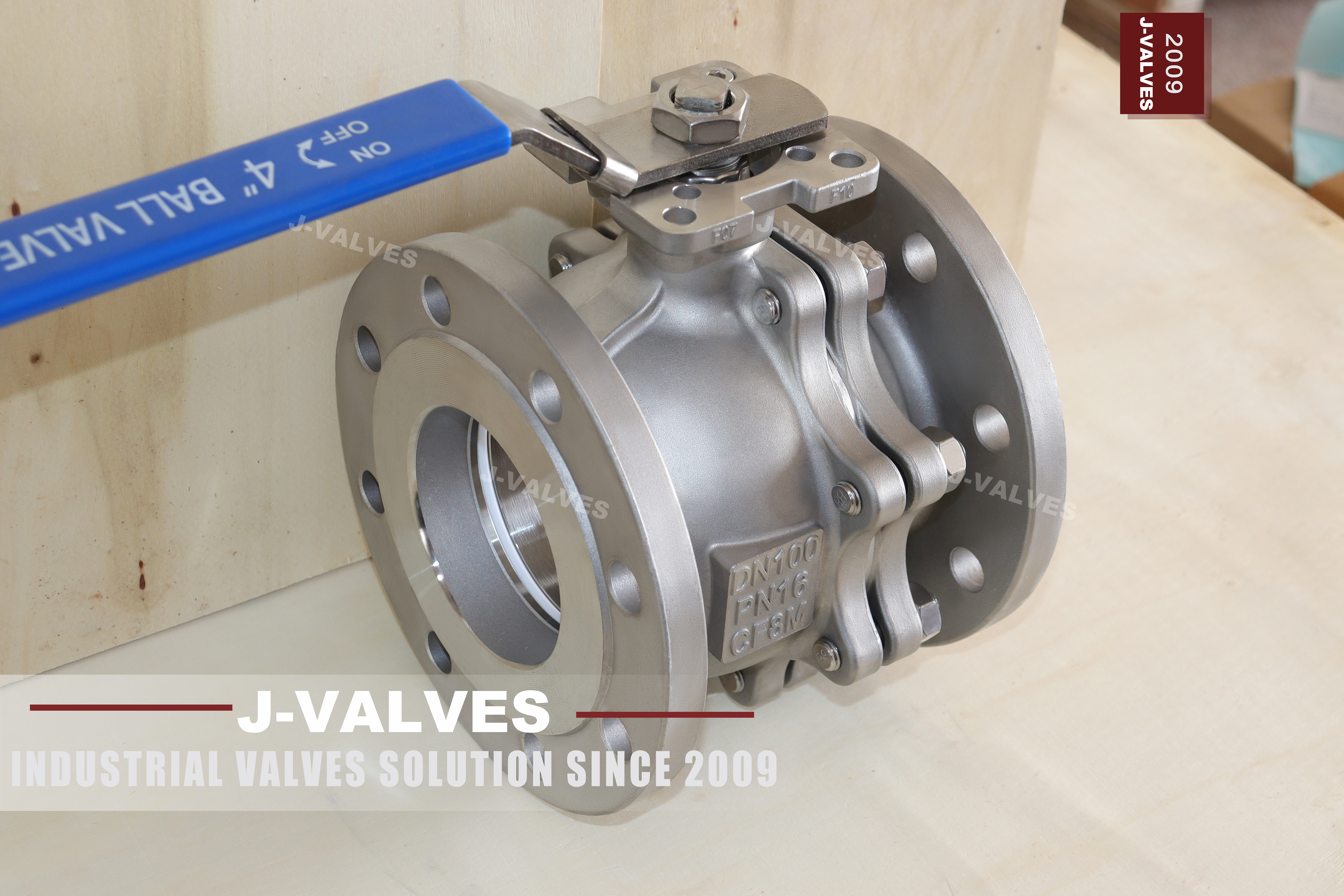
There are four standards named on this page and they do not all come from the same generation. DIN 3357 and DIN 2543 belong to the older German set. EN 12266, the test standard, and EN 1092-1, the flange standard, belong to the European set that replaced much of it. The face to face line, however, still names DIN 3202, which is one of the documents that the EN standards superseded.
That matters because a European buyer reads the list as a package. A valve quoted as DIN 3202 dimensioned and EN 12266 tested is a valve described in two vocabularies, and the number that decides whether it fits the space in the pipe is the one that has been superseded. This page is about that one line: what the current reference is, which series to ask for, and why leaving the old number on the drawing invites a valve that fits nothing.
Design and Construction
The body is two pieces, a main body and one end cap on a bolted joint, with the trim entering through that joint. At DN100 the joint is small enough to be opened on a bench, which is the practical case for the design at this size: a seat change does not need the valve cut out of the line, only a flange undone. The joint is a pressure boundary and gets the same shell test as the wall.
The ball floats between two seats, so the line pressure seats it downstream and the sealing force rises with the pressure. At this bore and this class the load is modest and the torque stays within a lever, which is why the valve is supplied with a lever as standard and a gear only where the valve is out of reach or under a cover.
The stem is bottom entry with an anti blowout shoulder, and the top of the stem carries an ISO 5211 mounting pad so that an actuator can be bolted on later without changing the valve. That pad is worth checking on the drawing rather than assuming, because a valve without it cannot be automated later without an adapter plate and a new stem coupling. A pad of the wrong size is an adapter plate and a new coupling.

Material Options
The body is CF8 or CF8M, the austenitic stainless castings, with CF8M chosen where the medium has chlorides and CF8 where it does not. The two are not grades of one material with a price between them: CF8M carries molybdenum and resists pitting in a way CF8 does not, and the difference shows up in a chloride line rather than on a datasheet. The plate carries one code and the certificate is written against that code.
The ball is CF8 or CF8M, polished, and the surface finish is one of the few claims on a valve page that can be measured at goods in. The stem is a 316 grade or 17-4PH, and the packing is PTFE V rings, graphite, or a combined low emission arrangement where the line is regulated for fugitive emissions. The finish is checked with a comparator rather than by eye.
The seat list runs from PTFE through reinforced PTFE, PPL and PEEK to a metal seat with an alloy hardfacing. That last one is a different valve in behaviour rather than an upgrade: a metal seat takes temperature and abrasion, costs torque, and is judged on a leakage rate rather than on zero leakage. The seat also sets the temperature the valve can be used at, well below the body range.
| Component | Standard Material | Optional Upgrade | Service Notes |
|---|---|---|---|
| Body and end cap | CF8 or CF8M cast stainless | the other casting on request | one code on the plate |
| Ball | CF8 or CF8M, polished | hard chrome or nickel deposit | finish is measurable at goods in |
| Stem | 316 grade or 17-4PH | on the order | bottom entry, anti blowout |
| Seat ring | PTFE | reinforced PTFE, PPL, PEEK or metal with hardfacing | sets the temperature ceiling |
| Body joint | one bolted joint with a gasket | spiral wound or PTFE envelope | renewed at every break |
| Packing | PTFE V rings | graphite or low emission arrangement | gland adjustable |
| Actuator mounting | ISO 5211 pad on the stem head | pad size on the drawing | needed to automate later |
| End connection | EN 1092-1 Type 11 B1 PN 16 | PN 25 or PN 40 | class changes the bolt circle |
Technical Specifications
The flanges are EN 1092-1 Type 11 B1, which is a complete designation rather than a nickname: it names the flange type and the facing, and a European buyer can order a counter flange against it without asking a second question. That is more than most pages give, and it is worth keeping on the order rather than shortening to PN 16. Shortened to PN 16 it describes only the pressure.
The face to face length is where the page is behind. The current reference for valve face to face dimensions in the EN world is EN 558, which publishes basic series and the valve types that go with them. A length quoted against DIN 3202 may coincide with an EN 558 series for this size and type, and it may not; the only safe course is to quote the series that the pipe layout was designed to and let the valve be built to it.
The pressure classes offered are PN 16, PN 25 and PN 40, and they are not interchangeable flanges: the outside diameter and the bolt circle change with the class. The valve on this page is PN 16. The operator is a lever, or a worm gear, or a pneumatic or electric actuator on the ISO 5211 pad. An actuator chosen for PN 16 will still bolt to the same pad.
| Item | Value |
|---|---|
| Nominal size | DN100 (four inch) |
| Pressure class | PN 16 as flanged, PN 25 and PN 40 available |
| Body style | two piece, one bolted body joint |
| Ball support | floating |
| Bore | full bore |
| Body material | CF8 or CF8M cast stainless steel |
| Ball material | CF8 or CF8M, polished |
| Ball finish | polished surface, measurable at goods in |
| Stem material | 316 grade or 17-4PH |
| Seat material | PTFE as standard |
| Seat options | reinforced PTFE, PPL, PEEK or metal with hardfacing |
| Packing | PTFE V rings, graphite, or low emission arrangement |
| Actuator mounting | ISO 5211 pad on the stem head |
| End connection | EN 1092-1 Type 11 B1 PN 16 |
| Flange option | PN 25 or PN 40, different bolt circles |
| Face to face | quoted to an EN 558 series, not to DIN 3202 |
| Design standard | DIN 3357, with ASME B16.34 and API 608 underneath |
| Test standard | EN 12266, or API 598 where the order names it |
| Test record | leakage class under EN 12266, visible leakage under API 598 |
| Shell test pressure | 1.5 times the rating |
| Temperature range | minus 29 to plus 425 Celsius, metal temperature |
| Temperature ceiling | set by the seat material, not by the body |
| Operation | lever, worm gear or actuator on the ISO 5211 pad |
| Fire safe option | API 607, named on the order |
| Marking | size, class, body code, heat number |
| Documentation | EN 10204 3.1 on request |
Standards and Compliance
DIN 3357 is the German design standard for ball valves, and EN 12266 is the European test standard, which rates leakage in classes rather than as a pass or fail. Both are current. DIN 3202, which the page cites for face to face, belongs to the set that EN 558 replaced, and a drawing that cites it is citing a withdrawn document even where the dimension itself has not changed.
EN 1092-1 gives the flange dimensions and the designation, and ASME B16.34 and API 608 are the rating and the general ball valve requirements that apply underneath. A DIN valve is not an ASME valve with a different flange: the two systems have their own test standards, their own marking conventions and their own documentation habits, and a specification that mixes them has to say which one governs where they disagree.
The fire safe option is a type test, and API 607, API 6FA and ISO 10497 are separate procedures. Where the line is regulated for fugitive emissions, the packing arrangement is a separate claim again, and it is tested to its own standard rather than implied by the fire certificate. A certificate that names neither the size nor the seat cannot be applied to this valve.
| Requirement | Standard | What J-VALVES Supplies |
|---|---|---|
| Pressure boundary | ASME B16.34 | rating and minimum wall |
| General ball valve | API 608 | marking, pressure test, fire safe option |
| Design, German set | DIN 3357 | ball valve design |
| Flange | EN 1092-1 Type 11 B1 | type and facing in one designation |
| Face to face | EN 558 series | the current reference, DIN 3202 was replaced |
| Testing | EN 12266 | leakage recorded in classes |
| Shell and seat test, ASME route | API 598 | 1.5 times shell, 1.1 times seat |
| Actuator interface | ISO 5211 | mounting pad and drive |
| Fire test | API 607, 6FA or ISO 10497 | named on the order |
Manufacturing Process
The body and the end cap are cast to one specification, cleaned, and machined from the flange faces. The flange is faced and drilled to EN 1092-1 Type 11 B1, the bore is machined through, and the joint face is finished before the seat pocket is cut from it so that the pocket stays square to the face. The ball is machined and then polished, because the finish is what the seat runs against and what the page claims.
The face to face length is set at the machining stage, and this is where a dimension quoted to the wrong series becomes irreversible. The body is not cut to length afterwards, so the series has to be on the drawing before the first cut. Assembly sets the ball and seats, fits the stem through the body with its anti blowout shoulder, and closes the joint on a new gasket with the faces checked for parallel.

Quality Control and Testing
The casting certificate is written against the heat number on the plate, and where the order asks for a positive material identification report it is issued against the same heat. The two austenitic castings look the same after painting, so the report is the only practical check at goods in, and it is quoted on request rather than claimed as a standing practice. The plate is the pointer, and the report is the file behind it.
The dimensional check is where this page earns its keep: the face to face length is measured against the series that was ordered, and the flange is checked against EN 1092-1 Type 11 B1 rather than against the valve beside it. A valve that is right in every other respect and a few millimetres out on length is a valve that will not go into the space the pipe was built around.
The shell test is run at one and a half times the PN 16 rating with the body assembled, and the seat test follows in both directions. Where the order names EN 12266, the result is recorded in that standard leakage class rather than as a simple pass, and where it names API 598, the acceptance is no visible leakage on a soft seat. The standard has to be named, because the two record different things.
| Step | What Is Checked | Standard or Acceptance |
|---|---|---|
| Casting | heat number and certificate | read against the stamped code |
| Casting identity | positive material identification | quoted when the order asks |
| Flange | checked against EN 1092-1 Type 11 B1 | not against the valve beside it |
| Face to face | measured against the EN 558 series ordered | set at machining, not adjustable later |
| Seat pocket | square to the joint face | cut from the finished face |
| Shell test | wall and joint at 1.5 times the rating | recorded against the named standard |
| Seat test | both directions, cavity open | EN 12266 class or API 598 acceptance |
| Marking | plate against the certificate | code, class and PN checked together |

Applications and Industry Service
This valve belongs on European plant piping: water, cooling, weak chemical service and utilities, where the line is built to EN flanges and the pipe layout has been designed around EN 558 lengths. It is bought because the joint is European and the space is European, and the stainless body is bought because the medium would corrode a carbon one. On an ASME line the same drawing would arrive with the wrong bolt circle.
It is the wrong valve where the line is ASME flanged, even at the same nominal size, because the bolt circle and the length are from a different system. It is also the wrong valve where the pipe space was built to a DIN 3202 length and nobody checked whether that length is an EN 558 series, because the answer may be that the valve does not fit.
Installation, Operation and Maintenance
The valve is fitted between EN 1092-1 counter flanges of the same class, with the faces parallel and the studs torqued in a cross pattern. A valve that is pulled into line by its studs will distort the body and the seat pocket with it, and the leak that follows is blamed on the seat. The lever is left where it can swing clear of insulation and structure.
Maintenance is the seat and the packing. The line is isolated and drained, the joint studs released, and the end cap taken off to expose the ball and one seat ring. The seat is replaced rather than re-torqued, the ball is inspected for damage to its finish, and the joint is remade on a new gasket and re-tested. The ISO 5211 pad is the place to fit an actuator later, and it is worth keeping clear of paint.
How to Specify and Order
The order needs size, class, flange standard and type, face to face standard and series, body material, bore, seat, packing, operator and test standard. Write the flange as EN 1092-1 Type 11 B1 PN 16, and write the length as an EN 558 series rather than as a number, because the number without the series cannot be checked. A number without a series is a number that two suppliers read differently.
Then name the test standard, because EN 12266 and API 598 record different things and a certificate to one is not a certificate to the other. A European project will usually ask for EN 12266 with a leakage class, and a project that asks for both is asking for two tests rather than one. Saying which governs avoids a discussion at the witness point. Naming one is cheaper than discovering the difference at the witness point.
FAQ
Q: Is DIN 3202 still current?
A: It is one of the older German documents that the European valve standards replaced, and the current reference for face to face dimensions is EN 558. Some dimensions were carried over, so a valve quoted to DIN 3202 may well measure the same as one quoted to an EN 558 series, but the document to cite on a drawing is the current one. Citing a superseded standard invites a valve built to the wrong series.
Q: Which EN 558 series should the order name?
A: The one the pipe layout was designed to. EN 558 publishes basic series by valve type, and a ball valve of this size and class falls into a particular series; the same valve can often be built to more than one. The right answer is not a number on a catalogue page but the series that the space in the pipe was built around, which is a project decision rather than a product decision.
Q: Can this valve be automated later?
A: Yes, if the stem head carries an ISO 5211 mounting pad, which this one does. The pad size and the drive determine which actuators bolt on directly, and a valve without the pad needs an adapter plate and a new coupling. If automation is a possibility, the pad belongs on the order rather than on a wish list.
Q: Why does the page list four standards?
A: Because the valve crosses two systems. DIN 3357 and DIN 2543 come from the German set, EN 1092-1 and EN 12266 from the European set, and the face to face line still cites DIN 3202 from the older generation. The list is not wrong so much as half updated, and the line that has not been updated is the one that decides whether the valve fits.
Q: Is EN 12266 the same as API 598?
A: No. Both test the shell and the seat, and both apply a multiple of the rating for the shell, but they record the result differently: EN 12266 places leakage in classes, while API 598 on a soft seat asks for no visible leakage. A certificate to one is not a certificate to the other, and a project that names both is asking for two tests.
Q: What is Type 11 B1?
A: It is an EN 1092-1 flange designation that names the flange type and the facing in one string, which is what a European buyer needs in order to order a counter flange without a second question. Keeping the full designation on the order is better than shortening it to PN 16, because the class alone does not describe the flange.


Hot Products


News
Ball Valves On A Bottom Loading Gantry: Creep, Dry Break And The Test That Proves Neither
A loading gantry cycles a ball valve far more than it is designed for and still cannot prove shut-off. Where creep starts, and what to specify.
Read More
Lined Ball Valves in Acid Service: The Liner Does Not Fail, The Steel Behind It Does
The valve came out of the line looking better than most valves that come out of a hydrochloric acid line. Three inch, PFA lined, cast body, Class 150, fourteen months in service on a 32 percent acid transfer duty at 55 to 60 degrees C, about forty open and close cycles a week. The paint was intact.
Read More
Ball Valves in Amine CO2 Capture: Heat Stable Salts, Rich Amine, And The Three Places The Body Thins
Rich amine at 110 C with heat stable salts is where capture plant ball valves fail. Materials, velocity limits, cavity gas and seat choice, with numbers.
Read More
Fail-Safe Ball Valve Actuators: Spring Return, Stored Air, And The Torque Nobody Checks
Spring return or stored air? The answer is a torque curve, not a datasheet box. Sizing, receiver volume, closing time and four silent failures.
Read More