


CHINA J-VALVES Offers Various High-quality I ndustrial Ball Valves
J-VALVES, a distinguished professional ball valve manufacturer rooted in China, takes pride in its extensive product portfolio. Our offerings span a wide range, including trunnion-mounted ball valves, floating ball valves, high-temperature ball valves, high-pressure ball valves, metal-sealed ball valves, ultra-low temperature ball valves, DBB ball valves, Three-way And Four-way Ball Valve, and fully welded ball valves. Each product is a testament to our commitment to precision engineering and reliable performance. Meticulously crafted, they are designed to not only meet but exceed the most stringent industrial demands, ensuring stable operation even under extreme conditions. This enables us to provide our clients with high-value services and makes our valves widely sought-after in industries.
Product Category
Contact Us


-
J-VALVES-Q41F
-
J-VALVES
Overview of the J-VALVES DN100 PN16 CF8M Two Piece Stainless Steel Floating Ball Valve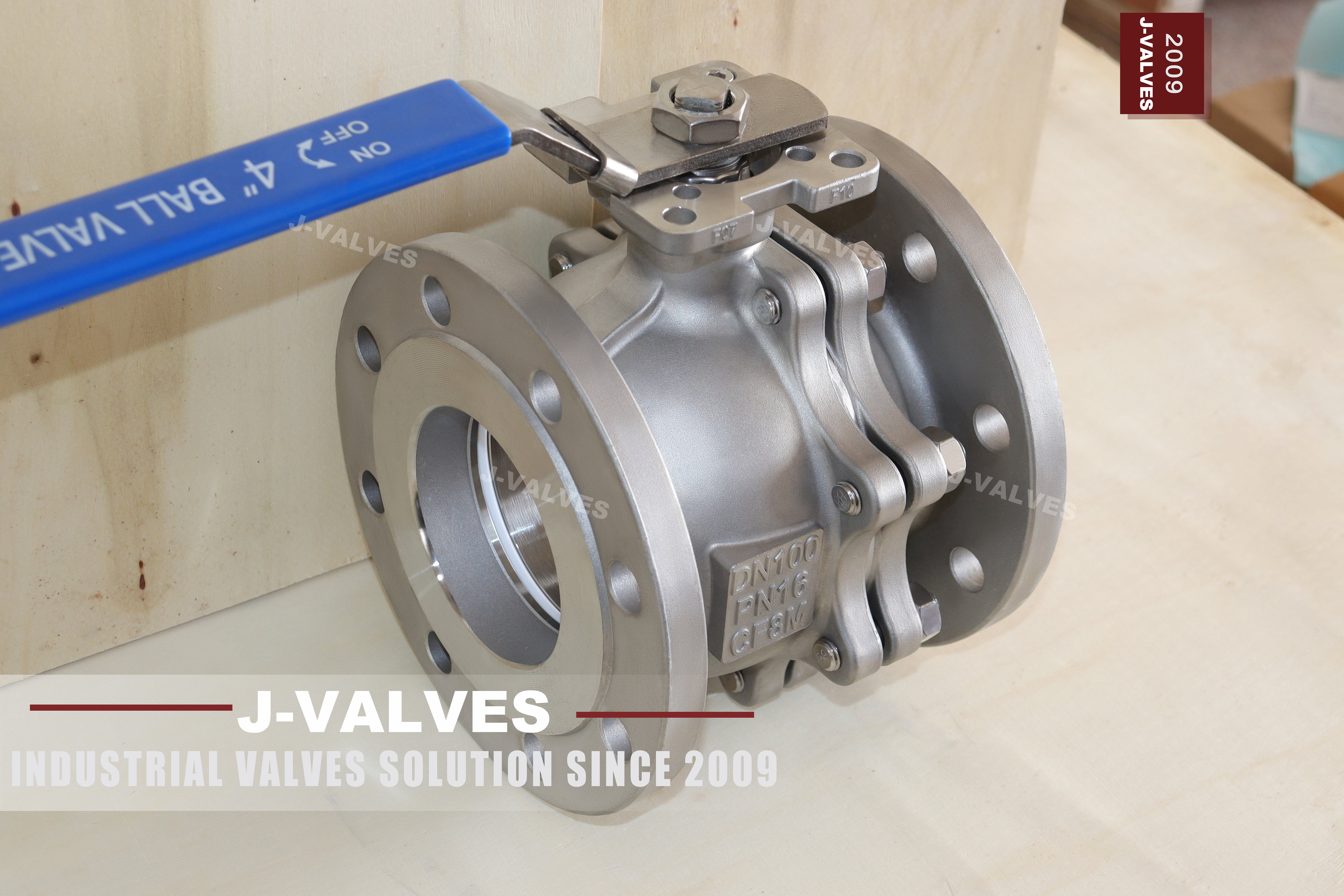
The original page makes a claim in the full bore paragraph that deserves a page of its own: it says the bore matches the pipe and allows pig passage. A full bore is indeed the first condition, and without it nothing else matters. But it is not the only condition, and a buyer who reads that sentence as a guarantee will one day try to pass a gauge through a valve that was never bought for the job.
So this page separates the two things the sentence runs together. On one side is the bore, which is a dimension and can be checked. On the other is pigging, which is a property of the whole installation: the bore has to line up with the pipe, the seat has to survive the passage, the cavity has to be clean, and the line has to be one that is pigged at all. A four inch soft seated valve is usually the wrong place for a pig, and saying so is more useful than repeating the phrase.
Design and Construction
The body is two pieces: a main body and one end cap on a bolted joint with a gasket between them. The trim goes in through that joint, so the ball, the seats and the stem are reachable without cutting the line, at the cost of taking a flange apart rather than lifting a centre section. At four inch that is a bench job, which is the honest case for the design at this size.
The ball floats. Line pressure pushes it downstream against the seat, and the sealing force rises with the pressure, which is why the design is compact and why the torque stays inside a lever. At DN100 and PN 16 the seat load is modest, and this is close to the size where the floating design stops being the obvious choice and a trunnion starts to make sense.
The bore is full, so the passage through the ball is nominally the same as the pipe bore. That is a machining and casting statement: the ball port is large, the seat rings do not intrude, and the body passage does not step down. It does not say anything about the roundness of the passage, the alignment of the ball port with the pipe when the valve is open, or whether the seat material will survive what is pushed through it.

Material Options
CF8M is the molybdenum bearing austenitic stainless casting, used where the medium would pit or corrode a carbon body: water with chlorides, weak acids, chemical service and plants where a rusting bore is not acceptable. It is the standard stainless grade for a valve body, and it is cast rather than forged because at four inch the casting route is cheaper and the wall is thick enough that a sound casting is not a difficulty.
The ball is solid CF8M or CF3M, with a nickel or chrome deposit as the option, and the stem is CF8M, a 316 grade or 17-4PH where the torque asks for it. The gasket is a graphite spiral wound or a PTFE envelope, and the bolting is stainless so that the body and its studs do not form a galvanic pair in a wet line. None of that is unusual; the point is that each of them is a line on the order.
The seat is PTFE as standard, with reinforced PTFE and PPL as the alternatives, and here the seat is the part that decides both the temperature and the pigging answer. A soft seat is a polymer ring sitting proud of the metal, and a pig with metal brushes or discs will find it. That is the practical reason a full bore soft seated valve is not automatically a pigging valve.
| Component | Standard Material | Optional Upgrade | Service Notes |
|---|---|---|---|
| Body and end cap | CF8M cast stainless | CF3M or CF8 on request | one code on the plate |
| Ball | CF8M or CF3M, solid | nickel or chrome deposit | port polished before assembly |
| Stem | CF8M or 316 | 17-4PH for higher torque | anti blowout |
| Seat ring | PTFE | reinforced PTFE or PPL | polymer ring, proud of the metal |
| Body joint | one bolted joint with a gasket | spiral wound or PTFE envelope | renewed at every break |
| Bolting | stainless studs and nuts | grade on the order | galvanic pair if mismatched |
| Packing | PTFE V rings | graphite | adjustable gland |
| End connection | raised face to EN 1092-1 PN 16 | GB/T 9113 PN 16 | the joint follows the flange table |
Technical Specifications
The class is written Class 150 on the title and PN 16 in the flange line, and the two are not the same statement: Class 150 is a rating and PN 16 is a flange table. The valves on this page are flanged to EN 1092-1 PN 16 or to GB/T 9113 PN 16, so the joint is a European one and the counter flange has to be cut to the same table. Mixing the two descriptions on an order is how a valve arrives with a bolt circle the pipe does not have.
The size is DN100, four inches, with a full bore and a face to face length dimensioned on the signed drawing for the flange standard ordered. The operator is a lever with a locking hole, with a gear, a pneumatic actuator or an electric actuator available where the valve is under a cover or out of reach. Weight is quoted with the drawing rather than tabulated, because it moves with the actuator.
The temperature line on the original page runs from minus 29 to plus 425 Celsius, which is the range of the pressure boundary and not of the seat. The seat is the lower limit and the one that matters, and the design temperature should be stated on the enquiry so that the seat is chosen against it rather than against the body. A drawing that carries one temperature for both will read as a valve that does more than it can.
| Item | Value |
|---|---|
| Nominal size | DN100 (four inch) |
| Pressure class | Class 150 rating, PN 16 flange table |
| Body style | two piece, one bolted body joint |
| Ball support | floating |
| Bore | full bore |
| Body material | CF8M cast stainless steel |
| Body options | CF3M or CF8 on request |
| Ball material | CF8M or CF3M, solid |
| Ball options | nickel or chrome surface deposit |
| Stem material | CF8M, 316 or 17-4PH |
| Seat material | PTFE as standard |
| Seat options | reinforced PTFE or PPL |
| Pigging suitability | a full bore is necessary, not sufficient; the seat and the line decide |
| Packing | PTFE V rings or graphite |
| Gasket | graphite spiral wound or PTFE envelope |
| Bolting | stainless studs and nuts |
| End connection | raised face flange to EN 1092-1 PN 16 |
| End option | GB/T 9113 PN 16 |
| Face to face | dimension on the signed GA drawing |
| Design standard | ASME B16.34 and API 608 |
| Test standard | API 598 shell and seat test |
| Test pressure | shell 1.5 times and seat 1.1 times the rating |
| Shell temperature range | minus 29 to plus 425 Celsius, metal temperature |
| Operation | lever with a locking hole, actuator on request |
| Fire safe option | API 607, named on the order |
| Marking | size, class, body code, heat number |
Standards and Compliance
ASME B16.34 gives the rating and the minimum wall for the casting, and API 608 gives the general ball valve requirements: marking, pressure test and the fire safe option. Where the valve is bought for a pipeline, API 6D applies and adds the cavity relief and the documentation package. The flanges are to EN 1092-1, which is a separate document from all three and is the one that decides the joint.
The fire safe claim is a type test, not a property of every valve. API 607 burns the soft seat away and then checks that the metal contact behind it still closes; API 6FA and ISO 10497 are separate procedures with their own acceptance. A certificate to one is not evidence for another, and the certificate should name the size range and the seat construction it was earned on rather than the phrase alone.
API 598 sets the shell test at one and a half times the rating and the seat test at one and one tenth times, with no visible leakage accepted on a soft seat. On a valve that may be used near its seat limit, the seat test is also where a marginal seat shows itself, which is why a hot test is worth asking for when the service temperature is near the top of the range.
| Requirement | Standard | What J-VALVES Supplies |
|---|---|---|
| Pressure boundary | ASME B16.34 | rating and minimum wall |
| General ball valve | API 608 | marking, pressure test, fire safe option |
| Flange, European | EN 1092-1 PN 16 | raised face |
| Flange, Chinese | GB/T 9113 PN 16 | raised face |
| Shell and seat test | API 598 | 1.5 times shell, 1.1 times seat |
| Fire test | API 607, 6FA or ISO 10497 | a type test, named on the order |
| Marking | API 608 | size, class, body code, heat number |
| Documentation | EN 10204 3.1 | issued against the heat number |
Manufacturing Process
A valve bought for its bore is machined for its bore. The casting is cleaned and the flange faced and drilled to the standard ordered, but the sequence that matters is the bore: it is cut through, then finished to the gauge the line uses rather than to a nominal size, and only then is the joint face machined and the seat pocket cut from it. Done the other way round it leaves a full bore that measures correctly on a drawing and will not pass the tool the line runs, which is a defect no pressure test will catch.
Assembly sets the ball between the two seats, fits the stem with its thrust washer and packing, and closes the joint on a new gasket with the faces checked for parallel. The valve is then stroked through ninety degrees to confirm that the ball port lines up with the body passage at each end of travel, which is the check that a full bore claim actually depends on and the one that is easiest to skip.

Quality Control and Testing
The casting certificate is written against the heat number stamped on the plate, and where the order asks for a positive material identification report it is issued against the same heat. That report is the only practical way to tell a CF8M body from a CF8 one after painting, and it is quoted on request rather than claimed as a standing practice. The two castings look identical under a coat of paint, so the paper is the difference between them.
The pressure test and the gauge check are two separate proofs and only one of them is on the test sheet. Pressure is the familiar one: one and a half times the PN 16 rating on the shell, one and one tenth on each seat, with the joint watched as closely as the wall. The gauge is the one that matters here, because where the line may be pigged the bore is checked against a gauge of the line size and the result is recorded. A nominal full bore that will not pass the gauge has been finished undersize, and no shell test will show it.
| Step | What Is Checked | Standard or Acceptance |
|---|---|---|
| Casting | heat number and certificate | read against the stamped code |
| Casting identity | positive material identification | quoted when the order asks |
| Joint face | flatness and finish | datum for the seat pocket |
| Seat pocket | square to the joint face | cut in the same setup |
| Port alignment | ball port against the body passage | checked at both ends of travel |
| Bore gauge | checked against the line gauge | recorded where the line is gauged |
| Shell test | wall and joint at 1.5 times | API 598 duration |
| Seat test | both directions, cavity open | no visible leakage on a soft seat |

Applications and Industry Service
This valve belongs on water with chlorides, on chemical transfer, on plant cooling and on food or pharmaceutical lines where a clean non staining bore matters. At four inch and PN 16 the pressure is modest, so the reasons to buy it are the medium and the cleanliness rather than the strength, and the full bore is bought to keep the pressure drop low rather than to pass anything through it.
It is the wrong valve for a line that is pigged with a metal bodied pig or a brush pig, for a line where the medium carries solids that settle in the cavity, and for a line that is cycled hot and cold across the seat limit. Where a pig genuinely has to pass, the valve is a different one: a metal seated, trunnion mounted valve with a bore that is certified against the gauge, and usually a larger size.

Installation, Operation and Maintenance
The valve goes in with the flanges parallel and the studs torqued in a cross pattern to the values for the PN 16 joint, and the lever is left where it can swing through ninety degrees clear of insulation and structure. The arrow on the body is a flow direction rather than an installation restriction on a floating valve, but the preferred direction is still the one the drawing shows, because the cavity relief depends on it.
Because the body is two pieces, the seat is reached from one end, and the work is a joint job rather than a line job. The studs come out in a cross pattern after the line is isolated and the cavity vented, the end cap is lifted away with its seat ring sitting in it, and the ring is renewed rather than cleaned. The ball is inspected for damage to its surface, since that surface is what the seat runs against, and the joint is closed on a new gasket and re-tested before the valve goes back.
How to Specify and Order
The order needs size, class, flange standard, body style, body code, bore, seat, gasket, operator and test standard. Write the flange standard as EN 1092-1 PN 16 or GB/T 9113 PN 16, and write the class beside it, because the two are different statements and the joint follows the flange rather than the class. An order that carries only one of them leaves the works to choose the other, and the choice will be whatever that works normally drills.
Where pigging is the reason for the full bore, say so in the enquiry and say what will be pushed through. The answer may be a different seat, a different body style, or a larger valve, and all three are cheaper to decide at the quotation than after the first pig is stuck. A full bore ordered for flow and a full bore ordered for pigging are two different orders even when the drawing looks the same.
FAQ
Q: Does a full bore mean the valve can be pigged?
A: It means the bore does not restrict the passage, which is the first condition. It does not mean the valve is a pigging valve. A pig needs a continuous passage with no step and no obstruction, a seat that will survive it, and a line that is designed to be pigged. On a soft seated valve the seat is a polymer ring that a brush or a metal disc will damage, so in most pigging duty the answer is a different valve.
Q: What would make this valve suitable for a pig?
A: A metal seat rather than a polymer one, a bore checked against the gauge the line uses, a ball port that lines up with the body passage at both ends of travel, and a cavity that does not trap debris. Those are the conditions, and they are checked at the works rather than assumed from the word full. Where they are all met, a soft seated valve can still be used for a foam pig on a clean line, which is a narrower claim than the page makes.
Q: Why is the class written two ways?
A: Because the title carries a rating and the flange line carries a table. Class 150 is the rating, and PN 16 is the European flange step the valve is actually drilled to. They are close but not the same document, and the one that decides whether the valve bolts to the pipe is the flange table. That is why the order should carry both, with the flange standard spelled out.
Q: Which temperature governs the service?
A: The seat. The body covers the stainless range up to the top of the carbon steel envelope, but the seat is PTFE as standard and reinforced PTFE or PPL above it, and the seat limit is well below the body limit. A valve chosen against the body range will run its seat past its limit and start to weep, and the fix is a different seat rather than a tighter gland.
Q: What is the fire safe claim on this valve?
A: It is a type test to API 607, in which the soft seat is burned away and the metal contact behind it has to close. It is not a statement that the valve will survive any fire, and it is not interchangeable with API 6FA or ISO 10497, which are different procedures. The order should name the test and keep the certificate with the valve, because the claim is only as good as the paper behind it.
Q: Why two piece rather than three piece at this size?
A: One joint, one gasket and one fewer pressure boundary to prove, at the cost of removing a flange rather than a centre section when a seat is changed. At four inch that is a bench job either way, so the two piece body is usually the cheaper answer unless the valve is expected to be opened often. Above this size the arithmetic starts to change.


Hot Products


News
Ball Valves On A Bottom Loading Gantry: Creep, Dry Break And The Test That Proves Neither
A loading gantry cycles a ball valve far more than it is designed for and still cannot prove shut-off. Where creep starts, and what to specify.
Read More
Lined Ball Valves in Acid Service: The Liner Does Not Fail, The Steel Behind It Does
The valve came out of the line looking better than most valves that come out of a hydrochloric acid line. Three inch, PFA lined, cast body, Class 150, fourteen months in service on a 32 percent acid transfer duty at 55 to 60 degrees C, about forty open and close cycles a week. The paint was intact.
Read More
Ball Valves in Amine CO2 Capture: Heat Stable Salts, Rich Amine, And The Three Places The Body Thins
Rich amine at 110 C with heat stable salts is where capture plant ball valves fail. Materials, velocity limits, cavity gas and seat choice, with numbers.
Read More
Fail-Safe Ball Valve Actuators: Spring Return, Stored Air, And The Torque Nobody Checks
Spring return or stored air? The answer is a torque curve, not a datasheet box. Sizing, receiver volume, closing time and four silent failures.
Read More