


CHINA J-VALVES Offers Various High-quality I ndustrial Ball Valves
J-VALVES, a distinguished professional ball valve manufacturer rooted in China, takes pride in its extensive product portfolio. Our offerings span a wide range, including trunnion-mounted ball valves, floating ball valves, high-temperature ball valves, high-pressure ball valves, metal-sealed ball valves, ultra-low temperature ball valves, DBB ball valves, Three-way And Four-way Ball Valve, and fully welded ball valves. Each product is a testament to our commitment to precision engineering and reliable performance. Meticulously crafted, they are designed to not only meet but exceed the most stringent industrial demands, ensuring stable operation even under extreme conditions. This enables us to provide our clients with high-value services and makes our valves widely sought-after in industries.
Product Category
Contact Us


-
J-VALVES-Q41F
-
J-VALVES
Overview of the J-VALVES 4 Inch 150LB C95500 Floating Ball Valve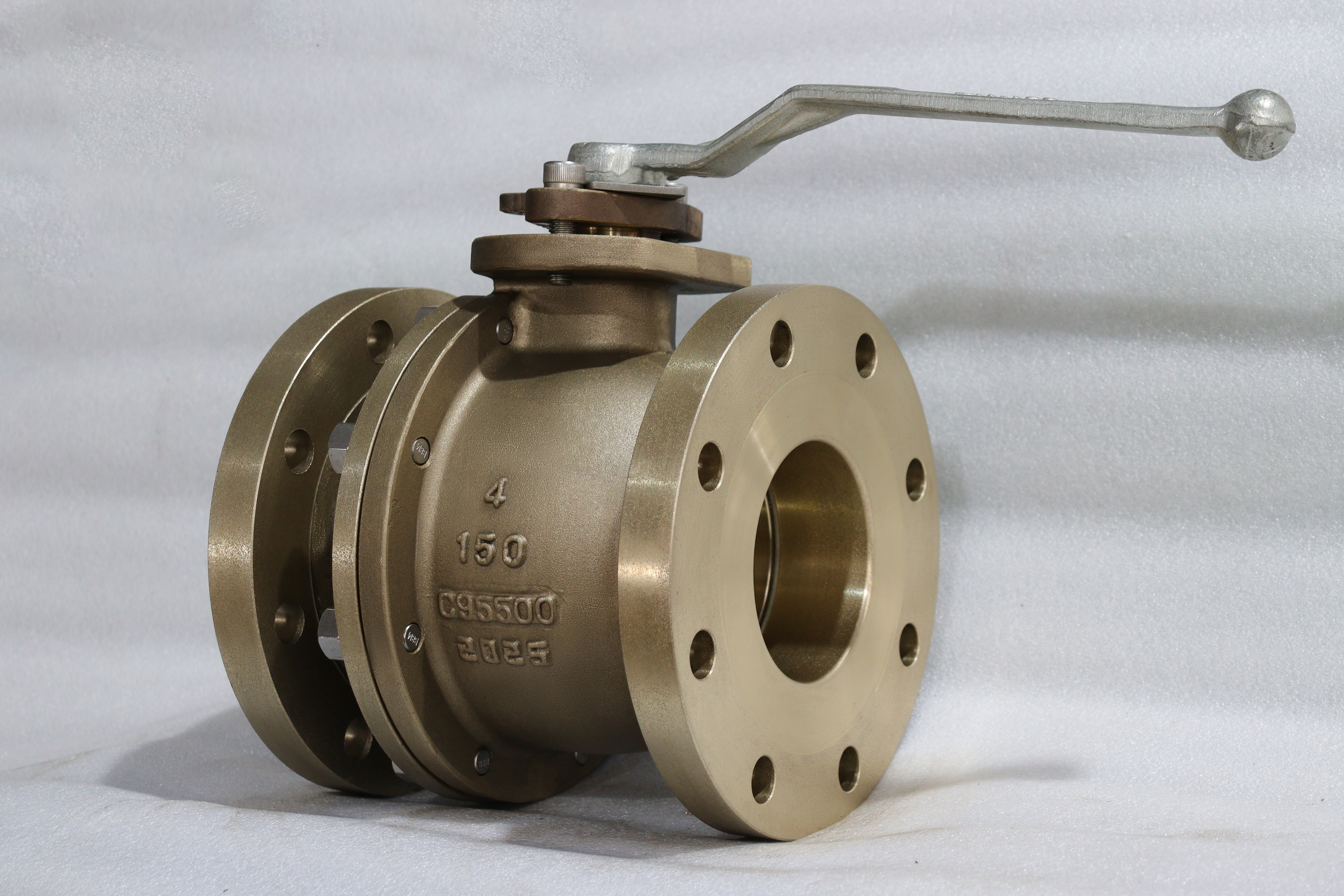
A steel valve with a sand hole in the body is a valve that gets repaired. The hole is ground out, welded, dressed and radiographed, and the valve ships with a record of the repair. A bronze valve with the same hole is a valve that gets scrapped, because the repair that works on steel does not work on a copper alloy casting: the heat changes the structure around the weld, and the alloy was chosen for what that structure does in seawater.
That single difference moves the whole quality argument upstream. On a bronze valve the deciding moment is at the foundry and at the incoming inspection, not at the final test, because by the time the valve is assembled a defect is no longer something to be fixed. This page is about what that means for the order, for what an inspection should look for, and for why a delivery of bronze valves is worth more attention than a delivery of steel ones.
Design and Construction
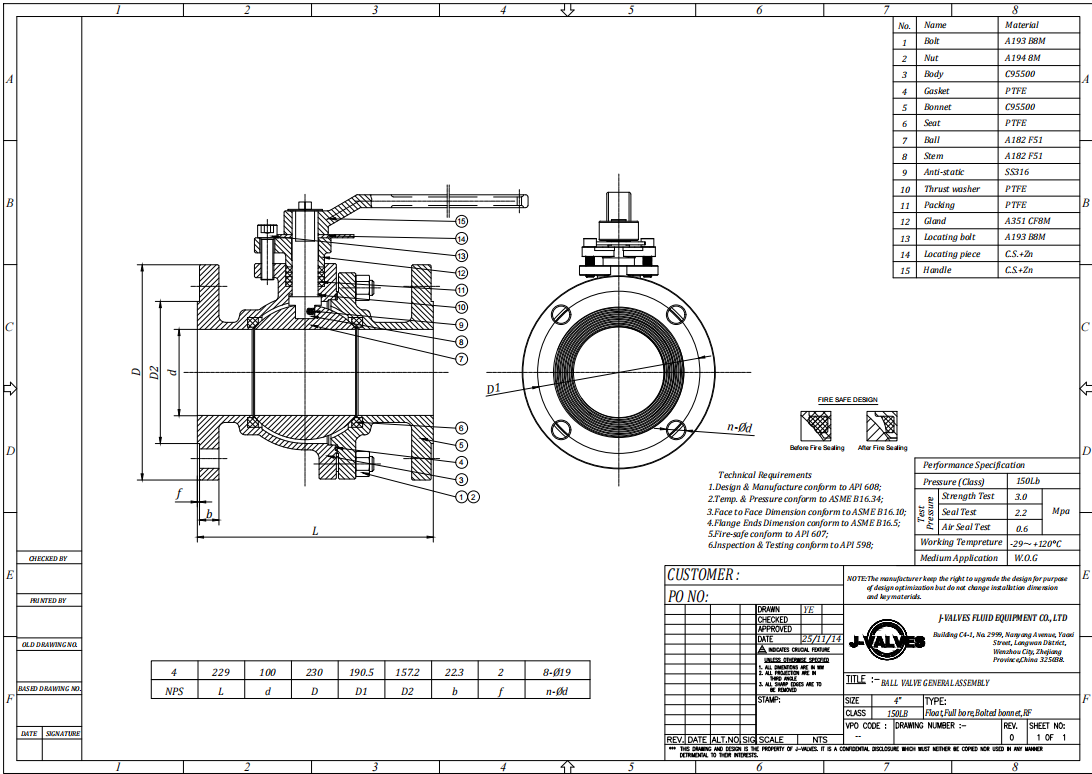
Two pieces with one bolted joint, the ball floating between two seats and the trim coming out through the end. The construction is ordinary; what is not ordinary is that every pressure-carrying part is a casting rather than a forging or a rolled section. A copper alloy body of this size is cast because the alloy is not made in the wrought forms that would allow a forged body, which means the whole pressure boundary inherits the properties of a casting.
The ball is bronze as well, either solid or plated, and the stem is bronze or a stainless on order. The bolts are a separate decision and a significant one on a bronze valve in seawater, because the fastener is often a different alloy from everything around it and becomes the place where the assembly fails first, and it is not a part a buyer thinks of as being part of the valve until it has failed.
Material Options
The body code is C95500, a nickel aluminium bronze casting, with a higher nickel grade listed as an alternative and a lower nickel grade listed as an economy option. The difference between them is corrosion behaviour rather than strength, and the choice belongs on the order by code rather than by description. The plate carries the code and the certificate is written against that code.
The seat is PTFE as standard with reinforced PTFE or PPL for temperature and a metal seat listed for higher duty. The bolts and the stem are named separately. Where a stainless is chosen for the ball or the stem, the assembly becomes a mix of alloys and the question of which one is anodic to which becomes part of the design rather than an afterthought.
| Component | Standard Material | Optional Upgrade | Service Notes |
|---|---|---|---|
| Body | C95500 nickel aluminium bronze casting, code as stamped | higher or lower nickel grade on order | cast, so the whole boundary is a casting |
| Ball | solid C95500 or plated | stainless on order | floats into the downstream seat |
| Stem | C95500, or stainless on order | named on the order | the part that sees the weather |
| Seat ring | PTFE | reinforced PTFE, PPL or metal | sets the temperature ceiling |
| Bolts | selected against the body and the pipe | named on the order | often a different alloy from the body |
| Body joint | one gasketed studded joint | not offered as a welded body | new gasket at every break |
| Casting repair | not weld repaired | accepted or scrapped at the foundry | the difference from a steel body |
| End facing | raised face to ASME B16.5 | chosen at order | Class 150 pattern |
Technical Specifications
On a four inch Class 150 valve the table entries are a short list, and the body grade is not one of them. The flange drilling and the raised face come from ASME B16.5 at four inch Class 150, the bore is full, and the face to face follows ASME B16.10 for a flanged valve of this size and class. Class 150 is PN 20 in the API 6D code. What none of those entries describes is how sound the casting is, because a copper alloy body is judged on its section and its soundness rather than on its dimensional class, and that judgement is made in the foundry and recorded before the valve is machined.
The figure that is not on the data sheet is the casting quality, and on this valve it is the one that matters. Whether the body was radiographed, at what coverage, and against which acceptance level are all order items rather than catalogue items, because a bronze casting cannot be reworked afterwards to compensate for a level that was never specified. That is the subject of the rest of this page.
| Item | Value |
|---|---|
| Nominal size | 4 inch (DN100) |
| Pressure class | Class 150 (PN 20, the API 6D pressure code) |
| Body style | two piece, one gasketed body joint |
| Ball support | floating, no trunnion |
| Bore | full bore |
| Body material | C95500 nickel aluminium bronze casting, code as stamped |
| Ball material | solid C95500 or plated, stainless on order |
| Stem material | C95500, or stainless on order |
| Seat material | PTFE as standard |
| Seat options | reinforced PTFE, PPL or metal seat |
| Bolts | selected against the body and the pipe, named on the order |
| End connection | raised face flange, ASME B16.5 Class 150 |
| Face to face | dimension on the signed GA drawing, held to ASME B16.10 |
| Governing body standard | ASME B16.24 for the alloy |
| Test standard | API 598 shell and seat test |
| Test pressure | shell 1.5 times and seat 1.1 times the class rating |
| Temperature range | minus 29 to plus 425 Celsius, metal temperature |
| Temperature ceiling | set by the seat material, not by the body code |
| Casting repair | not weld repaired, accepted or scrapped at the foundry |
| Casting examination | stated on the order with its acceptance level |
| Bolt isolation | specified on the drawing, not improvised on site |
| Marking | alloy code, size, class, heat number |
| Documentation | EN 10204 3.1 on request |
| Weight | quoted with the drawing for the size and trim ordered |
Standards and Compliance
The governing document for a copper alloy valve body is the bronze casting and valve standard rather than the steel valve standard, and the difference is not administrative: it carries its own rules on casting quality and on what may be done to a casting that does not meet them. A supplier who quotes a steel valve standard for a bronze body is quoting the wrong document, and the marking on the plate should be read against the right one.
The test acceptance is separate and comes from API 598, which applies to the assembled valve regardless of the body alloy: shell at one and a half times the rating and seat at one and one tenth times, in both directions with the cavity open. Nothing in the test standard asks where the casting came from, which is why the casting record has to be asked for by name.
| Requirement | Standard | What J-VALVES Supplies |
|---|---|---|
| Bronze valve body | ASME B16.24 | the casting and valve standard for this alloy |
| Casting quality | named on the order | with its acceptance level, before machining |
| Shell and seat test | API 598 | 1.5 times the rating for the shell, 1.1 times for the seat |
| Flange pattern | ASME B16.5 Class 150 | four inch, raised face |
| Face to face | ASME B16.10 | flanged valve length for the size and class |
| Pressure code | API 6D clause 7.2 | Class 150 is written PN 20 |
| Steel valve standard | not applicable to this body | a common wrong citation |
| Marking | the order and the applicable standard | alloy code, size, class, heat number |
| Documentation | EN 10204 3.1 | issued against the heat number on request |
Manufacturing Process
The body is cast, cleaned, and inspected before machining, and on a copper alloy the inspection is the operation that decides the yield rather than a formality at the end. Porosity and shrinkage are found by looking and by testing, and the decision at that point is binary: the casting is accepted as it is, or it is scrapped. There is no repair route that leaves the alloy as it was.
Machining follows the same sequence as any two piece valve, with the joint face and the seat pockets cut from one datum and the flange face finished last. What differs is that the machinist is also the last inspector of the casting, because a defect that reaches the seat pocket or the joint face at this stage has already passed the point where it could have been dealt with cheaply.

Quality Control and Testing
The shell test and the seat test are at the figures API 598 sets, and on a bronze body the shell test is watched at the casting as well as at the joint, because a casting defect that has survived machining will show here or not at all. The seat test follows in both directions, with the acceptance being no visible leakage rather than a rate.
The records that matter are the casting ones: the heat, the grade, and whichever examination the order asked for. Where the project wants radiographic examination or a penetrant check on the castings, both are written on the order and reported against the heat rather than against the individual valve. That is not a formality on a bronze valve; it is the only place where a defect can still be rejected. Whether radiography is required on these castings is a line on the order rather than a default, and the next grade in the family, C95800, is a different casting rather than a better one; the isolation question at the flange, bronze body versus steel studs, is a field problem that no cast grade solves.
| Step | What Is Checked | Standard or Acceptance |
|---|---|---|
| Casting | grade, heat number, visual and any ordered examination | the point where a defect is still rejectable |
| Casting decision | accepted as cast or scrapped | no weld repair route |
| Joint face and pocket | cut from one datum | the machinist is the last casting inspector |
| Body joint | gasket batch, stud torque | cross pattern to the drawing |
| Shell test | casting and the joint | API 598 at 1.5 times the rating |
| Seat test | no visible leakage, both directions | API 598 at 1.1 times, cavity open |
| Bolt material | checked against the drawing | the anodic part of the assembly |

Applications and Industry Service
This valve is for water and for seawater, in the sizes and classes where a bronze body is chosen over a stainless or a coated steel one. Cooling water, fire main, ballast, desalination trains and marine auxiliary systems are the usual places. In those services the alloy is the whole point of the valve, and the reason it is chosen is the reason it cannot be repaired with a weld.
It is the wrong valve where the temperature is high enough that a polymer seat is the limit rather than the body, where the medium would attack the alloy, and where the line is large enough that a casting of the required quality becomes the schedule risk rather than the valve. In each of those cases the answer is a different product rather than a better version of this one.

Installation, Operation and Maintenance
The bolts are the part to think about at installation. On a bronze valve in seawater the fastener is often a different alloy from the body and from the pipe flange, and the assembly becomes a small galvanic cell whose behaviour depends on the order of the metals rather than on any single one of them. Insulating washers and sleeves, or a fastener chosen to be cathodic to the body, are specified on the drawing rather than improvised on site.
Maintenance is the end cap off and the trim out, with a new gasket and the studs brought down in a cross pattern. The casting is inspected at the same time, particularly around the seat pocket and the joint face, because a bronze body that has been in seawater shows its condition at the machined surfaces first. A body that has been eroded at the pocket is replaced rather than repaired.
How to Specify and Order
The order needs size, class, body style, body code, seat material, end facing, operator and bolt material, and on a bronze body it needs the casting examination and its acceptance level. That last item is the one that distinguishes a bronze order from a steel one, because it is the only point at which a defective casting can still be rejected. Without it, acceptance is whatever the foundry decided.
Read the plate, the certificate and the drawing together. The plate carries the alloy code and the heat number, the certificate states what that heat was and which examinations it passed, and the drawing carries the face to face, the flange pattern, the bolt material and the joint torque. On a bronze valve the certificate is the document that carries the risk, so it is worth reading before the valve is unpacked rather than after.
FAQ
Q: Why can a bronze valve body not be repaired like a steel one?
A: Because the repair changes the material. Welding a copper alloy casting alters the structure around the weld, and on a nickel aluminium bronze that includes the phase that gives the alloy its resistance in seawater. A repaired area can be sound and still be the place where the body fails years later, so the casting is either accepted as it came out of the mould or scrapped.
Q: What should the order say about the casting?
A: The examination and its acceptance level, by name. Whether the castings are to be radiographed, at what coverage, and against which acceptance criteria are order items rather than catalogue items. On a bronze valve this is the only point at which a defect can still be rejected, because once the body is machined the option of scrapping it has become expensive.
Q: How can I tell a good bronze casting from a poor one?
A: At the machined surfaces, and at the seat pocket and joint face in particular. Porosity shows as small voids that interrupt the machined finish, and shrinkage shows as a surface that is not flat. Neither can be assessed from the outside of the body, which is why the casting record matters more than a visual check on delivery.
Q: Do the bolts have to be the same alloy as the body?
A: No, and on seawater service they should not be chosen by default. The fastener, the body and the pipe flange form a galvanic assembly, and which one is anodic depends on the order of the metals rather than on any single one of them. The bolt material belongs on the drawing, and insulating washers or sleeves may be part of the answer.
Q: Is this valve suitable for seawater?
A: That is what the alloy is for, and it is also why the body cannot be weld repaired. What has to be checked is the whole assembly rather than the body alone: the bolts, the stem if it is a different alloy, and the seat material against the temperature. A bronze body with the wrong fasteners is a galvanic cell with a valve in the middle of it.
Q: Which standard governs this valve?
A: ASME B16.24 covers the bronze valve body and its casting, and API 598 covers the shell and seat test on the assembled valve. The steel valve standards do not apply to a copper alloy body, and a certificate that cites one for this valve is citing the wrong document rather than a stricter one.


Hot Products


News
Ball Valves in Amine CO2 Capture: Heat Stable Salts, Rich Amine, And The Three Places The Body Thins
Rich amine at 110 C with heat stable salts is where capture plant ball valves fail. Materials, velocity limits, cavity gas and seat choice, with numbers.
Read More
Fail-Safe Ball Valve Actuators: Spring Return, Stored Air, And The Torque Nobody Checks
Spring return or stored air? The answer is a torque curve, not a datasheet box. Sizing, receiver volume, closing time and four silent failures.
Read More
Ball Valve Stem Leak: The Gland, The Backseat And The Repair That Cannot Be Done Live
A stem leak on a quarter turn valve is four different failures. What gland tightening buys you, why the backseat is usually absent, and what needs a shutdown.
Read More
Ball Valves in A Kraft Pulp Mill: Black Liquor, Green Liquor And The Cost of Choosing The Alloy by Habit
White liquor at pH 14 cracks carbon steel welds, black liquor sets solid below 100 C, green liquor dregs grind seats: alloy choice and torque in a kraft mill.
Read More