

CHINA J-VALVES Offers Various High-quality I ndustrial Ball Valves
J-VALVES, a distinguished professional ball valve manufacturer rooted in China, takes pride in its extensive product portfolio. Our offerings span a wide range, including trunnion-mounted ball valves, floating ball valves, high-temperature ball valves, high-pressure ball valves, metal-sealed ball valves, ultra-low temperature ball valves, DBB ball valves, Three-way And Four-way Ball Valve, and fully welded ball valves. Each product is a testament to our commitment to precision engineering and reliable performance. Meticulously crafted, they are designed to not only meet but exceed the most stringent industrial demands, ensuring stable operation even under extreme conditions. This enables us to provide our clients with high-value services and makes our valves widely sought-after in industries.
Product Category
Contact Us


-
J-VALVES-Q41F
-
J-VALVES
Overview of the J-VALVES 3x2 150LB CF8M Two Piece Extended Stem Floating Ball Valve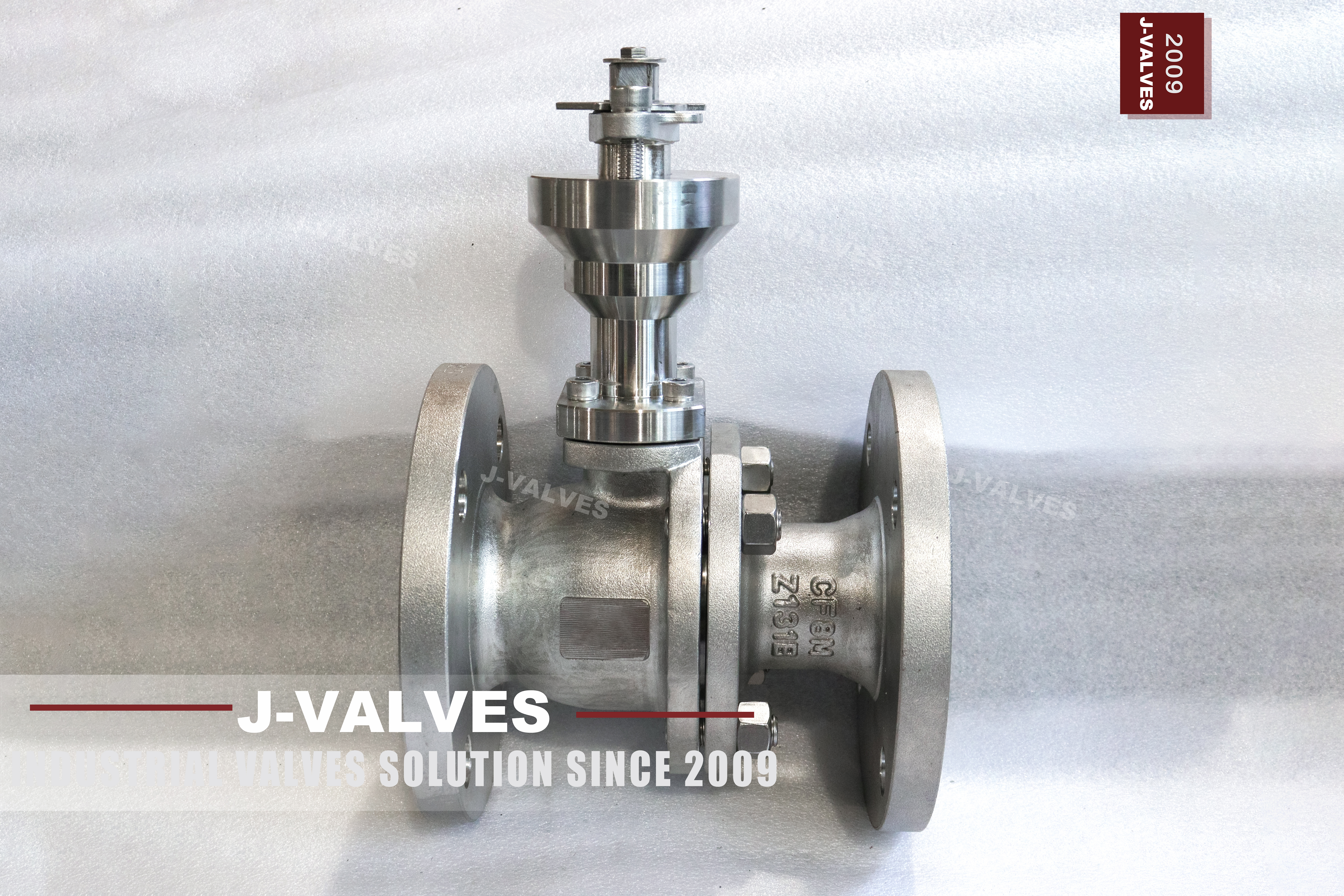
Two requirements get written as one sentence on cold service enquiries: a low temperature valve with an extended stem. They are not one requirement. The seat compound decides whether the valve still seals when the metal is cold, and the stem extension decides whether a person can reach the lever through the insulation. A valve can be correct on one and wrong on the other, and the wrong one is discovered in different ways.
This page separates them because the failure modes are different. A seat that is wrong for the temperature passes a shop test at ambient and fails on cool down, which looks like a manufacturing fault. An extension that is wrong for the installation is found on the day the insulation goes on, when the lever turns out to be inside the cladding. Both are order errors, and both are cheap to avoid.
Design and Construction
The body is two pieces with one bolted joint, and the ball floats between two seats. At three inch and Class 150 that is a comfortable design: the ball is small, the seat load is modest and the operating torque stays within a lever. The stem passes through the body into the ball and the packing sits in the body, so the extension above it is a tube and a shaft rather than part of the pressure boundary.
The extension exists because cold lines are insulated, and the insulation is thick. A lever that would sit against the pipe is buried in foam or in a cold box wall, so the stem is extended until the operator is outside the cladding. That is a geometric requirement, measured in metres on the drawing, and it has nothing to do with whether the valve is suitable for the temperature.
Material Options
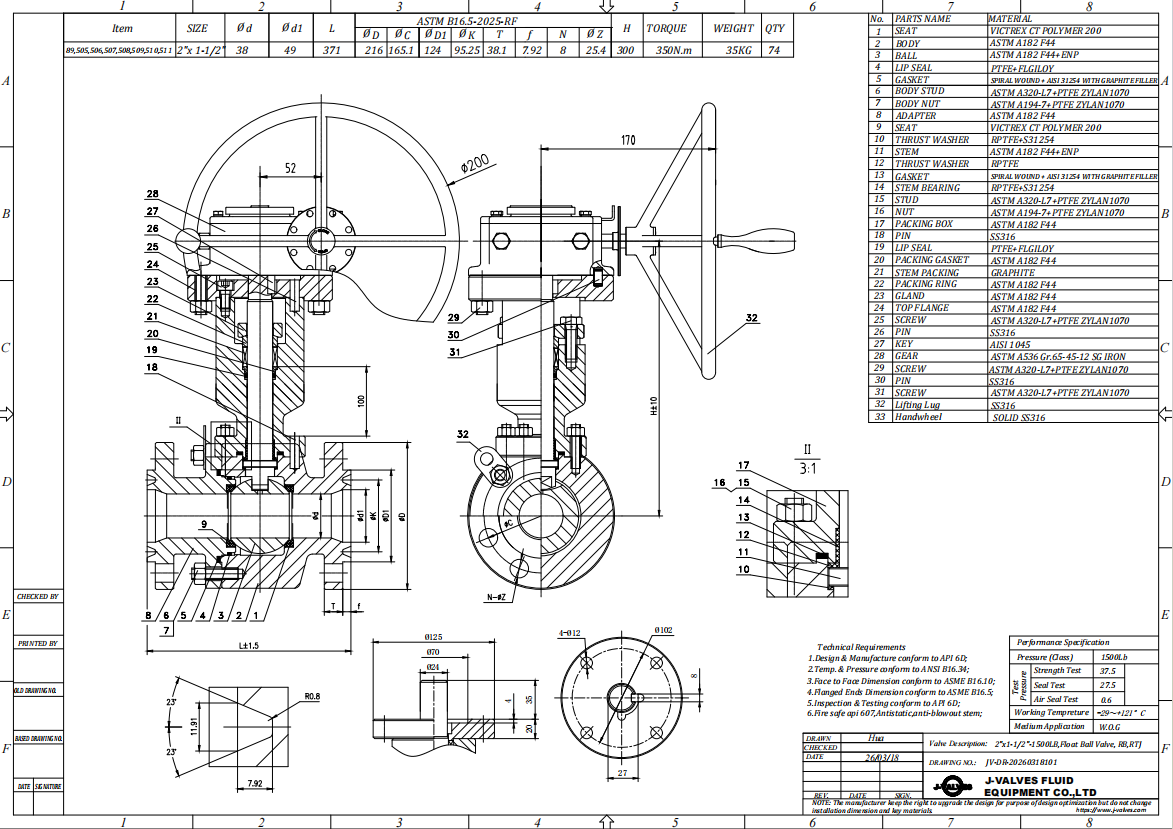
The body is cast stainless and the nameplate carries the casting code rather than a standard designation. Casting is what buys the shape at this size; the code is what the mill certificate and the 3.1 documentation are written against. On a cold line the casting matters for a second reason: a sound casting has no path for the medium to weep through a porous wall when the metal contracts and the joint loads change.
The seat is where the temperature decision is actually made. PTFE and reinforced PTFE cover the ordinary range, PPL covers a little more, and PCTFE is the compound that holds at the bottom of the range. The page lists PCTFE as an option for low temperature service, which is exactly right: it is a different compound, not a grade of the same one, and it has to be named. The ball and stem stay in the same alloy family as the body. A comparison of the two compounds only means something at the temperature and the medium of this line.
| Component | Standard Material | Optional Upgrade | Service Notes |
|---|---|---|---|
| Body halves | cast stainless, code as stamped | the same casting grade | one bolted joint |
| Ball | same alloy with hard chrome | low carbon variant | floats onto the downstream seat |
| Stem | stainless or precipitation hardening stainless | not changed for cold duty | packing stays in the body |
| Seat, standard | PTFE or reinforced PTFE | PPL for a little more temperature | ordinary ambient and warm range |
| Seat, cold | PCTFE | named on the order | the compound that holds at the bottom of the range |
| Packing | PTFE V-ring or graphite | graphite for the wider range | gland adjustable |
| Extension | cast or wrought stainless tube and shaft | length to the cladding | not a pressure part |
| Ends | raised face to ASME B16.5 | Class 150 only | three inch pattern |
| Operator | lever | worm gear or actuator | no pad stated on the page |
Technical Specifications
Inside a three inch body the ball carries a two inch bore, so the line steps down at the valve while the flanges stay at three inch. The ends are raised face to ASME B16.5 Class 150, and the face to face follows ASME B16.10 for the size and class. The extension is the one dimension no table can supply: it runs from the flange face to the top plate and is fixed by how much insulation and how much cold box wall the stem has to cross, so it comes off the installation drawing rather than off the valve size.
Two dimensions are worth naming as drawing items rather than page items: the extension length and the height of the top plate above the cladding. A valve ordered with an extension but without a length arrives at whatever the supplier considers standard, and on a cold box that is discovered when the panel is offered up. The bore and flange pattern come from the size data sheet.
| Item | Value |
|---|---|
| Nominal size | 3 x 2 inch (DN80 x DN50) |
| Pressure class | Class 150 (PN 20, the API 6D pressure code) |
| Body style | two piece, one bolted joint |
| Ball support | floating, no trunnion |
| Bore | reduced bore, DN50 through the ball |
| Body material | cast stainless, catalogue code CF8M as stamped |
| Ball material | same alloy with hard chrome, low carbon variant optional |
| Stem | stainless or precipitation hardening stainless |
| Seat, standard | PTFE or reinforced PTFE |
| Seat, cold service | PCTFE, named on the order |
| Packing | PTFE V-ring or graphite |
| Extension | stainless tube and shaft, length from the flange face to the top plate |
| End connection | raised face flange, ASME B16.5 Class 150 |
| Face to face | dimension on the signed GA drawing, held to ASME B16.10 |
| Design standard | ASME B16.34 and API 608 |
| Test standard | API 598 shell and seat test |
| Test pressure | shell 1.5 times and seat 1.1 times the class rating |
| Temperature range | minus 29 to plus 425 Celsius, metal temperature |
| Seat limit | set by the compound, not by the body; PCTFE for the cold end |
| Impact testing | not claimed on this page, to be specified if the duty needs it |
| Operation | lever; worm gear or actuator on request |
| Actuator pad | not described on this page |
| Fire test | not claimed on this page, API 607 to be specified |
| Anti static device | not described on this page |
| Marking | size, class, body code, heat number |
| Documentation | EN 10204 3.1 on request |
| Weight | quoted with the drawing for the size and trim ordered |
Standards and Compliance
Three documents share the work and none of them is a cold standard. ASME B16.34 gives the wall thickness and the rating for the alloy group at Class 150. API 608 is the product standard for a quarter turn valve: stem retention, seat, marking and test. API 598 decides what counts as a pass at the shell and at the seat. The question a cold line actually asks, whether the seat compound is still usable at the low end, is answered by the compound supplier and by nobody else, so it has to be written on the order.
Nothing on this page claims a fire test, an anti static device or a fugitive emission class. For cold service there is a fourth item that is often assumed and rarely specified: impact testing of the body material. On a cast austenitic body the impact requirement depends on the specification and the temperature, and if the project needs it, it is written on the order rather than inferred from the fact that the valve is for cold duty.
| Requirement | Standard | What J-VALVES Supplies |
|---|---|---|
| Pressure boundary | ASME B16.34 | minimum wall and rating for the cast austenitic group at Class 150 |
| Ball valve design | API 608 | stem retention, seat, marking, test |
| Shell and seat test | API 598 | 1.5 times the rating for the shell, 1.1 times for the seat |
| Flange pattern | ASME B16.5 Class 150 | raised face, three inch |
| Face to face | ASME B16.10 | flanged valve length for the size and class |
| Seat temperature | the compound certificate | not a valve standard, carried on the order |
| Impact testing | on request | written on the order if the duty needs it |
| Documentation | EN 10204 3.1 | issued against the heat number on request |
Manufacturing Process
The body is cast, cleaned and machined in setups that keep the bore, both seat pockets and the flange faces related to each other. On a casting this is where porosity shows: a pocket that breaks into a void is scrap, and a pocket that is machined into sound metal is a valve. The seat pockets are gauged for depth because the pocket sets the squeeze on the seat ring.
The extension is assembled separately, aligned on a surface plate and pinned, then fitted to the body. Because the extension will be inside insulation or a cold box, its external surfaces are prepared before assembly rather than after: a column that is painted after fitting has bare spots at the joint, and on a cold line those spots are where condensation sits first, and where it stays.

Quality Control and Testing
Testing is the standard pair at ambient: shell at one and a half times the Class 150 rating, seat at one and one tenth times in both directions, both from API 598. What the ambient test cannot prove is the cold behaviour of the seat, and no shop test can, because the compound is being asked to do something at a temperature the test bench is not at. That is why the compound and its certificate matter as much as the test sheet.
Two checks belong to the extension. The first is alignment over the full length, because a column out of line binds at one point in the quarter turn and the operator reads it as a stiff seat. The second is the surface preparation and coating of the column, checked before it goes into the insulation, where nobody will look at it again for years, until the cladding comes off.
| Step | What Is Checked | Standard or Acceptance |
|---|---|---|
| Incoming castings | code, heat number, soundness at the seat pocket | certificate against the stamped code |
| Body machining | bore, seat pocket depth, flange face squareness | in process gauging |
| Seat ring | compound identified, dimensions checked | certificate matched to the order line |
| Extension assembly | alignment over the full length | dial check on a surface plate |
| Column finish | surface preparation and coating before insulation | checked before fitting |
| Shell test | no leakage through the body wall | API 598 at 1.5 times the rating |
| Seat test | no visible leakage, both directions | API 598 at 1.1 times the rating |

Applications and Industry Service
The valve belongs on a cold branch that needs manual isolation and has to be operated from outside the cladding: a refrigerant line, a cold box penetration, a chilled water branch, a low temperature process line where the insulation is thick enough that a standard stem disappears into it. The medium is normally clean, and the duty is isolation rather than control, so the valve sits at one end of its travel for most of its life.
It is the wrong valve where the temperature goes below what the seat compound can take, where the body material has not been impact tested for the duty, or where the extension is being used to solve a clearance problem that will change later. An extension is a fixed dimension once the valve is made; if the insulation thickness is still being argued about, the valve should not be ordered yet.
Installation, Operation and Maintenance
Set the extension vertical, support the column at mid height where the length calls for it, and leave the top plate and the coupling accessible through the cladding. Seal the penetration so that moisture does not run down the tube into the insulation, and do not use the column as a fixing point for cladding or cable tray, which is what tends to happen on a cold box.
Operation is a quarter turn with a lever at this size, and the lever should not need a cheater. Maintenance is a seat and packing job: the packing is reached at the body, the seats need the body joint opened. On a cold line that means a warm up, a purge and a permit, so the job is planned rather than done in passing, and the valve should be ordered with that in mind.
How to Specify and Order
Write the size as 3x2 or DN80x50, the class as 150, the body code as it will be stamped, the seat compound by name, the extension length with its datum, the end facing and the operator. The seat compound is the line that decides whether the valve works cold, and the extension length is the line that decides whether anybody can reach it; both are frequently left as standard.
Ask for the drawing with the extension and the top plate height, the mill certificate behind the 3.1 documentation, the seat compound certificate with its temperature range, and the test sheet. Four documents for a small valve looks excessive until the first cold shutdown, when the seat certificate is the only paper that explains why the valve is passing and the test sheet says it passed.
FAQ
Q: Does an extended stem make a valve suitable for cold service?
A: No. The extension moves the operator outside the insulation; it does not change what the valve is made of or what the seat can take. A valve with a long stem and a PTFE seat is still limited by the PTFE. Cold service needs the seat compound to be chosen for the temperature first, and the extension chosen for the installation second.
Q: When is PCTFE the right seat instead of PTFE?
A: When the service temperature is below what PTFE or reinforced PTFE can hold. PCTFE is a different compound with a lower useful range than PTFE at the top end and a better one at the bottom, and it has to be named on the order because it is not the default build. Buying it by asking for a low temperature valve is how the wrong seat arrives.
Q: Is the extension a pressure boundary?
A: No. On this valve the packing stays in the body and the extension is a tube with a shaft inside. If the tube is damaged the valve becomes hard to operate but does not leak. An extended bonnet is a different construction, where the pressure boundary is carried up to the operator, and that is what most cryogenic valves use.
Q: Why does the page list impact testing separately?
A: Because it is not implied by the alloy or by the class. On a cast austenitic body the impact requirement depends on the specification and the service temperature, and a valve can be perfectly correct for Class 150 and still not meet a project requirement for low temperature toughness. If the project needs it, it goes on the order with the temperature.
Q: Can this valve be used on a line that is also insulated for heat?
A: The valve does not care whether the insulation is hot or cold, but the seat does. A hot insulated line needs a seat compound chosen for the top of the range, and the extension is there to get the operator outside the cladding in both cases. The two duties share a geometry and share nothing else.
Q: Is there another listing for this size on the site?
A: There is one at 3x2 with a higher class and a different structure, which is a different valve. For this size and class the listing on this page is the only one, which is why it should be kept as the indexed page and given the internal links rather than split across duplicates.


Hot Products


News
Ball Valves in A Kraft Pulp Mill: Black Liquor, Green Liquor And The Cost of Choosing The Alloy by Habit
White liquor at pH 14 cracks carbon steel welds, black liquor sets solid below 100 C, green liquor dregs grind seats: alloy choice and torque in a kraft mill.
Read More
Slug Flow And Ball Valves: What Actually Arrives At The Seat
A slug is liquid mass with momentum, not a pressure spike. What changes at the seat, in the cavity and at the actuator when liquid reaches a ball valve.
Read More
Ball Valves in Direct Lithium Extraction: PH 1 Eluate, Gypsum Scale And 438,000 Cycles in Twenty-Five Years
Direct lithium extraction swings valves from pH 1 eluate to pH 12 caustic, 48 column switches a day and gypsum scale. Materials, seats and torque.
Read More
Ball Valves in Geothermal Brine: Silica Scale, Chloride Cracking And The Cooling Trap
Why geothermal brine destroys ball valves: retrograde silica scale, calcite at the flash point, chloride cracking above 60 C and the 250 C seat limit.
Read More