

CHINA J-VALVES Offers Various High-quality I ndustrial Ball Valves
J-VALVES, a distinguished professional ball valve manufacturer rooted in China, takes pride in its extensive product portfolio. Our offerings span a wide range, including trunnion-mounted ball valves, floating ball valves, high-temperature ball valves, high-pressure ball valves, metal-sealed ball valves, ultra-low temperature ball valves, DBB ball valves, Three-way And Four-way Ball Valve, and fully welded ball valves. Each product is a testament to our commitment to precision engineering and reliable performance. Meticulously crafted, they are designed to not only meet but exceed the most stringent industrial demands, ensuring stable operation even under extreme conditions. This enables us to provide our clients with high-value services and makes our valves widely sought-after in industries.
Product Category
Contact Us


-
J-VALVES-Q41F
-
J-VALVES
Overview of the J-VALVES DN50x20 1500LB F44 Two Piece Extended Stem Floating Ball Valve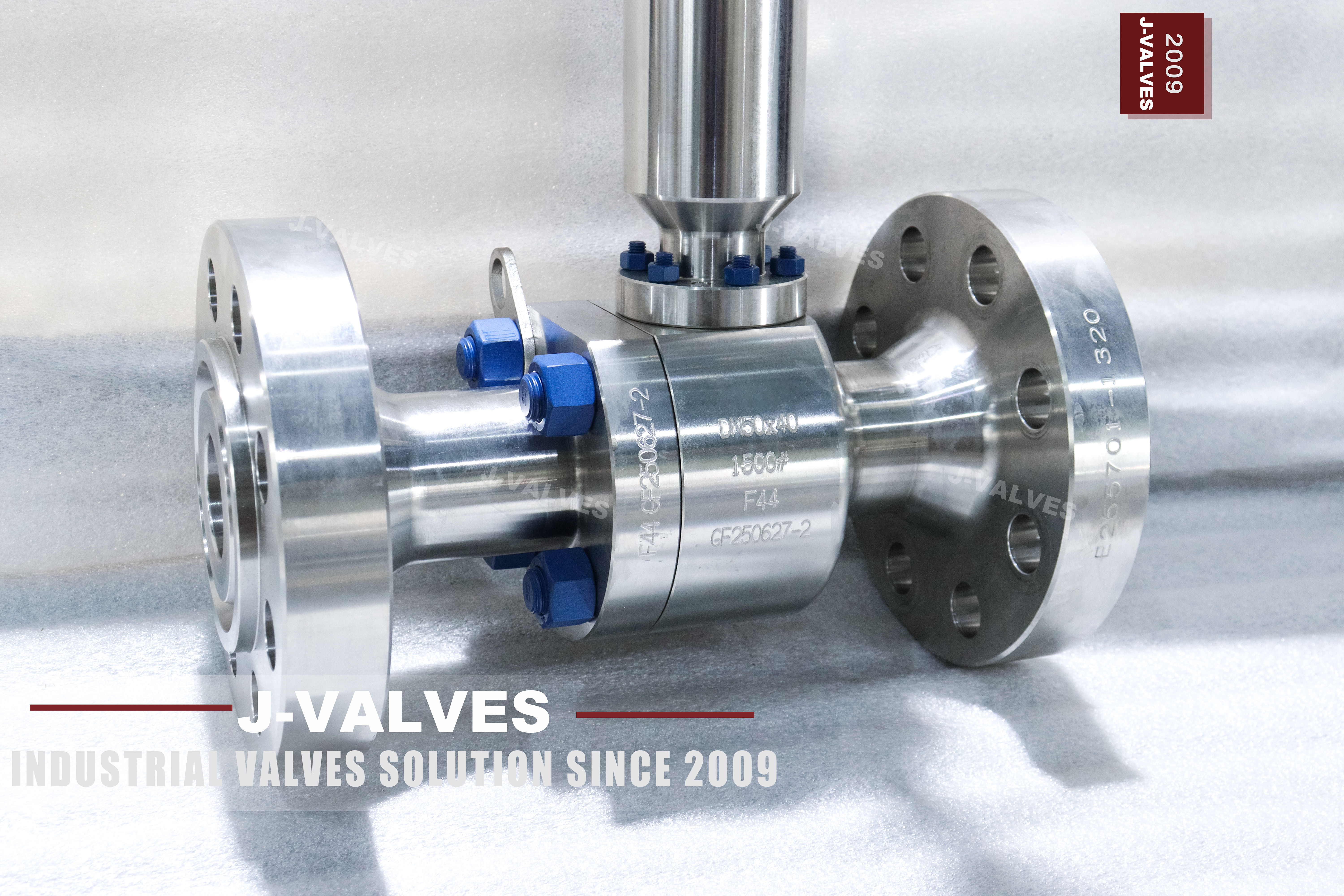
A fifteen hundred pound valve is usually assumed to be metal seated, and at six inch it is. At a three quarter inch bore the arithmetic that forces that choice is not there: the seat ring is small, the area carrying pressure is small, and the load that tries to extrude a soft seat is small with it. That is why this valve is offered with a soft seat as the standard build and a metal seat as an option, rather than the other way round.
The rest of the valve is what you would expect at this class: two piece body, floating ball, ring joint flanges, a forged super austenitic body for chloride service, and an extended stem for a cold box or an insulated line. The interesting decision is the seat, because it is the one choice on this valve where the pressure class does not make the decision for the buyer.
Design and Construction
The ball floats between two seats. At this bore the floating design is still comfortable: the ball is small, the travel it makes onto the downstream seat is short, and the seat does not have to absorb the load that a six inch ball would impose at the same pressure. A trunnion at three quarter inch would add parts without adding capability, which is why the design stays floating all the way to this class at this bore.
The body is in two pieces with one bolted joint, and the joint carries the cavity pressure like any other boundary. The stem passes through the body into the ball, with the packing in the body, and the extension above it is a tube and a shaft rather than a pressure part. Ring joint flanges close the ends, and the ring gasket is a one-time part that is replaced whenever the joint is broken.
Material Options
The body, the ball and the stem are the same forged super austenitic alloy family, and the nameplate carries a short catalogue code rather than a standard designation. That code is what the mill certificate is written against, and the composition and heat treatment behind it are declared on the 3.1 documentation. Reading the code as a standard grade and writing that grade into the order invents a requirement the supplier never quoted against.
The seat is where the options actually differ. A soft seat in reinforced PTFE, PEEK or PPL seals against a metal ball with almost no leakage, and at this bore it survives the pressure because the ring is small. A metal seat, the same alloy with a hard facing, survives temperature and abrasive solids that would destroy the soft compounds, and it seals to a leakage class rather than to zero. Those are two different purchases, not two grades of the same thing.
| Component | Standard Material | Optional Upgrade | Service Notes |
|---|---|---|---|
| Body and end body | forged super austenitic stainless, code as stamped | the same alloy | two pieces, one bolted joint |
| Ball | same alloy with hard chrome or nitriding | not offered in another family | floats onto the downstream seat |
| Stem | same alloy or precipitation hardening stainless | stainless grade | packing stays in the body |
| Seat, standard | reinforced PTFE, PEEK or PPL | metal seat with hard facing | soft seat holds at this bore |
| Seat, metal | same alloy with hard facing | lapped to its ball | seals to a leakage class |
| Packing | high density flexible graphite | not substituted | gland adjustable |
| Extension | same alloy tube and shaft | length to the cold box or insulation | not a pressure part |
| Fasteners | same alloy or matching alloy steel | stated on the order | high pressure joint |
| Ends | ring joint to ASME B16.5 | Class 1500 only | ring replaced at every break |
| Operator | lever, low torque type | worm gear or actuator | no pad stated on the page |
Technical Specifications
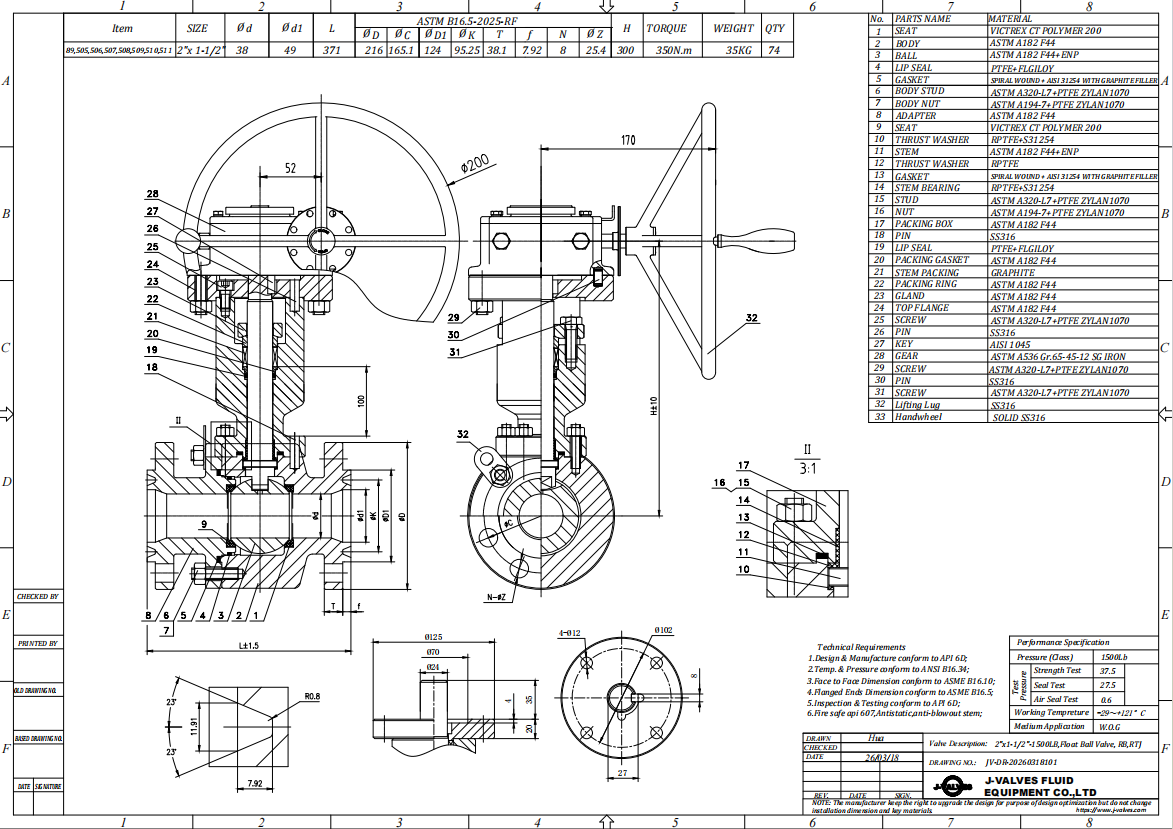
The bore is DN20 inside a DN50 body, so the valve is two sizes down in the run: the pipe connection is two inch and the flow passage is three quarter inch. The flanges are ring joint to ASME B16.5 Class 1500. Face to face follows ASME B16.10 for the size and class. The extension length is set by the cold box or the insulation and is dimensioned on the drawing rather than chosen from a list.
Two numbers belong to the standard rather than to this page. The pressure class is Class 1500, which API 6D writes as PN 250; a page or a quotation that shows PN 260 is using a figure that appears in neither API 6D nor EN 1092-1, and it should be queried rather than copied. The other is the shell test, one and a half times the rating, which is applied to the whole valve at Class 1500.
| Item | Value |
|---|---|
| Nominal size | 2 x 0.75 inch (DN50 x DN20) |
| Pressure class | Class 1500 (PN 250, the API 6D pressure code) |
| Body style | two piece, one bolted joint |
| Ball support | floating, no trunnion |
| Bore | reduced bore, DN20 through the ball |
| Body material | forged super austenitic stainless, catalogue code as stamped |
| Ball material | same alloy with hard chrome or nitriding |
| Stem | same alloy or precipitation hardening stainless |
| Seat, standard | reinforced PTFE, PEEK or PPL |
| Seat, optional | metal seat with hard facing, lapped to its ball |
| Packing | high density flexible graphite |
| Extension | same alloy tube and shaft, length on the drawing |
| Fasteners | same alloy or a matching alloy steel, stated on the order |
| End connection | ring joint flange, ASME B16.5 Class 1500 |
| Face to face | dimension on the signed GA drawing, held to ASME B16.10 |
| Design standard | ASME B16.34 and API 608 |
| Test standard | API 598 shell and seat test |
| Test pressure | shell 1.5 times and seat 1.1 times the class rating |
| Temperature range | minus 29 to plus 425 Celsius, metal temperature |
| Seat limit | the soft compound sets the ceiling; the metal seat sets the leakage class |
| Pressure code note | PN 260 does not appear in API 6D or EN 1092-1 |
| Operation | lever, low torque type; gear or actuator on request |
| Fire test | not claimed on this page, API 607 to be specified |
| Anti static device | not described on this page |
| Marking | size, class, body code, heat number |
| Documentation | EN 10204 3.1 on request |
| Weight | quoted with the drawing for the size and trim ordered |
Standards and Compliance
ASME B16.34 supplies the minimum wall and the rating for the alloy group at Class 1500. API 608 covers the quarter turn product requirements: stem retention, seat, marking, test. API 598 supplies both acceptance multipliers. The pressure code is a separate matter: Class 1500 maps to PN 250 in API 6D, and that mapping is worth knowing when a European specification and a Chinese quotation meet on the same purchase order.
Nothing here claims a fire test, an anti static device or a fugitive emission class. On a high pressure chloride line those are often required, and each is a type test on the design that has to be named with its standard: API 607 for a soft seated quarter turn valve, API 6FA for a pipeline valve, ISO 15848 for stem sealing. Assuming them because the valve is high pressure is how a delivery fails inspection.
| Requirement | Standard | What J-VALVES Supplies |
|---|---|---|
| Pressure boundary | ASME B16.34 | minimum wall and rating for the alloy group at Class 1500 |
| Ball valve design | API 608 | stem retention, seat, marking, test |
| Shell and seat test | API 598 | 1.5 times the rating for the shell, 1.1 times for the seat |
| Flange pattern | ASME B16.5 Class 1500 | ring joint facing, two inch |
| Face to face | ASME B16.10 | flanged valve length for the size and class |
| Pressure code | API 6D 7.2 | Class 1500 is written PN 250, not PN 260 |
| Marking | API 608 and the order | size, class, body code, heat number |
| Documentation | EN 10204 3.1 | issued against the heat number on request |
Manufacturing Process
The body is forged and machined, and the seat pockets are cut in one setup so that they stay coaxial. On a floating valve the pocket depth is what sets the seat squeeze, and at Class 1500 a few hundredths too deep is the difference between a seat that seals cold and one that only seals once pressure pushes the ball onto it. The pocket is gauged, not judged by feel.
The ball is ground and then plated or nitrided, and the finish is what the soft seat runs against. A metal seat gets a hard facing on the seating face and is lapped to the ball it will run with, so ball and seat are a matched pair that should be replaced together. The extension is assembled and aligned separately, then fitted, and the whole valve is cycled and tested before marking.

Quality Control and Testing
Testing follows API 598: shell at one and a half times the Class 1500 rating, seat at one and one tenth times, in both directions, with the valve cycled in between. On a soft seated valve the acceptance is no visible leakage past the seat; on a metal seated valve the acceptance is the leakage class written on the order, which is a different and lower bar, and it should be written down rather than argued at the gate.
Two checks matter more here than on a low pressure valve. The first is seat pocket depth and ball roundness, because at this class the seat has very little compliance to absorb either. The second is the ring joint groove: a damaged groove will leak regardless of how good the seat is, and it is not repairable at site. Both are recorded per valve rather than sampled.
| Step | What Is Checked | Standard or Acceptance |
|---|---|---|
| Incoming forgings | code, heat number, ultrasonic report | certificate against the stamped code |
| Seat pocket | depth and coaxiality | gauged, not judged by feel |
| Ball | roundness and surface finish | checked before matching to a seat |
| Metal seat | facing thickness and lap pattern | matched to its ball, recorded as a pair |
| Ring joint groove | profile and surface condition | checked before the flange is blanked |
| Shell test | no leakage through the body wall | API 598 at 1.5 times the rating |
| Seat test | no visible leakage, both directions | API 598 at 1.1 times the rating, after cycling |

Applications and Industry Service
This valve belongs on a small high pressure branch in a chloride bearing service: a sampling point on a seawater or brine line, an injection point on a chemical plant, a drain on a high pressure vessel where the flow is small and the pressure is not. The extension is for the cold box or the insulated line, where the operator has to be outside the cladding.
It is the wrong valve where the medium carries solids that will damage a soft seat, where the temperature is above the seat compound ceiling, or where the line is throttled. Those three are the reasons the metal seat option exists, and choosing it means accepting a leakage class instead of a tight shutoff. Buying a metal seat for tight shutoff is buying the wrong thing twice.
Installation, Operation and Maintenance
Ring joint flanges need the groove cleaned and a new ring every time the joint is opened. The ring is not reusable: it deforms to the groove, and a second make up with the same ring leaks. Studs are tightened in a cross pattern to the torque on the drawing, and the flanges are brought parallel before any torque is applied. The extension is set vertical and supported at mid height where the length calls for it.
Operation is a quarter turn through a lever at this bore, and the lever should move without a cheater. Maintenance is a seat and ring gasket job: the body joint opens, the seats and ball come out, and the ring gaskets at both ends are replaced. On a metal seated valve the ball and seat are a matched pair, so replacing one without the other wastes the new part.
How to Specify and Order
The order needs the size written as DN50x20 or 2 x 0.75, the class as Class 1500, the body code as it will be stamped, the seat type with its leakage class if it is metal, the end connection as ring joint to B16.5, the extension length, and the operator. The seat line is the one that decides whether the valve shuts tight or shuts to a class, and it is the line most often left as a word like standard.
Ask for the drawing with the extension and the ring joint detail, the mill certificate behind the 3.1 documentation, and the test sheet. On a high pressure small bore valve the test sheet is the document that shows whether the seat was proved at one and one tenth times the rating in both directions, and that single line tells a buyer more about the build than any photograph.
FAQ
Q: Can a soft seat really hold at Class 1500?
A: At this bore, yes, and the reason is area rather than pressure. The seat ring at three quarter inch is small, so the load trying to push the compound out of its pocket stays small even at a high class. At six inch the same pressure acts on a much larger ring and the seat has to be metal. This is why the seat decision on a high pressure valve has to be made per size, not per class.
Q: When should the metal seat be ordered instead?
A: When the temperature is above the soft compound ceiling, or when the medium carries solids that will damage a polymer face. It is not an upgrade for pressure: at this bore the soft seat already handles the class. What the metal seat costs is leakage, because a metal to metal seat seals to a class rather than to zero, and that class should be written on the order.
Q: Why does this page say PN 250 when other listings say PN 260?
A: Because PN 250 is the API 6D code for Class 1500 and 260 does not appear in API 6D or EN 1092-1. The 260 figure looks like a conversion of the rating into bar that has been rounded, and it is not a designation anybody can inspect against. If a quotation shows PN 260, ask which document it came from.
Q: Is the extension a pressure boundary?
A: No. The packing and the gland stay at the body, and the extension is a tube with a shaft inside. A damaged extension makes the valve hard to operate but does not make it leak. An extended bonnet is the other construction, where the pressure boundary is carried up to the operator, and that is what cryogenic service normally uses.
Q: What ends does this valve have and can they be changed?
A: Ring joint flanges to ASME B16.5 Class 1500. The groove is machined into the flange, so it cannot be changed at site; a line that needs raised face needs a different valve. The ring gasket itself is a one time part and is replaced every time the joint is opened, because it deforms to the groove on make up.
Q: Is there another listing for this valve?
A: Yes, one at the same size and class whose title uses the PN 260 figure. It describes the same valve with a pressure designation that cannot be traced to a standard, so the listing with Class 1500 in the title should be the indexed page and the other redirected to it rather than left to compete.


Hot Products


News
Ball Valves in A Kraft Pulp Mill: Black Liquor, Green Liquor And The Cost of Choosing The Alloy by Habit
White liquor at pH 14 cracks carbon steel welds, black liquor sets solid below 100 C, green liquor dregs grind seats: alloy choice and torque in a kraft mill.
Read More
Slug Flow And Ball Valves: What Actually Arrives At The Seat
A slug is liquid mass with momentum, not a pressure spike. What changes at the seat, in the cavity and at the actuator when liquid reaches a ball valve.
Read More
Ball Valves in Direct Lithium Extraction: PH 1 Eluate, Gypsum Scale And 438,000 Cycles in Twenty-Five Years
Direct lithium extraction swings valves from pH 1 eluate to pH 12 caustic, 48 column switches a day and gypsum scale. Materials, seats and torque.
Read More
Ball Valves in Geothermal Brine: Silica Scale, Chloride Cracking And The Cooling Trap
Why geothermal brine destroys ball valves: retrograde silica scale, calcite at the flash point, chloride cracking above 60 C and the 250 C seat limit.
Read More