

CHINA J-VALVES Offers Various High-quality I ndustrial Ball Valves
J-VALVES, a distinguished professional ball valve manufacturer rooted in China, takes pride in its extensive product portfolio. Our offerings span a wide range, including trunnion-mounted ball valves, floating ball valves, high-temperature ball valves, high-pressure ball valves, metal-sealed ball valves, ultra-low temperature ball valves, DBB ball valves, Three-way And Four-way Ball Valve, and fully welded ball valves. Each product is a testament to our commitment to precision engineering and reliable performance. Meticulously crafted, they are designed to not only meet but exceed the most stringent industrial demands, ensuring stable operation even under extreme conditions. This enables us to provide our clients with high-value services and makes our valves widely sought-after in industries.
Product Category
Contact Us


-
J-VALVES-Q41F
-
J-VALVES
Overview of the J-VALVES 150A 10K CF8 Two Piece Stainless Steel Flange Floating Ball Valve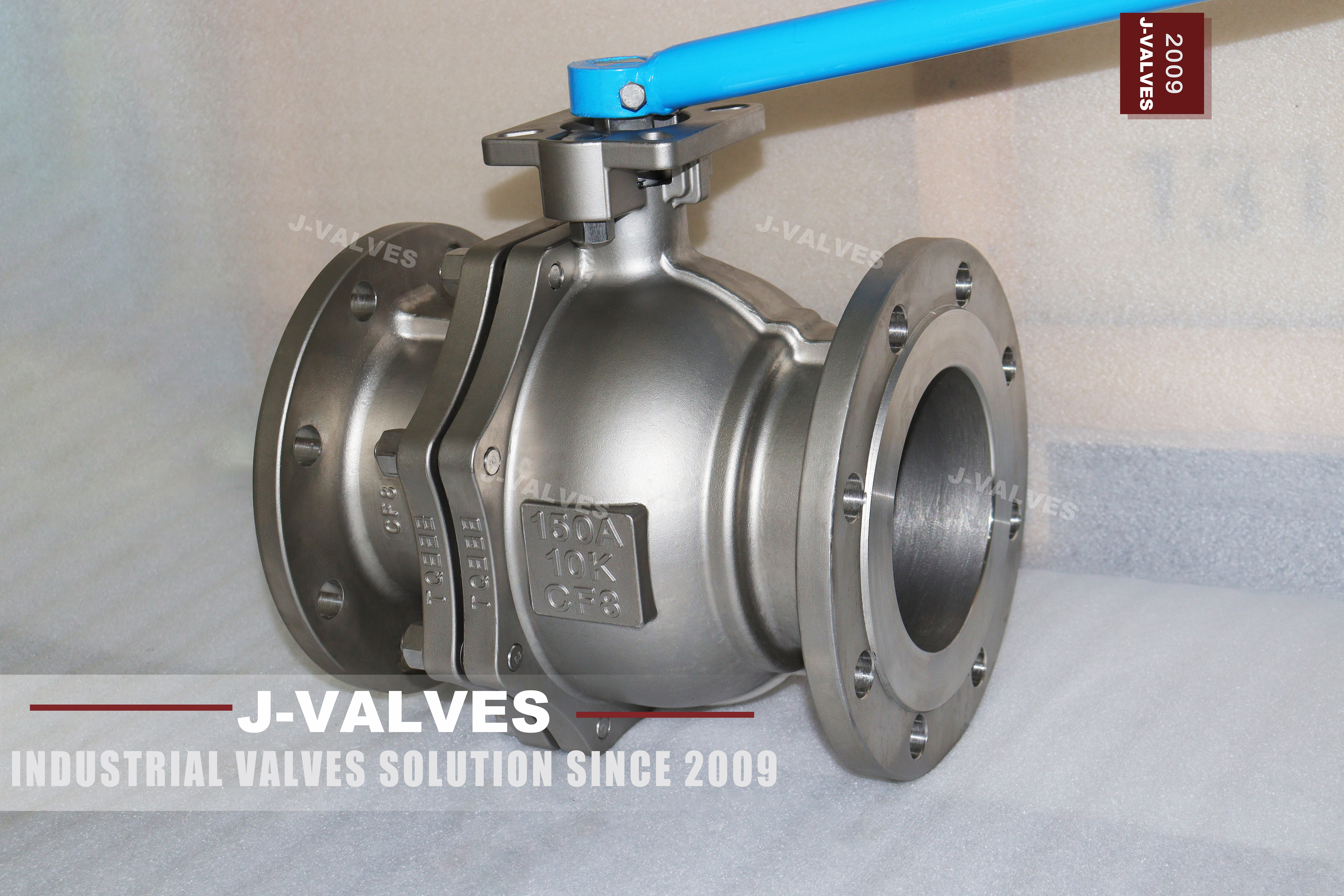
Both numbers in this valve name belong to the Japanese standard, and neither is an ASME number. 150A is how JIS writes a nominal size of DN150, which is six inches. 10K is the pressure code, ten kilograms per square centimetre, which the page itself states as one megapascal. A reader who takes 150A for a bore in millimetres and 10K for a class gets both wrong, and one of those mistakes is harmless while the other is a rating error waiting for an inspection.
The trap is that the flange patterns are close. A JIS B2220 10K flange and an ASME B16.5 Class 150 flange at this size have bolt circles that are near enough to line up, which is why these valves get used across both pipe systems on the same site. Lining up is not the same as being rated the same. Class 150 is roughly twice the pressure of 10K, so a 10K valve in a Class 150 line is being asked to hold double what it was built and tested for.
Design and Construction
Two pieces, one bolted joint, a floating ball and a lever. The body splits horizontally at the joint and everything inside goes in from that side. At DN150 the floating design is close to its practical limit, because the seat load grows with the bore and the ball is no longer small, but the 10K rating keeps that load low enough that the lever stays usable and the seats stay in one piece. Higher ratings at the same bore are where trunnion mounting becomes necessary.
The ball seals on the downstream seat. Line pressure pushes the ball away from the upstream seat and into the downstream one, so the seal is made by the medium itself and gets tighter as pressure rises within the rated band. That is why a floating valve holds well at low pressure, where a trunnion valve relies on spring preload alone. The design has no trunnion, no bearings and no gearbox, and each of those absences is a part that cannot fail.

Material Options
CF8 is the cast austenitic stainless grade that corresponds in composition to the 304 family, and it is named here as a casting because the body is cast. That matters for two reasons. A casting can be made at six inches in shapes a forging cannot, and a casting carries porosity risk that a forging does not, so the quality of the foundry is part of the specification even though no purchase order has a line for it. The grade code on the nameplate is what the certificate has to match.
Trim follows. The ball is the same cast grade with hard chrome plating, or a 316 grade if the medium needs the molybdenum. The stem is 304 or 316 stainless, and it is the part that sees the most wear in a lever operated valve because every stroke works it against the packing. Seats are PTFE, reinforced PTFE or PPL, and packing is flexible graphite or PTFE. None of those choices changes the rating; all of them change how long the valve lasts.
| Component | Standard Material | Optional Upgrade | Service Notes |
|---|---|---|---|
| Body and cap | CF8 cast austenitic stainless | 316 cast grade | two pieces, one bolted joint |
| Ball | CF8 with hard chrome plating | 316 grade ball | floating, seals on the downstream seat |
| Stem | 304 or 316 stainless | higher strength grade | works against the packing every stroke |
| Seat | PTFE | reinforced PTFE or PPL | sets the service temperature |
| Packing | flexible graphite or PTFE | as the order states | gland adjustable |
| Ends | raised face to JIS B2220, 10K | no ASME alternative on this page | metric bolt holes |
| Operator | lever with locking hole | worm gear, pneumatic or electric | quarter turn |
Technical Specifications
The size sheet gives the bore, the face to face and the flange dimensions for the 150A pattern. The face to face belongs with the JIS valve standard and should be read off that sheet rather than taken from the ASME table for a six inch valve, because the two tables were written for different flange systems and a valve built to one will not always land where the other expects. Overall height depends on the operator, so it comes with the drawing.
Full bore at 150A means the passage matches the pipe internal diameter and a pig will pass. At this size that is a real advantage on water and process lines where cleaning runs happen, and it is the reason the floating design is kept rather than moving to a reduced bore trunnion valve. The cost is a larger ball, a larger seat and a higher torque than a reduced bore valve of the same nominal size would have.
| Item | Value |
|---|---|
| Nominal size | 150A, the JIS code for DN150 (6 inch) |
| Pressure class | 10K, stated by the page as 1.0 MPa |
| Body construction | two piece, one bolted joint |
| Ball support | floating, no trunnion |
| Bore | full bore |
| Body material | CF8 cast austenitic stainless |
| Ball material | CF8 with hard chrome plating |
| Stem | 304 or 316 stainless |
| Seat | PTFE, reinforced PTFE or PPL |
| Packing | flexible graphite or PTFE |
| End connection | raised face to JIS B2220, 10K, metric drilling |
| Face to face | per the JIS size sheet for this pattern |
| Design standard | JIS B2071 |
| Reference standards | ASME B16.34 and API 608, reference only |
| Test standard | JIS B2003 |
| Reference test standard | API 598, not identical to JIS B2003 |
| Fire test | API 607, type test on the design |
| Temperature range | minus 29 to plus 425 Celsius, metal temperature |
| Operation | lever with locking hole; worm gear, pneumatic or electric optional |
| Bolting | metric threads, not interchangeable with ASME studs |
| Marking | size code, K rating, body grade, heat number |
| Documentation | EN 10204 3.1 on request |
| Weight | quoted with the drawing for the size and trim ordered |
| Country of manufacture | China |
Standards and Compliance
The page lists JIS B2071, ASME B16.34 and API 608 as design standards, and JIS B2003 with API 598 as test standards. Listing them together is where a buyer has to be careful. A valve built to the JIS ball valve standard is designed and dimensioned to that standard; naming ASME B16.34 beside it does not make the wall thickness an ASME wall, and for a 10K valve the two documents are working from different pressure bases. The governing standard should be the JIS one, with the others as reference.
Testing has the same issue in a smaller way. JIS B2003 is written around the K rating and API 598 is written around the class, so the two do not automatically produce the same test pressures for this valve. Both are legitimate; they are simply not the same table. Which one governs the acceptance belongs on the purchase order, and the test record should say which standard the numbers came from, otherwise the certificate cannot be checked against anything.
| Requirement | Standard | What J-VALVES Supplies |
|---|---|---|
| Ball valve design | JIS B2071 | the governing document for this valve |
| Pressure boundary reference | ASME B16.34 | reference only, not the design basis at 10K |
| Ball valve reference | API 608 | reference only, written around ASME classes |
| Flange pattern | JIS B2220, 10K | raised face, metric drilling |
| Test | JIS B2003 | the JIS test table for the K rating |
| Test reference | API 598 | the ASME table, not identical to the above |
| Fire test | API 607 | type test on the design, named on the order if required |
Manufacturing Process
The body starts as a casting in the CF8 grade, is cleaned and inspected before machining, and is then machined in one setup for the bore, both seat pockets and the raised face. The flange drilling is the JIS pattern, which means metric bolt holes on a metric bolt circle; that is the difference that shows up at site when a contractor arrives with imperial studs. The ball is ground, plated and polished, and the seats are turned and lapped flat before assembly.
Assembly is dry and clean, with the ball between the seats and the stem through the packing bore. The body halves are drawn together to a controlled torque so the seat crush is even on both sides. Every valve is cycled, shell tested and seat tested before marking, and the marking carries the size code, the K rating, the body grade and the heat number. The heat number is what connects the finished valve to the mill certificate behind the 3.1 documentation.

Quality Control and Testing
Testing follows the standard named on the order. The shell test proves the body and the joint hold pressure without leaking through the wall; the seat test proves the ball and seats close in both directions. Both are done before the valve is painted and marked, and both are recorded by serial number so a later query can be traced back to a specific unit rather than to a batch. A soft seated valve is expected to show no visible leakage at the seat during the test.
What the test cannot show is whether the casting is sound throughout, and on a cast body that is the question that matters. Radiography or dye penetrant on stated areas, a weld repair record if any repair was made, and positive material identification on the finished body are the checks that answer it. None of them is a default on a 10K valve, and all of them are worth writing into the order when the line is safety related rather than utility.
| Step | What Is Checked | Standard or Acceptance |
|---|---|---|
| Casting | grade, heat number, soundness of the cast wall | certificate plus visual and penetrant where ordered |
| Machining | seat pocket flatness, flange face squareness | in process gauging against the drawing |
| Flange drilling | metric hole size and bolt circle | checked against JIS B2220 |
| Shell test | no leakage through the body wall | JIS B2003 at the test pressure for 10K |
| Seat test | no visible leakage, both directions | JIS B2003, soft seat acceptance |
| Marking | 150A, 10K, body grade, heat number | against certificate and drawing |
| Packing | stud thread checked against the mating flange | confirmed before boxing |

Applications and Industry Service
These valves go where the pipe is flanged to the Japanese standard: water and wastewater treatment, building services, HVAC headers, and process plants built to Japanese or South East Asian engineering practice. They also turn up on desalination and cooling water trains where the medium is clean and the pressure is modest, and where a stainless body is bought for corrosion resistance rather than for strength. In those services the 10K rating is more than enough.
They are the wrong valve wherever the line is rated to an ASME class, because the flange will fit and the rating will not. They are also wrong for steam above the seat material's ceiling, for media that attack the cast grade, and for lines where the valve will be cycled constantly, because a lever operated floating ball valve at six inches is a maintenance item under that duty. Choosing it for those services is a decision about cost, not a decision about suitability.
Installation, Operation and Maintenance
The bolt holes will accept the flange, but the studs are a separate question. JIS uses metric threads and ASME uses imperial, so a valve that fits a class 150 flange may still need a different stud set from the one on the shelf, and a stud that is the wrong thread will either not start or will strip the hole when it is pulled down. Check the thread, not just the hole spacing, before the line is opened. Then tighten in a cross pattern in two passes.
Operation is a quarter turn lever with an optional locking hole. Maintenance is seat replacement through the body joint, and both seats are changed as a pair. Packing is adjusted at the gland and replaced when the gland runs out of travel. The lever should move without a cheater bar at all times; if it does not, the seat has swelled or the bore has scaled, and forcing it turns a seat replacement into a stem replacement. Cycle the valve occasionally even on a line that stays open.
How to Specify and Order
Write the size as 150A and the rating as 10K, then add the flange standard and the facing, because the size code alone does not fix the flange. Add the body grade, the ball and stem grades, the seat material, the operator and the governing design and test standards. If the enquiry came in written as 150A 10K but the pipe is flanged to ASME, that difference has to be settled before quoting rather than after delivery, because the answer changes both the valve and the stud set.
At delivery, check three things against each other: the nameplate, the certificate and the drawing. The nameplate should say 150A, 10K, the body grade and the heat number. The certificate should carry that heat number and the mechanical results for it. The drawing should carry the flange pattern, the face to face and the bore. If the nameplate says 10K and the drawing shows an ASME drilling, the valve is neither one thing nor the other and should not be shipped.
FAQ
Q: Is JIS 10K the same as ANSI 150?
A: No. 10K means ten kilograms per square centimetre, which the page states as one megapascal. Class 150 is an ASME rating that is roughly twice that at ambient temperature. The flanges are close enough at this size that the bolt holes will line up, which is why the two are so often confused, but lining up is a dimensional coincidence and not a statement about pressure. A 10K valve should not be put into a line rated to Class 150.
Q: What does 150A mean?
A: It is the JIS way of writing a nominal size of DN150, which is six inches. It is not a bore in millimetres and it is not a pressure. The A suffix belongs to the Japanese size designation, and the same valve in an ASME catalogue would be called six inch or DN150 with a class number after it. Reading 150A as 150 millimetres happens to give the right answer here, which is why the mistake survives.
Q: Can I use this valve on a Class 150 flange?
A: It may bolt up, and it should not be used there without a rating check. The bolt circle is close, so the valve will physically fit. The pressure rating is not close: 10K is about half of Class 150, so the valve would be operating outside its rating every time the line reaches its design pressure. If the line is Class 150 and the pipe is ASME flanged, the correct answer is an ASME rated valve with the same bore.
Q: Are the bolts metric?
A: Yes. JIS B2220 uses metric bolt holes and metric threads. An ASME Class 150 flange at the same nominal size uses imperial studs. A valve that fits both bolt circles may still need two different stud sets, and using an imperial stud in a metric hole damages the thread. This is the single most common site problem when JIS valves are installed by contractors who normally work to ASME, and it is worth checking before the line is opened.
Q: What is CF8?
A: It is a cast austenitic stainless grade with a composition in the 304 family. The C in the designation stands for cast, which distinguishes it from the wrought grades used for forgings and bar. It is used here because the body is a casting. The grade on the nameplate is what the mill certificate must match, and the certificate is what proves the casting was poured to that grade rather than to something close to it.
Q: What pressure is the valve tested at?
A: The test pressures follow the standard named on the order, and for this valve that is JIS B2003, which is written around the K rating. API 598 is also listed as a reference, but it is written around ASME classes and does not produce the same numbers for a 10K valve. The test record should state which standard the figures came from, so that the certificate can be checked against the specification rather than against an assumption.


Hot Products


News
Ball Valves in A Kraft Pulp Mill: Black Liquor, Green Liquor And The Cost of Choosing The Alloy by Habit
White liquor at pH 14 cracks carbon steel welds, black liquor sets solid below 100 C, green liquor dregs grind seats: alloy choice and torque in a kraft mill.
Read More
Slug Flow And Ball Valves: What Actually Arrives At The Seat
A slug is liquid mass with momentum, not a pressure spike. What changes at the seat, in the cavity and at the actuator when liquid reaches a ball valve.
Read More
Ball Valves in Direct Lithium Extraction: PH 1 Eluate, Gypsum Scale And 438,000 Cycles in Twenty-Five Years
Direct lithium extraction swings valves from pH 1 eluate to pH 12 caustic, 48 column switches a day and gypsum scale. Materials, seats and torque.
Read More
Ball Valves in Geothermal Brine: Silica Scale, Chloride Cracking And The Cooling Trap
Why geothermal brine destroys ball valves: retrograde silica scale, calcite at the flash point, chloride cracking above 60 C and the 250 C seat limit.
Read More