


CHINA J-VALVES Offers Various High-quality I ndustrial Ball Valves
J-VALVES, a distinguished professional ball valve manufacturer rooted in China, takes pride in its extensive product portfolio. Our offerings span a wide range, including trunnion-mounted ball valves, floating ball valves, high-temperature ball valves, high-pressure ball valves, metal-sealed ball valves, ultra-low temperature ball valves, DBB ball valves, Three-way And Four-way Ball Valve, and fully welded ball valves. Each product is a testament to our commitment to precision engineering and reliable performance. Meticulously crafted, they are designed to not only meet but exceed the most stringent industrial demands, ensuring stable operation even under extreme conditions. This enables us to provide our clients with high-value services and makes our valves widely sought-after in industries.
Product Category
Contact Us


-
J-VALVES-Q641F
-
J-VALVES
Overview of the J-VALVES DN50 PN16 CF8 Pneumatic Two Piece Flange Floating Ball Valve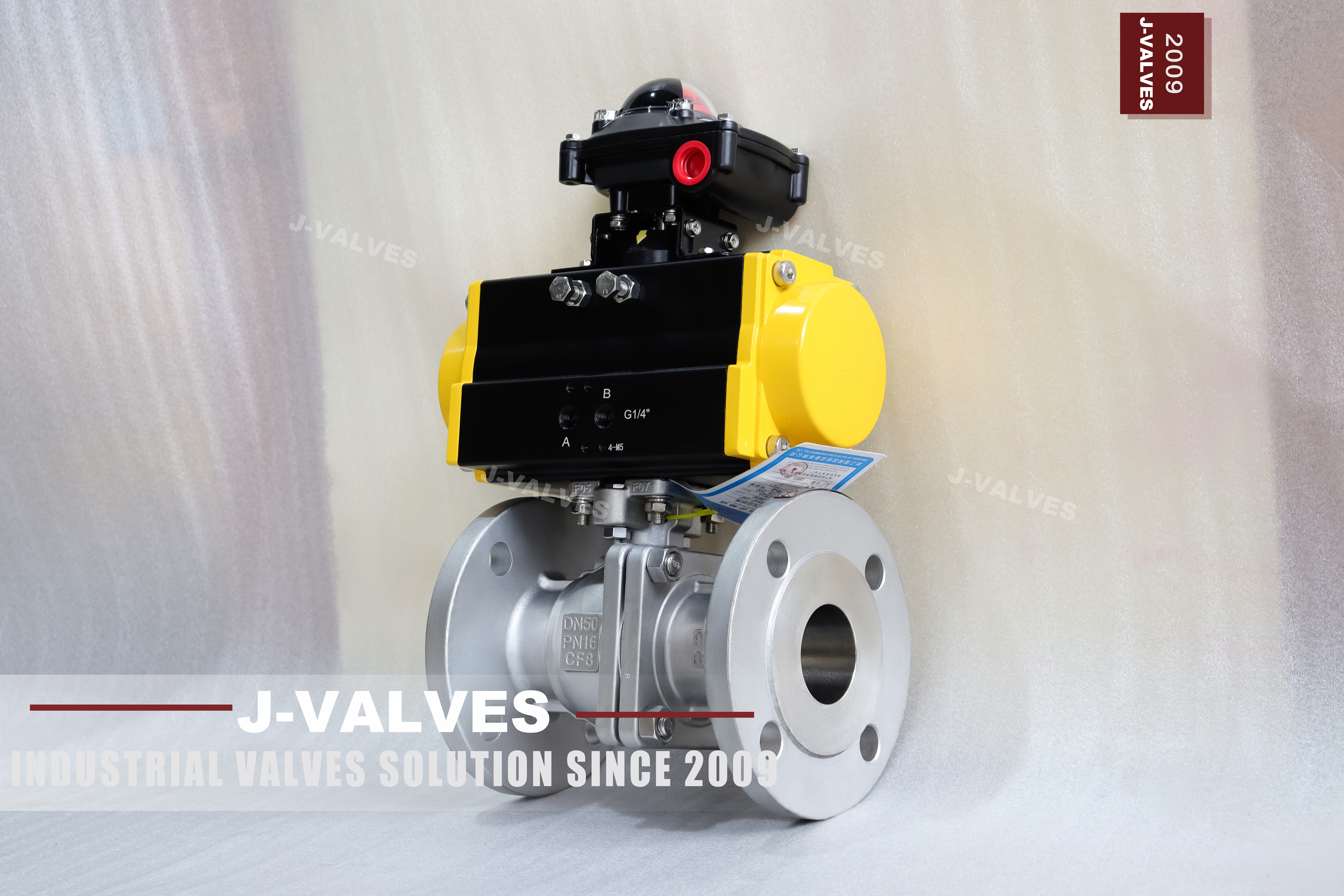
A DN50 two inch PN16 pneumatic floating ball valve with a cast A351 CF8 body, two piece construction and PTFE seats. EN 1092-1 and GB/T 9113 share one flange drilling at this size, so it will bolt to either a European or a Chinese counterflange, but PN16 is a cold rating and the allowed pressure falls with temperature. The actuator is a second pressure system with its own air supply and its own failure mode.
Three questions decide whether this valve is right, and they come in a fixed order. Does the flange match the counterflange on the line. Is the pressure at the working temperature still inside PN16. What happens to the ball when the air fails. The first is a drawing check, the second is a table lookup, and the third is a decision that has to be written into the order, because a spring return actuator and a double acting actuator are two different products on the same valve body.
Design and Construction
Two pieces: a main body carrying the ball, both seat rings and the stem, and one end body carrying the opposite flange. The ball floats between the seats, so the line pressure pushes it onto the downstream ring and the sealing force rises with the pressure. At two inch and PN16 that is a comfortable arrangement rather than a compromise: the seat load stays modest and the operating torque stays low enough for a small actuator.
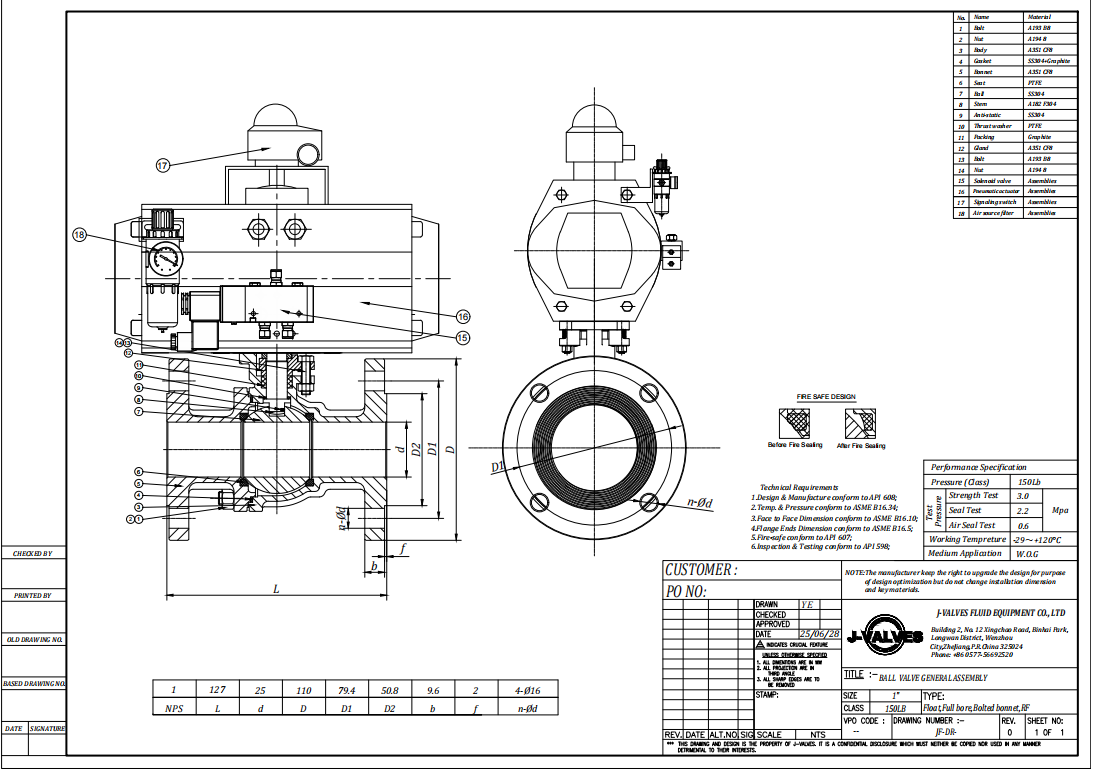
The stem comes up through the body with a shoulder that stops it being blown out, and the packing sits in an adjustable gland. Above the gland there is a mounting face and a squared stem end where the actuator bracket and coupling attach. That interface is where a pneumatic valve is really specified, because the bracket has to put the actuator concentric with the stem and hold it there through thousands of cycles, and a bracket that is merely the right bolt pattern will eventually wear the coupling.
Material Options
The body is A351 CF8, the cast equivalent of 304 stainless, and it is the right default for water, dilute chemical and food grade duties at this class. CF8M is the molybdenum bearing alternative and is the one to order where the medium carries chlorides. The cast grade is not the same product as a forged F304 body: the chemistry is comparable and the manufacturing route is not, so the two should be quoted as what they are rather than as equivalents.
The ball is CF8 or 304 with hard chrome plating, with 316 available where the medium requires it, and the seat is PTFE as standard with RPTFE and PPL as the higher temperature options. The stem is 304 or 316. Because this valve is a pneumatic one, the trim is not the only thing that has to be chosen: the actuator, the solenoid voltage, the switch type and the air treatment all sit in the same bill of materials and none of them is implied by the valve model number.
| Component | Standard Material | Optional Upgrade | Service Notes |
|---|---|---|---|
| Body and end body | CF8 cast stainless, solution annealed | CF8M for chlorides | two pieces, one bolted joint |
| Ball | CF8 or 304 with hard chrome plating | 316 stainless | floats onto the downstream seat |
| Seat | PTFE | RPTFE, PPL | sets the temperature of the valve |
| Stem | 304 stainless | 316 stainless | blowout proof shoulder |
| Packing | PTFE | flexible graphite | adjustable gland |
| Body gasket | PTFE | spiral wound stainless | renewed at every opening |
| End connection | RF flanged to EN 1092-1 PN16 | GB/T 9113 PN16, same drilling | facing and type still have to be checked |
| Actuator | Pneumatic, double acting or spring return | electric, handwheel override | fail position is an order decision |
| Air supply | 0.4 to 0.7 MPa, filtered and dry | as specified by the plant | undersized supply looks like a valve fault |
Technical Specifications
The envelope is DN50, PN16, a two piece cast A351 CF8 body, full bore, flanged to EN 1092-1 or GB/T 9113 with a raised face, face to face to EN 558 for the size, a PTFE seat, a pneumatic actuator with an air supply of 0.4 to 0.7 MPa, double acting or spring return, and an API 598 pressure test. Accessories include a solenoid valve, a limit switch box, a positioner, a filter regulator, a handwheel and a quick exhaust.
The air supply figure belongs in the specification because it is what the plant has to provide. A valve specified at 0.4 MPa and installed on a header that delivers less than that at the valve will not close against full differential pressure, and the failure will be blamed on the valve. The same applies to air quality: a filter regulator at the valve is not a luxury on a dirty plant air system, it is what keeps the solenoid and the cylinder working.
| Item | Value |
|---|---|
| Nominal bore | DN50 (2 inch) |
| Pressure class | PN16 |
| Rating note | PN16 is a cold rating; the allowed pressure falls with temperature |
| Body construction | two piece, cast, one bolted joint |
| Body | CF8 cast stainless, solution annealed |
| Body options | CF8M for chloride service |
| Ball | CF8 or 304 with hard chrome plating |
| Ball option | 316 stainless |
| Seat | PTFE |
| Seat options | RPTFE, PPL |
| Stem | 304 stainless |
| Stem option | 316 stainless |
| Packing | PTFE, adjustable gland |
| Body gasket | PTFE, renewed at every opening |
| End connection | RF flanged to EN 1092-1 PN16 |
| End option | GB/T 9113 PN16, same drilling at DN50 |
| Flange drilling | EN 1092-1 and GB/T 9113 share ISO 7005-1 dimensions at this size |
| Face to face | EN 558 for DN50 |
| Bore | full bore, DN50 |
| Actuator | pneumatic, double acting or spring return |
| Air supply | 0.4 to 0.7 MPa, filtered and dry |
| Fail position | stated on the order; spring return or stay put |
| Accessories | solenoid valve, limit switch box, positioner, filter regulator, handwheel, quick exhaust |
| Design basis | EN 12516-1 for shell strength, API 608 for the valve requirements |
| Pressure test | API 598, shell 1.5 times, seat 1.1 times |
| Material certificate | EN 10204 3.1 per heat, with solution annealing record |
| Marking | size, PN, body grade, heat number, flange standard |
| Temperature band | set by the seat compound, and the pressure allowed falls with temperature |
| Pig passage | full bore, but not a practical pig size |
| Cavity relief | relieves through the seat when the ball is closed |
| CE marking | where the valve falls in a pressure equipment category |
| Weight | quoted with the drawing and the actuator for the build ordered |
Standards and Compliance
Four documents matter here and they do different jobs. EN 1092-1 or GB/T 9113 sets the flange dimensions and the facing, and both take their dimensions from ISO 7005-1, which is why the drilling matches at this size. EN 558 sets the face to face for a flanged PN valve. EN 12516-1 sets the shell strength and the wall for a PN valve, which is the European counterpart of the ASME calculation. API 608 sets the ball valve requirements and API 598 the pressure test.
Material certification is EN 10204 3.1 per heat, and on a cast stainless body it also carries the solution annealing record, which is what makes the corrosion resistance real rather than nominal. Where the valve is supplied into a European pressure equipment scope, the CE marking and the category are stated on the declaration. The actuator is certified separately for its own supply and, where the plant is in a classified area, for the area classification rather than for the valve.
| Requirement | Standard | What J-VALVES Supplies |
|---|---|---|
| Flanges, European | EN 1092-1 | DN50 PN16, dimensions from ISO 7005-1 |
| Flanges, Chinese | GB/T 9113 | same ISO 7005-1 parentage, same drilling at this size |
| Face to face | EN 558 | flanged valve in the PN system, DN50 |
| Shell strength and wall | EN 12516-1 | the European calculation for a PN valve |
| Ball valve requirements | API 608 | stem retention, marking, testing |
| Pressure testing | API 598 | shell at 1.5 times, seat at 1.1 times |
| Material certificate | EN 10204 3.1 | per heat, with the solution annealing record |
| Actuator certification | separate from the valve | supply voltage, area classification where required |
Manufacturing Process
The body is cast, solution annealed, and machined with the bore, the seat pockets and both flange faces taken from common datums. Solution annealing is the step that matters on a cast austenitic body: it puts the carbides back into solution so that the corrosion resistance in the finished casting is the corrosion resistance of the grade, and it cannot be replaced by a passivation dip afterwards. The casting is examined before machining, because a defect found after the seat pockets are cut scraps the machining too.
The ball is machined and plated, the seats are machined to the interference the design calls for, and the two body parts are closed on new gaskets and torqued in a controlled sequence. The valve is pressure tested on its own before the actuator is fitted, and then the actuator is mounted on its bracket, the stroke is set, and the assembly is function tested with air. Testing the valve before the actuator is what keeps a seat fault and an actuator fault from being diagnosed as each other.

Quality Control and Testing
Every valve is shell tested at one and a half times its rating and seat tested at one point one times to API 598, with the seat test run in both directions because the two seats are independent. On a soft seated valve the expectation is no visible leak at the seat test. The shell test also proves the body joint, which on a two piece valve is the only place the pressure boundary is made by fasteners.
The pneumatic assembly adds its own checks. The actuator is function tested through a full stroke in both directions, the spring return is timed and confirmed to fail in the specified position on air loss, the solenoid is checked for the ordered voltage and function, and the limit switches are set at the actual open and closed positions rather than at the actuator travel limits. Material identification confirms the body and the trim against the 3.1 certificate, and the flange drilling is checked against the standard ordered.
| Step | What Is Checked | Standard or Acceptance |
|---|---|---|
| Casting | chemistry, mechanical properties, solution annealing | 3.1 certificate against A351 CF8 |
| Casting examination | surface and internal soundness before machining | as specified on the order |
| Machining | seat pockets square to the bore, flange faces parallel | drawing tolerance |
| Flange drilling | outside diameter, bolt circle, bolt count and size | EN 1092-1 or GB/T 9113 for DN50 PN16 |
| Shell test | body and body joint at 1.5 times | API 598, no leak |
| Seat test | each seat in both directions at 1.1 times | API 598 |
| Actuator function | full stroke both directions, fail position on air loss | per the order |
| Limit switches | set at the valve positions, not the cylinder travel | indication confirmed |
| Material identification | body, ball and stem against the certificate | positive identification |

Applications and Industry Service
The duty is automated isolation on water and light chemical service: water treatment and filtration, desalination pre-treatment, food and beverage process lines, chemical dosing, cooling water and HVAC, low pressure steam, and the isolation valves around a small packaged plant. In most of those the valve is operated from a control room rather than by hand, which is the reason it is pneumatic in the first place, and it is expected to stroke on demand after standing for weeks.
It is the wrong valve for a medium that attacks CF8, for a line rated above PN16 at the working temperature, and for a plant that cannot supply clean dry air at the specified pressure. It is also the wrong valve where the failure position has not been decided: a double acting actuator with no air supply stays where it is, and a process that assumes it will close is a process designed around an assumption.

Installation, Operation and Maintenance
Before the valve goes in, check the flange drilling against the counterflange and check the gasket against the facing. Fit a filter regulator close to the valve, set the supply to the pressure the actuator was sized for, and check that the solenoid voltage and the switch type match the control drawing. Bring the flanges together without pulling them with the studs, and tighten in a cross pattern in stages.
Set the open and closed stops on the actuator against the valve, not against the cylinder travel, and confirm the fail position by interrupting the air with the line isolated. Once a year, or at every shutdown, drain the filter bowl, check the gland, and stroke the valve fully in both directions. A pneumatic valve that is never stroked is a valve whose failure is discovered at the moment it is needed, which is the one time it matters.
How to Specify and Order
The order has to name the flange standard, the fail position and the accessory list, because none of the three is implied by the valve size. A typical line reads: DN50, PN16, two piece cast A351 CF8 body, full bore, RF flanged to EN 1092-1 PN16, face to face to EN 558, PTFE seat, pneumatic actuator, spring return close on air failure, solenoid at the control voltage, two limit switches, filter regulator, air supply 0.4 to 0.7 MPa.
Two further lines are worth adding. State the working pressure and the working temperature together, because PN16 is a cold rating and the pair is what decides whether the valve is inside it. State also the air supply actually available at the valve, not the pressure at the compressor, because the difference between the two is what an undersized actuator looks like on site. Both answers belong in the enquiry, not in a commissioning report.
FAQ
Q: Will a valve with GB/T 9113 flanges fit a European PN16 line?
A: At DN50 PN16 it will, because GB/T 9113 and EN 1092-1 both take their dimensions from ISO 7005-1, so the outside diameter, bolt circle, bolt count and bolt size are the same. Check the facing and the flange type as well, since those can differ between the two standards even where the drilling matches.
Q: Is PN16 the same as 16 bar at any temperature?
A: No. PN16 is a cold rating, and the pressure the valve may carry falls as the temperature rises. The allowed pressure at the working temperature comes from the pressure and temperature table for the body material, and the PN number alone does not answer the question. This matters on steam and on hot water, not on cold water.
Q: What happens to the valve when the air supply fails?
A: That depends on the actuator ordered. A spring return actuator drives the valve to its fail position, normally closed, when the air is lost. A double acting actuator has no spring and stays where it was. Both are valid, and the choice belongs in the order because it is a process safety decision rather than a valve decision.
Q: Does the air supply pressure matter?
A: It does. The actuator is sized against a supply pressure, and this valve is specified for 0.4 to 0.7 MPa. If the plant supplies less at the valve, the actuator may not close against full differential pressure, and the symptom looks like a sticking valve rather than an undersized air supply. A filter regulator at the valve is the usual fix and should be in the bill of materials.
Q: Can the actuator be removed and the valve operated by hand?
A: Yes, provided the valve is isolated first, because removing the actuator exposes the stem. A handwheel override on the actuator is the more common arrangement and does not require dismantling anything. Which one is fitted is decided at order, and the override is not a substitute for a proper isolation procedure.
Q: Why CF8 and not CF8M?
A: CF8 is the cast 304 grade and covers water, dilute chemicals and most food grade duties at PN16. CF8M adds molybdenum and is the grade to order where the medium carries chlorides, because the molybdenum is what resists pitting in those conditions. At this pressure class the choice is about corrosion, never about strength.


Hot Products


News
Ball Valves in A Kraft Pulp Mill: Black Liquor, Green Liquor And The Cost of Choosing The Alloy by Habit
White liquor at pH 14 cracks carbon steel welds, black liquor sets solid below 100 C, green liquor dregs grind seats: alloy choice and torque in a kraft mill.
Read More
Slug Flow And Ball Valves: What Actually Arrives At The Seat
A slug is liquid mass with momentum, not a pressure spike. What changes at the seat, in the cavity and at the actuator when liquid reaches a ball valve.
Read More
Ball Valves in Direct Lithium Extraction: PH 1 Eluate, Gypsum Scale And 438,000 Cycles in Twenty-Five Years
Direct lithium extraction swings valves from pH 1 eluate to pH 12 caustic, 48 column switches a day and gypsum scale. Materials, seats and torque.
Read More
Ball Valves in Geothermal Brine: Silica Scale, Chloride Cracking And The Cooling Trap
Why geothermal brine destroys ball valves: retrograde silica scale, calcite at the flash point, chloride cracking above 60 C and the 250 C seat limit.
Read More