


CHINA J-VALVES Offers Various High-quality I ndustrial Ball Valves
J-VALVES, a distinguished professional ball valve manufacturer rooted in China, takes pride in its extensive product portfolio. Our offerings span a wide range, including trunnion-mounted ball valves, floating ball valves, high-temperature ball valves, high-pressure ball valves, metal-sealed ball valves, ultra-low temperature ball valves, DBB ball valves, Three-way And Four-way Ball Valve, and fully welded ball valves. Each product is a testament to our commitment to precision engineering and reliable performance. Meticulously crafted, they are designed to not only meet but exceed the most stringent industrial demands, ensuring stable operation even under extreme conditions. This enables us to provide our clients with high-value services and makes our valves widely sought-after in industries.
Product Category
Contact Us


-
J-VALVES-Q41F
-
J-VALVES
Overview of the J-VALVES 1 Inch 300LB Two Piece Stainless Steel Floating Ball Valve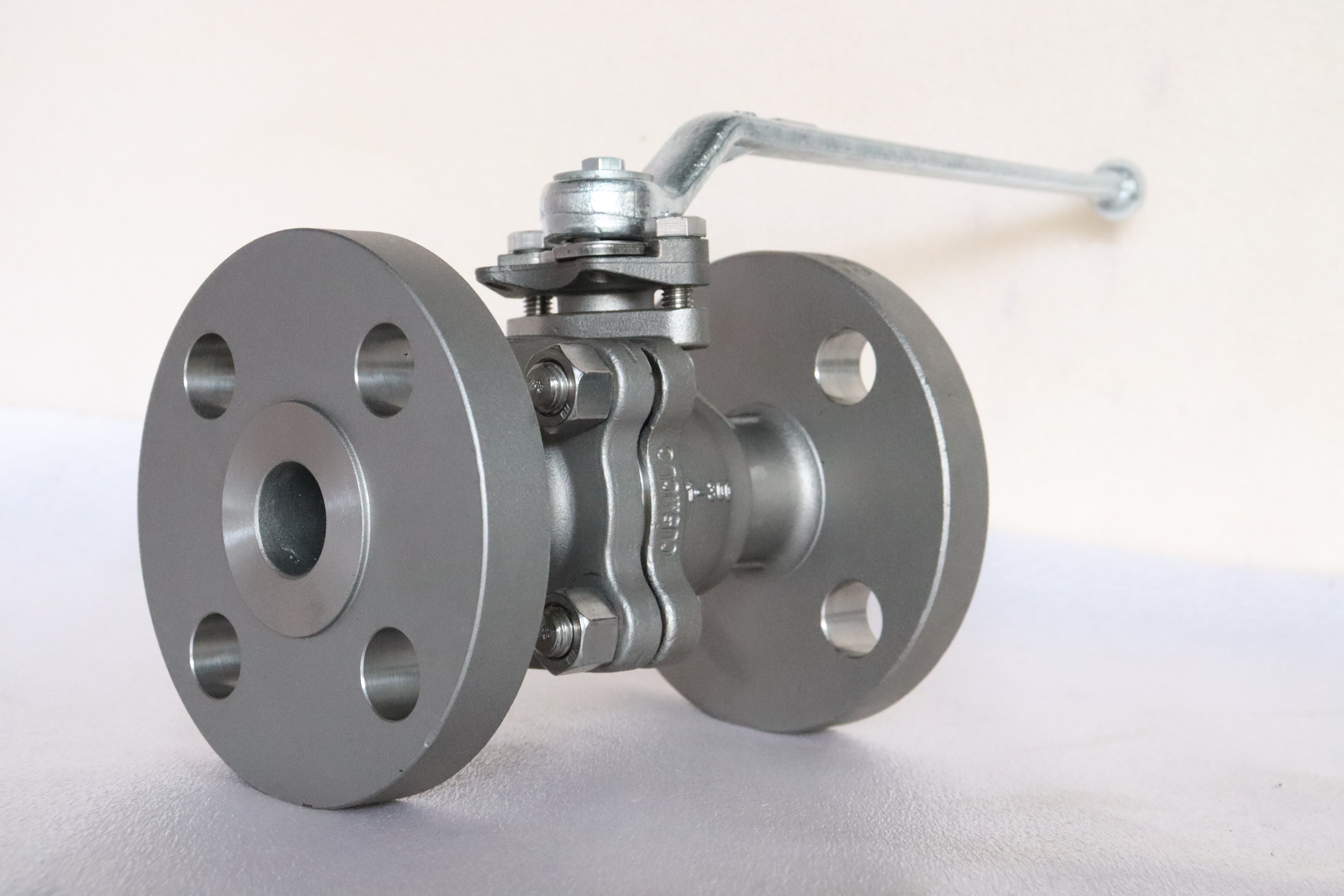
This is a one inch valve at Class 300: DN25 bore, a two piece cast stainless body, flanged ends, and a ball that floats between two seat rings. At this size the valve is small enough to be held in one hand and the lever is short, so the mechanical story is simple. What is not simple is the interface, because Class 300 is a different flange and a different face to face length from Class 150 at the same nominal size.
That is why this page starts at the joint rather than at the material. Most of the one inch valves sold into Class 300 lines are bought to replace something, and the buyer checks the flange drilling and the length before anything else. A valve that is correct in every other respect and 30 millimetres short will not go in, and the fix on site is a pair of adaptor flanges that nobody designed for.
Design and Construction
The body is in two castings. The main body carries the stem, the gland and one seat; the end cap carries the other seat and one flange, and bolts to the main body on a single gasket joint. That one joint is the whole maintenance story: undo the cap and the ball and both seats come out, which is why the two piece pattern is the cheapest way to make a small valve serviceable.
The ball floats, which at one inch means it moves a fraction of a millimetre and is pushed onto the downstream seat by the line pressure. The seat rings are backed by the body and the cap, so the load path is short and direct, and the lever effort stays low even at Class 300 because the ball is small and the seat area is small with it.

Material Options
The body is cast austenitic stainless, CF8 for the 304 equivalent and CF8M for the 316 equivalent. At one inch the choice is rarely about strength, because both grades are far stronger than the pressure needs; it is about the medium. CF8M carries molybdenum and holds up where chlorides are present, CF8 is the cheaper grade for water, food, pharmaceutical and weakly corrosive service. Neither grade is chosen for strength at DN25, and a buyer who orders by grade alone has not decided the thing that matters.
The grade that ships is the grade on the certificate, not the grade in the title. A cast body carries its heat number, and the EN 10204 3.1 certificate is issued against that heat; where a buyer needs proof, a positive material identification check on the body and the ball settles it in minutes. Two grades can look identical on a shelf, and at this size they usually do.
| Component | Standard Material | Optional Upgrade | Service Notes |
|---|---|---|---|
| Body and end cap | ASTM A351 CF8 cast stainless | CF8M for chloride service | two piece, one bolted joint |
| Ball | CF8 with hard chrome plating | CF8M, 316L, unplated | floats onto the downstream seat |
| Stem | 304 stainless | 316 stainless, 17-4PH | blowout proof shoulder, anti static |
| Seat | PTFE | RPTFE, PPL for higher temperature | backed by body and cap |
| Packing | PTFE | flexible graphite | adjustable gland |
| Body gasket | PTFE | spiral wound stainless | renewed at every opening |
| End connection | RF flanged to ASME B16.5 Class 300 | RTJ where ordered | not interchangeable with Class 150 |
| Operator | Lever with a locking hole | worm gear, pneumatic, electric | quarter turn, travel stops set |
| Face to face | ASME B16.10 for Class 300 at DN25 | short or long pattern per the table | state it if replacing an existing valve |
Technical Specifications
The envelope is DN25, Class 300, two piece cast body, full bore, flanged raised face to ASME B16.5, face to face to ASME B16.10, PTFE or RPTFE seat, lever with a locking hole, tested to API 598. The wall thickness comes from ASME B16.34 for Class 300 in the austenitic group, and at this size the casting is thick enough that the wall is not what limits the valve.
Class 300 changes three dimensions against Class 150 at the same nominal bore. The flange is thicker and its bolt circle is wider, the studs are a size up, and the face to face length is a different figure in the same B16.10 table. None of those can be absorbed by longer studs or a thinner gasket, which is why the two classes are not interchangeable at the joint even when the bore is identical.
| Item | Value |
|---|---|
| Nominal size | 1 inch (DN25) |
| Pressure class | Class 300 (PN50) |
| Body construction | two piece, one bolted joint |
| Body and end cap | ASTM A351 CF8 cast stainless |
| Body option | CF8M for chloride service |
| Ball | CF8 with hard chrome plating |
| Ball options | CF8M, 316L |
| Stem | 304 stainless, blowout proof |
| Stem option | 316 stainless, 17-4PH |
| Seat | PTFE |
| Seat options | RPTFE, PPL |
| Packing | PTFE, adjustable gland |
| Packing option | flexible graphite |
| Body gasket | PTFE |
| Gasket option | spiral wound stainless |
| End connection | RF flanged to ASME B16.5 Class 300 |
| Face to face | ASME B16.10, Class 300 column |
| Bore | full bore, DN25 |
| Operator | lever with a locking hole |
| Operator options | worm gear, pneumatic, electric |
| Design standard | ASME B16.34 and API 608 |
| Pressure test | API 598, shell 1.5 times, seat 1.1 times |
| Flange difference | thicker flange, wider bolt circle, larger studs than Class 150 |
| Face to face difference | a different B16.10 figure from Class 150 at the same size |
| Interchangeability | not interchangeable with Class 150 at the joint |
| Anti static | spring contact between stem and body |
| Material certificate | EN 10204 3.1 per heat |
| Marking | size, class, body grade, heat number |
| Temperature band | set by the seat compound first, then by the body grade |
| Pig passage | not applicable at DN25, the full bore is about pressure drop |
Standards and Compliance
ASME B16.34 gives the wall and the pressure temperature rating, and API 608 gives the general requirements for a flanged ball valve: stem retention, anti static path where required, marking, and the test. The flange is ASME B16.5 Class 300 and the face to face is ASME B16.10. Those four references are the ones to quote on an order, and they are also the four that a substitute valve most often fails on.
Where the valve is going into a line designed to a European or Japanese standard, the rating will not be written as Class 300 and the flange will not be to B16.5. That is a different valve, not a different label: PN40 flanges to EN 1092-1 and 10K flanges to JIS do not share a bolt circle with Class 300, and a page that lists all three under one product is describing three products.
| Requirement | Standard | What J-VALVES Supplies |
|---|---|---|
| Pressure boundary | ASME B16.34 | wall thickness and rating, austenitic group |
| Ball valve requirements | API 608 | stem retention, marking, testing |
| Flanges | ASME B16.5 | Class 300, raised face |
| Face to face | ASME B16.10 | Class 300 column, not the Class 150 one |
| Pressure testing | API 598 | shell at 1.5 times, seat at 1.1 times |
| Cast stainless grade | ASTM A351 | CF8 and CF8M, solution annealed |
| Material certificate | EN 10204 3.1 | per heat, with the heat number on the body |
| Marking | size, class, body grade, heat number | read back against the certificate |
Manufacturing Process
Both castings come from the same pattern, are solution annealed and then machined. The joint face on the main body and the matching face on the cap are cut as a pair so that the gasket has two flat, parallel surfaces to sit in; a joint closed on faces that are not parallel will weep at the thin side whatever the stud torque. The seat pockets are cut after that, from the joint face as the datum.
The ball is machined, ground and polished, then plated where a hard chrome finish is ordered. The stem is machined with the shoulder that stops it being blown out, and the anti static path is fitted as the valve is assembled, because it is a spring contact between stem and body that cannot be added through a finished gland. The plating bath is checked for thickness on a coupon from the same batch, not only on the parts.

Quality Control and Testing
Every valve is shell tested at one and a half times its rating with the body joint assembled, then seat tested at one point one times in both directions. The joint is the place to watch during the shell test: a casting flaw in the cap or a gasket that is not seated shows up there, and at Class 300 the joint sees twice the pressure a Class 150 valve of the same size would.
Two checks are worth naming because they are often skipped on small valves. The bore and the seat pocket are measured after plating, since plating thickness moves the ball diameter and can change the seat interference; and the lever is operated through a full quarter turn with the valve pressurised, to prove the travel stops are set so the ball seats at both ends rather than a few degrees short.
| Step | What Is Checked | Standard or Acceptance |
|---|---|---|
| Casting | chemical composition, visual and dimensional | A351 grade against the 3.1 certificate |
| Joint faces | flatness and parallelism of the pair | cut as a pair, checked on a surface plate |
| Seat pockets | diameter, depth, square to the bore | measured after plating |
| Ball | sphericity, surface finish, plating thickness | checked against the seat ring |
| Stem | shoulder diameter, anti static contact resistance | drawing dimension and continuity check |
| Shell test | body and joint at 1.5 times the rating | API 598, no leak |
| Seat test | both directions at 1.1 times | API 598, no visible leak |
| Lever | quarter turn travel, stops at both ends | operated under pressure |
| Marking | size, class, grade, heat number | compared with the certificate before packing |

Applications and Industry Service
The duty is isolation on small bore process and utility lines at moderate pressure: instrument and sample lines, dosing and injection skids, small water and air distribution, food and pharmaceutical transfer where a stainless body is required for cleanliness, and the isolation valve in front of a small pump or a filter. In all of those duties the valve is a block valve, opened and closed a few times a week rather than modulated, which is the service a quarter turn ball valve is built for.
It is the wrong valve for a line that has to be pigged, whatever the full bore label suggests, because a one inch line does not carry a pig; the full bore here is about pressure drop and about not trapping debris, not about passage. It is also the wrong valve above the seat temperature, where the seat has to move to PPL or to a metal seat rather than the body to a higher grade.

Installation, Operation and Maintenance
Fit the valve with the stem vertical or horizontal, check that the two flange faces are parallel and that the gasket is the right size for the facing, then draw the studs up in a cross pattern. At one inch it is tempting to tighten by feel; the joint still has a torque figure and the casting still cracks if the studs are pulled down on one side first.
Operate a quarter turn, fully open or fully closed, and leave the lever in the locking hole position if the valve must not be moved. For a seat change, isolate, vent and drain, take the cap studs out, and expect to renew the body gasket and both seat rings; the ball is reusable if it is not scored, which is checked by hand against a straight edge rather than by eye.
How to Specify and Order
A one inch order is short enough that people write it from memory, which is exactly how the wrong class arrives on site. Put the eight items on the drawing line by line: the size, the class, the body grade, the bore, the end facing, the seat compound, the operator and the standard. Then the line itself: one inch, Class 300, body CF8M, full bore, RF flanged to ASME B16.5, RPTFE seat, lever with a locking hole, API 608 with a 3.1 certificate. Anything left off is filled in by the supplier default rather than by the drawing, and the default is whatever is in stock.
Add two things that the form does not ask for. State the face to face length you need if the valve replaces an existing one, because the class and the size do not fully determine it and a short pattern valve will not fill a long pattern gap. And state the medium, because it decides between CF8 and CF8M before the castings are poured, and cannot be decided afterwards.
FAQ
Q: Can a Class 150 valve be used in a Class 300 line with adaptor flanges?
A: No. The adaptor adds two more joints to a line that is already at a higher rating, and neither the adaptor nor the extra gaskets are rated for it. The flange thickness, the bolt circle and the stud size all differ between Class 150 and Class 300 at one inch, so the valve also ends up the wrong length in the gap. Use a Class 300 valve and keep one joint on each side.
Q: What changes between Class 150 and Class 300 at one inch?
A: Three things: a thicker flange with a wider bolt circle and larger studs, a different face to face figure in the ASME B16.10 table, and a heavier wall from ASME B16.34. The bore stays the same. Because the flange and the length both move, the two classes are not interchangeable at the joint even though the valve looks the same.
Q: Is CF8 or CF8M the right body for this valve?
A: CF8M where the medium carries chlorides, CF8 everywhere else. At one inch the pressure is never the reason to choose between them; the medium is. The grade that ships is the grade on the 3.1 certificate for the heat number stamped on the body, and a positive material identification check settles any doubt before installation.
Q: Why is the page written as full bore if one inch lines are not pigged?
A: Because the bore is full and that is what the term means: the ball passage matches the pipe bore, so the pressure drop is the same as a piece of pipe and nothing collects in a step. Pig passage is a separate property that matters from about two inch upward, and it is not a claim that should be made for a DN25 valve.
Q: Which seat should be ordered?
A: PTFE for water, air, oil and most process liquids at ordinary temperature, RPTFE where a little more strength is wanted at the same temperature, and PPL where the temperature goes beyond what PTFE holds. The body grade is not the limit here; the seat is, and the seat is also the cheapest thing to change at the order stage.
Q: Can the valve be repaired in line?
A: The end cap comes off and both seats and the ball come out, with the valve still bolted in the line. The line still has to be isolated, vented and drained first, and the body gasket is renewed each time. It is a planned job of an hour on a bench, not a field repair under pressure.


Hot Products


News
Ball Valves in A Kraft Pulp Mill: Black Liquor, Green Liquor And The Cost of Choosing The Alloy by Habit
White liquor at pH 14 cracks carbon steel welds, black liquor sets solid below 100 C, green liquor dregs grind seats: alloy choice and torque in a kraft mill.
Read More
Slug Flow And Ball Valves: What Actually Arrives At The Seat
A slug is liquid mass with momentum, not a pressure spike. What changes at the seat, in the cavity and at the actuator when liquid reaches a ball valve.
Read More
Ball Valves in Direct Lithium Extraction: PH 1 Eluate, Gypsum Scale And 438,000 Cycles in Twenty-Five Years
Direct lithium extraction swings valves from pH 1 eluate to pH 12 caustic, 48 column switches a day and gypsum scale. Materials, seats and torque.
Read More
Ball Valves in Geothermal Brine: Silica Scale, Chloride Cracking And The Cooling Trap
Why geothermal brine destroys ball valves: retrograde silica scale, calcite at the flash point, chloride cracking above 60 C and the 250 C seat limit.
Read More