


CHINA J-VALVES Offers Various High-quality I ndustrial Ball Valves
J-VALVES, a distinguished professional ball valve manufacturer rooted in China, takes pride in its extensive product portfolio. Our offerings span a wide range, including trunnion-mounted ball valves, floating ball valves, high-temperature ball valves, high-pressure ball valves, metal-sealed ball valves, ultra-low temperature ball valves, DBB ball valves, Three-way And Four-way Ball Valve, and fully welded ball valves. Each product is a testament to our commitment to precision engineering and reliable performance. Meticulously crafted, they are designed to not only meet but exceed the most stringent industrial demands, ensuring stable operation even under extreme conditions. This enables us to provide our clients with high-value services and makes our valves widely sought-after in industries.
Product Category
Contact Us


-
J-VALVES-Q41F
-
J-VALVES
Overview of the J-VALVES DIN DN100 PN16 CF8M Two Piece Ball Valve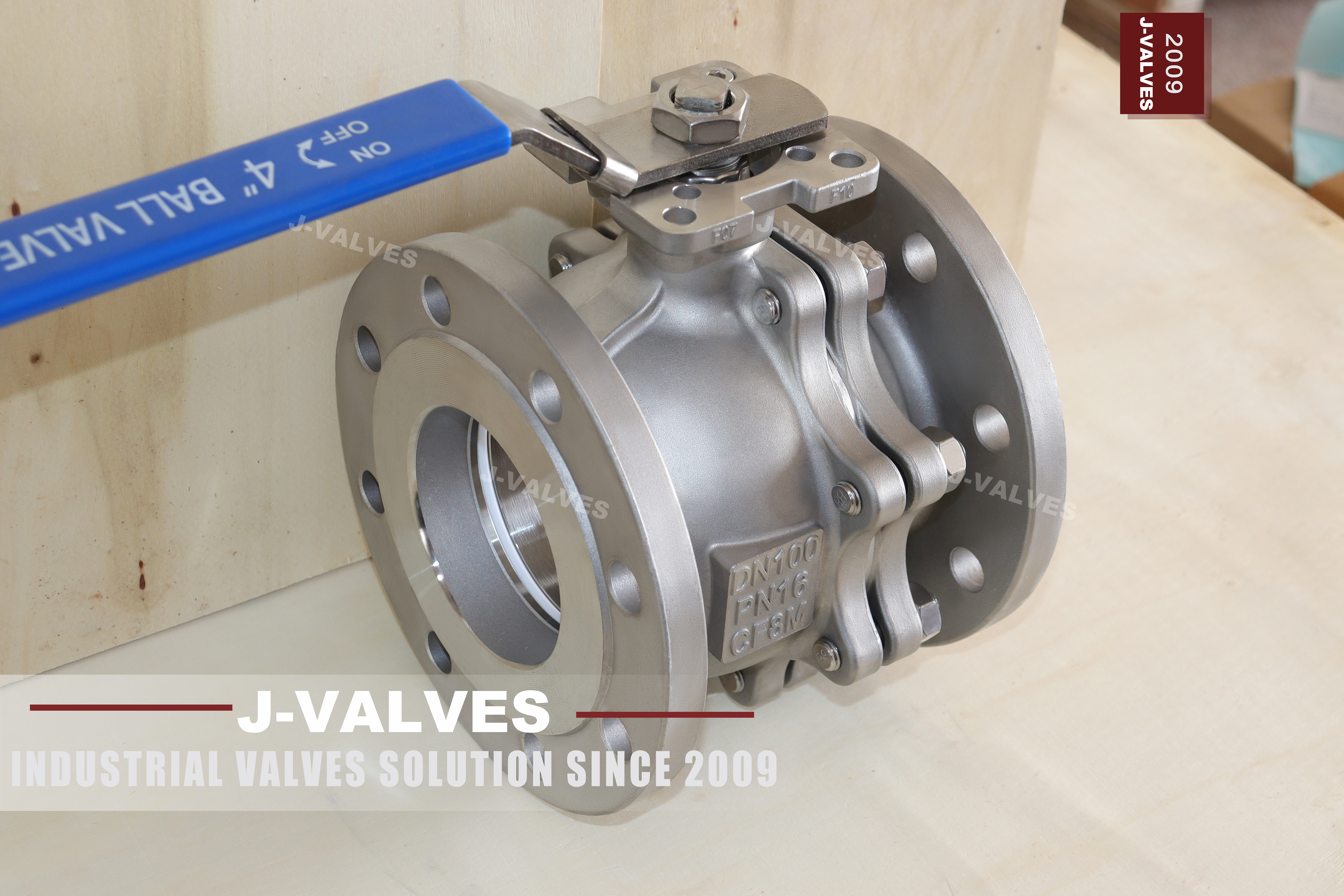
This is a four inch nominal, PN16, two piece stainless steel floating ball valve built to the German dimensional system rather than the American one. The body is CF8M, the bore is full port at DN100, the flanges are raised face to EN 1092-1, the design follows DIN 3357, the face to face length follows DIN 2543 and the test is to DIN EN 12266. The ball floats against the downstream seat and the operator is a lever on the smaller sizes and a worm gear here.
The reason this page exists is that the two dimensional systems do not interchange. An ASME B16.10 Class 150 four inch valve and a DIN 2543 DN100 PN16 valve are both called four inch and both have the same bore, and their face to face lengths are not the same. On a new line that is a drawing decision. On a replacement in a European skid with fixed pipe, it is the difference between a valve that drops in and a valve that needs the spool cut.
Design and Construction
The body is two piece. The end cap bolts to the main body on one side and carries one seat; the other seat sits in the body. The ball is trapped between the two seats and is free to move a fraction of a millimetre downstream under line pressure, which is what presses it onto the seat and produces the seal. Because the load path is through the ball rather than through a trunnion, the design is limited to the sizes and classes where that load stays manageable, and DN100 PN16 is well inside that limit.
The stem is inserted from the top through the gland and is retained so that it cannot be blown out if the gland is removed under pressure. The stem to ball drive is a slot or a square, and the anti static path runs from the ball through the stem to the body so that a static charge cannot build up across the seat. Both of those are required by the ball valve standards rather than being optional features, and both are present on this valve as standard.

Material Options
The body and the end cap are cast austenitic stainless, CF8 for the 304 equivalent and CF8M for the 316 equivalent. CF8M is the default here because the molybdenum content is what gives resistance to chlorides and to the pitting that a 304 body suffers in cooling water and in some process streams. Neither grade is a substitute for a duplex in a chloride-rich line at temperature, and this page does not claim to be the answer to that duty.
The trim is stainless throughout, which is the point of the valve. The ball is CF8 or CF8M polished to a fine finish because the seal depends on the ball surface as much as on the seat, the stem is 316 or 17-4PH, and the seat is PTFE or RPTFE as standard with PPL and PEEK above that and a metal seat with a cobalt alloy facing where the temperature rules out a polymer. The body gasket and the packing are selected for the same temperature as the seat.
| Component | Standard Material | Optional Upgrade | Service Notes |
|---|---|---|---|
| Body and end cap | ASTM A351 CF8M cast stainless | CF8 for the 304 equivalent | CF8M is the default where chlorides are present |
| Ball | CF8 or CF8M, ground and polished | Hard chrome or cobalt alloy facing | the seat seals only where the ball surface matches |
| Stem | 316 stainless | 17-4PH precipitation hardening | anti blowout shoulder is standard |
| Seat ring | PTFE or RPTFE | PPL, PEEK, metal with cobalt alloy facing | metal seat above the polymer temperature limit |
| Body gasket | PTFE | Spiral wound for higher temperature | replaced every time the body is opened |
| Stem packing | PTFE V-ring | Graphite for higher temperature | matched to the seat temperature |
| Anti static device | Spring loaded ball to stem to body | Not applicable | required by the ball valve standards |
| Operator | Lever | Worm gear, pneumatic, electric | gear where the measured torque needs it |
Technical Specifications
The declared envelope is DN100, PN16, two piece body, full port bore, raised face flanges to EN 1092-1 form B1, face to face to DIN 2543, and a lever or a worm gear depending on the torque of the build. The pressure rating can be extended to PN25 or PN40 in the same body family, which changes the flange and the wall but not the dimensional system, so the face to face length stays inside the same standard family.
The flange reference on this page is the face form, not a flange type. EN 1092-1 form B1 describes the raised face; the flange type number in the same standard describes the way the flange attaches to pipe, and a valve body flange is integral rather than a weld neck. That distinction matters when a buyer reads a data sheet that quotes a type number for a valve, because the type number is describing the mating pipe flange and not the valve.
| Item | Value |
|---|---|
| Nominal size | DN100 (4 inch) |
| Pressure rating | PN16 |
| Rating options | PN25, PN40 in the same body family |
| Body construction | two piece, bolted end cap |
| Ball support | floating, no trunnion |
| Body material | ASTM A351 CF8M cast stainless steel |
| Body option | ASTM A351 CF8 |
| Ball | CF8 or CF8M, ground and polished |
| Stem | 316 stainless steel |
| Stem option | 17-4PH precipitation hardening |
| Seat | PTFE or RPTFE |
| Seat options | PPL, PEEK, metal with cobalt alloy facing |
| Bore | full port, DN100 |
| End connection | flanged raised face to EN 1092-1 form B1 |
| Face to face | DIN 2543 |
| Design standard | DIN 3357 |
| Pressure testing | DIN EN 12266 |
| Alternative test standard | API 598 where the order names it |
| Wall thickness basis | ASME B16.34 where quoted |
| Operator | lever as standard |
| Operator options | worm gear, pneumatic, electric |
| Anti static | spring loaded path from ball to stem to body |
| Stem retention | blowout proof, retained by the body |
| Body cavity | self relieving through the seat |
| Temperature basis | set by the seat compound and the packing ordered |
| Body gasket | PTFE, spiral wound for higher temperature |
| Flange bolts | stainless or isolation coated on a stainless line |
| Marking | size, PN16, CF8M, heat number on the nameplate |
| Documentation | EN 10204 3.1, DIN EN 12266 test record, GA drawing |
| Typical duty | process water, food and beverage, pharmaceutical, plant piping |
Standards and Compliance
DIN 3357 is the German ball valve standard and it sets the general requirements: the pressure and temperature ratings, the materials, the test requirements and the marking. DIN 2543 fixes the face to face dimensions for flanged ball valves, which is the number a European installer looks up first. DIN EN 12266 governs the pressure testing, and EN 1092-1 governs the flange dimensions and the face form. Between them they define a valve that fits a European line without adapters.
Where the same valve is also sold outside Europe, the ASME standards are quoted alongside and the two do not always agree. ASME B16.34 supplies a wall thickness calculation, API 608 supplies the ball valve specifics, and API 598 supplies a test procedure that differs from DIN EN 12266 in the hold time and the acceptance criteria. A valve cannot be certified to both test standards at once, so the order has to name the one that the receiving inspection will apply.
| Requirement | Standard | What J-VALVES Supplies |
|---|---|---|
| Ball valve general requirements | DIN 3357 | design, materials, testing and marking |
| Face to face dimensions | DIN 2543 | length confirmed on the drawing against the standard |
| Pressure testing | DIN EN 12266 | shell and seat test record per valve |
| Flange dimensions and face form | EN 1092-1 form B1 | raised face, outside diameter, bolt circle and holes |
| Wall thickness where ASME is quoted | ASME B16.34 | wall calculation sheet on request |
| Ball valve specifics where ASME is quoted | API 608 | anti static path, blowout proof stem, nameplate |
| Pressure testing where ASME is quoted | API 598 | alternative test procedure, named on the order |
| Material certificate | EN 10204 3.1 | certificate per casting heat number |
Manufacturing Process
The body and the end cap are precision cast in CF8M, solution annealed, then machined. The two joint faces are machined so that they stay parallel to each other and square to the bore, because the joint is a gasketed pressure boundary and a mismatch there shows up as a weep rather than as a burst. The seat pockets are machined to take the seat ring squarely, and the flange face is turned to the EN 1092-1 form B1 profile with the raised face height and the finish the standard requires.
The ball is machined, ground and polished, then checked for sphericity, because a seat seals against the ball only where the two surfaces match. The stem is machined with the anti blowout shoulder and the anti static drilling, assembled through the gland, and the packing is compressed to a set load rather than to a feel. The assembled valve is then torqued and the figure recorded, which is what decides whether the operator is a lever or a gear.

Quality Control and Testing
Each valve is shell tested and seat tested to DIN EN 12266, with the seat tested in both directions because a floating ball seals downstream and the upstream seat is only proven on reverse flow. The test pressures, the hold times and the result are recorded per valve. The material certificate is to EN 10204 3.1 against the casting heat number, and for a European order the 3.1 certificate is usually a contractual requirement rather than an option.
The dimensional inspection is where a DIN valve earns its price. The face to face length is checked against DIN 2543, the flange outside diameter, bolt circle and bolt hole diameter against EN 1092-1, and the raised face height and finish against form B1. The bore is checked for full port against the nominal diameter. All of those are recorded on the inspection sheet that goes out with the valve, because a European receiving inspection will ask for them.
| Step | What Is Checked | Standard or Acceptance |
|---|---|---|
| Incoming casting | chemical composition and heat number | EN 10204 3.1 against A351 CF8M |
| Machining | parallelism of the two joint faces, seat pocket squareness | drawing tolerance, checked on a surface plate |
| Flange | outside diameter, bolt circle, bolt hole diameter, raised face height | EN 1092-1 form B1, gauged |
| Face to face | end to end length of the assembled valve | DIN 2543, recorded on the inspection sheet |
| Ball | sphericity and surface finish | seat contact band continuous under marking compound |
| Shell test | body and the end cap joint at 1.5 times PN16 | DIN EN 12266, no leak |
| Seat test | each seat in both directions at 1.1 times PN16 | DIN EN 12266, no visible leak |
| Torque | breakaway and running torque on the assembled valve | recorded, decides lever or gear |
| Marking | nameplate against the order | size, PN16, CF8M, heat number, Din 3357 marking |

Applications and Industry Service
The duty is European process and utility piping in stainless: food and beverage lines where a carbon steel body would contaminate the product, pharmaceutical and fine chemical service where the wetted surfaces have to be corrosion resistant and cleanable, water treatment and cooling circuits, and general plant piping on skids built to DIN. In those systems the valve is chosen for the wetted material and for the fact that it fits the pipe that is already there.
It is also the standard choice where a line has to be pigged or cleaned, because the full port bore passes a pig and leaves no pocket for product to sit in. Where the duty is abrasive or the temperature is above what a PTFE seat survives, the metal seat version is ordered and the same body carries it. Where the line is chloride rich and hot, this valve is not the right answer and a duplex body is, which is a different conversation.

Installation, Operation and Maintenance
Fit the valve with the stem up or horizontal, check the gasket against both the raised face on the valve and the mating flange, and tighten the flange bolts in a cross pattern to the torque the gasket maker specifies rather than to a feel. On a stainless line, use stainless or isolation coated studs, because a carbon steel stud in a stainless flange will corrode and seize long before the valve does. Leave the lever free to swing through the quarter turn.
Operate the valve fully open or fully closed rather than leaving it part open as a throttle, because a floating ball partly open puts the seat in the flow and erodes it. When the seats are replaced, replace the body gasket and the stem packing at the same time, and check the ball surface for scratches before fitting a new seat onto it. A new seat on a scored ball will leak again within a few cycles and the valve will be blamed rather than the ball.
How to Specify and Order
An order for this valve states size, rating, body grade, seat compound, flange standard and face, face to face standard, and operator. A typical line reads: DN100, PN16, two piece body in CF8M, full port, RPTFE seat, raised face to EN 1092-1 form B1, face to face to DIN 2543, worm gear. If the valve is for a European skid, DIN 2543 in that line is the field that prevents the most expensive mistake, because it is the one a site fitter checks last and suffers first.
Where the valve replaces an existing one, measure the installed face to face length and the flange bolt circle on site and put both on the enquiry. Where the line is new, send the design pressure, the design temperature, the fluid and the pipe material. If the order will be inspected to DIN EN 12266 rather than API 598, say so at enquiry stage, because the test record is issued differently and it cannot be re-issued later from a test that was run to the other procedure.
FAQ
Q: Will a DIN DN100 PN16 valve replace an ASME four inch Class 150 valve?
A: Not directly. Both are called four inch and both have a DN100 bore, but the face to face length and the flange drilling come from different standards: DIN 2543 and EN 1092-1 on one side, ASME B16.10 and ASME B16.5 on the other. On a new line that is a drawing decision; on a replacement in a fixed spool it is a pipe cut. Measure the installed length and bolt circle before ordering.
Q: What do DIN 3357 and DIN 2543 each cover?
A: DIN 3357 is the general ball valve standard: ratings, materials, test requirements and marking. DIN 2543 fixes the face to face dimensions for flanged ball valves, which is the dimension an installer looks up first. They are complementary, and a data sheet that quotes only one of them is only half the dimensional answer.
Q: Is the body CF8 or CF8M?
A: Both are available, and CF8M is the default on this page because the molybdenum content gives resistance to chlorides and to pitting in cooling water and process streams. The photograph and the file name for this size show the CF8M build. A CF8 body is perfectly serviceable where the fluid is not chloride bearing, and it is cheaper.
Q: Why does the data sheet mention a flange type number?
A: Because the type number describes how a flange attaches to pipe, and a valve body flange is integral. The useful reference for a valve is the face form, EN 1092-1 form B1 for a raised face, plus the pressure rating. Quoting a type number for a valve is a common shortcut that tells the buyer nothing about the face that has to seal.
Q: Which seat should I order for hot service?
A: PTFE is the standard and stops well below the temperature a metal seat covers. PPL and PEEK raise the limit, and a metal seat with a cobalt alloy facing is available where the process rules out a polymer altogether. The seat and the packing have to be chosen together, because a metal seat with PTFE packing is only as hot as the packing.
Q: Can the valve be certified to both DIN EN 12266 and API 598?
A: The valve can be built to satisfy both, but the test record has to name the procedure that was actually run, because the two differ in hold time and acceptance criteria. If the receiving inspection will apply one of them, name it on the order. A certificate cannot be re-issued later from a test that was run to the other procedure.


Hot Products


News
Ball Valves in A Kraft Pulp Mill: Black Liquor, Green Liquor And The Cost of Choosing The Alloy by Habit
White liquor at pH 14 cracks carbon steel welds, black liquor sets solid below 100 C, green liquor dregs grind seats: alloy choice and torque in a kraft mill.
Read More
Slug Flow And Ball Valves: What Actually Arrives At The Seat
A slug is liquid mass with momentum, not a pressure spike. What changes at the seat, in the cavity and at the actuator when liquid reaches a ball valve.
Read More
Ball Valves in Direct Lithium Extraction: PH 1 Eluate, Gypsum Scale And 438,000 Cycles in Twenty-Five Years
Direct lithium extraction swings valves from pH 1 eluate to pH 12 caustic, 48 column switches a day and gypsum scale. Materials, seats and torque.
Read More
Ball Valves in Geothermal Brine: Silica Scale, Chloride Cracking And The Cooling Trap
Why geothermal brine destroys ball valves: retrograde silica scale, calcite at the flash point, chloride cracking above 60 C and the 250 C seat limit.
Read More