


CHINA J-VALVES Offers Various High-quality I ndustrial Ball Valves
J-VALVES, a distinguished professional ball valve manufacturer rooted in China, takes pride in its extensive product portfolio. Our offerings span a wide range, including trunnion-mounted ball valves, floating ball valves, high-temperature ball valves, high-pressure ball valves, metal-sealed ball valves, ultra-low temperature ball valves, DBB ball valves, Three-way And Four-way Ball Valve, and fully welded ball valves. Each product is a testament to our commitment to precision engineering and reliable performance. Meticulously crafted, they are designed to not only meet but exceed the most stringent industrial demands, ensuring stable operation even under extreme conditions. This enables us to provide our clients with high-value services and makes our valves widely sought-after in industries.
Product Category
Contact Us


-
J-VALVES-Q47F
-
J-VALVES
Overview of the J-VALVES 6 Inch Class 300 WCB Two-Piece Floating Ball Valve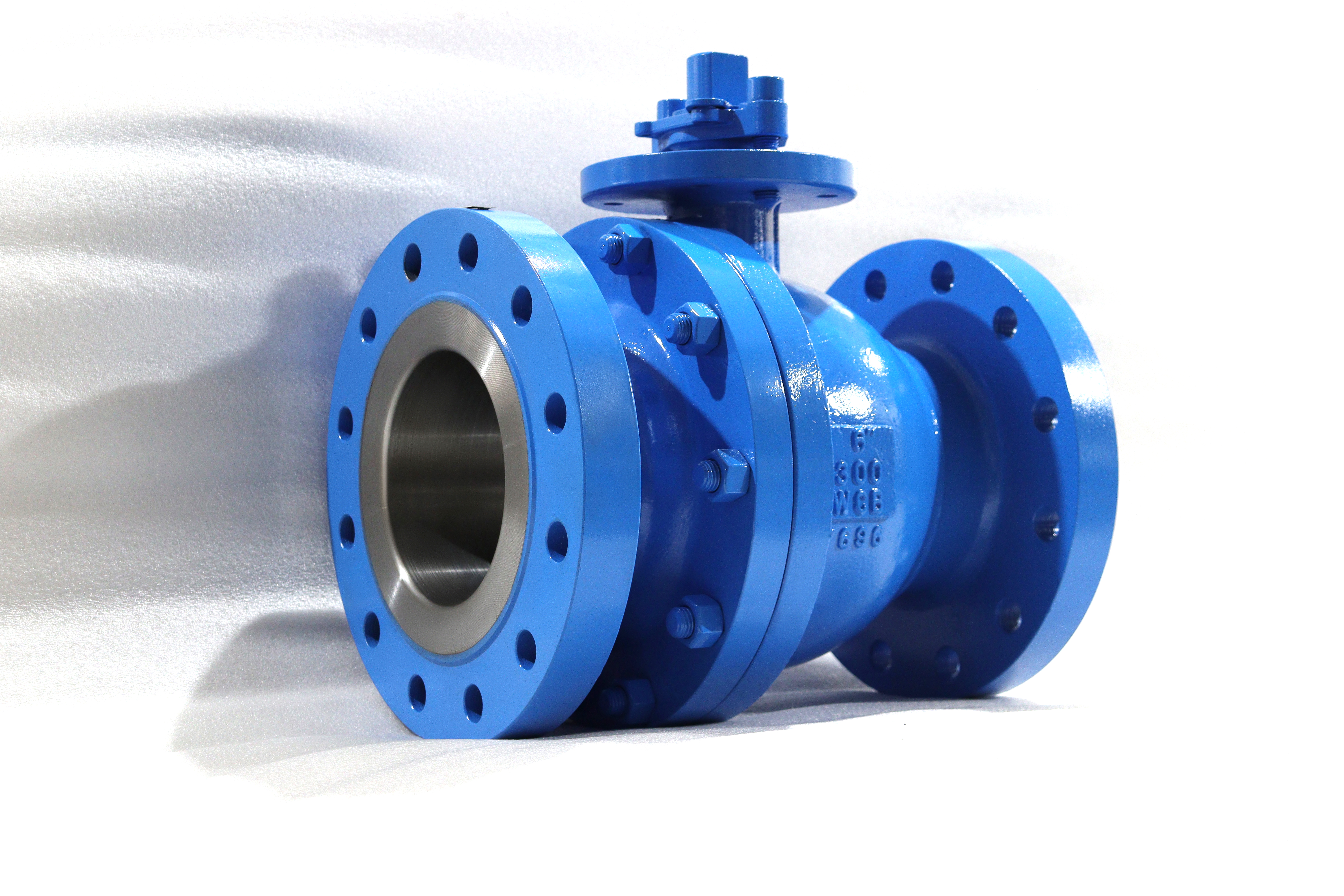
This is a 6 inch Class 300 floating ball valve in cast carbon steel. The body is ASTM A216 WCB, split into two parts: a main body and one bolted end cap, with ASME B16.5 raised face flanges at both ends and a full bore through the ball. The nameplate also carries PN50, because API 6D clause 7.2 records Class 300 under that designation, and both marks are legitimate on a valve. What is not legitimate is treating PN50 as a flange standard, and that one point decides whether the valve will bolt to the line.
The ball is not carried on trunnions. It sits loose between two seat rings and line pressure pushes it downstream onto the seat, so the seal is made by the medium rather than by a spring or a piston. That is why this design has no seat injection ports, no piston-effect seat rings and no external cavity relief: if trapped liquid expands in the cavity with the valve closed, the pressure pushes the ball off the upstream seat and vents back into the line. Fewer parts in the pressure boundary is the whole argument at this size and class.
Class 300 at 6 inch is the working ground of the two-piece floating valve: steam and condensate headers, plant utilities, tank farm isolation, hot oil circuits, compressed air and refinery utility lines. It is a soft-seated isolation valve, worked a few times a shift at most, bought for a flange that matches and a seat that still holds after a year of standing pressure.
Design and Construction
A two-piece body means the ball, both seats and the stem go in through one end. The end cap carries the body joint and one seat ring, and it belongs on the downstream side. With the valve closed the joint then sits behind the downstream seat instead of facing the full line pressure on the high side. Sealing is bidirectional, but that does not make the installation direction free. Fit the valve by the arrow cast on the body, and read the arrow before the bolts go in, because a reversed two-piece valve keeps its joint on the high side for the rest of its life.
The stem enters from inside the cavity, so line pressure cannot blow it out; the packing sits above a shoulder that is trapped by the body itself. Its tang engages a slot in the ball rather than a fixed connection, which is what lets the ball float axially while the stem turns it. The stem therefore carries torque, not the side load of the ball against the seat. The clearance in that slot is also why a floating valve feels slightly different at the handle from a trunnion design.
Both seat rings are soft: PTFE as standard, then RPTFE to 180 C, PEEK to 260 C, PPL to 280 C, and a Stellite-faced metal ring above that. Behind each soft seat is a metal shoulder, and that is the fire-safe path. If the seat burns away, the ball lands on metal and the joint is still held by a graphite gasket. The body joint gasket is graphite spiral wound for the same reason; a PTFE flat gasket seals better on water but leaves nothing behind in a fire.
Static is a real issue on a soft-seated valve, because the seats insulate the ball from the body. A spring-loaded plunger in the stem keeps ball, stem and body electrically continuous, and API 608 requires it. On a metal-seated valve the metal contact does that job by itself; here it has to be built in and then proved on the test bench, which is why continuity is a recorded reading and not an assumption.

Material Options
WCB is the default and stays the default unless the medium or the temperature says otherwise. The options below change what the valve is made of, not what class it is.
| Component | Standard Material | Optional Upgrade | Service Notes |
|---|---|---|---|
| Body and end cap | ASTM A216 WCB cast carbon steel | A350 LF2 for -46 C; A217 WC6 or WC9 above 425 C | WCB is ASME B16.34 group 1.1, ceiling 425 C |
| Ball | A105 or WCB, ENP plated | Hard chrome; stainless hardfacing | ENP for water and gas, hard facing for abrasive duty |
| Stem | A105 with ENP | 17-4PH; SUS420 | 17-4PH held to 22 HRC where NACE applies |
| Seat | PTFE | RPTFE, PEEK, PPL, Stellite-faced metal | The seat, not the body, sets the valve temperature |
| Body joint gasket | Graphite spiral wound | PTFE flat gasket for water | Graphite is the fire-safe path at the joint |
| Packing | Graphite with Inconel wire | PTFE V-ring | Graphite for steam and for fire survival |
| Bolting | A193 B7 studs, A194 2H nuts | B7M or B8M for sour and marine | B7M is the sour service default |
| End connection | ASME B16.5 Class 300 raised face | Ring joint facing on request | Class 300 at NPS 6 uses twelve bolts |
| Operator | Lever with locking device | Worm gear, pneumatic, electric | Gear size confirmed against the GA drawing |
A word on the forged option, because catalogues oversell it. ASTM A105 and A216 WCB sit in the same ASME B16.34 material group, 1.1, and their pressure temperature ratings are identical point for point. Forging buys soundness, no internal shrinkage and a wall that can be made thinner; it does not buy a higher class. What does change the range is A350 LF2, which takes the body down to -46 C, and that matters in cold climates and on LPG. Above 425 C neither carbon grade is the answer: the choice is A217 WC6 or WC9, or an austenitic body.
Technical Specifications
The table carries only what the drawing and the standards actually fix. Values that depend on the pattern, the trim and the operator, face to face included, are confirmed on the signed GA drawing before the order is released, because two patterns from two foundries rarely share them.
| Item | Value |
|---|---|
| Nominal size | NPS 6, DN150 |
| Pressure class | Class 300, marked PN50 to API 6D clause 7.2 |
| Body material | ASTM A216 WCB |
| End connection | ASME B16.5 Class 300 raised face, both ends |
| Bore | Full bore, 150.0 mm waterway per API 6D Table 1 |
| Face to face | ASME B16.10, confirmed on the signed GA drawing |
| Body temperature | -29 to +425 C, per the J-VALVES ball valve table |
| Governing limit | The lower of body and seat |
| Design standard | ASME B16.34, API 608 |
| Pressure test | API 598, every valve |
| Fire test | API 607, ISO 10497 |
| Marking | MSS SP-25 |
Standards and Compliance
Start with the marking. API 6D clause 7.2 lists a PN designation against each class: Class 150 as PN20, 300 as PN50, 400 as PN64, 600 as PN100, 900 as PN150, 1500 as PN250 and 2500 as PN420. So PN50 on this nameplate is not an error and not something a translator invented; it is the pipeline valve standard's own cross reference. The same clause says that pressure temperature values for a PN marked valve come from EN 1092-1 and for a Class marked valve from ASME B16.34.
Now read the other half of it. EN 1092-1 rates flanges at PN2.5, 6, 10, 16, 25, 40, 63, 100, 160, 250, 320 and 400. There is no PN50 step: the series runs from PN40 straight to PN63 with nothing in between. A datasheet that asks for a PN50 flange is therefore asking for a part nobody makes. What the writer usually means is Class 300 to ASME B16.5, and that is the wording to put in the enquiry.
The cost of getting this wrong is visible at DN150, where three flanges share the nominal size and none of them share a bolt pattern. ASME B16.5 Class 300 at NPS 6 is 317.5 mm outside diameter, a 269.9 mm bolt circle, twelve 3/4 inch bolts and a 215.9 mm raised face. EN 1092-1 PN40 at DN150 is 300 mm, 250 mm, eight M24 bolts and a 218 mm face. PN63 is 345 mm, 280 mm, eight M30 bolts and the same 218 mm face. Twelve bolts against eight is not a tolerance problem, and no flange can be drilled to satisfy both.
One more reading, because it catches people in the other direction. The 50 in PN50 is a designation, not a pressure. The rating behind it is the B16.34 table: WCB in group 1.1 at Class 300 allows 740 psi at 100 F, and the allowable falls as the temperature rises. At the top of the carbon range the same valve is a fraction of that, which is why the pressure temperature table, not the class number, decides whether the valve is adequate for the duty.
| Requirement | Standard | What J-VALVES Supplies |
|---|---|---|
| Pressure temperature rating | ASME B16.34, group 1.1 | 740 psi at 100 F for Class 300, reducing with temperature |
| Product design | API 608, ASME B16.34 | Floating ball, two-piece body, anti-blowout stem |
| Face to face | ASME B16.10 | Value confirmed on the GA drawing before release |
| Flange drilling | ASME B16.5 Class 300, raised face | Twelve bolt holes at NPS 6 |
| Pressure test | API 598 | Shell at 1.5 times the class, seat at 1.1 times, every valve |
| Fire test | API 607, ISO 10497 | Certificate issued for the size and class supplied |
| Anti-static | API 608 | Continuity measured and recorded on the test sheet |
| Marking | MSS SP-25 | Size, class, material, heat number, serial number |
| Sour service | NACE MR0175, ISO 15156 | On request, with hardness limits on stem and ball |
Manufacturing Process
WCB bodies are sand cast, and the two halves are machined as a pair. The joint faces are turned flat and parallel to each other, the seat pockets are bored to depth, and the flange drilling is taken from the same centre line. Doing the joint faces in one set up is what keeps the gasket load even; a joint that is flat but not parallel leaks at one side no matter how much torque goes onto the bolts.
Balls are machined from A105 or WCB, ground and lapped, then plated. Electroless nickel is the standard finish for water and gas, hard chrome goes onto abrasive duty and stainless hardfacing onto slurries. Assembly is dry, with the seat squeeze and the gland load set to the build sheet, and the stem torque recorded before the valve is filled. Then every valve is tested rather than sampled.

Quality Control and Testing
Eight checks, and the first four are the ones that cannot be corrected later.
| Step | What Is Checked | Standard or Acceptance |
|---|---|---|
| 1 Incoming casting | Chemistry, heat number, visual on joint faces and seat pockets | ASTM A216 WCB, 3.1 certificate |
| 2 Machining | Joint face flatness and parallelism, seat pocket depth, flange drilling | GA drawing, in-house tolerance |
| 3 Ball and stem | Roundness, surface finish, plating thickness, tang fit in the slot | In-house specification |
| 4 Assembly | Seat squeeze, gland load, dry stem torque | Build sheet, recorded per serial number |
| 5 Shell test | Body and joint under 1.5 times the class, no leakage | API 598 |
| 6 Seat test | Both directions at 1.1 times the class, leakage against the class allowed | API 598 |
| 7 Anti-static | Ball to stem to body continuity | API 608, under 10 ohm |
| 8 Final | Marking, flange face protection, cavity drained, crate | MSS SP-25, packing list |
The documents ship with the valve: a 3.1 certificate to EN 10204 for body and trim, the shell and seat records carrying the serial number, the anti-static reading, the fire certificate for the size and class supplied, and the GA drawing that matches the pattern actually used.

Applications and Industry Service
Class 300 is a steam class, and most of these valves go into steam and condensate: distribution headers, tracer lines, heat exchangers, and the isolation either side of a trap station. Saturated steam at moderate pressure is kind to a soft seat as long as the valve is worked fully open or fully closed. Left part open it is not, because the mixture wires away the seat edge and the leak starts exactly there.
Beyond steam the list is plant utility work: hot oil, compressed air, tank farm and loading isolation, water and firewater where the authority accepts a soft-seated valve, and refinery utility headers. It is not the valve for a buried line, a subsea tie-in, a pigged line in reduced bore, or a circuit that needs double block and bleed to prove two barriers. At those points the answer is a different body, not a different option sheet.
Installation, Operation and Maintenance
Set the valve with the stem up or horizontal, never pointing down, so the gland stays accessible and debris does not collect on it. Bring the flange bolts up in a cross pattern in at least three passes and check that the two faces are parallel before the last pass; a Class 300 joint at this size has twelve bolts and one side is easy to load first. Support the pipe either side, because a 6 inch valve hung between two unsupported flanges puts the body joint into bending.
A quarter turn, open or shut. A soft-seated ball valve is not a control valve: throttling at part open puts the seat edge into the highest velocity in the line and erodes it, and on steam it also wires the seat. If the line needs modulation, put a control valve in and keep this one for isolation.
The gland can be adjusted with the line live, and that is the extent of it. Packing replacement above the shoulder, seat work and ball replacement all need the pressure boundary open, which means isolation, drain and a vented cavity before a bolt moves. Once the valve is out, the end cap comes off and the ball and both seats lift out as a set, which is the reason to accept a two-piece body in the first place.
How to Specify and Order
Six lines settle most enquiries: size and class written as NPS 6 Class 300 to ASME B16.5, medium and concentration, design pressure and design temperature, seat compound, operation, and the certificate package. Write the flange standard rather than PN50, and state the facing, because a ring joint facing cannot be converted from a raised face after the body has been cast.
Where the order is for a project rather than a spare, send the line list with it. Two valves that look identical on a datasheet can differ in seat compound, trim finish and operator, and those three decide whether the valve is still sealing in five years.
FAQ
Q: Is PN50 the same as Class 300?
A: Yes on the valve, no on the flange, and that is where orders go wrong. API 6D clause 7.2 records Class 300 as PN50, so a nameplate carrying both marks is correct. EN 1092-1 does not have a PN50 step at all: its ratings run from PN40 straight to PN63. A PN50 flange therefore does not exist, and the enquiry should read Class 300 to ASME B16.5. At DN150 the drillings are not close: ASME Class 300 is 317.5 mm outside diameter on a 269.9 mm bolt circle with twelve 3/4 inch bolts and a 215.9 mm raised face, EN PN40 is 300 mm, 250 mm, eight M24 and a 218 mm face, and PN63 is 345 mm, 280 mm, eight M30 and the same 218 mm face.
Q: Can a floating ball valve give double block and bleed?
A: No, and the reason is structural rather than a matter of options. The pressure that seals the downstream seat is the same pressure that unloads the upstream one, so a floating ball never presents two independent barriers that can be proved from a bleed point. What it does have is a cavity that relieves itself: overpressure pushes the ball off the upstream seat and back into the line. Where double block and bleed is a hard requirement, order a trunnion valve; where it is only a preference, this valve isolates perfectly well with one barrier.
Q: How hot can this valve run?
A: The body is stated to 425 C across the J-VALVES ball valve range, and that is a shell figure for ASTM A216 WCB in ASME B16.34 group 1.1, not the working limit of this valve. The seat governs: RPTFE to 180 C, PEEK to 260 C, PPL to 280 C, and a Stellite-faced metal seat above that with a looser leakage class. Read 425 C as the point where carbon steel stops being the right body, and move to A217 WC6 or WC9, or an austenitic grade, rather than expecting a soft seat to follow.
Q: Does a 6 inch full bore match the pipe?
A: No. Full bore means the waterway equals the nominal size, so a 6 inch valve has a 150.0 mm bore per API 6D Table 1; it does not mean the bore equals the pipe. Schedule 40 pipe at NPS 6 has an internal diameter of about 154 mm, so the valve is slightly smaller than the pipe, which is normal and does not make it a reduced bore valve. On a pigged line, size the pig against the 150.0 mm waterway rather than the pipe, because the valve is the tightest point in the run.


Hot Products


News
Ball Valves in A Kraft Pulp Mill: Black Liquor, Green Liquor And The Cost of Choosing The Alloy by Habit
White liquor at pH 14 cracks carbon steel welds, black liquor sets solid below 100 C, green liquor dregs grind seats: alloy choice and torque in a kraft mill.
Read More
Slug Flow And Ball Valves: What Actually Arrives At The Seat
A slug is liquid mass with momentum, not a pressure spike. What changes at the seat, in the cavity and at the actuator when liquid reaches a ball valve.
Read More
Ball Valves in Direct Lithium Extraction: PH 1 Eluate, Gypsum Scale And 438,000 Cycles in Twenty-Five Years
Direct lithium extraction swings valves from pH 1 eluate to pH 12 caustic, 48 column switches a day and gypsum scale. Materials, seats and torque.
Read More
Ball Valves in Geothermal Brine: Silica Scale, Chloride Cracking And The Cooling Trap
Why geothermal brine destroys ball valves: retrograde silica scale, calcite at the flash point, chloride cracking above 60 C and the 250 C seat limit.
Read More