


CHINA J-VALVES Offers Various High-quality I ndustrial Ball Valves
J-VALVES, a distinguished professional ball valve manufacturer rooted in China, takes pride in its extensive product portfolio. Our offerings span a wide range, including trunnion-mounted ball valves, floating ball valves, high-temperature ball valves, high-pressure ball valves, metal-sealed ball valves, ultra-low temperature ball valves, DBB ball valves, Three-way And Four-way Ball Valve, and fully welded ball valves. Each product is a testament to our commitment to precision engineering and reliable performance. Meticulously crafted, they are designed to not only meet but exceed the most stringent industrial demands, ensuring stable operation even under extreme conditions. This enables us to provide our clients with high-value services and makes our valves widely sought-after in industries.
Product Category
Contact Us

-
J-VALVES-Q347F
-
J-VALVES
Overview of the J-VALVES 8 Inch 2500LB F304 F316 Trunnion Ball Valve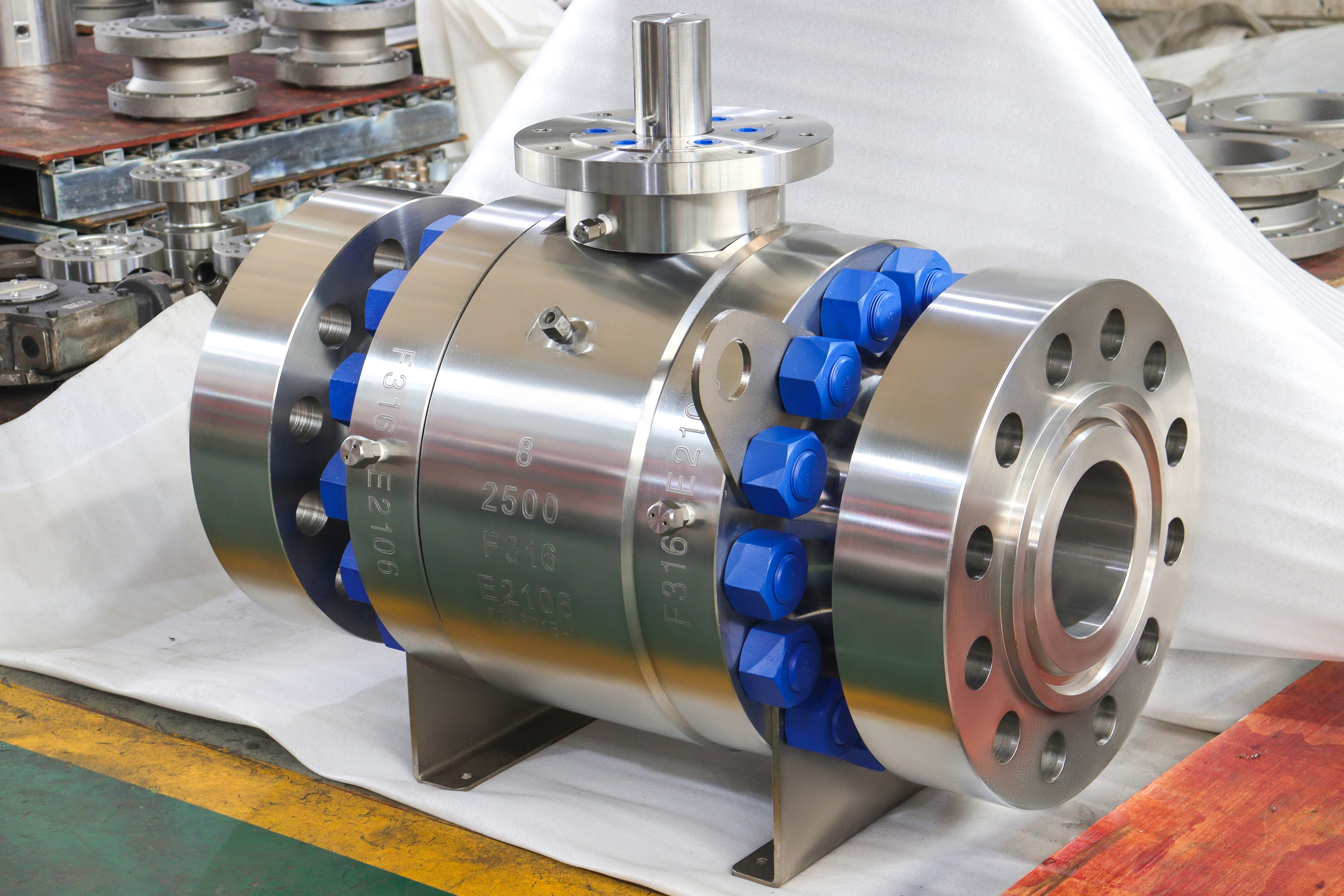
This is an eight inch valve at the top of the pressure range: DN200 bore, Class 2500, which API 6D writes as PN420. The body is forged austenitic stainless steel in three bolted pieces, the ends are ring type joint flanges to ASME B16.5, and the ball is carried on upper and lower trunnions running in bearings. It is supplied with a gearbox and a handwheel, and the same bonnet interface takes an actuator when the line is automated later.
The body grade is not a single answer. Both ASTM A182 F304 and A182 F316 are supplied in this body, and the difference between them is molybdenum: F316 carries two to three percent, F304 carries none. That single alloying element is what decides pitting and crevice corrosion resistance in chlorides, and at this size it also decides a real part of the price. Two to three percent of molybdenum is a small number with a large effect, and it is the only difference that matters between the two grades in this body.
So the honest version of the product name is the one written in the slug as a joined word, read as a choice rather than a grade. The page below sets out what the choice costs in both directions, and then covers the parts of a Class 2500 valve that are decided by the class rather than by the alloy: the wall, the ring joint flanges and the twelve stud holes that hold the joint closed.
Design and Construction
The ball is fixed between two trunnions and turns in place, so the pressure load goes into the bearings rather than into the seat. The seats move instead: each is a piston that line pressure pushes against the ball, and the seal is made where the seat face meets the ball. Because the ball does not move, the torque stays inside what a gearbox can deliver even at 2500 pounds.
The three piece body has two bolted joints, one either side of the centre section. Each is a thick ring closed on a metal ring gasket in a machined groove, and at Class 2500 the stud load that keeps that joint tight is substantial. The reward is access: the ball, the seats and the trunnion bearings come out with the valve still in the line, which is the reason a stainless body at this class is built in three pieces rather than welded.
The ring type joint is not a preference here. At Class 2500 and eight inch, a sheet or spiral wound gasket is not reliable, so the flange carries a groove and a metal ring sits in it, and the seal is metal to metal. That means the groove is a machined feature with a tolerance, it has to be protected in transit, and the ring is replaced every time the joint is opened.
Seat effect is chosen with the order, and at this class it is usually double piston effect so that both seats seal against pressure from either side. Single piston effect is available where the cavity has to vent upstream. The difference changes the seat parts and therefore the drawing, so it is not something to leave until the valve is on site and the procedure is being written.

Material Options
F304 is the lower cost of the two: eighteen chromium, eight nickel, no molybdenum, and adequate for water, most food and beverage duty, solvents and mildly corrosive chemicals. F316 adds molybdenum and is the choice wherever chlorides are present, including seawater-adjacent atmospheres, brine, many organic acids and most pharmaceutical process streams where cleaning agents contain chloride. Both are forged austenitic stainless and both are non magnetic, so they cannot be told apart by looking, by weighing or by a magnet.
The choice is not only about corrosion. At Class 2500 the body wall is thick, so the material is a meaningful part of the cost, and specifying F316 for a stream that does not need it is money spent on nothing. Specifying F304 for a stream that does need molybdenum is a valve that pits at a gasket face in two years. The medium decides, and the medium is a line on the enquiry form.
| Component | Standard Material | Optional Upgrade | Service Notes |
|---|---|---|---|
| Body and end caps | ASTM A182 F304 or F316 forged stainless | F316L | three pieces, two bolted joints |
| Ball | F316 with electroless nickel plating | cobalt alloy hardfacing, tungsten carbide | carried on trunnions |
| Trunnion and bearings | Surface hardened stainless | 17-4PH | takes the pressure load off the seats |
| Stem | F316 | 17-4PH, nickel alloy 718 | blowout proof, keyed to the ball |
| Seat ring | PEEK | RPTFE, polyamide, metal with flexible graphite | single or double piston effect |
| Body gasket | Ring type joint metal ring | F316L, soft iron, low carbon steel plated | new ring at every joint opening |
| Packing | PTFE V-ring | Flexible graphite | fire safe configuration |
| Body studs | ASTM A193 B8M with A194 8M nuts | B7 with A194 2H nuts | taken up in a cross pattern in stages |
| Operator | Worm gear with handwheel | pneumatic, electric, hydraulic | mounting flange and keyed stem |
Technical Specifications
The envelope is DN200, Class 2500, three piece body in forged F304 or F316, ring type joint flanges with twelve stud holes to ASME B16.5, face to face to ASME B16.10, and pressure testing to API 598 and API 6D. The stem is keyed to the ball, blowout proof and machined for a gearbox or an actuator at the top. The flange drilling, the ring joint groove and the face to face length are all fixed by the class and the size, so they are not choices the buyer has to make. Both grades are supplied with ring type joint flanged ends to ASME B16.5, so the flange and the joint ring are part of the envelope, not an accessory.
Four things have to be written down before the valve is built: the body grade, the bore, the seat compound and the operator. Each one changes parts rather than options, and the first one changes the certificate as well, because the certificate is issued against the heat that was cast and the grade on it has to match the grade on the order. Each of those four also appears on the general arrangement drawing, and the drawing is what the buyer signs before machining starts.
| Item | Value |
|---|---|
| Nominal size | 8 inch (DN200) |
| Pressure class | Class 2500 (PN420) |
| Body construction | three piece, two bolted joints |
| Ball support | trunnion mounted, upper and lower bearings |
| Body material | ASTM A182 F304 or F316 forged stainless steel |
| Body option | F316L |
| Grade difference | F316 carries molybdenum, F304 does not |
| Material group | ASME B16.34 group 3.1 austenitic |
| Rating at 38 C | Class 2500 = 425.5 bar |
| Temperature range | minus 254 to plus 538 C for group 3.1, derated with temperature |
| Ball | F316 with electroless nickel plating |
| Ball options | cobalt alloy hardfacing, tungsten carbide |
| Trunnion | surface hardened stainless |
| Trunnion option | 17-4PH |
| Stem | F316 |
| Stem options | 17-4PH, nickel alloy 718 |
| Seat | PEEK |
| Seat options | RPTFE, polyamide, metal with flexible graphite |
| Seat effect | double piston effect as standard, single on request |
| Body gasket | ring type joint metal ring |
| Body studs | ASTM A193 B8M with A194 8M nuts |
| Bore | full bore, DN200 |
| Flange bolting | twelve stud holes to ASME B16.5 Class 2500 |
| End connection | ring type joint flange to ASME B16.5 Class 2500 |
| Face to face | ASME B16.10 |
| Wall thickness | ASME B16.34 |
| Design standards | ASME B16.34, API 6D and API 608 |
| Pressure testing | API 598 and API 6D, shell and seat |
| Operator | worm gear with handwheel |
| Actuation options | pneumatic, electric, hydraulic |
| Marking | size, class, grade and heat number on the body and nameplate |
| Documentation | EN 10204 3.1, test record, general arrangement drawing |
Standards and Compliance
ASME B16.34 sets wall thickness and rating. Both F304 and F316 are austenitic stainless in material group 3.1, and Class 2500 corresponds to 425.5 bar at 38 degrees Celsius. The group table runs to 538 degrees, but the allowable stress falls as temperature rises, so the rating at the top of the table is not the rating at room temperature. Where the two grades differ is in the pressure temperature tables: the ratings at room temperature are the same, and the behaviour at high temperature is not.
API 6D covers the pipeline requirements, including cavity relief and the anti static provisions, and API 608 covers the ball valve details and the nameplate. The ring joint groove and the ring dimensions come from ASME B16.5, and the face to face from ASME B16.10. Where the project asks for fire survival, the test is to API 607 and the certificate is issued separately from the material certificate.
| Requirement | Standard | What J-VALVES Supplies |
|---|---|---|
| Wall thickness and rating | ASME B16.34 | group 3.1 austenitic, Class 2500 = 425.5 bar at 38 C |
| Pipeline valve requirements | API 6D | cavity relief, anti static, marking |
| Ball valve specifics | API 608 | blowout proof stem, nameplate content |
| Flanges and ring grooves | ASME B16.5 | Class 2500 ring type joint, twelve stud holes |
| Face to face | ASME B16.10 | long pattern for DN200 Class 2500 |
| Pressure testing | API 598 and API 6D | shell at 1.5 times, seat at 1.1 times |
| Fire safety where ordered | API 607 | fire test certificate |
| Material certificate | EN 10204 3.1 | grade and heat number stated, PMI on request |
Manufacturing Process
The three body parts start as A182 forgings in the grade ordered, are solution annealed and then machined. Because the two grades are visually identical, the heat number is the only thing that separates them on the shop floor, and it is stamped on each part before machining so that a mixed batch cannot happen quietly. That is a traceability control rather than a metallurgical one, and it matters more than it sounds.
The ball is machined, ground and lapped, then plated or hardfaced, and checked for roundness against the seat rings. Assembly is the centre section on stands, seats and trunnions in, ball lowered in, end caps on with new ring gaskets, studs taken up in a cross pattern in stages, then the stem and packing, the gearbox, and the travel stops set so the ball lands exactly on both seats.

Quality Control and Testing
Each heat is checked for composition and mechanical properties, and the certificate is issued against it. Where a customer wants proof that the valve in the crate is the grade on the paperwork, positive material identification is run on the finished parts and the result goes on the record, which is the only practical way to tell F304 from F316 once the valve is assembled.
Every valve is shell tested at one and a half times the rating and seat tested at one point one times to API 598 and API 6D, with both seats tested in both directions. The ring joint grooves are gauged, the flange drilling checked against ASME B16.5, and the breakaway torque measured with the gearbox fitted and recorded for actuator sizing. The torque figure is the one an actuator supplier will ask for first, and it cannot be calculated reliably from the bore and the class alone.
| Step | What Is Checked | Standard or Acceptance |
|---|---|---|
| Incoming forging | grade, composition, mechanical properties, ultrasonic testing | EN 10204 3.1 against A182 F304 or F316 |
| Grade separation | heat number stamped before machining, checked at assembly | no mixed heats in one valve |
| Machining | seat pocket squareness, joint face flatness and parallelism | drawing tolerance, measured on the face |
| Ring joint groove | groove width, depth, angle and finish | ASME B16.5 Class 2500 |
| Ball | roundness, finish, plating or hardfacing thickness | drawing range |
| Shell test | body and both joints at 1.5 times | API 598 and API 6D, no leak |
| Seat test | each seat in both directions at 1.1 times | API 598, no visible leak |
| Torque | breakaway and running torque with the gearbox fitted | recorded and issued for actuator sizing |

Applications and Industry Service
The duty is high pressure isolation in corrosive service: chemical injection and letdown, high pressure process lines in pharmaceutical and fine chemical plants, offshore topside systems where chloride stress and weight both count, gas conditioning and high pressure test loops. In most of these the valve is open or closed for long periods and moved only for isolation. The two applications that most often decide the grade are a chloride-containing cleaning cycle and a seawater-adjacent atmosphere, because both attack F304 at gaskets and crevices.
It is not a throttling valve, and at 2500 pounds a part open ball will damage its own seat in a short time. It is also not the right answer where the medium would attack both grades equally, because then the money spent on molybdenum is buying nothing and a nickel alloy or a duplex grade is the honest recommendation. Saying that plainly is more useful than selling a more expensive alloy to a line that does not need it.

Installation, Operation and Maintenance
Support the pipe on both sides and check that the flanges are parallel before the studs are drawn up, because a Class 2500 joint closed with the bolts is a bending load in a body stiff enough to crack rather than deflect. Ring joints take a new ring every time, the groove is cleaned and inspected, and the studs are lubricated and taken up in a cross pattern to the specified torque.
Operate through the gearbox and never with an extension bar. If the valve is stiff, the cause is usually trapped cavity pressure or a seat that has taken a set, and forcing it damages the stem key before it moves the ball. On a valve that is rarely cycled, work it through a full cycle on a schedule so the seat does not take a permanent set in one position.
How to Specify and Order
Write the size, the class, the body grade, the bore, the seat effect, the seat compound and the operator. A typical line reads: eight inch, Class 2500, body A182 F316, full bore, double piston effect seats, PEEK seat, ring type joint flanges to ASME B16.5, worm gear. If the grade is F304, write F304, because the two are not interchangeable on a certificate. If the project specification already names a grade, quote to it and do not substitute, because a substitution changes the certificate and the certificate is what the inspector reads.
Send the medium with its chloride content, the design temperature, and whether an actuator will follow. The chloride figure is what decides between the two grades, the temperature decides the seat, and the actuator decides the stem top and the mounting flange. All three are cheaper to settle on the enquiry than on the drawing revision. The same enquiry should say whether the valve will be pigged and whether the joint will be opened often, because those two answers decide the bore and the facing.
FAQ
Q: Is it F304 or F316?
A: It is whichever one the order says, and both are supplied in this body. The slug on this URL joins the two because the product family covers both, not because the valve is made of both. The difference is molybdenum: F316 has it, F304 does not. Send the medium and its chloride level, and the grade follows.
Q: When is F304 enough?
A: Where there are no chlorides and no strong acids: water, steam condensate inside the temperature band, solvents, food and beverage duty with chloride-free cleaning, and general chemical service that the project specification already accepts F304 for. It is a real saving at this class, because the body wall is thick and the material is a meaningful part of the price.
Q: When must it be F316?
A: Wherever chlorides are present, including seawater-adjacent atmospheres, brine lines, many organic acids, and process streams where chloride-containing cleaning agents are used. F304 pits and suffers crevice corrosion under gaskets in those conditions, and the failure usually appears at a flange face rather than in the open bore, which is why it is often mistaken for a gasket problem at first.
Q: What is special about the flanges at this class?
A: They are ring type joint: a metal ring sits in a machined groove and the seal is metal to metal, with twelve stud holes on the eight inch Class 2500 pattern. A raised face with a soft gasket is not reliable at this pressure and diameter. The groove is a tolerance feature, it has to be protected until installation, and a new ring goes in every time the joint is opened.
Q: Full bore or reduced bore?
A: This build is full bore at DN200. A reduced bore version exists in the same body and is written as a size pair; it cuts the ball, the seat and the torque, and it costs less. It will not pass a pig, and it cannot be converted into a full bore valve later, so the choice belongs with the line design rather than with the purchasing department.
Q: Can it be actuated?
A: Yes. The stem top is keyed and the bonnet carries a mounting flange, so a pneumatic, electric or hydraulic actuator mounts in place of the gearbox. Give the actuator supplier the measured torque from the test record rather than an estimate, because at Class 2500 the difference between an estimate and a measurement is enough to undersize a cylinder.


Hot Products


News
Ball Valves in A Kraft Pulp Mill: Black Liquor, Green Liquor And The Cost of Choosing The Alloy by Habit
White liquor at pH 14 cracks carbon steel welds, black liquor sets solid below 100 C, green liquor dregs grind seats: alloy choice and torque in a kraft mill.
Read More
Slug Flow And Ball Valves: What Actually Arrives At The Seat
A slug is liquid mass with momentum, not a pressure spike. What changes at the seat, in the cavity and at the actuator when liquid reaches a ball valve.
Read More
Ball Valves in Direct Lithium Extraction: PH 1 Eluate, Gypsum Scale And 438,000 Cycles in Twenty-Five Years
Direct lithium extraction swings valves from pH 1 eluate to pH 12 caustic, 48 column switches a day and gypsum scale. Materials, seats and torque.
Read More
Ball Valves in Geothermal Brine: Silica Scale, Chloride Cracking And The Cooling Trap
Why geothermal brine destroys ball valves: retrograde silica scale, calcite at the flash point, chloride cracking above 60 C and the 250 C seat limit.
Read More