


CHINA J-VALVES Offers Various High-quality I ndustrial Ball Valves
J-VALVES, a distinguished professional ball valve manufacturer rooted in China, takes pride in its extensive product portfolio. Our offerings span a wide range, including trunnion-mounted ball valves, floating ball valves, high-temperature ball valves, high-pressure ball valves, metal-sealed ball valves, ultra-low temperature ball valves, DBB ball valves, Three-way And Four-way Ball Valve, and fully welded ball valves. Each product is a testament to our commitment to precision engineering and reliable performance. Meticulously crafted, they are designed to not only meet but exceed the most stringent industrial demands, ensuring stable operation even under extreme conditions. This enables us to provide our clients with high-value services and makes our valves widely sought-after in industries.
Product Category
Contact Us

Pressure Class:ASME Class 150 to 600 / PN16 to PN40 / JIS 10K to 20K
Body Construction:Two piece and three piece
Body Material:CF8M, CF8, CF3M, WCB, A105, duplex 2205
Ball:CF8M or F316, mirror polished, ENP optional
Seat:PTFE, RPTFE, PPL, PEEK
Bore:Full port standard, reduced port on request
Flange Standard:ASME B16.5, EN 1092-1, JIS B2220
Facing:RF, FF, RTJ
Face to Face:ASME B16.10 long pattern, EN 558
Mounting Pad:ISO 5211 F03 to F12, high pad on request
Design Standard:API 608, ASME B16.34, EN 13709
Test Standard:API 598, EN 12266-1
Operation:Lever, gear, pneumatic or electric actuator
-
Q41F-16P
-
J-VALVES
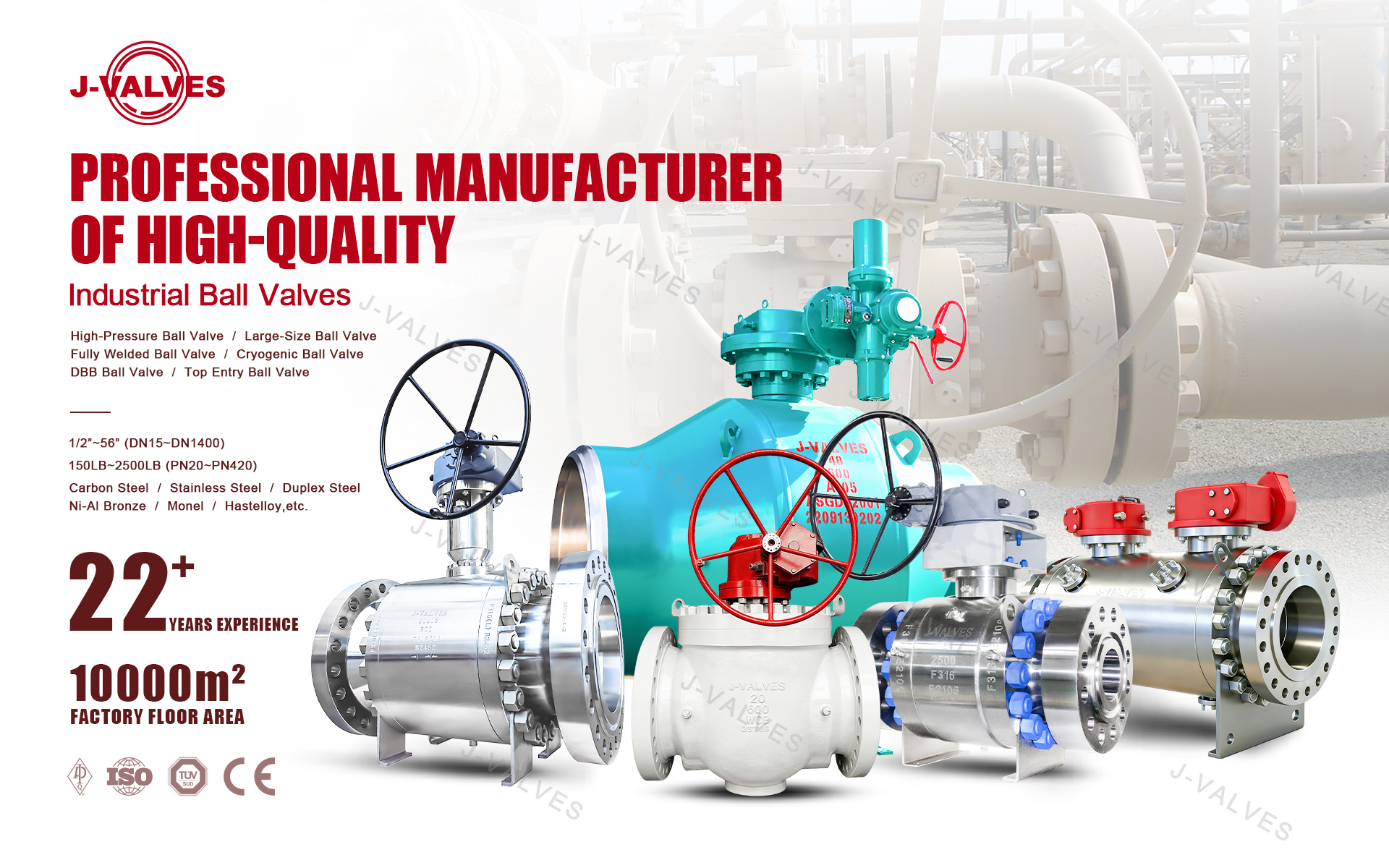
A flange ball valve is a quarter-turn isolation valve whose body ends in flanges drilled to a named standard, so it can be bolted into a line and removed again without cutting pipe. It is the default choice from 2 inch upward in water, chemical and utility service, and it is the only practical choice where an actuator has to be hung on top, because the flange pair carries the bending moment that a threaded joint cannot.
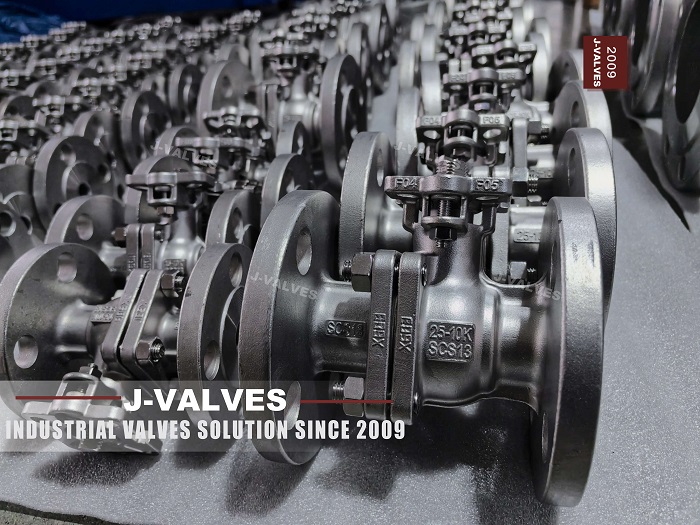
J-VALVES builds these valves from 1/2 inch to 8 inch in Class 150 to 600 and PN16 to PN40, in two piece and three piece bodies, with CF8M, CF8, CF3M, WCB and duplex bodies. Almost every enquiry that goes wrong goes wrong on one of two points: the flange does not match the pipe, or the floating design has been asked to do a job that needs a trunnion. This page deals with both, in that order.
What the Flange Buys You, and What It Costs
A threaded joint seals on a taper or on a face, and it seals once. Every time you break it, the seal is remade by a different mechanism, with tape or paste, by whoever is on shift. A flanged joint seals on a gasket compressed between two machined faces by a known bolt load, and it can be remade to the same condition with a torque wrench. That repeatability, not the pressure rating, is what you are paying for.
The flange also does three structural jobs. It spreads the bolt load over the full face instead of concentrating it on a few threads. It carries the bending moment from the pipe and from the weight of an actuator. And it lets a large valve be dropped out of a line as a unit, which matters when the valve weighs more than two people can lift in a confined space.
The cost is a second casting, two faces to machine and drill, a body gasket and a set of bolts. It is also a commitment: the body pattern is drilled for one standard, so a single valve cannot serve an ASME project and an EN project at the same time.

The Four Numbers That Decide Whether It Bolts Up
Buyers compare pressure ratings and assume the joint follows. It does not. Four dimensions have to match, and only one of them is the rating.
| Dimension | What it is | What happens if it is wrong |
|---|---|---|
| Flange standard | ASME B16.5, EN 1092-1, JIS B2220, or a project spec | Bolt holes are in the wrong place. Nothing else can fix it. |
| Bolt circle and hole count | PCD, number of bolts, thread and size | Holes line up but bolts do not pass, or the flange will not seat flat. |
| Facing | RF, FF or RTJ, plus the finish | Gasket crushes unevenly, joint weeps at the first thermal cycle. |
| Face to face | ASME B16.10, EN 558, JIS B2002 | Valve does not fit the gap; the spool has to be remade. |
The trap is that Class and PN look equivalent and are not. A 4 inch Class 150 flange has a 190.5 mm bolt circle with eight 5/8 inch bolts. A DN100 PN16 flange has a 180 mm bolt circle with eight M16 bolts. Both are rated around 16 to 20 bar, both are called "four inch", and they will not bolt together. The same is true of JIS 10K, which is a 155 mm bolt circle on a DN50 body against 152.4 mm for Class 150 — close enough to look right in a photograph, far enough to fail on site.
| Nominal size | Class 150 B16.5 | PN16 EN 1092-1 | 10K JIS B2220 |
|---|---|---|---|
| DN50 / 2 inch | OD 152.4, PCD 120.7, 4 × 5/8 in | OD 165, PCD 125, 4 × M16 | OD 155, PCD 120, 4 × M16 |
| DN80 / 3 inch | OD 190.5, PCD 152.4, 4 × 5/8 in | OD 200, PCD 160, 8 × M16 | OD 185, PCD 150, 8 × M16 |
| DN100 / 4 inch | OD 228.6, PCD 190.5, 8 × 5/8 in | OD 220, PCD 180, 8 × M16 | OD 210, PCD 175, 8 × M16 |
Read the third row twice. Three flanges, all described as four inch, three different bolt circles, and the bolt count on the 3 inch line changes between systems. This is the single most common reason a valve is returned.

Facing: Where the Seal Actually Happens
| Facing | Geometry | Gasket | Where it belongs |
|---|---|---|---|
| RF, raised face | Annulus about 2 mm high inside the bolt circle | Spiral wound, graphite, PTFE envelope | Default to Class 600 in steel pipe |
| FF, flat face | Full face, no raised annulus | Full face sheet or ring | Cast iron and non-metallic mating flanges, low pressure |
| RTJ, ring joint | Machined groove, metal ring gasket | Soft iron, soft steel, 316 ring | Class 900 and above, hydrogen, severe thermal cycling |
The raised face works because it concentrates the available bolt load on a small area, which raises gasket stress without raising bolt size. That is also its weakness: the annulus is exposed to the fluid and to atmosphere, so a stainless raised face in seawater service will crevice corrode at the gasket line. A flat face with a full face gasket protects the flange but needs more bolt load for the same seal.
Ring joint is a different mechanism. The seal is metal on metal, formed by a ring crushed into a groove, and it survives temperatures and pressure cycling that would relax any soft gasket. It is also unforgiving: a scratched groove leaks, and the ring is single use.

Where Floating Stops Working
A floating ball valve seals because line pressure pushes the ball into the downstream seat. The force is pressure times the area inside the seat contact line, so it grows with both size and class, and it cannot be capped. Past roughly 150 kN the seat is being squeezed beyond its elastic limit, the operating torque becomes too high for a lever, and the stem has to grow to transmit it.
| Size | Floating is sensible to | Above that |
|---|---|---|
| 2 inch | Class 1500 | Gear operator, larger stem |
| 3 inch | Class 900 | Trunnion from Class 1500 |
| 4 inch | Class 600 | Trunnion from Class 900 |
| 6 inch | Class 300 | Trunnion from Class 600 |
| 8 inch | Class 150 | Trunnion from Class 300 |
The table is a rule of thumb, not a standard. What it tells you is that "8 inch Class 300 flange ball valve" is a legitimate enquiry and "8 inch Class 600 floating" is a valve that exists in catalogues and should not exist in a line. If the datasheet asks for the second, the answer is a trunnion valve with the same face to face, not a bigger lever.

Specification Checklist
Five lines decide whether the quotation comes back comparable.
Size and class, in the units the project uses, with the DN equivalent in brackets so nobody converts wrongly.
Flange standard and facing, not just "flanged". B16.5 RF and EN 1092-1 RF are different products.
Face to face, especially on a replacement or where insulation has to run continuously across the body.
Body and trim material, plus the seat material separately, because the seat sets the temperature limit, not the body.
Test standard and certificate, API 598 against EN 12266-1, and whether an EN 10204 3.1 certificate is needed.
Add the fluid, the operating temperature, whether the valve is cycled daily or left open for a year, and whether an actuator will be fitted later. Those four answers change the seat, the stem, the packing and whether a mounting pad should be cast in from the start — retrofitting a pad is not possible on a finished body.
Flange Ball Valve FAQ
Will a PN16 flange bolt to a Class 150 flange?
No. The pressure ratings are close but the bolt circles are not. A 4 inch Class 150 flange to ASME B16.5 has a 190.5 mm bolt circle with eight 5/8 inch bolts; a DN100 PN16 flange to EN 1092-1 has a 180 mm bolt circle with eight M16 bolts. The 10.5 mm difference means the holes will not line up, and no gasket corrects it. The two systems need an adapter flange or a valve built to the matching standard.
Which facing should I specify, RF, FF or RTJ?
Raised face for most process duty to Class 600, because the raised annulus concentrates bolt load on a small area and seals with a spiral wound or graphite gasket. Flat face where the mating flange is cast iron or where the flange is non-metallic, since a raised face would crack it. Ring joint above Class 900, in hydrogen service, and wherever the specification calls for a metal-to-metal gasket, because a groove and a steel ring survive thermal cycling that relaxes a soft gasket.
At what size does a floating ball valve stop being the right choice?
It is a product of size and class rather than either alone. As a working rule a floating design holds to about 150 kN of seat thrust, which covers 8 inch at Class 150, 6 inch at Class 300, 4 inch at Class 600 and 3 inch at Class 900. Beyond the combination the operating torque becomes unmanageable by hand and the seat creeps, so the valve moves to a trunnion mounted design. An 8 inch Class 600 floating valve is catalogued by many suppliers but is not a good engineering choice.
Why does a flanged valve cost more than the same size threaded valve?
Two castings instead of one, two flange faces to machine and drill, a body gasket, and a set of bolts. The flange also has to be drilled to a specific standard, so one body pattern cannot serve ASME, EN and JIS customers. The premium buys you removal without cutting pipe, a joint that can carry bending load from the pipe, and the ability to hang an actuator on top without the pipe taking the torque.
Can the valve be installed with the stem pointing down?
It can be, and it should not be. With the stem down the body cavity becomes a trap for debris and, in liquid service, for the liquid itself; the packing sits at the lowest point where any leakage collects, and on a vertical line the weight of the ball and stem works against the seat. Stem up or horizontal is normal. Horizontal is preferred on large valves where a vertical stem would put the operator above head height.
What is the difference between a flange ball valve and a flanged butterfly valve in the same line?
Face to face and torque. A ball valve to ASME B16.10 is much longer than a butterfly valve to API 609, so they are not interchangeable in an existing spool; a wafer butterfly also relies on the mating flanges for its own body strength, while a ball valve is self-contained. The ball valve gives bubble tight shutoff in both directions and a piggable bore, which is why it is used at battery limits and for positive isolation.
Hot Products


News
Ball Valves On A Bottom Loading Gantry: Creep, Dry Break And The Test That Proves Neither
A loading gantry cycles a ball valve far more than it is designed for and still cannot prove shut-off. Where creep starts, and what to specify.
Read More
Lined Ball Valves in Acid Service: The Liner Does Not Fail, The Steel Behind It Does
The valve came out of the line looking better than most valves that come out of a hydrochloric acid line. Three inch, PFA lined, cast body, Class 150, fourteen months in service on a 32 percent acid transfer duty at 55 to 60 degrees C, about forty open and close cycles a week. The paint was intact.
Read More
Ball Valves in Amine CO2 Capture: Heat Stable Salts, Rich Amine, And The Three Places The Body Thins
Rich amine at 110 C with heat stable salts is where capture plant ball valves fail. Materials, velocity limits, cavity gas and seat choice, with numbers.
Read More
Fail-Safe Ball Valve Actuators: Spring Return, Stored Air, And The Torque Nobody Checks
Spring return or stored air? The answer is a torque curve, not a datasheet box. Sizing, receiver volume, closing time and four silent failures.
Read More