


CHINA J-VALVES Offers Various High-quality I ndustrial Ball Valves
J-VALVES, a distinguished professional ball valve manufacturer rooted in China, takes pride in its extensive product portfolio. Our offerings span a wide range, including trunnion-mounted ball valves, floating ball valves, high-temperature ball valves, high-pressure ball valves, metal-sealed ball valves, ultra-low temperature ball valves, DBB ball valves, Three-way And Four-way Ball Valve, and fully welded ball valves. Each product is a testament to our commitment to precision engineering and reliable performance. Meticulously crafted, they are designed to not only meet but exceed the most stringent industrial demands, ensuring stable operation even under extreme conditions. This enables us to provide our clients with high-value services and makes our valves widely sought-after in industries.
Product Category
Contact Us


-
J-VALVES-Q47F
-
J-VALVES
Overview of the J-VALVES Three Piece Stainless Steel Metal Sealed Flange Ball Valve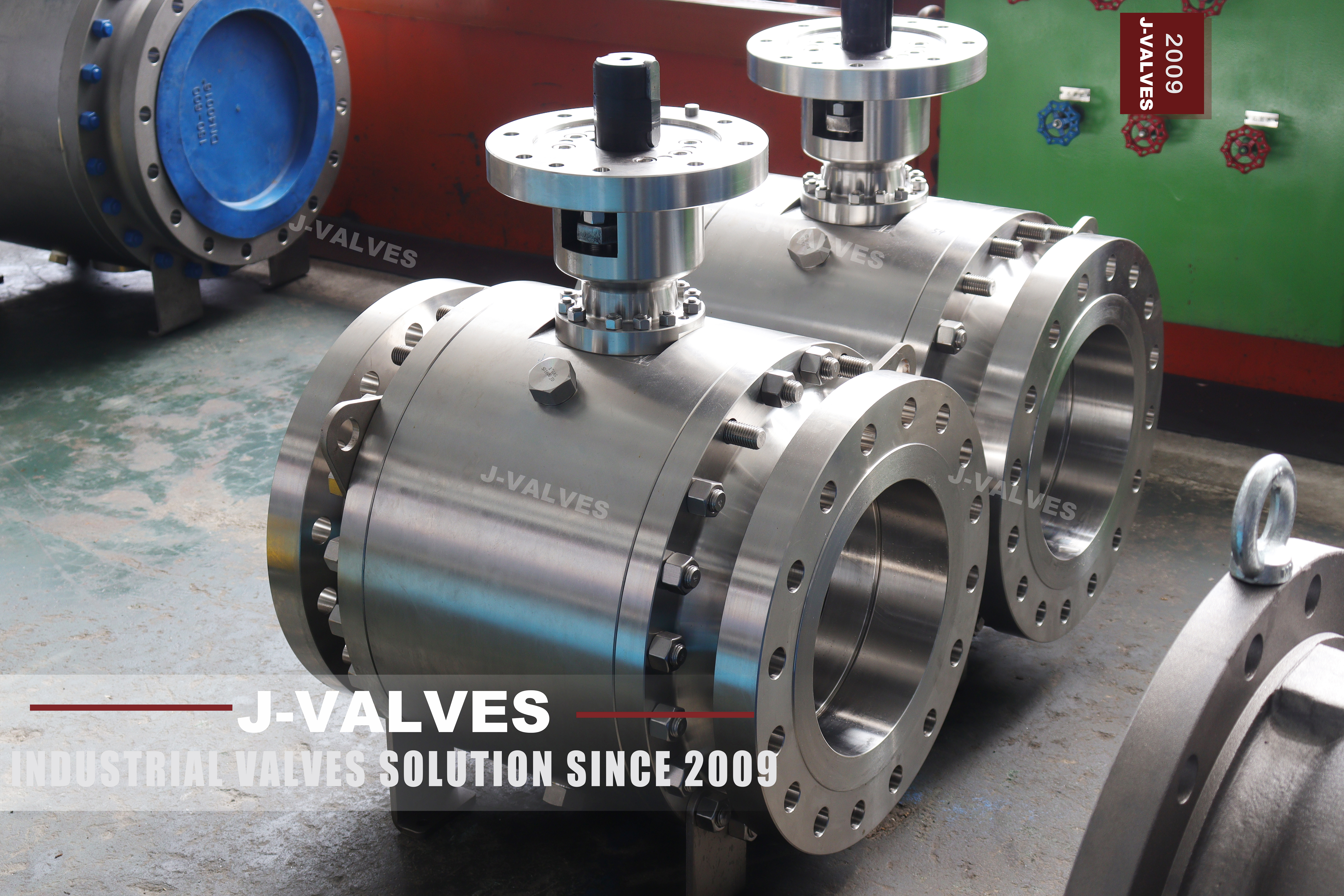
A page that lists two to twenty four inch and one hundred and fifty to twenty five hundred pound looks like a grid, and readers treat it as one. Pick a size, pick a class, place the order. The trouble is that the two ranges are bounded by different things: the size ceiling is set by how much seat area has to be pressed against the ball and how much torque that takes to turn, while the pressure ceiling is set by the contact stress the seat pair can survive. They are independent, so the corner of the grid is not a product.
Metal seats make that independence sharper than soft seats do, because a soft seat conforms and a metal one does not. The seal depends on two hard surfaces meeting closely enough, with a hardness difference so that one wears and the other does not. Everything else on this page follows from that: the torque, the leakage acceptance, and the fact that the size and the class have to be checked separately rather than multiplied.
Design and Construction
Three sections, two bolted joints, and the middle section carries the ball and both seat rings out when the studs are released. That is the reason to take this body style with a metal seat in particular, because a metal seat is the part that wears and the part that has to be replaced; a body that cannot give access to it has no advantage over a welded one except in the first year.
The seat pair is a ring of hard material against a ball that is either hardened or coated, and the two are chosen as a pair rather than separately. If both are the same hardness the two surfaces polish each other and neither beds in; if the difference is too great the softer one wears through. The ball is carried on trunnions at the sizes where the seat load would otherwise have to be turned by the operator, which is most of the range on this page.

Material Options
The body is stainless, and the code is whatever the order states, with the plate carrying that code rather than a mill designation. The stainless body is not the reason the valve is metal seated; the two choices are made separately, and a customer can have a stainless body with a soft seat or a carbon steel body with a metal seat. Both are valid and they solve different problems.
The seat pair is where the material decision actually sits. The ring and the ball surface are chosen together for the medium, the temperature and the solids, and the order should name the pair rather than only one half of it. Where the medium is abrasive, the pair is chosen for wear; where it is hot, for strength at temperature; and where it is both, the pair is the compromise the application has to accept.
| Component | Standard Material | Optional Upgrade | Service Notes |
|---|---|---|---|
| Body | stainless steel, code as stamped | other alloys on order | three sections, two bolted joints |
| Ball | hardened or hard faced | paired with the seat ring | finish is half the seal |
| Seat ring | hard faced metal | chosen as a pair with the ball | wears, and is replaceable |
| Seat pair | hardness difference between ring and ball | stated on the order | without it the two polish each other |
| Trunnion | surface hardened, or 17-4PH | named on the order | takes the seat load at large sizes |
| Body joints | two gasketed studded joints | not offered as a welded body | access to the seat pair |
| End facing | ASME B16.5 or EN 1092-1 | chosen at order | two flange systems, one rating |
| Operator | lever at the small end, gear above it | actuator on request | torque decides, not size |
Technical Specifications
The size range on this page runs from two inch to twenty four inch and the class range from 150 to 2500, and neither is a promise about the other. At the large end the seat ring is a wide annulus and the force needed to press it against the ball grows with the area, so the operator becomes a gear and the body becomes a trunnion body. At the small end the ring is narrow, the torque is manageable by hand, and the limit is the contact stress rather than the drive.
Face to face follows ASME B16.10 for a flanged valve of the size and class ordered, the flange follows ASME B16.5 or EN 1092-1 as stated, and the actual dimensions of a build are on the signed general arrangement drawing. No torque figure is printed here, because the torque of a metal seated valve depends on the seat pair and the medium and is quoted with the drawing for the size ordered.
| Item | Value |
|---|---|
| Body style | three piece, two gasketed body joints |
| Seat type | metal seated, hard faced ring against a hardened ball |
| Seat pair | hardness difference stated on the order |
| Size range | two inch to twenty four inch, per the catalogue |
| Class range | 150 to 2500, per the catalogue |
| Size ceiling driver | seat ring area and the torque to turn against it |
| Pressure ceiling driver | contact stress the seat pair can take |
| Body material | stainless steel, code as stamped |
| Ball material | hardened or hard faced, paired with the ring |
| Trunnion | fitted where the seat load needs it |
| End connection | ASME B16.5 or EN 1092-1, stated on the order |
| Face to face | dimension on the signed GA drawing, held to ASME B16.10 |
| Design standard | ASME B16.34, and API 6D where ordered |
| Test standard | API 598 shell and seat test |
| Test pressure | shell 1.5 times and seat 1.1 times the class rating |
| Seat acceptance | a leakage rate class, not zero leakage |
| Temperature range | per the seat pair and the body code, stated on the order |
| Torque | measured at test and quoted with the drawing |
| Operator | lever at the small end, worm gear above it |
| Marking | size, class, body code, heat number |
| Documentation | EN 10204 3.1 on request |
| Weight | quoted with the drawing for the size and trim ordered |
| Range page note | size and class are independent limits, not a grid |
Standards and Compliance
ASME B16.34 sets the wall and the rating; API 6D adds the pipeline requirements where the valve is ordered to it. The standard that actually decides whether a metal seated valve is acceptable is the leakage one, and that is a rate class rather than a rule: ISO 5208 and API 598 each define acceptance rates, and a metal seat is judged against a rate because it cannot be judged against zero.
This is the sentence that causes the most argument at the desk. A quotation that promises zero leakage on a metal seat is either quoting a soft seat or has not read the rate table. The honest order says which rate class is required, at which differential, in which direction, because a metal seat can pass one class in one direction and a different one in the other.
| Requirement | Standard | What J-VALVES Supplies |
|---|---|---|
| Pressure boundary | ASME B16.34 | minimum wall and the rating for the alloy group |
| Pipeline valve | API 6D | design, testing, marking and documentation where ordered |
| Seat acceptance | API 598 and ISO 5208 | a rate class, not zero leakage |
| Shell and seat test | API 598 | 1.5 times the rating for the shell, 1.1 times for the seat |
| Flange pattern | ASME B16.5 or EN 1092-1 | stated separately from the rating |
| Face to face | ASME B16.10 | flanged valve length for the size and class |
| Pressure code | API 6D clause 7.2 | PN and Class are two notations of one rating |
| Marking | API 6D | size, class, body code, heat number |
| Documentation | EN 10204 3.1 | issued against the heat number on request |
Manufacturing Process
The body sections are machined and the seat pockets are cut to take a ring that is harder than the body, so the pocket dimension is held to the ring rather than to the body bore. The ball is machined, then surfaced, then finished, and the finish on the ball is the other half of the seal: a metal seat against a rough ball will pass a rate test once and fail it after a hundred cycles.
The hard facing is applied before final grinding, so that the finished surface is the applied material rather than the base metal with a coating on it. After assembly the valve is cycled enough times to bed the pair before it is tested, because a metal seat that has not been bedded reads high on torque and poor on leakage in the same test. The bedding is part of the build, not part of the customer acceptance.

Quality Control and Testing
The shell test is at one and a half times the rating and the seat test at one and one tenth times, both in the directions the order names, with the acceptance taken from the rate class rather than from a visual judgement. On a metal seat the seat test is the one that decides, and it is done after bedding so that the figure reported is the figure the valve will hold in service rather than the figure it held on the day it was assembled.
The torque is measured and recorded rather than felt, because on a metal seated valve the torque is the number that tells the operator whether the valve is still serviceable. A torque that has risen against the figure on the drawing means the pair has worn or the medium has deposited on the seat, and that is information worth having before the valve fails to close rather than after.
| Step | What Is Checked | Standard or Acceptance |
|---|---|---|
| Body sections | code, heat number, certificate | checked against the stamped code |
| Seat pocket | held to the ring, not to the bore | the ring decides the pocket |
| Ball finish | surface finish before assembly | a rough ball fails a rate test after cycling |
| Hard facing | applied before final grinding | the finished surface is the applied material |
| Bedding | cycled until the pair seats | before the acceptance test |
| Shell test | wall and both joints | API 598 at 1.5 times the rating |
| Seat test | rate class, both directions, differential named | API 598 or ISO 5208 |
| Torque | measured and recorded against the drawing | the number that predicts wear |

Applications and Industry Service
Metal seats are for the services where a soft seat cannot survive: high temperature, abrasive solids, and media that attack the polymer. Steam, hot oil, slurries, catalyst lines and abrasive powders are the usual list. In those services the valve is chosen for the seat pair and the body is chosen for the medium, and the class is whatever the line needs rather than something the seat decides.
The valve is the wrong choice where tight shutoff matters more than temperature, because a soft seat is tighter, and where the medium is clean and cool, because there is nothing for the metal seat to buy. It is also the wrong choice where the operator is infrequent and weak, because the torque of a metal seat is higher than a soft seat of the same size and that is a fact of the design rather than a defect to be corrected.

Installation, Operation and Maintenance
Install with the seat pair protected: a metal seat is a precision surface and grit left in the line during construction will score it on the first closing. Flush the line before the valve is operated, or fit a strainer upstream for the commissioning period, and remove it afterwards. The valve is mounted so the cavity can drain if the medium is a slurry, because a cavity that packs will hold the ball off its seat.
Maintenance is the middle section out and the seat rings replaced as a pair, since replacing one half of a worn pair puts a new surface against an old one and the old one becomes the wear part. The ball is inspected at the same time, and a ball that has lost its finish is resurfaced or replaced rather than polished by hand. After reassembly the seat test is repeated against the same rate class the valve was accepted to.
How to Specify and Order
The order needs size, class, body style, body code, seat pair, end facing, operator, and the leakage rate class with the differential and the direction. The last item is the one that separates a metal seated order from a soft seated one, and it is the one most often left as the word tight. Tight is not a class, and a valve accepted against a vague word is a valve that will be argued about on site.
Because the size and the class on a range page are independent, the order should state both explicitly rather than naming a model that implies them. The drawing then carries the face to face, the flange pattern, the torque and the rate class, and the certificate carries the body code and the heat. Those three documents are what a maintenance crew will still have when the valve is opened years later.
FAQ
Q: Can I order any size in any class on this page?
A: Not necessarily, and the page cannot tell you which corners exist because the two ranges are bounded by different things. The size ceiling comes from the seat ring area and the torque needed to turn the ball against it; the pressure ceiling comes from the contact stress the seat pair can take. Ask for the size and the class together and the answer will be specific to that combination.
Q: Does a metal seated valve seal tight?
A: It seals to a rate class, not to zero. Metal surfaces do not conform the way a polymer does, so the acceptance is defined as a leakage rate at a stated differential in a stated direction, under API 598 or ISO 5208. A quotation that promises zero leakage on a metal seat is either quoting a soft seat or has not read the rate table.
Q: Why is the torque higher than a soft seated valve?
A: Because the seal depends on pressing two hard surfaces together rather than on a polymer deforming into the surface. That takes more force, and the force is what the operator has to overcome. It is a property of the design rather than a fault, and it is why the operator changes from a lever to a gear earlier on a metal seated valve than on a soft seated one of the same size.
Q: What decides the hardness of the seat pair?
A: The application, and the two halves are chosen together. If the ring and the ball are the same hardness they polish each other and neither beds in; if the difference is too great the softer one wears through. The pair is named on the order, and it is the seat pair rather than the body material that decides how long the valve holds its rate class.
Q: Is this valve suitable for steam?
A: Yes, and steam is one of the services it is for, along with hot oil, slurries and abrasive media. What has to be checked is the temperature against the seat pair rather than against the body code, because the body can be well inside its limit while the seat pair is at the edge of its own. The order should state the temperature and the medium, not only the class.
Q: Why does the page give a range instead of one size?
A: Because it is a range page rather than a single valve: it describes a family that is built across a size and class span. What it cannot do is tell you that every size exists in every class. For a real order, state the size, the class, the seat pair and the rate class, and the drawing that comes back is the specification of the valve you are buying.


Hot Products


News
Ball Valves in Amine CO2 Capture: Heat Stable Salts, Rich Amine, And The Three Places The Body Thins
Rich amine at 110 C with heat stable salts is where capture plant ball valves fail. Materials, velocity limits, cavity gas and seat choice, with numbers.
Read More
Fail-Safe Ball Valve Actuators: Spring Return, Stored Air, And The Torque Nobody Checks
Spring return or stored air? The answer is a torque curve, not a datasheet box. Sizing, receiver volume, closing time and four silent failures.
Read More
Ball Valve Stem Leak: The Gland, The Backseat And The Repair That Cannot Be Done Live
A stem leak on a quarter turn valve is four different failures. What gland tightening buys you, why the backseat is usually absent, and what needs a shutdown.
Read More
Ball Valves in A Kraft Pulp Mill: Black Liquor, Green Liquor And The Cost of Choosing The Alloy by Habit
White liquor at pH 14 cracks carbon steel welds, black liquor sets solid below 100 C, green liquor dregs grind seats: alloy choice and torque in a kraft mill.
Read More