

CHINA J-VALVES Offers Various High-quality I ndustrial Ball Valves
J-VALVES, a distinguished professional ball valve manufacturer rooted in China, takes pride in its extensive product portfolio. Our offerings span a wide range, including trunnion-mounted ball valves, floating ball valves, high-temperature ball valves, high-pressure ball valves, metal-sealed ball valves, ultra-low temperature ball valves, DBB ball valves, Three-way And Four-way Ball Valve, and fully welded ball valves. Each product is a testament to our commitment to precision engineering and reliable performance. Meticulously crafted, they are designed to not only meet but exceed the most stringent industrial demands, ensuring stable operation even under extreme conditions. This enables us to provide our clients with high-value services and makes our valves widely sought-after in industries.
Product Category
Contact Us


Pressure Class:ASME Class 150 (300 and 600 on request)
Fire Test:API 607 6th edition, ISO 10497
Body Material:Stainless steel CF8M, CF8, CF3M; carbon steel WCB
Ball:CF8M or F316, mirror polished, ENP optional
Ball Type:Floating, two piece body
Seat:PTFE or RPTFE primary, metal secondary seat
Packing:Flexible graphite, live loaded optional
Body Gasket:Spiral wound 316L with graphite filler
Stem:F316, blowout proof, anti-static
Design Standard:API 608, ASME B16.34
Mounting Pad:ISO 5211 high mounting pad, F04 to F12
Flange Standard:ASME B16.5 RF or RTJ
Test Standard:API 598, plus post-fire test to API 607
Certificate:EN 10204 3.1, fire test report by serial number
-
Q41F-150LB
-
J-VALVES
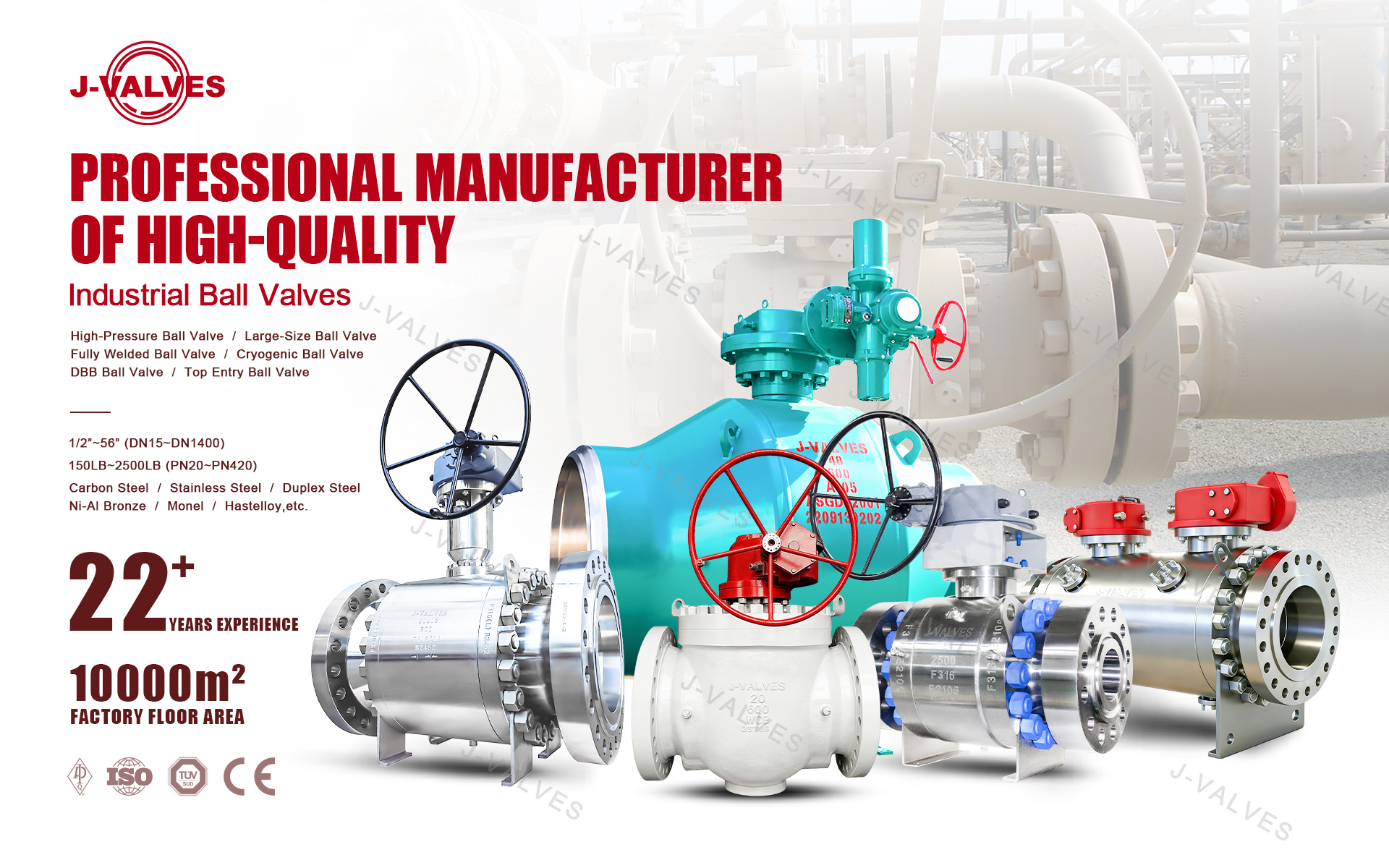
A fire safe flange ball valve is a valve that keeps a defined seal after being exposed to a fire, because its soft parts are backed by metal and its sealing materials are graphite rather than polymer. The claim is proved by test to API 607 or ISO 10497: 30 minutes in a pool fire at roughly 760 to 980 °C, then cool down, then a pressure test on a valve whose seat has been destroyed.
J-VALVES builds them from 1/2 inch to 8 inch in Class 150, with 300 and 600 on request, in CF8M, CF8, CF3M and WCB, with a PTFE primary seat and a metal secondary seat, graphite packing and a graphite-filled spiral wound body gasket. They are specified in refineries, LPG terminals, loading arms and anywhere the fluid will burn. This page is about what the certificate actually means, because a fire safe claim that has not been tested is worse than no claim at all: it puts a hazard on a drawing that nobody verifies.
The Test, Step by Step
The procedure is short and unambiguous, which is why it is a good purchase criterion.
| Step | What happens | What is measured |
|---|---|---|
| 1 | Valve closed, filled with water, pressurised to the rated pressure | Baseline seat and shell tightness |
| 2 | Pool fire, 760 to 980 °C flame, 30 minutes | Body temperature, minimum 650 °C reached |
| 3 | Fire out, valve cooled in air | Nothing; the valve is not touched |
| 4 | Shell test at rated pressure | No structural failure, no external leak |
| 5 | Seat test at rated pressure | Leakage below the limit for that size |
Two details are worth understanding. The valve is not operated between the fire and the test, so a valve that only seals after being cycled does not pass. And the test medium is water at ambient, which is the easiest fluid to seal; a valve that leaks on water after the fire will leak on gas much sooner, which is why some project specifications add a nitrogen test on top.

What Is Actually Left Sealing
A soft seated ball valve seals because a PTFE ring is pressed against a polished ball. At 300 °C that ring is gone. Three features take over, and a valve needs all three.
The secondary seat. The PTFE seat sits in a metal carrier, and the carrier face is machined to the same spherical radius as the ball, slightly behind the polymer. When the polymer burns away, line pressure pushes the ball back onto that metal face. Ni55 or Ni60 hardfacing is used on the carrier where the duty is abrasive or where the ball is stainless, so the face does not gall.
The packing. Flexible graphite rings replace PTFE. Graphite does not melt, does not burn in the absence of sustained oxygen, and expands slightly when heated, which maintains gland load instead of losing it. A graphite packing with a sacrificial PTFE ring on top is common: the PTFE gives low-friction sealing in normal service, the graphite survives the fire.
The body joint. A spiral wound gasket with a graphite filler, on a 316L winding, keeps its resilience at 650 °C. A PTFE flat gasket in the same joint will flow out and the joint will leak. This is where cheap fire safe claims fail: the seat is upgraded, the gasket is not.
Class 150 and the Temperature You Actually Get
150 LB is 19.6 bar at 38 °C for the austenitic group, about 285 psi. That figure falls with temperature, and the practical number at 200 °C is closer to 16 bar. The class is a pressure boundary statement and says nothing about whether the seat will still be there.
| Service | Body class | Seat | Fire safe |
|---|---|---|---|
| Cooling water, ambient | 150 | RPTFE | Not normally specified |
| Hydrocarbon liquid, ambient | 150 or 300 | RPTFE plus metal backup | API 607 required |
| LPG, loading arm | 300 | RPTFE plus metal backup | API 607 with gas test on request |
| Hot oil to 250 °C | 300 | PEEK plus metal backup | API 607, graphite everywhere |
The row that catches people out is the second. A standard RPTFE seated valve in hydrocarbon service is not fire safe no matter what the body class is, and the difference is inside the seat pocket, invisible from outside. It has to be specified at the order stage.

Four Ways a Fire Safe Claim Fails on Paper
No certificate, only a phrase. "Fire safe design" on a datasheet means nothing. Ask for the test report, the edition of the standard, the size and class tested, and the laboratory. A report for a 2 inch valve does not cover an 8 inch valve.
PTFE gasket left in the body joint. The seat passes, the joint leaks, and the external leakage criterion fails. Check the gasket material line as carefully as the seat line.
Fire safe confused with fire resistant. The valve is not expected to keep working; it is expected to keep containing. Specifications that ask for "fire resistant" and then quote 607 are asking two different things.
The actuator is not in scope. The test covers the valve. A standard pneumatic actuator with elastomer seals will fail in the same fire, so the assembly needs its own consideration — a fire shield, or a fusible link arrangement, depending on the project.

Where It Is Required, and Where It Is Not
Fire safe construction is normally specified for hydrocarbon liquids and gases, for LPG and LNG, for solvents, and for any line where a leak would feed a pool fire. It is rarely worth the cost on cooling water, instrument air, or clean utility service, and a specification that demands it everywhere is usually copied from another project.
The useful question is not "is this valve fire safe" but "what happens to this line if the valve seat is destroyed". If the answer is that inventory drains into a fire, specify 607 and check the certificate. If the answer is that the line loses water pressure, spend the money on the seat material instead.
Fire Safe Ball Valve FAQ
What does the API 607 test actually do to the valve?
The valve is filled with water, closed, and pressurised to its rated pressure. It is then exposed to a pool fire with a flame temperature of roughly 760 to 980 °C for 30 minutes, and the body must reach at least 650 °C. After the fire the valve is cooled and pressure tested again: the shell must not leak, and the seat leakage must stay under the limit that the standard sets for that size, measured with water. What passes is a valve that still holds a seal after its soft parts have been destroyed, not a valve that survived undamaged.
If the seat is PTFE, how can the valve be fire safe?
Because the PTFE seat is only the primary seal. Behind it there is a metal seat carrier, or a machined metal face on the ball, that comes into contact once the PTFE has burned or extruded away. The ball is pushed into that metal face by line pressure, so the valve reverts to a metal seated valve with a much higher but finite leak rate. That is exactly what API 607 measures: not zero leakage, but leakage below a defined limit after the fire.
What else has to change for a valve to pass?
Three things. The packing becomes flexible graphite, because PTFE rings melt and burn. The body gasket becomes spiral wound with a graphite filler, for the same reason. The stem seal arrangement gets a graphite shear ring or a metal backup so the gland does not simply blow out when the packing is consumed. A valve with a fire safe seat and a PTFE body gasket will fail the external leakage criterion, and this is the most common way a cheap fire safe claim falls apart.
Is a fire safe valve still usable after a fire?
It is expected to be replaced. The test proves the valve will not add fuel to the fire and will not fail catastrophically, and that it can be isolated afterwards so the line can be made safe. It does not prove the seat, the packing or the stem bearings are still within tolerance, and most specifications require replacement after exposure. Treat the certificate as a statement about containment during and immediately after the fire, not about service life.
What is the difference between API 607 and API 6FA?
API 607 applies to quarter-turn valves generally and is the reference for a fire safe ball valve built to API 608 or to a general specification. API 6FA is written specifically for valves to API 6D, which is the pipeline standard, and its acceptance criteria and documentation are tied to that scope. A valve can carry both, and on a pipeline project the specification will normally name 6FA. ISO 10497 is the international equivalent of the 607 procedure and is what a European project usually cites.
Does a fire safe valve also need anti-static and a cavity relief?
Yes, and they address different hazards. The anti-static device, measured at not more than 10 ohms between ball, stem and body, prevents a spark from igniting the product in the first place. The cavity relief prevents trapped liquid from expanding and splitting the body in a fire, which would defeat the whole purpose of the design. Neither is covered by the fire test itself, which is why both appear as separate requirements in the same specification.
Hot Products


News
Ball Valves On A Bottom Loading Gantry: Creep, Dry Break And The Test That Proves Neither
A loading gantry cycles a ball valve far more than it is designed for and still cannot prove shut-off. Where creep starts, and what to specify.
Read More
Lined Ball Valves in Acid Service: The Liner Does Not Fail, The Steel Behind It Does
The valve came out of the line looking better than most valves that come out of a hydrochloric acid line. Three inch, PFA lined, cast body, Class 150, fourteen months in service on a 32 percent acid transfer duty at 55 to 60 degrees C, about forty open and close cycles a week. The paint was intact.
Read More
Ball Valves in Amine CO2 Capture: Heat Stable Salts, Rich Amine, And The Three Places The Body Thins
Rich amine at 110 C with heat stable salts is where capture plant ball valves fail. Materials, velocity limits, cavity gas and seat choice, with numbers.
Read More
Fail-Safe Ball Valve Actuators: Spring Return, Stored Air, And The Torque Nobody Checks
Spring return or stored air? The answer is a torque curve, not a datasheet box. Sizing, receiver volume, closing time and four silent failures.
Read More