
CHINA J-VALVES Offers Various High-quality I ndustrial Ball Valves
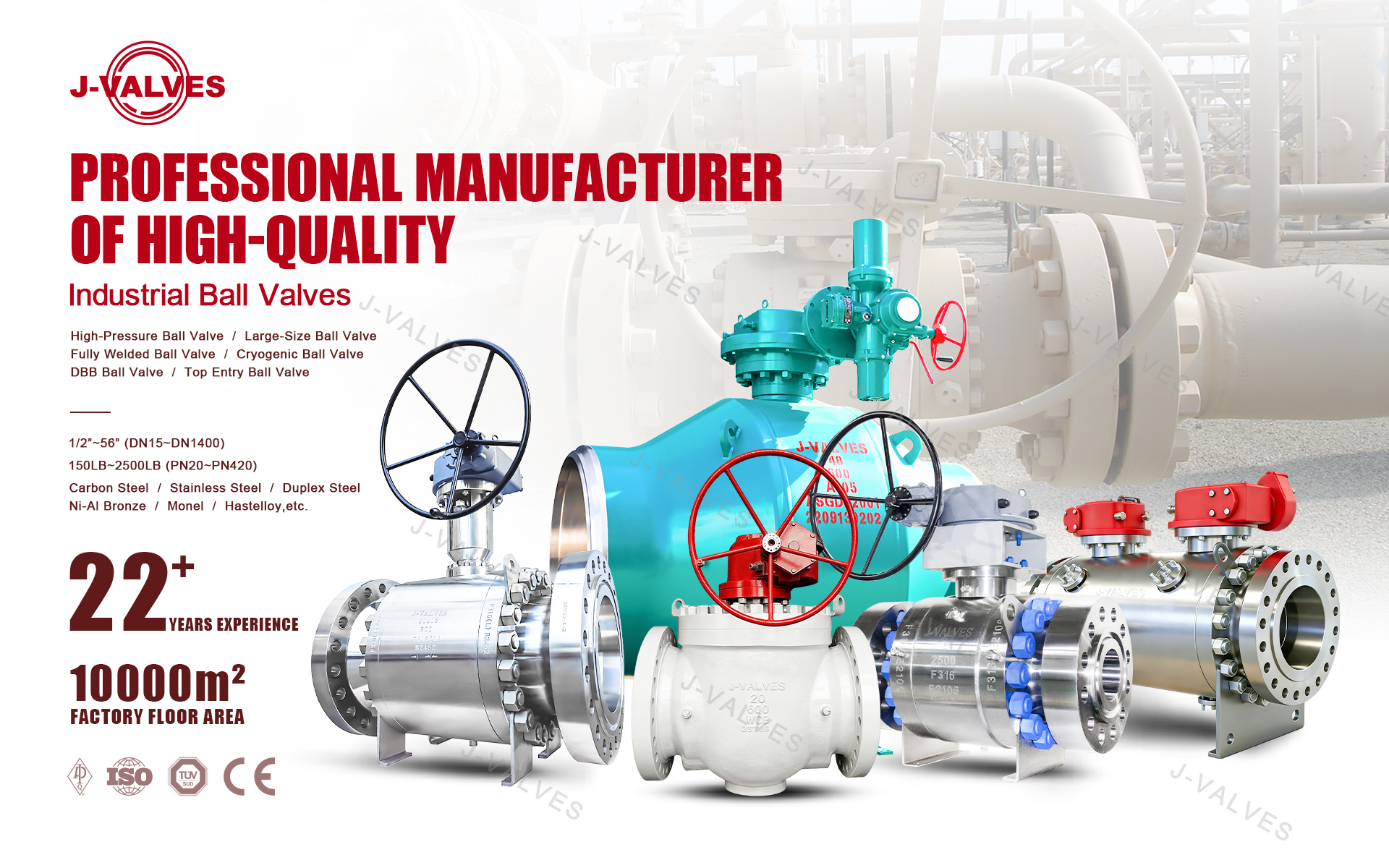
J-VALVES, a distinguished professional ball valve manufacturer rooted in China, takes pride in its extensive product portfolio. Our offerings span a wide range, including trunnion-mounted ball valves, floating ball valves, high-temperature ball valves, high-pressure ball valves, metal-sealed ball valves, ultra-low temperature ball valves, DBB ball valves, Three-way And Four-way Ball Valve, and fully welded ball valves. Each product is a testament to our commitment to precision engineering and reliable performance. Meticulously crafted, they are designed to not only meet but exceed the most stringent industrial demands, ensuring stable operation even under extreme conditions. This enables us to provide our clients with high-value services and makes our valves widely sought-after in industries.
Product Category
Contact Us


Pressure Class: ASME Class 150 to 2500 / PN20 to PN420
Body Material: ASTM A182 F304L forging, ASTM A351 CF3 casting
Carbon Content: 0.030 percent maximum
Body Style: One, two and three piece
Ball: A182 F304L with ENP 25 micrometres or hard alloy coating
Ball Finish :Sphericity 0.005 mm, Ra 0.4 micrometres, lapped with its seat
Seat:RPTFE, PCTFE, PEEK, or metal with Stellite hardfacing
Stem: A182 F304L surface hardened, or 17-4PH for galling resistance
Packing: PTFE V-ring or flexible graphite, live loaded
End Connection: Threaded NPT / BSP, socket weld, butt weld, flanged RF / RTJ
Design Standard: ASME B16.34, API 608, API 6D above 4 inch
Leakage Class: ANSI/FCI 70-2 Class VI soft seated, Class V metal seated
Fugitive Emission: ISO 15848-1 and TA-Luft, class and cycle count stated
Temperature Range: -29 to 425 degrees C, limited by seat material
Operation: Lever, worm gear, pneumatic, electric or hydraulic
-
Q41F
-
J-VALVES
An F304L stainless steel ball valve is a quarter-turn isolation valve whose pressure boundary is made from the low carbon grade of 18-8 austenitic stainless, ASTM A182 F304L when forged or A351 CF3 when cast, with a maximum carbon content of 0.030 percent. The low carbon is not a small metallurgical footnote: it is the whole reason the grade exists, and it decides whether the valve can be welded into a line without becoming susceptible to intergranular corrosion at the weld heat affected zone.
J-VALVES is a stainless ball valve manufacturer that makes these F304L ball valves from 1/4 inch to 12 inch in ASME Class 150 to 2500, forged or cast, soft or metal seated, with flanged, threaded, socket weld and butt weld ends. The buyers are chemical plant maintenance groups, pharmaceutical and food processors, instrument and sampling system packagers, and water treatment contractors who need a valve that will not rust, will not contaminate the product, and will hold a tight shut-off at pressure. This page covers what 304L is, when it is the right choice and when it is a mistake, the sealing architecture that produces a Class VI shut-off, and the measurements that decide whether the ball and seat will actually seal.

What F304L Actually Is
F304L is the forging specification for 304L austenitic stainless under ASTM A182. An A182 F304L valve body is a forging, and the specification number belongs on the datasheet because 304L bar stock machined into a body is a different article from a forged and normalised one. The chemistry that matters is 18 to 20 percent chromium, 8 to 12 percent nickel, and carbon at 0.030 percent maximum, against 0.08 percent maximum for standard 304. Molybdenum is absent, and that absence is the single most important limitation of the grade.
Property | F304L forged | CF3 cast | F316L forged |
|---|---|---|---|
Specification | ASTM A182 | ASTM A351 | ASTM A182 |
Carbon, maximum | 0.030 percent | 0.030 percent | 0.030 percent |
Chromium | 18.0 to 20.0 percent | 17.0 to 21.0 percent | 16.0 to 18.0 percent |
Nickel | 8.0 to 12.0 percent | 8.0 to 12.0 percent | 10.0 to 14.0 percent |
Molybdenum | None | None | 2.0 to 3.0 percent |
Minimum yield | 170 MPa | 205 MPa | 170 MPa |
Minimum tensile | 485 MPa | 485 MPa | 485 MPa |
Corrosion resistance | Oxidising acids, organic chemicals, food, potable water | As F304L, with cast surface effects | Adds chlorides, seawater splash, reducing acids |
Note the yield figure: 170 MPa for F304L is lower than the 205 MPa of WCB carbon steel and lower than the 250 MPa of A105N. Stainless is chosen for corrosion, not for strength, and a designer who substitutes 304L for carbon steel expecting a stronger body gets the opposite. Where strength and corrosion are both needed, the answer is usually a duplex grade, not a thicker 304L wall.
Why Low Carbon Exists: Sensitisation
When a standard 304 with 0.06 to 0.08 percent carbon is held between roughly 425 and 815 degrees Celsius, chromium and carbon combine and precipitate as chromium carbides at the grain boundaries. The chromium that forms the carbide is drawn out of the adjacent metal, so a narrow band either side of each grain boundary drops below the roughly 12 percent needed for passivity. The steel still looks like stainless, but that band is no longer stainless, and in a corrosive medium it dissolves. The result is intergranular corrosion, and it appears as a network of cracks or a crumbling surface rather than as uniform wastage.
Welding produces exactly that temperature band in the heat affected zone. The weld itself is fine; the metal a millimetre or two away from the weld is where the damage happens, and it happens even on a well made weld, because it is a thermal effect and not a welding defect.
Dropping carbon to 0.030 percent removes the problem, because there is not enough carbon left to precipitate a damaging amount of carbide. That is the entire purpose of the L suffix, and it is why a low carbon stainless ball valve is the grade to specify whenever the body or the adjoining pipe will be welded. It means the valve can be welded into a line and left without a solution anneal, which for a valve body installed in a stainless line is the only practical option.
Two practical consequences follow. First, a 304L valve welded to a 316L pipe is normal and correct, because both are low carbon. Second, a 304L valve welded to a standard 304 pipe puts the sensitised zone in the pipe, not the valve, and the pipe is the item that will fail. The material of the adjoining pipe is part of the valve selection.
304L, 316L, CF3 and When 304L Is Wrong
The most expensive mistake with this valve is using it where the fluid contains chlorides. Molybdenum is what gives 316L its resistance to pitting and crevice attack in chloride environments, and 304L has none.
Service | 304L | 316L | Note |
|---|---|---|---|
Nitric acid, any concentration up to about 65 percent at ambient | Preferred | Acceptable but not better | Molybdenum is not needed and 304L is the standard choice for nitric |
Organic chemicals, solvents, alcohols | Good | Good | Both are normally acceptable |
Food, dairy, brewing, pharmaceutical | Good | Good | Surface finish and cleanability matter more than the grade |
Potable and process water, low chloride | Good | Good | Below roughly 200 mg/l chloride at ambient |
Cooling water with chloride above about 200 mg/l | Not recommended | Acceptable to moderate levels | Pitting starts in crevices under the seat and at the body joint |
Seawater, brine, de-icing salt | No | Marginal at best | Duplex or a higher alloy is the correct answer |
Hydrochloric acid, wet chloride gas | No | No | Neither austenitic grade resists this |
Caustic soda above about 30 percent at temperature | No | No | Caustic stress corrosion cracking; use carbon steel or nickel alloy |
A CF3 ball valve is the cast version of the same grade, used for bodies above the size where forging becomes uneconomic. It is a legitimate grade, but a casting has a dendritic structure and a surface skin that differs from the core, so a cast body needs solution annealing after casting and pickling or passivation after machining. A CF3 body that has been machined and shipped without passivation will show rust spots in storage, and the rust is not a material failure, it is free iron contamination on the surface.
High Pressure Ball Valve Design in Small Sizes
This valve is most often bought at 1/4 to 2 inch in Class 1500 and 2500, where it sits on instrument root connections, sample points, chemical injection lines and hydraulic skids. That combination of small bore and high class produces three design problems that do not exist on a 6 inch Class 300 valve.
Wall thickness and bore. A 1/2 inch Class 2500 body has a wall that is thick relative to the bore, and the flow passage is a small hole through a lot of metal. The body is not the limiting item; the seat and the stem seals are.
Seat extrusion. A soft seat at 425 bar has a large pressure trying to push it through the gap between the seat carrier and the ball. PTFE creeps under that load even at ambient temperature. The design answers are an anti-extrusion ring on the low pressure side of the seat, a seat material with higher compressive strength (PCTFE or PEEK rather than PTFE), and a seat pocket with a closing clearance measured in hundredths of a millimetre. A Class 2500 soft seated valve that does not have all three will extrude its seat, and the failure looks like a leak that appears after a few weeks rather than at commissioning.
Stem sealing at high differential. A small stem with a large pressure across the packing has a high leakage driving force and very little room for a packing stack. The usual solution is a live loaded graphite or PTFE stack with disc springs, so the packing stays compressed as it relaxes thermally.
Sealing Architecture
A Class VI claim is the sum of four seals, not one. The main seat is the visible one, and the other three are what make the claim hold over time.
Seal | Function | Typical material | What fails it |
|---|---|---|---|
Main seat | Primary shut-off against the ball | RPTFE, PCTFE, PEEK, or metal with Stellite | Extrusion at high pressure, compression set, debris scoring |
Seat to body | Stops process bypassing the seat carrier | O-ring, graphite ring, or metal-to-metal with a spring | O-ring hardening, groove damage during assembly |
Stem packing | Stops leakage along the stem | PTFE V-ring, graphite, live loaded | Thermal relaxation, gland not retightened, side load on stem |
Body joint | Stops leakage at the split line | Spiral wound, O-ring, or welded | Bolt relaxation, gasket creep, thermal cycling |
The spring preloaded seat deserves its own note. On a valve where sealing depends only on line pressure, the seat lifts off the ball as pressure falls, so the valve leaks at low pressure and in vacuum even though it held 100 bar. A spring or wave washer behind the seat keeps a minimum contact stress regardless of pressure, which is what makes a soft seated valve usable on a vacuum line or on a low pressure drain. When a customer asks for a valve that holds under vacuum, the answer is a spring loaded seat, not a different ball finish.
Leakage Classes and What They Mean in Millilitres
A Class VI ball valve is a measured claim, and bubble tight is not a standard. The standards that are actually quoted are ANSI/FCI 70-2 for control valves, ISO 5208 for industrial valves, and MSS SP-61 for steel valves, and they do not say the same thing.
Port size | FCI 70-2 Class VI allowable leakage | Test condition |
|---|---|---|
1 inch | 0.15 ml per minute | Air or nitrogen, 3.5 bar differential |
1.5 inch | 0.30 ml per minute | As above |
2 inch | 0.45 ml per minute | As above |
3 inch | 0.90 ml per minute | As above |
4 inch | 1.70 ml per minute | As above |
6 inch | 4.00 ml per minute | As above |
8 inch | 6.75 ml per minute | As above |
Class VI is therefore a measured, size dependent allowance, and it is achievable with a lapped soft seat and a well finished ball. ISO 5208 rate A is stricter in a different way: no visible leakage at the specified test pressure and duration, which for a soft seated valve is the normal acceptance. A supplier who says "zero leakage" and does not name the standard, the pressure and the test medium has not made a claim that can be checked, and on a purchase order that phrase is worth nothing.
Metal seated valves do not meet Class VI. They are normally accepted at FCI 70-2 Class IV or V, or at ISO 5208 rate C or D by agreement, and the leak rate depends on the test medium: a valve that passes on water may fail on air, because air finds paths that water's surface tension closes.
Fugitive Emissions and the Stem
An ISO 15848 ball valve is certified as an assembly, not as a packing brand. Stem leakage is the emission path that regulators measure, and the standards are ISO 15848-1 for industrial valves and the German TA-Luft requirement, with EPA Method 21 used for monitoring in service.
A quoted figure such as 50 ppm means nothing on its own. It has to be stated with the standard, the tightness class, the test gas, the temperature class and the number of mechanical and thermal cycles. ISO 15848-1 defines tightness classes by measured leak rate in parts per million by volume, with class A the tightest, and it defines endurance classes by cycle count, so a valve certified to the tightest class after 20 cycles is a different claim from one certified after 1,000 cycles. On a purchase order, ask for the class, the cycle count and the temperature, and the certificate should show all three.
What makes the claim hold in service is live loading. Graphite packing relaxes as the stem cycles and as temperature changes, and a gland tightened at assembly loses preload within weeks. Disc springs or Belleville washers on the gland bolts maintain the load, and the gland bolts should be long enough that the spring stack has travel left. A valve with a tall gland and no springs will pass the factory test and fail the first site survey.
Ball Finish, Roundness and Why It Is Measured
A soft seat seals because the seat is pressed against the ball over a narrow band. If the ball is not round, that band varies in width as the ball rotates, and the contact stress varies with it. The seat conforms at first, then takes a permanent set in the shape of the error, and the valve leaks in the position it was left in rather than in the position it was tested in.
Two numbers control this. Sphericity, measured on a coordinate measuring machine as the total radial deviation of the lapped sphere, is normally held to 0.005 mm or better. Surface roughness, measured with a profilometer along a trace across the sealing band, is normally Ra 0.4 micrometres or better for a soft seat and finer for a metal seat. Both are measurements on the finished part, not on the drawing, and both should be available on request for a Class VI or a metal seated valve.
The ball and seat are also lapped as a pair on better valves, which means the seat carries the record of the ball it was matched to and the two should be replaced together. That is the practical reason a spare seat supplied without its ball may not achieve the original leak rate.
Galling, Assembly and the Stem
Austenitic stainless has a tendency to gall when two stainless surfaces slide under load, because the oxide film reforms slowly and the exposed metal welds microspically to its counterpart. A 304L stem in a 304L bonnet, with a 304L gland, is a galling assembly waiting for a maintenance fitter.
Three fixes are standard. Use a different hardness or a different alloy for one of the two surfaces, typically a 17-4PH or nitrided stem in a 304L body. Apply a solid film lubricant such as molybdenum disulphide to the stem and the gland threads. And control the surface finish, because a rough thread galling is far more likely than a ground and polished one. None of these is expensive, and all of them are invisible on a datasheet, which is why they are worth asking about.

Testing and Documentation
The test sequence for this valve is the standard one, with two additions that matter for stainless.
Step | Check | Acceptance |
|---|---|---|
1 | Positive material identification on body, ball and stem | Grade matches the certificate; molybdenum absent confirms 304 rather than 316 |
2 | Intergranular corrosion test, when specified | ASTM A262 Practice E, for welded or hot formed parts in nitric service |
3 | Shell test, hydrostatic, 1.5 times the 38 degree rating | No leak, no deformation; chloride content of the test water below 30 mg/l and drained and dried afterwards |
4 | Seat test, 1.1 times rating, both directions | ISO 5208 rate A, or FCI 70-2 Class VI with the measured value recorded |
5 | Stem leak test, when fugitive emission is specified | To ISO 15848-1 with class, cycle count and temperature stated |
6 | Surface condition after test | No free iron staining, no chloride pitting; passivation repeated if the test water was not controlled |
The chloride point is not pedantry. Hydrostatic test water containing chlorides, left to dry in a stainless body, produces pitting under the seat and at the body joint that appears weeks later as a leak. Test water specification and proper drying belong in the purchase order for any 300 series valve, and a supplier who tests with site water and ships wet is creating a warranty claim.

F304L Stainless Steel Ball Valve FAQ
What is the difference between 304 and 304L for a ball valve?
The difference is carbon: 0.08 percent maximum for 304 against 0.030 percent for 304L. The lower carbon prevents chromium carbide precipitation at grain boundaries in the 425 to 815 degrees Celsius range, which is the range a weld heat affected zone passes through. That makes 304L weldable without a solution anneal, which is why it is the normal grade for a valve body welded into a line. Mechanical strength is slightly lower than 304, not higher.
Can a 304L ball valve be used with seawater?
No. 304L has no molybdenum, so it is susceptible to pitting and crevice attack in chloride environments, and the crevices under the seat and at the body joint are exactly where it starts. Seawater service needs a duplex stainless such as F51 or F55, or a higher nickel alloy. Brackish cooling water above roughly 200 mg/l chloride is also outside the sensible range for 304L.
What does Class VI shut-off mean in practice?
ANSI/FCI 70-2 Class VI defines a measured allowable leakage that depends on port size, tested with air or nitrogen at 3.5 bar differential: 0.15 ml per minute for a 1 inch port up to 6.75 ml per minute for an 8 inch port. It is achievable with a lapped soft seat and a ball finished to about 0.005 mm sphericity and Ra 0.4 micrometres. It is not the same as zero leakage, and metal seated valves do not meet it.
Why is the valve rated to 425 degrees Celsius if 304L is a low temperature material?
Those are separate limits. 425 degrees Celsius is the body rating limit for the stainless grade under ASME B16.34, and the valve can be built for it with a metal seat and graphite packing. The seat material sets the real limit: RPTFE to about 180 degrees Celsius, PEEK to 250, metal beyond that. A valve ordered for 400 degrees Celsius with a PTFE seat is mis-specified even though the body is rated for it.
What causes a stainless ball valve to leak after a few weeks in service?
The three common causes are chloride pitting from test water left in the body, seat extrusion at high pressure where the seat pocket clearance or the anti-extrusion ring is inadequate, and galling or relaxation at the stem packing where the gland is not live loaded. All three pass a factory test and appear later. Specifying low chloride test water with proper drying, a seat pocket with controlled clearance, and live loaded packing addresses them.
What information do you need to quote this valve?
Size, class, body material and whether forged or cast, seat material, end connection (threaded, socket weld, butt weld, flanged RF or RTJ), design pressure and temperature, fluid with chloride concentration and pH, leakage class or test standard, fugitive emission requirement, actuation, surface finish or passivation requirement, certification and quantity.
Hot Products


News
Ball Valves in A Kraft Pulp Mill: Black Liquor, Green Liquor And The Cost of Choosing The Alloy by Habit
White liquor at pH 14 cracks carbon steel welds, black liquor sets solid below 100 C, green liquor dregs grind seats: alloy choice and torque in a kraft mill.
Read More
Slug Flow And Ball Valves: What Actually Arrives At The Seat
A slug is liquid mass with momentum, not a pressure spike. What changes at the seat, in the cavity and at the actuator when liquid reaches a ball valve.
Read More
Ball Valves in Direct Lithium Extraction: PH 1 Eluate, Gypsum Scale And 438,000 Cycles in Twenty-Five Years
Direct lithium extraction swings valves from pH 1 eluate to pH 12 caustic, 48 column switches a day and gypsum scale. Materials, seats and torque.
Read More
Ball Valves in Geothermal Brine: Silica Scale, Chloride Cracking And The Cooling Trap
Why geothermal brine destroys ball valves: retrograde silica scale, calcite at the flash point, chloride cracking above 60 C and the 250 C seat limit.
Read More