


CHINA J-VALVES Offers Various High-quality I ndustrial Ball Valves
J-VALVES, a distinguished professional ball valve manufacturer rooted in China, takes pride in its extensive product portfolio. Our offerings span a wide range, including trunnion-mounted ball valves, floating ball valves, high-temperature ball valves, high-pressure ball valves, metal-sealed ball valves, ultra-low temperature ball valves, DBB ball valves, Three-way And Four-way Ball Valve, and fully welded ball valves. Each product is a testament to our commitment to precision engineering and reliable performance. Meticulously crafted, they are designed to not only meet but exceed the most stringent industrial demands, ensuring stable operation even under extreme conditions. This enables us to provide our clients with high-value services and makes our valves widely sought-after in industries.
Product Category
Contact Us


-
J-VALVES-Q41F
-
J-VALVES
Overview of the J-VALVES DN50x40 Class 1500 F44 Floating Ball Valve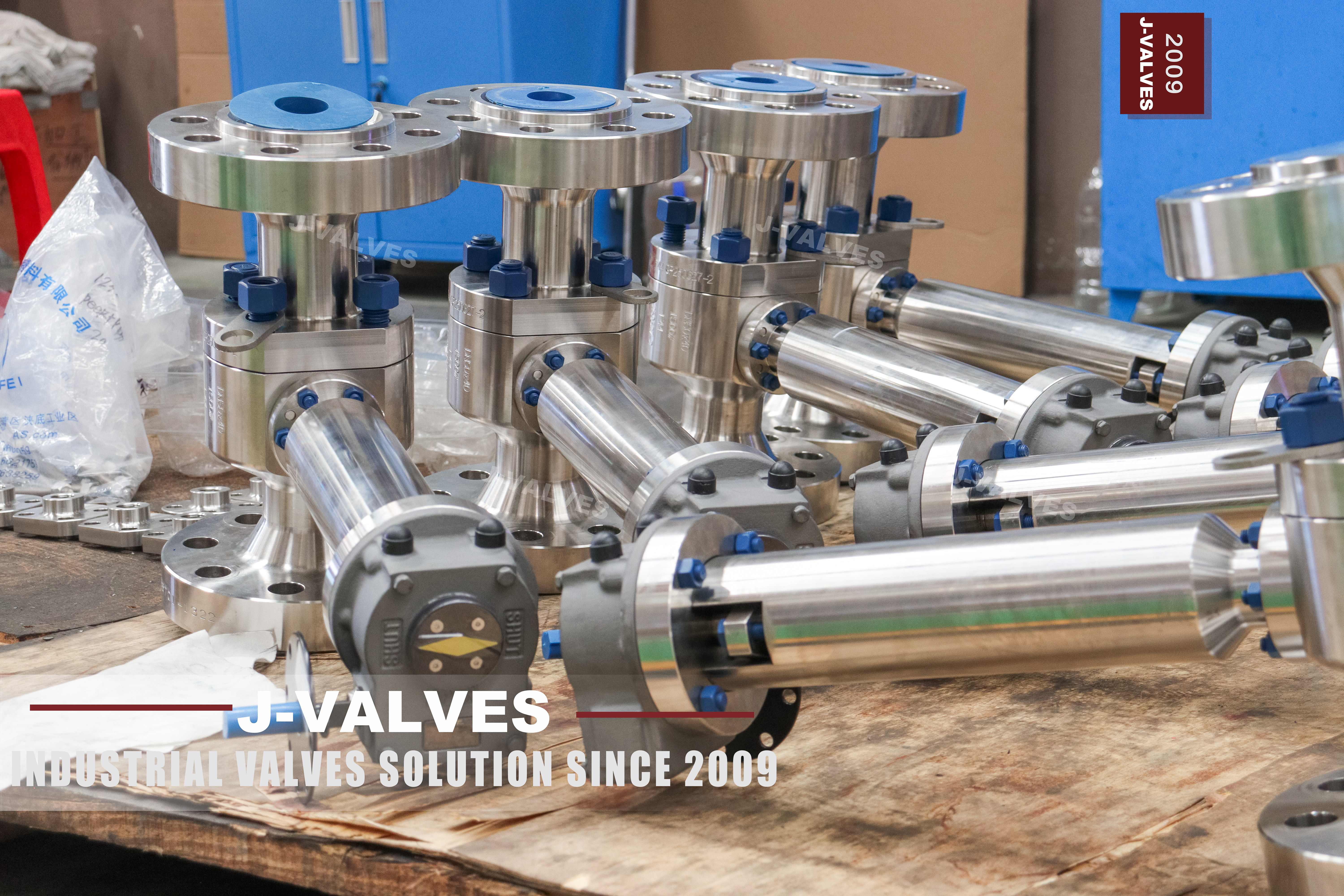
This is a two-piece flanged floating ball valve on a DN50 body with a DN40 bore, rated Class 1500, forged in ASTM A182 F44, with a bolted stem column that lifts the gear operator clear of insulation. Its job is narrow: isolating a small-bore line that is both high pressure and wet with chloride, on a pipe run that is also lagged.
Four stamps tell you what it is: DN50x40, 1500#, F44, and the heat number CF250327-2. The end cap repeats that heat number vertically on its joint face, which is the only place the two halves can be shown to belong together. Nothing else on the valve states the material, which is why the certificate matters more than the photograph.
The class is what gets misread. Class 1500 is 3600 psi in the austenitic group of ASME B16.34 at 100 F; the carbon group reads 3705 psi for the same class, and the difference is the group, not the quality. The figure 260 is a label API 6D clause 7.2 gives this class, and it is not on the valve: the metal says 1500. Read it as a pressure in bar and you are wrong twice, once about the unit, once about the group.
What the valve is not is worth settling first. Not a trunnion valve, so the ball is not carried on bearings. Not metal seated by default, so the leakage acceptance follows whichever polymer is fitted. And no double block and bleed in the trunnion sense, because a floating ball seals on one seat at a time.
Design and Construction
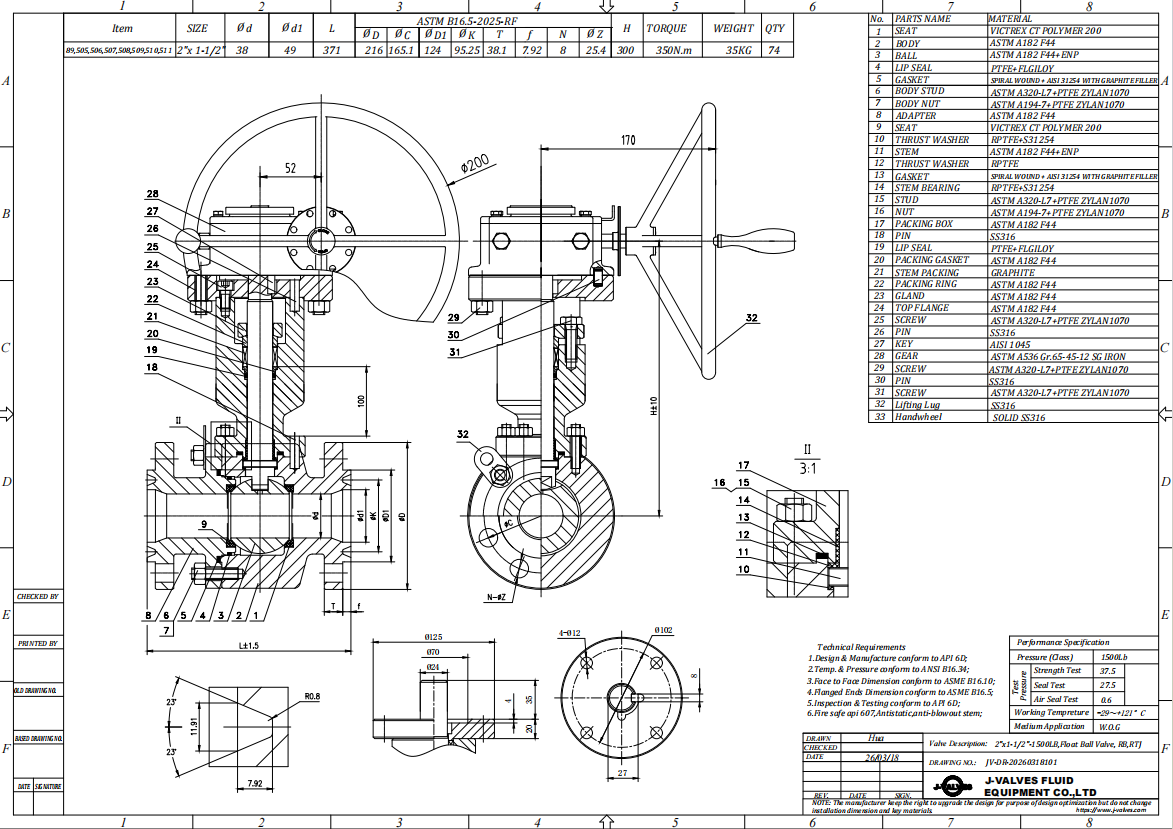
The body is two pieces: a main body with both flange ends forged into it, and one end cap closing the cavity from the pipe side. That single gasketed joint, closed by studs, is a pressure boundary at this class and the joint opened when seats are changed. Hence the matching heat numbers, and hence a gasket that is a purchased item rather than a consumable from a bin.
The ball floats: nothing holds it except the two seats. Pressure on the closed bore area pushes it downstream and the thrust lands on the downstream seat, which must contain it through the polymer without extruding it out of the pocket. A reduced bore is the answer, and not for the reason the old page gives. Saving wall thickness is secondary; the bore sets the thrust, the thrust sets the seat contact pressure, and that pressure sets both the sealing behaviour and the effort at the handwheel.
At Class 1500 this valve sits at the top of its own product standard. API 608 covers floating ball valves from Class 150 to Class 1500, and above that the trunnion design takes over. The size ladder has the same edge: the floating line runs from 1/2 inch to 8 inch and stops because thrust grows with the square of the bore. A DN40 bore here is comfortable; a large bore would need a seat load no polymer can hold.
The cavity is where floating and trunnion valves differ most. Closed, it holds liquid at the pressure it had when the valve shut, and if that liquid warms it expands with nowhere to go. A trunnion valve handles this with seat behaviour; a floating valve handles it with a relief hole in the upstream seat or a cavity plug in the body. Neither is visible from outside, so it belongs in the order rather than in the hope.
The stem is in two pieces: the valve stem ends at the body gland where the packing sits, and a separate extension shaft runs up the column, joined by the clamp visible through the window near the top. Three things follow. The packing runs at line temperature because it has not moved; the column is dry, so a leak does not run down the pipe; and the leak weeps at the body neck under the lagging, where the first evidence is staining rather than a drip. The other catalogue way is to raise the stuffing box to the top of the extension, which leaks where you can see it. Both are sold as extended stem valves, so the drawing should say which one is being bought; this page describes the dry column, which is what the photographs show.
The operator is a worm gear with a handwheel, not a lever. The gear is delivered rather than optional at this class, and it changes two things: it removes the operator's feel for the seat, so the valve can be forced against the stop; and it puts a bending moment on the column, because a handwheel is pushed sideways as well as turned. The studs at the column base carry that moment, not the pressure.
Inside, the stem has a shoulder trapped by the body so pressure cannot blow it out, and a conductive path keeps ball, stem and body electrically continuous; both are requirements of the product standard. Fire safety rests on what survives when the polymer is gone: graphite packing, a graphite filled gasket, and the metal ring the ball can still land on.
Material Options
F44 is one alloy wearing four names, and the paperwork is where they get confused. ASTM A182 F44 is the forging specification, UNS S31254 the alloy, 254SMO a mill's trade name, 6Mo the family nickname. Only the first two belong on a purchase order. A request written as 254SMO asks for a brand, and the certificate will name S31254, leaving no basis to reject a body that is metallurgically right but came from another mill.
The composition is what the price is for: roughly 20 percent chromium for the passive film, 18 percent nickel to hold the austenitic structure, 6 percent molybdenum for pitting and crevice resistance, 0.2 percent nitrogen for strength and pitting resistance, copper for sulphuric acid, carbon capped at 0.02 percent. Molybdenum is the expensive line and the one that does the work in chloride.
What 6Mo does not do matters as much. It is not immune to chloride: it resists pitting and crevice attack, and a crevice holding stagnant concentrate will eventually attack any stainless steel. It is no nickel alloy substitute in hot concentrated chloride or wet chlorine gas. And its allowable stress sits below carbon steel, so a 6Mo body at Class 1500 is thicker and heavier than the same body in WCB, not lighter.
The grade is a forging grade. Offered as a casting, the certificate changes to A351 CK3MCuN, and a buyer who specified A182 F44 has not specified a casting. That is not academic here: the two are qualified by different tests, and the file approving one does not approve the other.
The old page offers the ball in "F44 or F44L". There is no F44L. A182 lists F44 as S31254 and stops, UNS has no low carbon variant, and there was never a reason to create one, because the alloy is already capped at 0.02 percent carbon. A quotation offering F44L is either a typographical habit or a promise that cannot be certified, so ask which UNS number the certificate will carry.
The stem is offered in F44 or 17-4PH, and this choice decides the corrosion performance of the valve. 17-4PH is much stronger, which is why it is used on stems, and it is markedly less resistant to chloride stress corrosion than the body it passes through. On a wet chloride line, a 6Mo body with a 17-4PH stem puts the weakest alloy where nobody photographs. If the service is also sour, NACE MR0175 caps 17-4PH at 22 HRC and the strong condition is gone.
Seats are where class and temperature meet. PTFE, RPTFE, PEEK and PPL each have their own ceiling, which is why one range written across four materials describes none of them. A polymer seat at this differential also needs tight pocket clearance and an anti-extrusion ring; above the polymer ceiling the valve becomes metal seated and the acceptance changes with it. Packing follows the same logic: graphite survives a fire, PTFE seals lower and fails first. The body joint takes a spiral wound gasket with graphite filler, preloaded well above class pressure to stay tight through thermal cycles.
Bolting is the last material decision and the one most often left to the supplier. A 6Mo body with carbon steel studs is a galvanic pair in chloride atmosphere, and the stud is what corrodes. Either controlled alloy steel with a proper coating or a matching stainless, and either way the certificate says which.
| Component | Standard Material | Optional Upgrade | Service Notes |
|---|---|---|---|
| Body and end cap | ASTM A182 F44 forging, UNS S31254 | A182 F316 where chloride is low | Both halves carry the same heat number |
| Ball | A182 F44, hard chrome plated or nitrided | Cobalt alloy overlay on request | Not a pressure part, grade on the certificate |
| Seats | PTFE, RPTFE, PEEK or PPL | Metal ring with hardfacing | The seat, not the body, caps the temperature |
| Stem | A182 F44 | 17-4PH for higher strength | 17-4PH is the weaker alloy in chloride |
| Stem packing | Flexible graphite | PTFE for low emission duty | Graphite is the fire safe path |
| Body gasket | Spiral wound, graphite filler | PTFE filler for clean duty | New gasket at every joint opening |
Technical Specifications
Three numbers answer to the same class and are not interchangeable. Class 1500 is the marking on the body. PN260 is the API 6D label, and it appears in catalogues. The rating is a table value: 3600 psi in the austenitic group at 100 F. Specify PN260 and then expect a metric flange and you will not get one, because these ends are drilled to ASME B16.5.
Temperature needs two rows. B16.34 lists austenitic grades well above the 425 C on the old sheet, but the alloy's own published data stops lower, because a 6Mo austenitic steel forms sigma phase in the 600 to 900 C window and a thick section does not need to reach it to start. The seat stops it sooner: PTFE to about 200 C, PEEK about 260 C, PPL close to PEEK. The body figure only becomes real when the valve is metal seated. The low end comes from seat and packing rather than the forging, which is why the range starts at -29 C.
The ends are RTJ, a decision inside the flange standard. B16.5 gives Class 1500 at NPS 2 in both raised face and ring joint; the ring joint is specified here, and the ring is a separate purchase that does not ship with the valve. The two facings are not interchangeable on the same bolt pattern, so a site holding raised face gaskets cannot close this joint.
| Item | Value | Basis |
|---|---|---|
| Size | DN50 ends, DN40 bore, NPS 2 by 1.5 | Body stamp and order drawing |
| Pressure class | Class 1500, recorded as PN260 | Body stamp, API 6D clause 7.2 |
| Rating at 100 F | 3600 psi | ASME B16.34 austenitic group |
| Body material | ASTM A182 F44, UNS S31254 | Body stamp and EN 10204 3.1 |
| End connection | RTJ flange, NPS 2, Class 1500 | ASME B16.5 |
| Face to face | Table value plus signed GA drawing | ASME B16.10 |
| Temperature, body | Flange rating listed to 1000 F | ASME B16.34 |
| Temperature, seat | About 200 C PTFE, about 260 C PEEK | Seat material, not the body |
| Design standard | API 608 with ASME B16.34 | Floating ball valve scope |
| Test standard | API 598, shell and seat | API 598 |
Standards and Compliance
The product standard here is API 608, and what matters is its scope. It covers flanged, threaded and welding end ball valves from Class 150 to Class 1500, which is the band this valve sits in at the top edge. ASME B16.34 supplies wall thickness and ratings. API 6D governs trunnion mounted pipeline valves, and although its clause 7.2 is where the PN260 label comes from, it is not what this valve is built or tested to. Writing all three on one line, as the old page does, leaves the inspector to choose.
API 598 is the test. Shell at 1.5 times the class rating proves body and joint; seat at 1.1 times proves the closure in each direction, because a floating valve has two seats seeing different conditions. With a polymer seat the acceptance is zero visible leakage; with a metal seat it is a rate that depends on size, and polishing does not change that.
Fire safety is a test, not a claim. API 607 and ISO 10497 are equivalent, and both burn the valve and check it still seals. What passes is graphite packing, a graphite filled gasket, and the metal ring the ball lands on when the polymer is gone; a valve with PTFE packing cannot pass, whatever the seat is made of. Anti-static continuity is required by the product standard and measured at assembly, because a floating ball in a polymer seat is insulated until the spring loaded contact bridges it.
For sour service the governing document is NACE MR0175, and the answer is a condition rather than a material name. A 6Mo body is acceptable in many of its environments; the stem is where the hardness limit bites. Declare stem material, heat treatment and hardness at the inquiry, because they cannot be added to a certificate afterwards.
| Requirement | Standard | What It Covers |
|---|---|---|
| Product design | API 608 | Scope, marking, anti-static, fire safe requirement |
| Wall and rating | ASME B16.34 | Pressure temperature tables and minimum wall |
| Flanges | ASME B16.5 | Drillings, ring groove dimensions, facing |
| Testing | API 598 | Shell test, seat test, acceptance |
| Fire | API 607, ISO 10497 | Post burn sealing |
| Sour service | NACE MR0175 | Material condition and hardness limits |
Manufacturing Process
Forging 6Mo is not forging 316. The alloy work hardens quickly, needs a high forging force and has a narrower window of temperature, so the body is pressed with the flange necks formed in the same operation rather than welded on. That is why the transition from barrel to flange is a cone on the photograph, and why the grain flow follows it to the face.
Machining is where most of the cost sits. The work hardening that makes the alloy strong makes it hard to cut, and low thermal conductivity keeps heat in the tool edge, so inserts wear and the surface can smear instead of cutting. Threads and the ring groove punish a tired tool, because both are checked by a gauge that does not forgive.
Contamination control is specific to 6Mo. Free iron from a brush, a bench or a tool that has touched carbon steel becomes a pitting site, and it pits in chloride before the alloy does. Parts stay on segregated tooling, are pickled and passivated after machining, and are checked for free iron before assembly rather than after the first leak.
Ball and seat ring are lapped as a pair and stay a pair; a ball swapped from stock has lost the match that made it seal, and at this class the difference between a good and a marginal seat lives in the contact band, not on the drawing. Body and end cap are machined and marked together for the same reason. Assembly ends with the column, which brings a tolerance a standard valve does not have: the shaft must run true, the coupling must absorb what misalignment remains, and the gland must compress evenly when reached through a tube. The shell test runs with the column fitted, so its base joint is proved with the body.

Quality Control and Testing
Incoming inspection starts with the certificate, not the part. The heat number on the EN 10204 3.1 certificate must match the number stamped on body and end cap, because that is the only link between metal and paperwork. A certificate covering "F44" with no heat number is a description, not a record.
Positive material identification is fast on this alloy and worth doing in front of the buyer. A handheld analyser reads molybdenum near six percent on F44 and near two on 316, a gap no instrument misses, so the gun settles whether the body is the grade ordered. It cannot see carbon or free iron, so the certificate still carries the carbon and the pickling record still carries contamination control.
Dimensional checks concentrate on the joint: ring groove profile to the gasket standard, joint face flatness, bore alignment through both halves. A groove out of profile will not seal with a new ring and will not be fixed by tightening, and at this class it shows up as a weeping joint on the first hydro. Pressure testing follows the standard with each seat recorded separately, because a valve that seals one way and not the other fails in service in a way nobody predicted.
Functional checks close the loop: the gear runs a full cycle, the coupling is checked for slip, anti-static resistance is measured, and the gland is inspected for even compression after the cycles. That last item is specific to the column, because a gland set before the column was fitted can look correct and still leak once the shaft settles.
| Check | Method | Acceptance |
|---|---|---|
| Heat traceability | Certificate against body and end cap stamps | Same heat number on all three |
| Alloy identity | PMI on body, ball and stem | Molybdenum reading consistent with S31254 |
| Ring groove | Profile gauge to the gasket standard | Within the groove tolerance |
| Shell | Hydrostatic at 1.5 times the rating | No leak at body or joint |
| Seat | Hydrostatic at 1.1 times, each direction | Zero visible on a polymer seat |
| Anti-static | Resistance between ball and body | Low resistance, recorded at assembly |

Applications and Industry Service
Class 1500, a DN40 bore and a 6Mo body together point at one duty: a small line where pressure is high and the fluid is chloride bearing. Chemical injection on produced water, chloride brine dosing, hypochlorite and chlorine dioxide lines in pulp mills, phosphoric acid at pressure, and the high pressure side of a reverse osmosis train all sit inside that description.
What the alloy buys is not general corrosion resistance. It is resistance to pitting and crevice attack in stagnant chloride, the failure that takes out 316 valves in a year: seat pocket, flange crevice and thread roots hold liquid, chloride concentrates as water evaporates, and attack starts where nobody can see it. Six percent molybdenum and the nitrogen addition raise resistance to that one mechanism.
What it does not buy is a licence to ignore the medium. Wet chlorine gas, hot concentrated chloride and strongly oxidising acids at temperature are nickel alloy territory, where a 6Mo valve fails the way a 316 valve fails, only later. The honest rule is that F44 covers chloride in water at moderate temperature, and beyond that the answer is a higher alloy rather than a higher class.
The class usually comes from position rather than process. A valve upstream of a letdown station, or on a hydraulic injection line, sees full system pressure while the rest of the plant runs at a fraction of it, which is why a DN50 line carries a Class 1500 valve and the same valve further downstream is Class 300. The column belongs to the insulation instead: the operator sits outside the cladding at a reachable height, and the stem passes through the lagging without becoming a thermal bridge into the gland.
Installation, Operation and Maintenance
The column goes up, not sideways. Vertically the gearbox sits over the valve and the handwheel load travels down the column; horizontally the same load becomes a bending moment on the base studs and the body neck, and the gearbox needs its own support. If the layout forces a horizontal operator, say so at the order stage so column and bracket are designed together.
Insulation stops at the column base. Lagging the column hides the joint, traps moisture against the studs, defeats the purpose of the extension, and hides the staining that would tell you the packing is weeping. The body may be lagged; the column should not be, and the joint between them should stay visible.
The flange joint is a ring joint and it is assembled once. A new ring goes in, the groove is clean and undamaged, the studs are lubricated on the threads and under the nuts, and the joint is tightened in a crossing pattern in stages. A ring already compressed will not seat again, so a spare belongs on the shelf before the first maintenance, not after it.
Operation is a full quarter turn, open or closed. Left part open, a floating ball runs its seat over the port edge in the flow, and the seat decides the leakage acceptance. The gear makes it easy to force the valve, so treat the stop as a stop; if the handwheel becomes noticeably harder, the cause is usually the seat or cavity pressure, not a need for more effort. Three of the four common jobs can be done in line: packing adjusted, coupling re-clamped, body joint opened for a seat change with the line isolated. The fourth, replacing the ball, is a bench job. Keep a ring gasket, a body gasket, a seat set and packing rings on site.
How to Specify and Order
A specification that gets this valve right reads: two piece flanged floating ball valve, DN50 by DN40 reduced bore, Class 1500, body and end cap to ASTM A182 F44 (UNS S31254), ball in the same grade with hard chrome, seats in PEEK, stem in A182 F44, graphite packing, RTJ flanges to ASME B16.5, extended stem column with worm gear, design to API 608 and ASME B16.34, tested to API 598, EN 10204 3.1 with heat numbers, PMI report, and a general arrangement drawing for approval. Every word removes a question.
Five answers make the quotation exact: the medium with its chloride content and temperature, the class and the bore, the stem material and condition if the service is sour, the seat material with the temperature it will see, and the extension length with the operator position on a drawing. Three are process data only the buyer has; two are choices the buyer should make rather than inherit.
Four things are worth striking from any inquiry. A trade name on its own, because 254SMO is a brand and the certificate will not use it. F44L, because the grade does not exist. API 6D as the design standard, because it belongs to a trunnion valve and sends the quotation the wrong way. And zero leakage written against a metal seat at this class, because it cannot be met and the argument comes after delivery rather than before it.
What comes with the valve matters as much as the valve: the 3.1 certificate with heat numbers matching the stamps, the PMI report, the hydrostatic and seat records, the fire test certificate for the configuration supplied, the drawing showing column length and operator position, and the installation and maintenance instructions. Ask in the inquiry rather than after shipment, because at this class the paperwork is what the inspector reads first.
FAQ
Q: Is F44L a grade I can order?
A: No. ASTM A182 lists F44 as UNS S31254 and stops there, and UNS has no low carbon variant of S31254, because the alloy is already capped at 0.02 percent carbon. The L suffix was never created for this grade, so a sheet that offers F44L is offering something no mill can certify. Ask which UNS number the certificate will carry; if the answer is S31254 the material is right and the suffix was a typographical habit, and if there is no answer the offer should be rejected.
Q: Why offer a floating ball valve at Class 1500 instead of a trunnion valve?
A: Because the bore is small. A floating ball puts the whole pressure load on the downstream seat, and that load grows with the bore, so the design works comfortably at DN40 and stops working at large sizes, which is where the trunnion takes over. Class 1500 is also the top of the scope of API 608, the product standard for floating valves, so this valve sits at the corner where the family ends in both directions. Above this class, or well above this bore, the enquiry should go to a trunnion valve.
Q: Where does a packing leak show up on a valve with an extended stem?
A: At the body, not at the handwheel. On this design the packing stays in the body gland and the column above it is dry, with a clamped coupling joining the valve stem to the extension shaft, so a weeping gland sends liquid into the insulation at the body neck rather than down the outside of the pipe. The first evidence is usually staining on the cladding or corrosion on the studs. A valve built the other way, with the stuffing box raised to the top of the extension, leaks in plain sight at the operator.
Q: Can this valve run at 425 C, and what limits it first?
A: The seat limits it first, and the alloy limits it second. PTFE is good to about 200 C and PEEK to about 260 C, so above those figures the valve has to be metal seated and the leakage acceptance changes. The body figure is not a free pass either: a 6Mo austenitic steel forms sigma phase in the 600 to 900 C window, and a thick section does not need to reach that window for the process to start. The 425 C on the original sheet is a carbon steel habit rather than a number this alloy and this seat can both hold.


Hot Products


News
Ball Valves in A Kraft Pulp Mill: Black Liquor, Green Liquor And The Cost of Choosing The Alloy by Habit
White liquor at pH 14 cracks carbon steel welds, black liquor sets solid below 100 C, green liquor dregs grind seats: alloy choice and torque in a kraft mill.
Read More
Slug Flow And Ball Valves: What Actually Arrives At The Seat
A slug is liquid mass with momentum, not a pressure spike. What changes at the seat, in the cavity and at the actuator when liquid reaches a ball valve.
Read More
Ball Valves in Direct Lithium Extraction: PH 1 Eluate, Gypsum Scale And 438,000 Cycles in Twenty-Five Years
Direct lithium extraction swings valves from pH 1 eluate to pH 12 caustic, 48 column switches a day and gypsum scale. Materials, seats and torque.
Read More
Ball Valves in Geothermal Brine: Silica Scale, Chloride Cracking And The Cooling Trap
Why geothermal brine destroys ball valves: retrograde silica scale, calcite at the flash point, chloride cracking above 60 C and the 250 C seat limit.
Read More