CHINA J-VALVES Offers Various High-quality I ndustrial Ball Valves
J-VALVES, a distinguished professional ball valve manufacturer rooted in China, takes pride in its extensive product portfolio. Our offerings span a wide range, including trunnion-mounted ball valves, floating ball valves, high-temperature ball valves, high-pressure ball valves, metal-sealed ball valves, ultra-low temperature ball valves, DBB ball valves, Three-way And Four-way Ball Valve, and fully welded ball valves. Each product is a testament to our commitment to precision engineering and reliable performance. Meticulously crafted, they are designed to not only meet but exceed the most stringent industrial demands, ensuring stable operation even under extreme conditions. This enables us to provide our clients with high-value services and makes our valves widely sought-after in industries.
Product Category
Contact Us


Pressure Class: ASME Class 300 (PN50), Class 150 to 600 available
Temperature Range: -29°C to +425°C in WCB, to +593°C in WC6 / WC9
Body Material: A216 WCB / WCC, A217 WC6 / WC9, A352 LCC
Body Style: Cast one piece body, bolted top entry bonnet
Ball: A105 + ENP, F304, F316, F6a, surface hardened
Seat: RPTFE, PEEK, PPL, or Stellite 6 metal seat
Stem: F6a, F304, F316, 17-4PH, anti blowout
Packing: Flexible graphite, Inconel wire reinforced, PTFE V rings for low temperature
End Connection: Flanged RF / RTJ to ASME B16.5, butt weld to ASME B16.25
Design Standard: ASME B16.34, API 608, API 6D
Test Standard: API 598, API 6D
Fire Safe: API 607 / ISO 10497
Operation: Lever up to 2 inch, worm gear above, pneumatic or electric
-
SQ347H / Y
-
J-VALVES
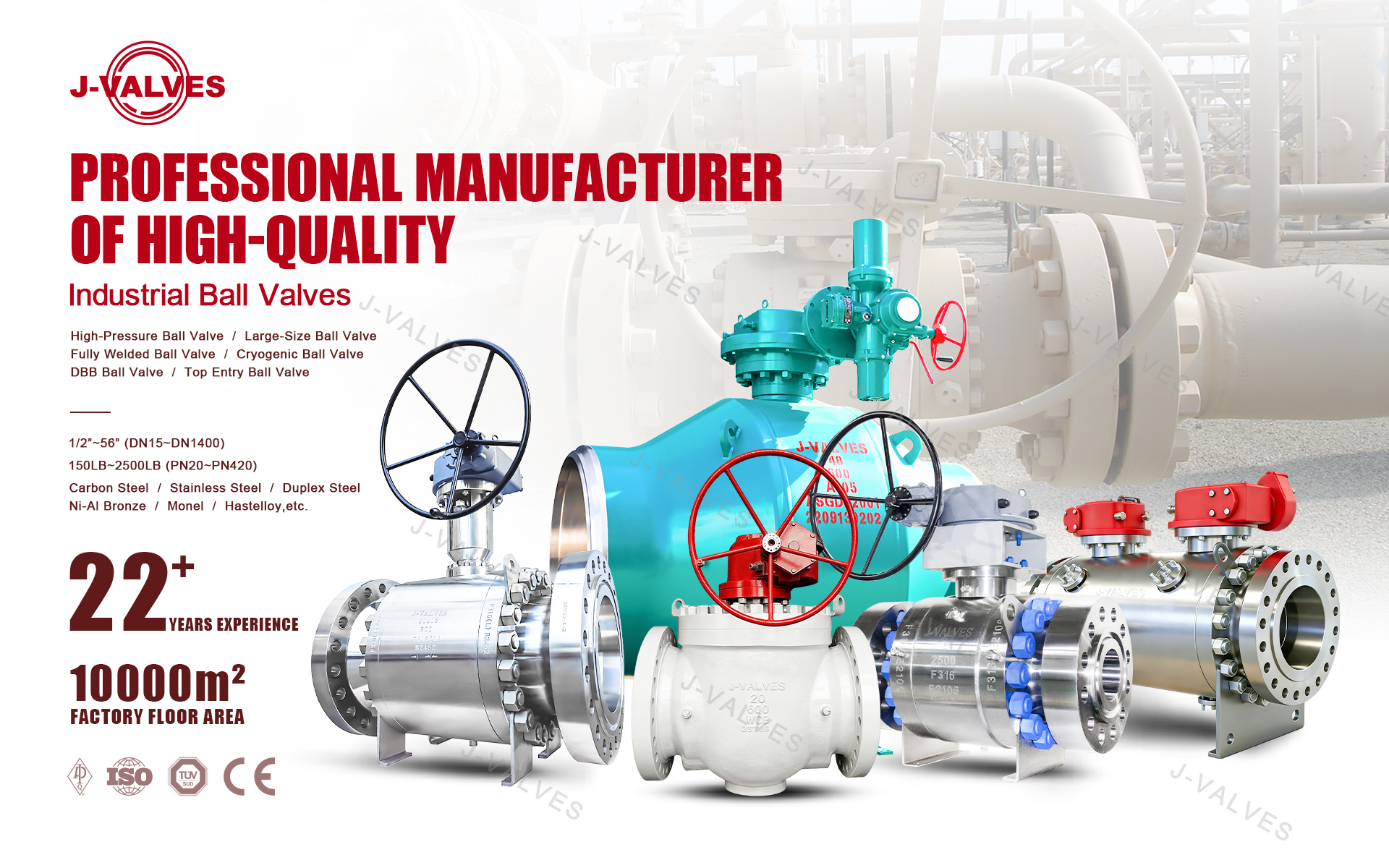
A cast steel top entry ball valve is a single piece cast body with a bolted bonnet, used where the line cannot be cut and the body has to be cast rather than forged. In steam service at 10 inch Class 300 it is the practical answer for a header isolation valve that must be repairable in place, because a forged body of that size is expensive and a side entry body cannot be serviced without removing the valve.
J-VALVES casts this valve in A216 WCB for saturated and superheated steam to 425°C, and in A217 WC6 or WC9 chrome moly for service up to about 593°C. The 10 inch (DN250) Class 300 build is the size most often ordered for boiler outlet, turbine admission, desuperheater and plant steam header isolation, and it is normally supplied with a gear operator or a pneumatic actuator.

Cast Body or Forged Body: The Real Decision
The choice is not about strength. A cast WCB body of 10 inch Class 300 has ample wall thickness for the rating, and its tensile and yield properties are specified in A216 just as A105 is specified in A182. The difference is soundness and shape. A forging is denser and has no shrinkage porosity, but it can only be made in simple shapes, so a forged 10 inch body becomes a block with a lot of machining and a lot of scrap.
Criterion | Cast body (WCB / WC6) | Forged body (A105 / F316) |
|---|---|---|
Soundness | Requires radiographic or ultrasonic examination of critical sections | Uniform, no shrinkage porosity |
Shape freedom | Complex passages, integral bonnet neck, ribbing | Simple shapes, more machining |
Cost at 10 inch Class 300 | Lower by 20 to 35 percent | Higher |
Cost at 2 inch Class 1500 | Relatively higher, pattern and setup dominate | Lower |
Repairability | Weld repair permitted under A216 with procedure qualification | Limited weld repair |
Typical use | Steam headers, large water lines, utility stations | High pressure, sour, offshore, small bore |
Why Steam Pushes the Design Toward WC6
Steam above about 425°C starts to attack carbon steel in a way that is not mechanical. The oxide scale grows, spalls, and the wall thins from the inside while the outside still looks new. Chrome moly grades slow that oxidation because the chromium forms a protective oxide that stays attached, and 1.25Cr-0.5Mo, which is A217 WC6, is the standard answer up to roughly 593°C.
WC6 also holds strength better at temperature. At 500°C the allowable stress for WC6 is roughly 60 percent higher than for WCB, which at Class 300 often means a thinner wall and a lighter valve. That is why a specification that says cast steel is not enough: the grade has to be named, and the design temperature has to be stated, because WCB and WC6 are not interchangeable at 500°C.
Seat Choice for Steam
Steam is clean, dry and hot, which is the easy case for a metal seat except for one detail: at 300°C and above, a PTFE seat is outside its range and an RPTFE seat is close to its limit. Metal seated with a Stellite 6 overlay is the usual choice for continuous steam, and it also gives fire safety without a secondary seat.
Seat | Continuous limit | Steam suitability | Leakage |
|---|---|---|---|
PTFE | 200°C | Low pressure saturated steam only | Rate A |
RPTFE | 220 to 230°C | Saturated steam, cycling duty | Rate A |
PEEK | 260°C | Superheated steam at low class | Rate A to B |
Stellite 6 metal | 550°C and above with WC6 body | All steam service | Rate V / VI |
PCTFE | -196 to 120°C | Not for steam | Rate A |
A metal seat on steam will not be bubble tight when cold. It becomes tight when the body reaches operating temperature and the seat and ball expand into their running fit. That is normal and should be stated in the manual, because a maintenance crew that tests a cold metal seated steam valve at rate A will condemn a valve that is perfectly good.
The Top Entry Advantage on a Steam Header
A steam header is a bad place to cut pipe. It is insulated, often at height, usually inside a plant that cannot be shut down for a single valve, and the pipe itself is often alloy that needs preheat and post weld heat treatment before it can be welded back. A top entry body removes all of that from the maintenance scope: the bonnet comes off, the ball and seats come out, and the header stays hot and insulated.
The insulation detail matters more than it sounds. On a lagged steam line the bonnet is the one part that must stay accessible, so the valve is ordered with an extended bonnet that clears the insulation thickness. If that dimension is missed at the order stage, the insulation has to be cut away in service, and the resulting cold spot becomes the place where the gland weeps.
Gland, Packing and Thermal Movement
At 300 to 500°C a 400 mm stainless stem grows about 1.5 to 2.5 mm between cold and hot. If the gland is tightened cold to a torque that assumes no growth, the packing is over compressed when hot and the stem scores. The correct arrangement is graphite packing with live loaded studs or disc springs, so the gland follows the stem instead of fighting it.
The stem is anti blowout and retained by the bonnet, and on this design the upper stem seal can be replaced with the valve in service and the cavity vented. That is worth having on a header valve, because it turns a gland leak from a shutdown into a fifteen minute job with the valve closed.

Inspection and Testing
The body casting is examined visually, dimensionally and by radiography on the critical sections, with weld repair only under an approved procedure and never on the seat pocket. The shell test is at 1.5 times the 38°C rating, the seat test at 1.1 times, and both are recorded by serial number. For steam service we also record the hardness of the heat affected zones where weld repair was made, because that is where a WC6 body will crack first in thermal cycling.
Documentation is EN 10204 3.1 material certificates with the actual heat chemistry, impact results where the grade requires them, the hydrostatic and seat records, and a dimensional report including face to face, bonnet height and stem extension length. For a plant with a pressure systems file, that package is usually enough to close out the valve without a site inspection.

Specifying This Valve
Size, class and design temperature, with the temperature stated as continuous rather than maximum.
Steam condition: saturated, superheated, and the pressure at the valve, not at the boiler.
Body grade, and whether the line material has to match for welding.
Seat type and the leakage rate expected at operating temperature.
Bonnet or stem extension length to clear the insulation.
Whether the valve is insulated with a removable box or a blanket, which changes the extension.
Actuation, and whether a handwheel is needed as a fallback.
Whether weld repair records and hardness surveys are required in the document package.
Cast Steel Top Entry Ball Valve FAQ
What is the difference between a cast steel and a forged steel ball valve?
A cast body is poured to shape, so it can have complex internal passages and an integral bonnet neck at lower cost for large sizes. A forged body is pressed from a billet, so it is denser with no shrinkage porosity but limited to simple shapes. Cast is usual from about 6 inch upward, forged from about 4 inch downward and for high pressure or sour service.
When should WC6 be used instead of WCB?
When the design temperature is above about 425°C, or when the steam is superheated. WC6 is 1.25Cr-0.5Mo and is used to roughly 593°C, with higher allowable stress and better oxidation resistance than WCB. The grade should always be named in the specification together with the design temperature.
Can a metal seated ball valve seal bubble tight on steam?
Not when cold. A metal seat achieves its running fit at operating temperature, so a cold seat test at rate A is not a valid acceptance criterion. Specify API 598 rate V or VI and test at the specified condition, and expect the valve to improve after the first heat up.
Why choose a top entry body for a steam header?
Because the header usually cannot be cut, is insulated and is at height. A top entry valve is serviced by removing the bonnet, so the ball and seats are replaced without cutting pipe, without removing insulation from the pipe, and without a crane. That is also why the bonnet extension length has to be fixed at the order stage.
What packing is used at 400°C and above?
Flexible graphite, usually with live loading on the gland studs so the packing follows the stem as it grows. PTFE and PTFE based packings are limited to about 200°C at the gland and must not be used on superheated steam.
What is the lead time for a 10 inch Class 300 WC6 valve?
Usually 6 to 9 weeks. WC6 castings are less common than WCB and the pattern may need to be scheduled, and a metal seated version adds lapping and hardfacing time. Drawing approval before casting shortens the review and avoids a re-make.
Hot Products


News
Ball Valves in A Kraft Pulp Mill: Black Liquor, Green Liquor And The Cost of Choosing The Alloy by Habit
White liquor at pH 14 cracks carbon steel welds, black liquor sets solid below 100 C, green liquor dregs grind seats: alloy choice and torque in a kraft mill.
Read More
Slug Flow And Ball Valves: What Actually Arrives At The Seat
A slug is liquid mass with momentum, not a pressure spike. What changes at the seat, in the cavity and at the actuator when liquid reaches a ball valve.
Read More
Ball Valves in Direct Lithium Extraction: PH 1 Eluate, Gypsum Scale And 438,000 Cycles in Twenty-Five Years
Direct lithium extraction swings valves from pH 1 eluate to pH 12 caustic, 48 column switches a day and gypsum scale. Materials, seats and torque.
Read More
Ball Valves in Geothermal Brine: Silica Scale, Chloride Cracking And The Cooling Trap
Why geothermal brine destroys ball valves: retrograde silica scale, calcite at the flash point, chloride cracking above 60 C and the 250 C seat limit.
Read More