

CHINA J-VALVES Offers Various High-quality I ndustrial Ball Valves
J-VALVES, a distinguished professional ball valve manufacturer rooted in China, takes pride in its extensive product portfolio. Our offerings span a wide range, including trunnion-mounted ball valves, floating ball valves, high-temperature ball valves, high-pressure ball valves, metal-sealed ball valves, ultra-low temperature ball valves, DBB ball valves, Three-way And Four-way Ball Valve, and fully welded ball valves. Each product is a testament to our commitment to precision engineering and reliable performance. Meticulously crafted, they are designed to not only meet but exceed the most stringent industrial demands, ensuring stable operation even under extreme conditions. This enables us to provide our clients with high-value services and makes our valves widely sought-after in industries.
Product Category
Contact Us


Pressure Class: Class 150 to 600 (PN20 to PN100)
Temperature Range: -29°C to +200°C with PTFE, to +425°C with metal seat
Body Material: ASTM A216 WCB cast carbon steel
Ball: A216 WCB with hard chrome, or 304 / 316 stainless
Seat:PTFE, RPTFE, PPL, or metal seat option
Stem: A182 F6a or 2Cr13, anti blowout
Packing: PTFE V rings or flexible graphite
Body Style: Two piece, floating ball, full or reduced port
End Connection: Flanged RF to ASME B16.5 or EN 1092-1
Design Standard: API 6D, API 608, ASME B16.34
Test Standard: API 6D, API 598, ISO 5208
Fire Safe: API 607 / API 6FA
Operation: Lever, worm gear, pneumatic, electric
-
Q41F
-
J-VALVES
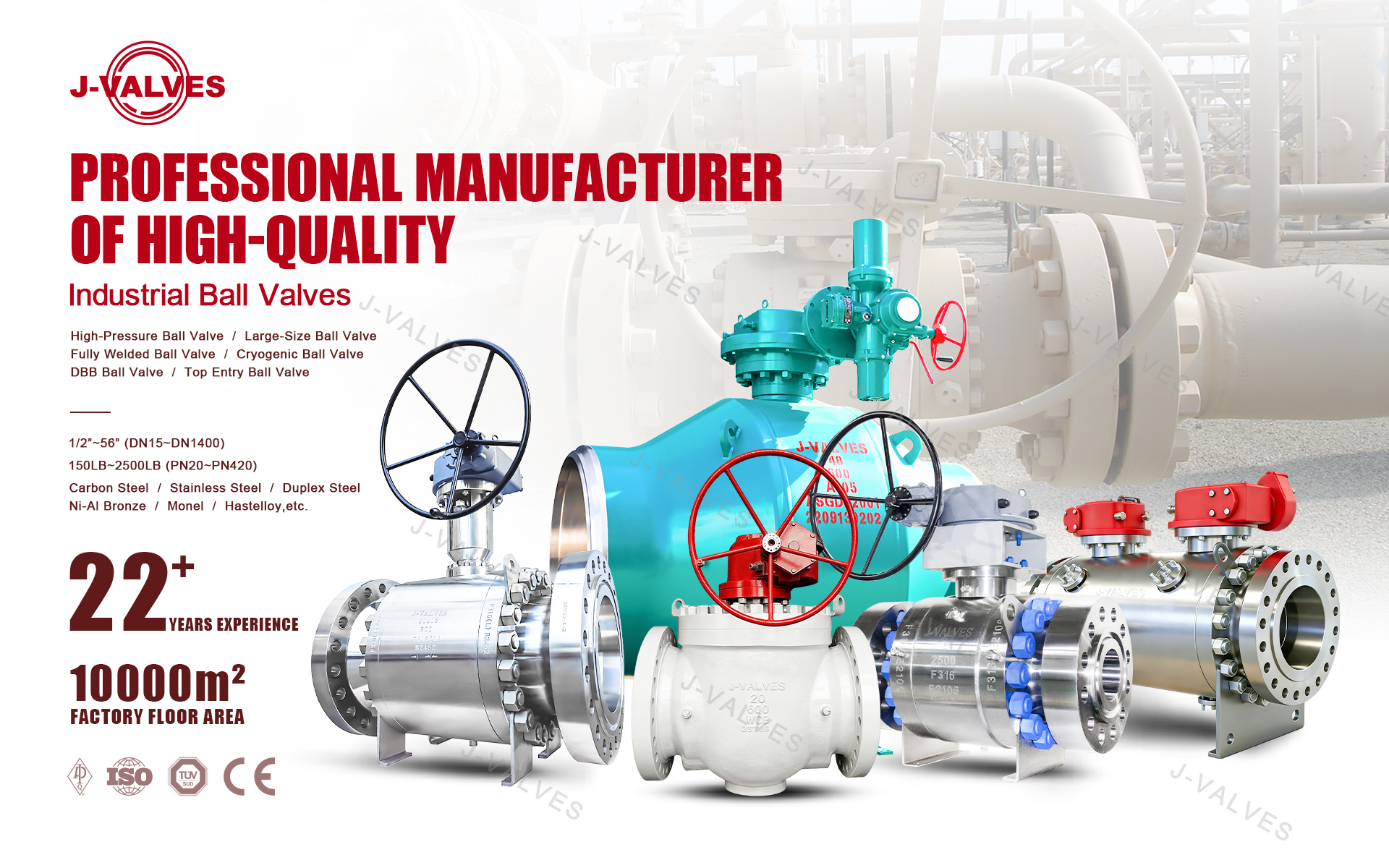
A DN80 WCB floating ball valve is the 3 inch carbon steel isolation valve that appears on almost every utility line in a plant: cooling water, instrument air, fuel gas, lube oil, and tank farm transfer. It is not a difficult valve to make, which is exactly why the differences between a good one and a cheap one are invisible until it has been cycled a few thousand times.
J-VALVES builds the 3 inch size in A216 WCB as a two piece body with RF flanges, Class 150 to 600, PTFE or RPTFE seat, F6a stem and an ISO 5211 pad for actuation. It is the highest volume size in the range, and the one where the detail decisions, seat pocket depth, stem finish, gasket confinement, decide whether the valve is still tight at year five.
Why 3 Inch Is the Most Specified and Least Examined Size
Three inch is the size where a line stops being an instrument connection and becomes a process line, so it gets a real valve, but it is still small enough that nobody reviews the drawing. On a large project there may be two hundred of them in the valve list, all bought on price, and the first sign of a problem is a maintenance report three years later listing seat leakage on a group of valves from the same batch.
The parts that fail are predictable. The seat pocket is machined too deep, so the seat has less squeeze than the design intended. The ball is polished to a roughness that looks good but is measured across the wrong direction. The stem finish is left at 1.6 micrometres when the packing needs 0.4. None of these show up in a dimensional report unless the report was written to catch them.

WCB: What It Is and Where It Stops
A216 WCB is cast carbon steel with about 0.30 percent maximum carbon, 0.50 to 0.90 manganese and 0.60 maximum silicon, with minimum yield of 250 MPa and tensile of 485 to 655 MPa. It is weldable, machinable, cheap, and adequate for water, oil, gas and steam to 425°C. Its limitation is not strength but corrosion and low temperature toughness.
Service | WCB suitable | Better choice | Reason |
|---|---|---|---|
Water, cooling, fire main | Yes | WCB with epoxy lining for soft water | Corrosion allowance is enough |
Steam to 425°C | Yes | WC6 above 450°C | Oxidation and creep above 425°C |
Fuel gas, dry | Yes | WCB with NACE if sour | Sour service needs hardness control |
Seawater | No | Cu5MCuC or duplex | WCB corrodes rapidly in chloride |
Below -29°C | No | A350 LF2 to -46°C, stainless below | Charpy toughness falls sharply |
Dilute acid | No | F316 or lined body | Carbon steel is not corrosion resistant |
The Two Piece Joint Is the Maintenance Decision
A two piece body splits at a single flanged joint next to the ball, so the internals come out after unbolting one set of studs. That is fast on a bench and awkward in a pipe rack, because the downstream pipe has to be supported when the joint opens. A three piece body puts the joint in two places and lets the centre section drop out, which is better in a rack and worse for the number of gaskets.
The gasket itself is usually a spiral wound 316L with a graphite filler, confined in a machined groove. A confined gasket cannot be blown out and cannot creep, and on a 3 inch Class 300 valve it costs almost nothing. An unconfined flat gasket on the same joint is the single most common cause of a body joint weep, and it is chosen because it is cheaper by a few percent.
Seat, Flow and Pressure Drop
A full port 3 inch ball valve has a bore of about 76 mm and a Cv in the order of 1,100, so the pressure drop across it in the open position is negligible compared with a globe valve of the same size. That is the reason ball valves replaced gate valves on utility lines: not the quarter turn, but the straight bore.
Configuration | Bore | Relative Cv | Use |
|---|---|---|---|
Full port 3 inch | About 76 mm | 1.0 | Pigging, viscous media, minimum pressure drop |
Reduced port 3 inch | About 62 mm | 0.65 to 0.70 | Cost and weight saving, clean fluids |
Full port 3 inch with soft seat | About 76 mm | 1.0 | Bubble tight isolation, rate A |
3 inch metal seated | About 76 mm | 1.0 | High temperature, abrasive, rate V or VI |
The seat material sets the temperature and the leakage, not the flow. PTFE covers -29 to 200°C and gives rate A. RPTFE adds strength at the same temperature. PEEK reaches 260°C with a higher torque. Above that the choice is a metal seat, and the leakage rate changes from zero to a measured figure, which should be written into the specification rather than discovered at commissioning.

Flange Drilling: Where DN80 Orders Go Wrong
A DN80 valve can be ordered with PN16, PN40, Class 150 or Class 300 flanges, and only one of them will bolt to the pipe in front of it. PN16 at DN80 has 8 bolts on a 160 mm circle with 18 mm holes; Class 150 has 4 bolts on a 152.4 mm circle with 19 mm holes. The outside diameters are also different, so the gasket does not bridge the two.
The failure mode is a valve delivered to site, matched against the flange, found not to fit, and returned. It costs six weeks. Writing both the pressure system and the flange standard on the purchase order, for example DN80 PN16 to EN 1092-1, removes the ambiguity entirely.
Testing and Delivery
Shell test at 1.5 times the rating, seat test at 1.1 times, both to API 598, with the seat result at rate A for a soft seated valve. The body casting is examined and pressure tested before machining, and any weld repair is recorded. The standard delivery is 3 to 5 weeks for Class 150 and 300 in WCB, and the valve ships with a 3.1 certificate, a dimensional report and the test records.
Actuation is worth deciding at the order stage even if the valve is bought manual. An ISO 5211 pad costs almost nothing when it is cast in and cannot be added later without changing the bonnet, and about one in five utility valves ends up actuated within its life.

DN80 WCB Floating Ball Valve FAQ
What does DN80 mean in inches?
DN80 is a nominal size of 80 mm, which corresponds to 3 inch nominal pipe. The actual bore of a full port DN80 ball valve is about 76 mm, and the flange dimensions follow the pressure standard rather than the nominal size.
What is WCB material?
WCB is cast carbon steel to ASTM A216, with about 0.30 percent maximum carbon and minimum yield of 250 MPa. It is the standard body material for water, oil, gas and steam up to 425°C, and it is not suitable for seawater or for service below about -29°C without impact testing.
Will a DN80 PN16 valve fit a 3 inch Class 150 flange?
No. The bolt circles and hole sizes differ, 160 mm with 18 mm holes for PN16 against 152.4 mm with 19 mm holes for Class 150, and the flange outside diameters also differ. An adapter or a spool piece with the correct drilling is needed.
What is the flow coefficient of a 3 inch ball valve?
A full port 3 inch ball valve has a Cv in the order of 1,100. A reduced port version is about 65 to 70 percent of that. The exact figure depends on the bore and the seat geometry and should be taken from the manufacturer data sheet rather than estimated.
Should I choose a two piece or three piece body?
A two piece body is cheaper and has one gasketed joint, and it is fine where the valve can be removed for maintenance. A three piece body lets the centre section be dropped out between two fixed flanges, which is better in a pipe rack or where the line cannot be moved. Both need the downstream pipe supported when the joint is opened.
What is the lead time for a DN80 WCB valve?
Three to five weeks for Class 150 and 300 in WCB with a PTFE seat, and four to six weeks for Class 600 or a metal seat. Actuated versions add two to three weeks depending on the actuator and whether a positioner is required.
Hot Products


News
Ball Valves in A Kraft Pulp Mill: Black Liquor, Green Liquor And The Cost of Choosing The Alloy by Habit
White liquor at pH 14 cracks carbon steel welds, black liquor sets solid below 100 C, green liquor dregs grind seats: alloy choice and torque in a kraft mill.
Read More
Slug Flow And Ball Valves: What Actually Arrives At The Seat
A slug is liquid mass with momentum, not a pressure spike. What changes at the seat, in the cavity and at the actuator when liquid reaches a ball valve.
Read More
Ball Valves in Direct Lithium Extraction: PH 1 Eluate, Gypsum Scale And 438,000 Cycles in Twenty-Five Years
Direct lithium extraction swings valves from pH 1 eluate to pH 12 caustic, 48 column switches a day and gypsum scale. Materials, seats and torque.
Read More
Ball Valves in Geothermal Brine: Silica Scale, Chloride Cracking And The Cooling Trap
Why geothermal brine destroys ball valves: retrograde silica scale, calcite at the flash point, chloride cracking above 60 C and the 250 C seat limit.
Read More