

CHINA J-VALVES Offers Various High-quality I ndustrial Ball Valves
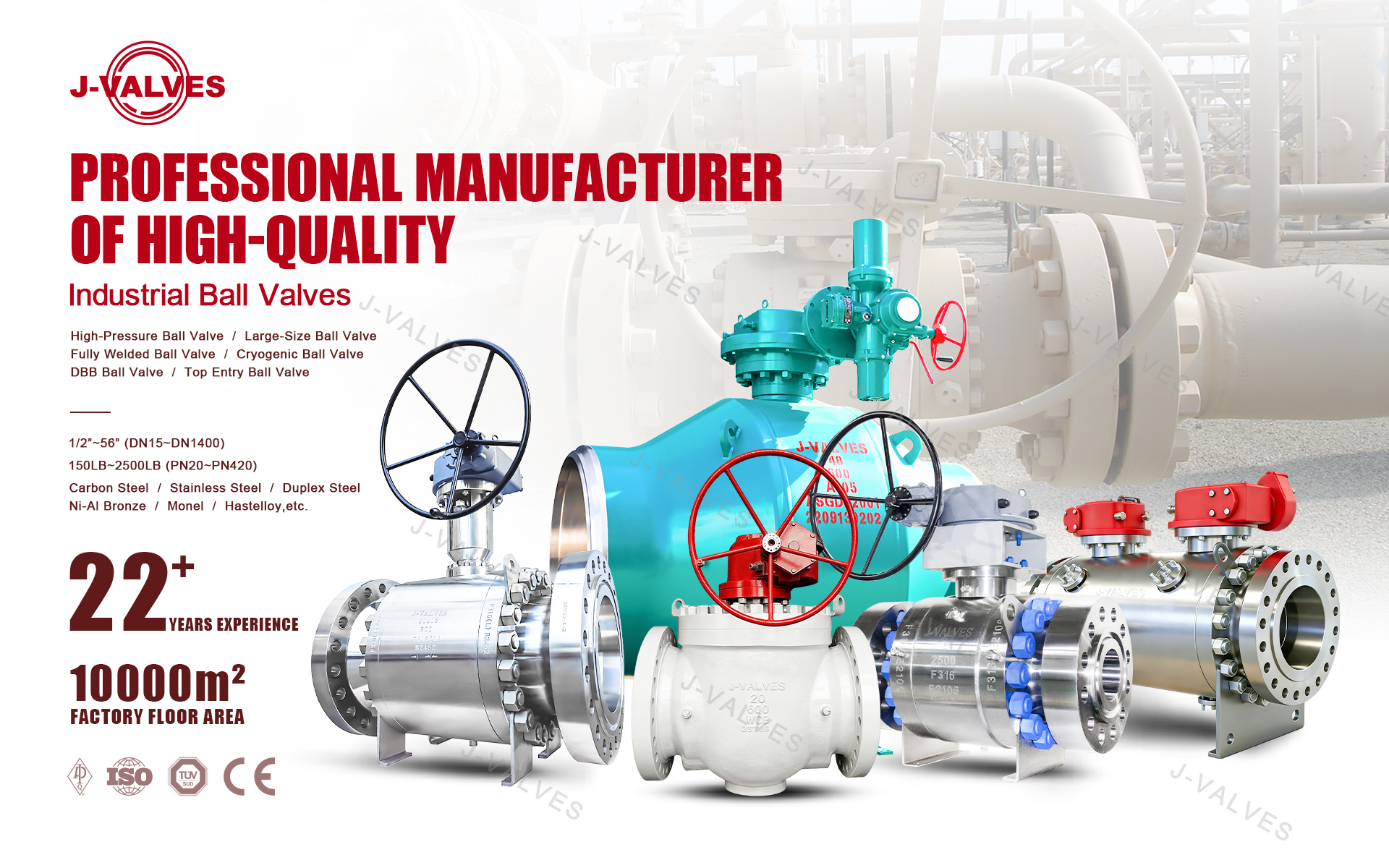
J-VALVES, a distinguished professional ball valve manufacturer rooted in China, takes pride in its extensive product portfolio. Our offerings span a wide range, including trunnion-mounted ball valves, floating ball valves, high-temperature ball valves, high-pressure ball valves, metal-sealed ball valves, ultra-low temperature ball valves, DBB ball valves, Three-way And Four-way Ball Valve, and fully welded ball valves. Each product is a testament to our commitment to precision engineering and reliable performance. Meticulously crafted, they are designed to not only meet but exceed the most stringent industrial demands, ensuring stable operation even under extreme conditions. This enables us to provide our clients with high-value services and makes our valves widely sought-after in industries.
Product Category
Contact Us


Pressure Class: ASME Class 1500 (PN250), Class 150 to 2500 available
Temperature Range: -46°C to +200°C, to +425°C with metal seat
Body Material: ASTM A105N normalized forged carbon steel
Ball: A105N + ENP, or 316 stainless
Seat: Nylon, PEEK, or metal hard seat
Stem: 17-4PH or A564 Type 630, extended, anti blowout
Packing: Graphite with O ring secondary, in the gland plate at the top
Stem Extension: 300 to 2000 mm to order, sealed housing, guide above 800 mm
Body Style: Two or three piece, trunnion mounted
End Connection: Flanged RF / RTJ to ASME B16.5
Design Standard: API 6D, ASME B16.34
Test Standard: API 6D, API 598, ISO 5208
Certification: API 6D, API 607, EN 10204 3.1, PED / ATEX optional
-
Q347H/Y
-
J-VALVES
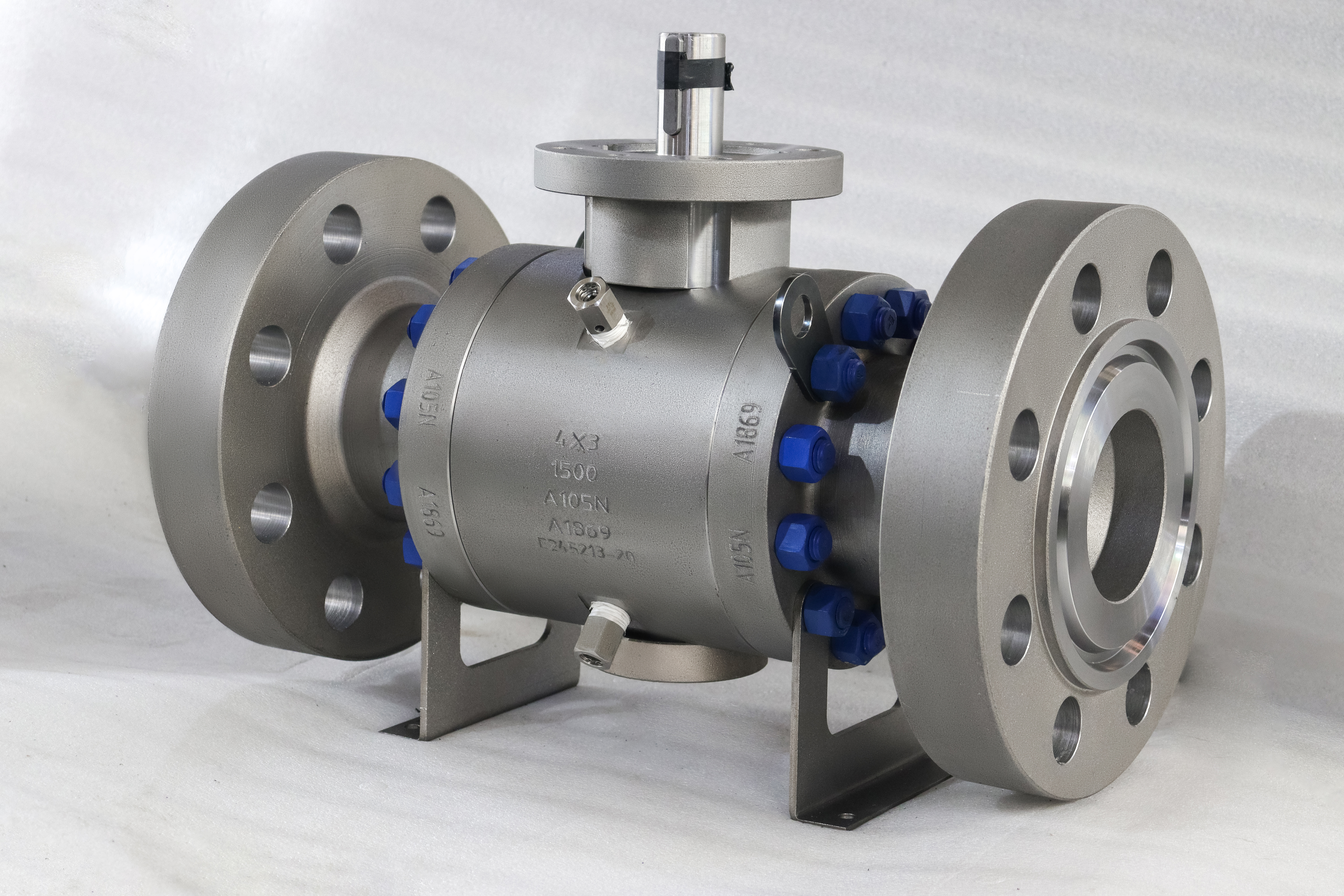
A long stem ball valve is an ordinary valve with the operator moved away from the body: the stem is extended so the packing and the handwheel or actuator sit above ground, above the insulation, or outside a wall, while the body stays in the line. On a buried 2 inch Class 1500 gas line it is the difference between an accessible isolation point and a hole in the road every time the valve needs to be operated.
J-VALVES builds this valve with an ASTM A105N normalized forged body, a trunnion mounted ball, an F6a or 17-4PH stem, and an extension length agreed per project, typically 300 mm to 2000 mm. The stem seal sits in the gland plate at the top of the extension, not at the body, so a seal failure does not become a leak into the ground.
What a Long Stem Is Actually For
There are four reasons to extend a stem, and they are not interchangeable. The valve is buried and the operator must be at grade. The line is insulated and the operator must clear the insulation. The valve is inside a cold box or a hot box and the seal must sit outside it. The valve is on a wall or a deck penetration and the operator must be on the accessible side.
Reason | Typical extension | What sets the length | Detail that gets missed |
|---|---|---|---|
Buried line, valve pit or direct buried | 600 to 2000 mm | Depth of cover plus 300 mm of clearance | Extension housing must be sealed against groundwater |
Insulated hot line | 150 to 400 mm | Insulation thickness plus removable box | Insulation must not be cut away in service |
Cold box or cryogenic | 300 to 800 mm | Wall thickness plus the distance to keep the gland above 0°C | Vapour barrier must be continuous |
Wall or deck penetration | 100 to 300 mm | Wall thickness plus flange clearance | Bending load from the extension has to be carried |
Each of these changes the drawing in a different way. A buried valve needs a sealed housing and a stem that will not corrode in groundwater. An insulated valve needs a steam jacketed or simply long neck so the gland does not sit at line temperature. A cold box valve needs a vapour barrier and a length calculated from heat leak, not from convenience.

How the Extension Length Is Calculated
The starting point is the physical obstruction: the depth of cover for a buried valve, the insulation thickness plus the cladding and the removable box for an insulated one. To that, add the distance needed to keep the packing within its temperature range at the specified ambient, and then add the room the operator or actuator needs.
For a buried line the second term is usually small, because the ground temperature is stable and the fluid is not extreme. For an insulated 300°C line the second term dominates: a 200 mm carbon steel stem conducts enough heat to take the gland above 100°C, and a 400 mm stem brings it down to a range where graphite packing and a standard handwheel are both comfortable. The calculation is a fin equation, and it is worth doing rather than copying a length from another project.
Where the Stem Seal Sits, and Why It Matters
On a standard valve the packing sits in the bonnet, directly above the body. On a long stem valve the packing sits in a gland plate at the top of the extension, and the extension itself is a dry column. That relocation is the whole point: if the packing leaks, the leak is at the top where it can be seen, not at the bottom where it enters the soil or the insulation.
The column is not a pressure boundary, but it has to be strong enough to resist bending and stiff enough that the stem does not rub. On extensions above about 800 mm we add a steady bearing or a guide inside the housing, and on very long extensions the housing is flanged in sections so it can be installed and removed without lifting the valve.
A105N at -46°C and at 200°C
A105N is the normalized grade of A105 forged carbon steel, and normalization is what gives it consistent grain size and impact toughness. It is used from about -29°C as standard, and to -46°C when impact tested and specified, which is why it appears on low temperature lines that are not cold enough for stainless. At the top end it is good to about 425°C, though 200°C is the practical limit where a PTFE seat is used.
Service condition | A105N suitable | Alternative | Note |
|---|---|---|---|
-46 to -29°C | Yes, with Charpy test at the design temperature | A350 LF2 | Impact test must be on the certificate |
-29 to 200°C | Yes, standard | None needed | Normal operating band with PTFE seat |
200 to 425°C | Yes, with graphite packing and metal seat | A105N with WC6 trim | PTFE seat no longer suitable |
Below -46°C | No | A350 LF2 to -46°C, F316 below | Charpy shelf collapses |
Sour service | Yes, with NACE MR0175 | A105N with hardness control | Hardness limit applies to stem and bolting |
Class 1500 at 2 Inch: Small Valve, Serious Pressure
At 2 inch the valve is small enough to carry, but Class 1500 is about 25.5 MPa at 38°C and the seat thrust is still substantial for a 50 mm bore. That is why this size is trunnion mounted rather than floating in high pressure service: the trunnion takes the pressure load and the stem only transmits torque, which keeps the operating torque low enough for a handwheel through a 1500 mm extension.
The end connections are RF or RTJ flanges to ASME B16.5, and at Class 1500 the RTJ is common because the joint is more forgiving of the bolt relaxation that follows thermal cycling. Face to face follows ASME B16.10, and the extension does not change it, which matters when the valve replaces an existing one in a spool.
Bending, Alignment and Installation
A 1500 mm extension is a lever, and anything that pushes on the handwheel becomes a bending moment at the gland and at the body joint. The housing should be supported independently at intervals, the extension should be vertical where possible, and the valve should not be used as a pipe support. On a buried installation the housing is surrounded by compacted sand or a sleeve, not by rubble.
Alignment is the other failure mode. If the body and the extension housing are not coaxial, the stem rubs on the guide, the packing wears on one side and the torque rises. We align and pin the housing at the works and mark the orientation, so the site only has to bolt it down in the position it was built for.

Testing and the Records That Matter
Shell and seat tests follow API 598 at 1.5 and 1.1 times the rating. Two additional checks belong on a long stem valve: a stem rotation test through the full quarter turn with the extension fitted, to prove there is no binding, and a packing leak test at the gland plate with the valve under pressure. Both are quick and both catch the faults that would otherwise be found after backfill.
The document package includes the 3.1 certificate with the Charpy results if low temperature, the dimensional report including the extension length measured from the body centre to the gland face, the shell and seat records, and a drawing showing the orientation and the support points. For a buried valve that drawing is the only record of where it is.

Specifying a Long Stem Valve
Size, class, and the face to face dimension if the valve replaces an existing one.
Why the stem is extended, since the four reasons lead to different housings.
The extension length and the datum it is measured from, body centre to gland face is the usual convention.
Whether the extension is exposed, in a pit, in a sleeve or insulated.
Design minimum temperature, and whether Charpy testing to -46°C is required.
Operator type and the torque available at the top of the extension.
Support and guide arrangement for extensions above 800 mm.
Orientation on site, and whether the housing must be rotational adjustable.
Long Stem Ball Valve FAQ
What is a long stem ball valve?
It is a ball valve with an extended stem so the packing and the operator sit away from the body, above ground, above insulation or outside a wall. The body stays in the line and the extension brings the operating point to where a person or an actuator can reach it.
Why does the stem seal move to the top of the extension?
So that a packing leak appears at the accessible end rather than at the buried body or inside the insulation. The extension itself is a dry column and is not a pressure boundary, which is also why it can be built in sections and flanged.
How long should the extension be?
It is calculated from the obstruction, the insulation or cover depth, the distance needed to keep the packing within its temperature range, and the room the operator needs. Buried valves typically use 600 to 2000 mm, insulated hot lines 150 to 400 mm, and cold box valves 300 to 800 mm.
What temperature can A105N handle?
About -29°C as standard and -46°C when impact tested, up to about 425°C at the top end. The practical limit is usually the seat rather than the body, since a PTFE seat stops at about 200°C.
Does the extension change the face to face dimension?
No. Face to face follows ASME B16.10 as for a standard valve, and the extension is added above the bonnet. That is what allows a long stem valve to replace a standard valve in an existing spool.
How is a long stem valve supported when buried?
The housing is supported independently at intervals, surrounded by compacted sand or a sleeve rather than rubble, and kept vertical where possible. Extensions above about 800 mm have an internal guide or steady bearing so the stem cannot rub.
Hot Products


News
Ball Valves in A Kraft Pulp Mill: Black Liquor, Green Liquor And The Cost of Choosing The Alloy by Habit
White liquor at pH 14 cracks carbon steel welds, black liquor sets solid below 100 C, green liquor dregs grind seats: alloy choice and torque in a kraft mill.
Read More
Slug Flow And Ball Valves: What Actually Arrives At The Seat
A slug is liquid mass with momentum, not a pressure spike. What changes at the seat, in the cavity and at the actuator when liquid reaches a ball valve.
Read More
Ball Valves in Direct Lithium Extraction: PH 1 Eluate, Gypsum Scale And 438,000 Cycles in Twenty-Five Years
Direct lithium extraction swings valves from pH 1 eluate to pH 12 caustic, 48 column switches a day and gypsum scale. Materials, seats and torque.
Read More
Ball Valves in Geothermal Brine: Silica Scale, Chloride Cracking And The Cooling Trap
Why geothermal brine destroys ball valves: retrograde silica scale, calcite at the flash point, chloride cracking above 60 C and the 250 C seat limit.
Read More