


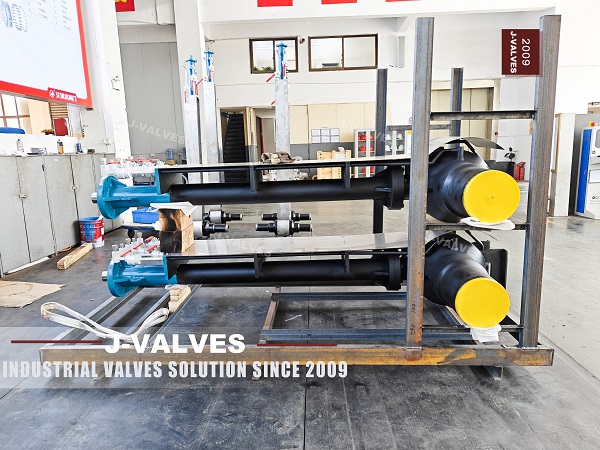
Buried does not change the ball. It changes who can reach it.
A buried ball valve is the same valve as the one standing on a skid, with one exception: there is nobody in front of it. The ball, the seats, the stem seals and the body joints are the same parts doing the same job at the same pressure. What changes is that every decision an operator would make by hand — turning the valve, reading the cavity gauge, draining the body, watching the gland for a weep — either has to be moved to the surface or given up entirely. The extended stem exists for that reason and for no other.
That reframing is worth holding on to, because most buried-valve conversations are about depth, and depth is the least interesting variable in the problem. A valve can be buried at whatever depth the site drawing shows. What cannot be adjusted once the trench is backfilled is whether the things that need reaching were brought up with the stem, and whether the extension was designed as a mechanical part rather than as a length of pipe.
Two architectures hide under one product name
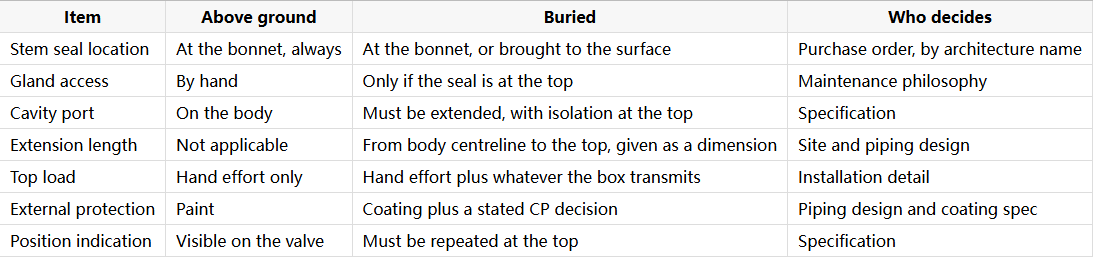
Before any dimension is discussed, one question settles most of the design: where is the stem seal. There are two answers in the market and they are not interchangeable.
In the first, the stem seal stays at the valve. The packing sits in the bonnet at the body, in the usual place, and the extension is a dry column with a shaft in it. This is compact, cheap, and it keeps the pressure boundary exactly where an above-ground valve keeps it. It also means the gland cannot be tightened, repacked or even inspected without excavation, so a valve that starts to weep through the packing has to be dug out or left weeping.
In the second, the stem seal is moved to the top. The extension becomes a pressure-containing column, the packing is at the surface, and the gland is serviceable by a person standing at the box. That is the whole point of burying a valve somebody expects to maintain, and it costs more, because the column is now a designed pressure part with its own wall thickness, its own material and its own shell test. A valve of this type is sometimes described as having a pressure-containing extension or a buried bonnet; the naming varies by maker, the engineering does not.
The failure mode of getting this wrong is quiet. A buyer who assumes the gland is accessible and receives the first architecture has a valve that passes every test in the shop and cannot be maintained in the ground. A buyer who assumes a dry column and receives the second has a pressure part that was never in the specification and never witnessed at test. Either way the paperwork looks complete, which is why the architecture has to be written down by name rather than inferred from a drawing title.
What the extension actually carries
Two loads, and neither of them is the one people plan for.
The first is torsion. The column is a shaft in torsion over its whole length, so its torsional stiffness decides how much of the input at the top arrives at the ball. A long slender stem winds up; the operator feels a spring rather than a seat. For a hand operator that is merely misleading, because the effort at the top reads as stiffness that is not in the valve. For a powered operator it is worse: a torque switch or a torque-limiting device at the top sees the wind-up as stored energy, and that energy releases the instant the ball breaks away, so the device trips late and the valve takes a shock it was never sized for. Extension length is therefore a shaft design input, and it belongs in the same conversation as the operator selection rather than in the piping layout.
The second is bending, and it arrives from above. The top of the column is where a person leans, where a key is hammered home, where a wrench gets an extension bar slipped over it. None of that should reach the stem at the gland, because a stem bent by a fraction of a degree at the packing is a stem that leaks and then scores. The load path has to go into the housing through a guide bearing near the top, and the housing in turn must not be asked to carry loads it was not designed for. This is the argument for keeping the road box or valve box structurally independent of the extension: a box bolted to the top of the stem tube turns every vehicle that crosses it into a bending moment on the gland.
Depth is set by three things, and the valve is none of them
Cover over the pipe is set by the piping design code and the site: traffic loading, frost penetration, agricultural working depth, the client's own buried-piping standard. Pipe elevation is set by the pipeline profile and by the need to keep the body clear of the trench bottom and its bedding. The operating height at the top is set by the box and by the person who has to stand at it. The valve maker receives a dimension from body centreline to the top of the extension, and that dimension is a site decision that arrives on a drawing.
This is where catalogue lengths cause trouble. A buried valve quoted with a standard extension length is a valve that will either finish below the box and need a spacer, or finish above it and foul the lid. Neither outcome is dangerous and both are expensive, and both are avoidable by one line on the enquiry: state the dimension, and state that the extension is made to it.
The ports have to come up with the stem
An extended stem on its own solves the turning problem and leaves the diagnosis problem untouched. On a buried valve, the body cavity port is where the seats are proved, and it is two metres underground. If it is not extended it will never be opened, and the first evidence of a passing seat becomes product in the soil.
So the extension is not only a stem tube. It is the place where the cavity vent, the cavity drain and, on valves that carry them, the seat sealant lines reach the surface. Each of those is a small bore line running alongside the stem, and each needs three things at the top: its own isolation, its own cap, and a route that does not hold water. A cavity vent that terminates in a pocket will fill and then freeze, and a sealant line with no cap at the top is a leak path pointing at the operator.
A body drain belongs in the same list. A drain at the lowest point of a buried body is a fitting that can never be used, which makes it a corrosion pocket with a thread in it. Where a body drain is required by the specification, it should be extended with the rest.
The annulus is a wet tube, whichever architecture was bought
Ground water finds the column from below, condensation forms in it from above, and the annular space between stem and housing is a small volume with two large steel surfaces in it. A column sealed at the top holds that moisture indefinitely. A column open at the top collects rain. The workable arrangement is a drain at the bottom, a cap at the top that sheds water while letting vapour out, and the assumption — written into the material selection — that the inside of the column is a wet environment. That assumption is what decides whether the stem in the column is stainless or coated, and whether the guide bearings are a bearing material or a piece of mild steel waiting to become a rust bridge.
Coating, and the question nobody writes down
A buried body needs a coating system and it needs to survive backfill, which is the part of installation that damages coatings most. Field joints and the penetration where the extension leaves the body are the two places where a holiday is most likely and least visible, and they are the two places that get the least attention because they are done in the trench.
The question that goes unasked is electrical continuity. Cathodic protection only protects steel it can reach, so the valve has to be either continuous with the pipeline and inside the CP system, or deliberately isolated from it with isolating gaskets and a spark gap. Both are legitimate. What is not legitimate is the accidental third case, where an isolating gasket sits on one flange and bare steel contacts the other side, so the valve becomes the anode of a cell it was never designed to be in. On a buried valve this decision is made at the flange, by whoever assembles it, unless the purchase order makes it first.
The operator at the top
A handwheel under a box is a valve nobody turns. The gear ratio that made a large valve easy at waist height makes it slow at knee height, in the dark, through a lid. Three arrangements work: a bare operating nut on a key square, operated with a tee wrench kept on site; a gear operator at the surface with its input shaft and handwheel brought up; or an actuator mounted at the top with the extension carrying the drive.
Whichever is chosen, the extension should carry a visible position indicator, meaning a pointer on the stem head and a scale that reads from outside the box. An operator at the surface cannot see the ball. A buried valve that is a quarter turn away from where the paperwork says it is will be operated the wrong way at the worst moment, and the indicator is the only defence against that.
Where buried valves actually fail
The list is short and it repeats. A gland that begins to weep and cannot be reached. Water standing in the column until the stem scores at the guide and the torque climbs until a key shears. Coating damaged during backfill, with external corrosion starting under an intact-looking wrap. A cavity port left below grade, so a leaking seat is discovered as a loss of product rather than as a gauge reading. An extension used as a step or a lever point, bending the stem at the packing. And an extension length taken from a catalogue instead of from the site drawing, which produces either a spacer or a second excavation.
Only one of those is a valve problem. The rest are interface problems that were settled by whoever wrote the enquiry, which is why the buried valve is a specification exercise more than a design exercise.
Testing a buried valve, and what the test does not cover
The pressure tests are the usual ones: shell at 1.5 times rating, seat at 1.1 times in both directions. Where the extension is a pressure-containing part, it is a pressure part and it is shell tested as one, separately from the body, so that a leak into the column is detectable instead of hidden. That is a test a dry-column valve does not need and a surface-seal valve cannot skip.
What no pressure test covers is whether the shaft assembly works at length. That needs a functional check: operate from the top, confirm the full quarter turn in both directions, confirm the indicator agrees with the ball, and record the torque measured at the top. That record is worth keeping, because it is the only baseline the site will ever have. When the same valve is operated five years later and feels stiff, the question of whether it was always stiff is answered by a number in a file rather than by an argument.
What to write into the purchase order
Six lines carry the whole requirement. Which architecture, stated as seal at the valve or seal at the surface, with the consequence spelled out. The dimension from body centreline to the top of the extension, and confirmation that the extension is made to it. Which ports are extended — cavity vent, cavity drain, sealant — with their size and their isolation at the top. The coating system, the field joint coating, and whether the valve is to be electrically continuous with the pipeline or isolated from it. The operator at the top, meaning nut and key size, gear operator with input shaft, or actuator mounting, together with the position indicator and the lockout. And whether the top of the extension is designed for the box load or the box is independently supported.
J-VALVES builds buried and extended-stem ball valves from 1/2 to 56 inch (DN15 to DN1400) in ASME Class 150 to 2500, in floating and trunnion-mounted patterns and in three-piece, top-entry and fully welded bodies, with the extension made to the customer's centreline-to-top dimension, the cavity port extended to the surface with its own isolation, and either the seal at the valve or a pressure-containing extension with its own shell test. Bodies are shell tested at 1.5 times and seats at 1.1 times rated pressure in both directions, with FBE or liquid coating systems, API 607 fire-safe construction, NACE MR0175 materials and EN 10204 3.1 certificates available on the same order.
Frequently Asked Questions
How long should a buried ball valve stem extension be? There is no standard length, and that is the point. The length comes from the site: cover required over the pipe, the elevation of the pipeline, and the height at which the operator or the box has to sit. The valve maker is given a dimension from body centreline to the top of the extension and builds to it. A valve ordered with a catalogue length usually needs a spacer or a second excavation.
Is the stem extension a pressure-containing part? It depends on where the stem seal sits. If the packing stays at the valve body, the extension is a dry column and carries no pressure. If the seal is brought to the surface so the gland can be serviced, the column is a pressure boundary, and it has to be designed, shell tested and certified as a pressure part in its own right. The two are not interchangeable and the purchase order should name which one is wanted.
Can an ordinary above-ground ball valve be buried with a stem extension fitted? The body usually can be, with the right coating. The installation usually cannot. The cavity port stays below grade and is never used, the gland becomes unreachable, and the external coating is rarely specified for backfill damage. Burying a standard valve is possible; maintaining it afterwards is the part that fails.


