


CHINA J-VALVES Offers Various High-quality I ndustrial Ball Valves
J-VALVES, a distinguished professional ball valve manufacturer rooted in China, takes pride in its extensive product portfolio. Our offerings span a wide range, including trunnion-mounted ball valves, floating ball valves, high-temperature ball valves, high-pressure ball valves, metal-sealed ball valves, ultra-low temperature ball valves, DBB ball valves, Three-way And Four-way Ball Valve, and fully welded ball valves. Each product is a testament to our commitment to precision engineering and reliable performance. Meticulously crafted, they are designed to not only meet but exceed the most stringent industrial demands, ensuring stable operation even under extreme conditions. This enables us to provide our clients with high-value services and makes our valves widely sought-after in industries.
Product Category
Contact Us

-
J-VALVES-Q347F
-
J-VALVES
Overview of the J-VALVES 8 Inch 2500LB F11 Chrome Moly Flange Ball Valve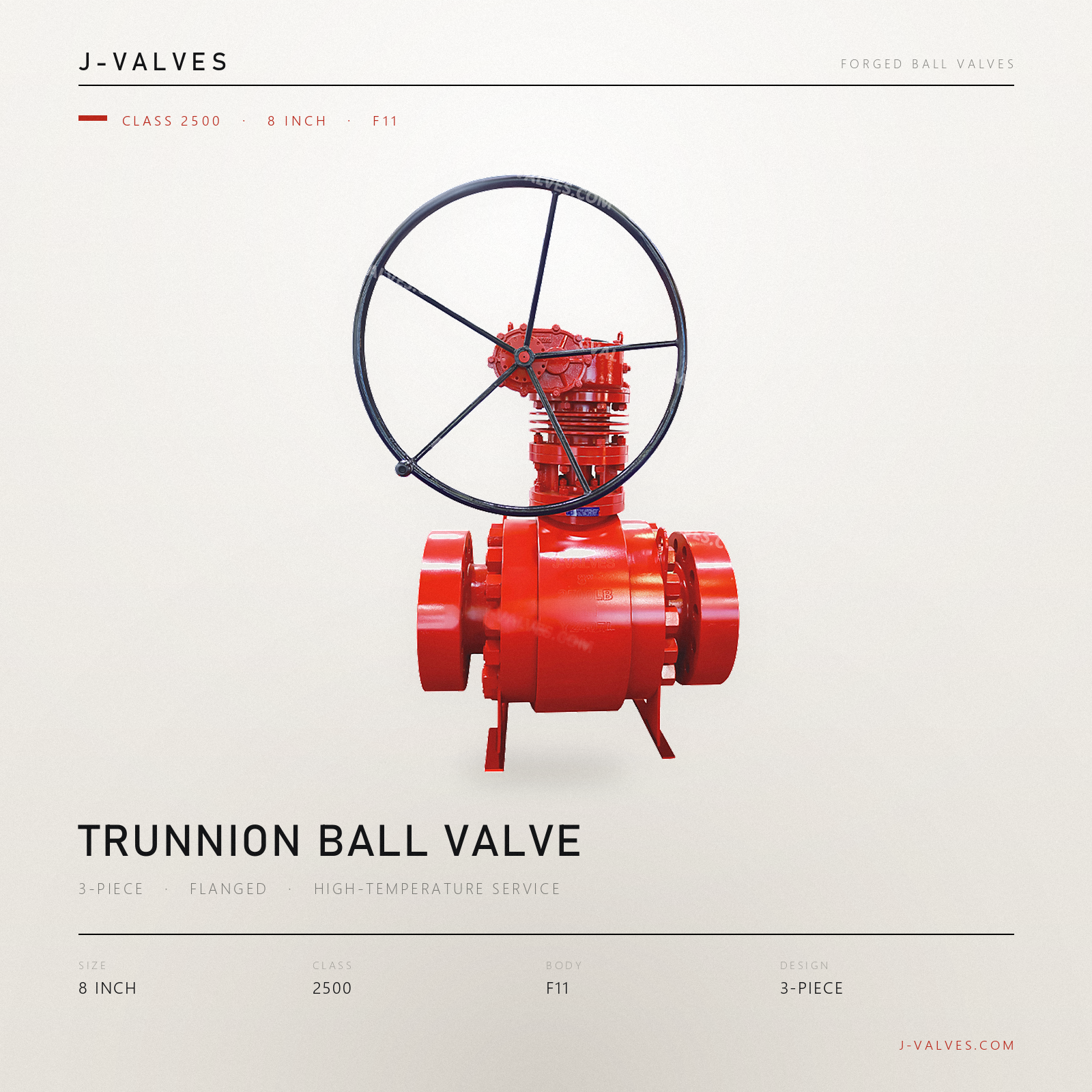
An eight inch Class 2500 ball valve with a forged 1.25Cr-0.5Mo body to A182 F11. The class fixes the wall and the ring joint flange; the chrome moly fixes what the valve can do above the carbon steel ceiling. Metal seats, A193 B16 bolting, graphite packing and ring gaskets are the four items that must be ordered together, and API 6D governs how the finished valve is tested and marked.
Two decisions decide whether this valve is the right purchase, and they are made by different people. The Class 2500 rating decides the wall, the flange and the test pressure, and at eight inch that means a heavy forged body with a ring joint face. The chrome moly grade decides what happens to the metal at temperature: carbon steel stops being a safe choice well before the temperatures this valve is bought for, and an austenitic stainless loses strength where 1.25Cr-0.5Mo still has creep strength. Buying both at once is the whole point of the part.
Design and Construction
Three pieces: a centre body that carries the ball, both seats and the stem, and two side bodies that carry the flanges. The ball is held between an upper and a lower trunnion instead of floating, so the pressure load goes into bearings rather than into the downstream seat, and the operating torque stays within what a gearbox can deliver. At Class 2500 that is not a refinement. On a floating design the seat would carry the whole thrust of an eight inch bore at 2500 rating, and no seat ring of that size survives it.
The stem is separate from the ball and is retained by the body so it cannot be blown out; the packing sits in a gland that can be adjusted and repacked with the valve in place. Both seat rings are spring loaded against the ball, which keeps a sealing force on the seat at low line pressure, and the body cavity relieves through the seat rather than through an external vent. The two bolted body joints are the only places where the pressure boundary is made by fasteners instead of by a forging, which is where assembly quality actually shows.

Material Options
The body is forged A182 F11, normalised and tempered. The grade is 1.25 percent chromium with half a percent molybdenum, and the chromium is there for oxidation resistance and the molybdenum for creep strength. Above the range where carbon steel is allowed, that combination is what keeps a pressure boundary from thinning under load over years of service. It is not a corrosion grade: F11 is a high temperature grade, and it is chosen for temperature and for the resistance of its oxide scale, not for chloride service.
The trim has to survive the same temperature as the body, which is where most of the practical choices sit. The ball and the seat rings are hardfaced with a cobalt alloy, with a nickel alloy as the alternative where cobalt is not acceptable to the end user; hard chrome is available for lower temperature duties but is not the right answer at the top of the range. The stem is 17-4PH or a nickel alloy, and bolting moves to A193 B16, which is the chrome moly bolt grade for high temperature flanged joints.
| Component | Standard Material | Optional Upgrade | Service Notes |
|---|---|---|---|
| Body and side bodies | ASTM A182 F11 forged, normalised and tempered | A182 F22, A105, F316 | three pieces, two bolted joints |
| Ball | F11 with cobalt alloy hardfacing | nickel alloy hardfacing, hard chrome | lapped to its own seat pair |
| Seat | Metal seat, hardfaced, spring loaded | nickel alloy hardfacing | pass or fail to API 598, not zero leakage |
| Stem | 17-4PH | nickel alloy | retained by the body, blowout proof |
| Bolting | ASTM A193 B16 | B7 for lower temperature | the high temperature joint depends on it |
| Body gasket | Spiral wound, graphite filled | ring joint at the body joint on request | renewed at every opening |
| End connection | RTJ flanged to ASME B16.5 Class 2500 | RF flanged where the line allows it | groove cannot be changed on site |
| Ring gasket | ASME B16.20 metal ring | soft iron, low carbon steel, stainless | new ring at every opening |
| Operator | Worm gear | pneumatic, electric, hydraulic | fitted after the pressure test |
Technical Specifications
The envelope is DN200, Class 2500, a three piece forged F11 body, full bore, ring joint flanges to ASME B16.5 at Class 2500, face to face to ASME B16.10 for that size and class, a metal seat, graphite packing, a worm gear operator and an API 598 pressure test. Class 2500 corresponds to PN 420 in the API 6D pressure designation table. The declared envelope is listed below; every dimension in it comes from the drawing signed for the build ordered, and that drawing is the only place where the numbers are final.
The end connection is the field that gets under specified. At this class a raised face is not the normal choice, and the ring joint groove has to be stated with its ring type, because an R ring, an RX ring and a BX ring do not interchange even where the flange size is the same. The groove is machined into the flange and cannot be changed on site. Face to face at this size and class is likewise a drawing figure, not a catalogue figure, because the body is not a catalogue casting.
| Item | Value |
|---|---|
| Nominal bore | 8 inch (DN200) |
| Pressure class | Class 2500 (PN 420, also written PN420) |
| Body construction | three piece, forged, two bolted joints |
| Body | ASTM A182 F11 forged 1.25Cr-0.5Mo |
| Body heat treatment | normalised and tempered |
| Body options | A182 F22, A105, F316 |
| Ball | F11 with cobalt alloy hardfacing |
| Ball option | nickel alloy hardfacing, hard chrome for lower temperature |
| Seat | metal seat, hardfaced, spring loaded |
| Seat option | nickel alloy hardfacing |
| Stem | 17-4PH, retained by the body |
| Stem option | nickel alloy |
| Bolting | ASTM A193 B16 |
| Bolting option | ASTM A193 B7 for lower temperature |
| Body gasket | spiral wound, graphite filled |
| End connection | RTJ flanged to ASME B16.5 Class 2500 |
| Ring gasket | ASME B16.20 metal ring, R or RX type as ordered |
| Face to face | ASME B16.10 for DN200 at Class 2500 |
| Bore | full bore, DN200 |
| Packing | flexible graphite, adjustable gland |
| Operator | worm gear |
| Operator options | pneumatic, electric, hydraulic |
| Design standard | ASME B16.34 and API 6D |
| Pressure test | API 598, shell 1.5 times, seat 1.1 times |
| Fire test | API 607 or API 6FA where ordered |
| Sour service | NACE MR0175 where specified |
| Material certificate | EN 10204 3.1 per heat |
| Non destructive examination | UT or MT on forgings as ordered |
| Marking | size, class, body grade, heat number, tag number |
| Temperature band | read from the B16.34 table for F11 at this class, with the packing stated |
| Pig passage | full bore, piggable |
| Cavity relief | self relieving through the seat |
| Paint | high temperature system to the project specification |
| Weight | quoted with the drawing for the build ordered |
Standards and Compliance
Three documents divide the work and they should not be quoted as if they were interchangeable. ASME B16.34 supplies the wall thickness and the pressure and temperature rating table for the body material, which is where the allowed pressure at the design temperature comes from. API 6D supplies the functional requirements for a pipeline valve, including the test regime, the marking and the documentation set. API 608 is the general steel ball valve standard; it is written for a different scope, and an order at this class should be placed to API 6D.
Around those three sit the joint standards. ASME B16.5 sets the flange and the groove profile, ASME B16.20 sets the ring gasket that goes into it, and ASME B16.10 sets the face to face. Material certification is EN 10204 3.1 per heat, and where the medium is sour the order adds NACE MR0175 and the hardness limits that come with it. Marking and packing, including the tag number on the nameplate, follow the project specification and the API 6D marking clause, and that is what the crate label has to agree with.
| Requirement | Standard | What J-VALVES Supplies |
|---|---|---|
| Pressure boundary | ASME B16.34 | wall thickness and the rating table for F11 at this class |
| Pipeline valve requirements | API 6D | test regime, marking and the documentation set |
| Flanges and groove | ASME B16.5 | Class 2500 ring joint facing |
| Ring joint gaskets | ASME B16.20 | R, RX and BX rings, matched to the groove |
| Face to face | ASME B16.10 | for DN200 at Class 2500 |
| Pressure testing | API 598 | shell at 1.5 times, seat at 1.1 times, both directions |
| Sour service where required | NACE MR0175 | hardness limits and material condition |
| Material certificate | EN 10204 3.1 | per heat, with the grade and heat number |
Manufacturing Process
The body starts as a forged billet rather than a casting, because at this wall thickness a forging gives a sound section without the shrinkage risk that follows a heavy cast node. It is normalised and tempered to the F11 condition, then machined with the bore, the seat pockets and both flange faces taken from common datums, so that the seat sits square to the bore and the two flange faces stay parallel to each other. Those two relationships are what the assembly depends on, and neither can be recovered by tightening afterwards.
The ball and the seat rings are hardfaced, ground and lapped as a pair, because a metal seat seals on the match between two surfaces rather than on the compression of a soft insert. The lapped pair is kept together through assembly and test. The valve is assembled on new gaskets, the body joints are torqued in a controlled sequence, and the operator is fitted only after the pressure test, so that a gearbox fault can never be mistaken for a seat fault during the test.

Quality Control and Testing
Every valve is shell tested at one and a half times its rating and seat tested at one point one times, both to API 598, and the seat test is run in both directions. On a trunnion valve with two spring loaded seats, testing from one side proves one seat and tells you nothing about the other, which is the failure that shows up after installation when the line is back pressured from the far end. A metal seated valve is judged pass or fail against the API 598 allowance; it is not a zero leakage device and should not be ordered as one.
The checks specific to this product are material and geometry. Positive material identification confirms the body, the ball and the stem against the certificate, because chrome moly and alloy trim look alike on the bench. Hardness is checked on the hardfaced surfaces to the limits in the order, the ring joint groove is checked for profile and depth with a gauge rather than by eye, and the body joints are checked for gasket seating and bolt extension. Forgings are ultrasonic or magnetic particle inspected as the order requires.
| Step | What Is Checked | Standard or Acceptance |
|---|---|---|
| Forging | composition, mechanical properties, heat treatment record | 3.1 certificate against A182 F11 |
| Ultrasonic or magnetic particle | internal and surface soundness of the forging | as specified to API 6D |
| Machining | bore and seat pocket square to each other, flange faces parallel | drawing tolerance |
| Hardfacing | thickness and hardness on ball and seat | hardness limits in the order |
| Ring joint groove | profile, depth and surface condition | B16.5 table for the size and class |
| Body joints | gasket seating, bolt extension, torque sequence | controlled tightening record |
| Shell test | body and both joints at 1.5 times | API 598, no leak |
| Seat test | each seat in both directions at 1.1 times | API 598 allowance |
| Material identification | positive identification on body, ball and stem | confirms F11 against the certificate |

Applications and Industry Service
The duty is high temperature isolation on heavy process lines: superheated steam headers, hydrogen and hydrotreater circuits, catalytic and thermal cracking, synthesis gas, and the hot section of a power plant. In those services the valve is closed most of its life and has to open on demand after long standing at temperature, which is the hardest thing to ask of a metal seated valve, because the ball and the seat have had every opportunity to bond, scale or creep into contact with each other.
It is the wrong valve for chloride bearing water, for a line that needs a soft seat to reach bubble tight shutoff, and for a low pressure duty where a carbon steel or stainless body would do the same job for less. It is also the wrong valve where the line will be opened often, because a ring joint needs a new ring every time and the groove has to be inspected each time. Above the temperature for which the grade and the packing are rated together, the correct answer is a different material, not a different seat.

Installation, Operation and Maintenance
Align the flanges without pulling them together with the studs, fit a new ring, and bring the joint up in a cross pattern in stages so the ring is deformed evenly. At this class the stud load is large and the ring is thin, so a joint that is tightened one stud at a time will leak in the pattern of the tightening rather than at random. Hot torque after the first thermal cycle is normal practice on a high temperature line, and the retorque value comes from the joint calculation, not from the workshop habit.
Operate the valve a quarter turn, fully open or fully closed, and leave the gearbox locked where the line must not be moved. The stem packing is adjustable and can be replaced with the valve in service, which is why the gland is accessible from the outside. Where seat injection ports are fitted, they are an emergency measure to get a leaking seat to the next shutdown; they are not a maintenance routine, and the seat is expected to be repaired or replaced at the first opportunity.
How to Specify and Order
The order has to carry the size, the class, the body grade with its heat treatment, the bore, the facing with the ring type, the trim and its hardfacing, the bolting grade, the packing, the operator and the standard set. A typical line reads: eight inch, Class 2500, body A182 F11 normalised and tempered, full bore, RTJ flanged to ASME B16.5 with R rings to B16.20, metal seat with cobalt alloy hardfacing, A193 B16 bolting, graphite packing, worm gear operator, API 6D.
Two lines are worth adding and both are routinely left out. State the design temperature, because it is what the rating table is read against and it decides between this grade and the next one up. State also whether the medium is sour and whether positive material identification is required at witness, because those two decide the hardness limits, the bolting and the documentation package, and neither can be added after the body has been forged. Packing and marking are then fixed by the project tag list.
FAQ
Q: Why use F11 instead of 316 stainless at this temperature?
A: Because the two fail differently. An austenitic stainless keeps its corrosion resistance but loses strength and creeps at the top of its range, while 1.25Cr-0.5Mo is a creep resisting grade with an oxide scale that holds at temperature. Above the carbon steel ceiling and below the point where a higher alloy is needed, F11 is the standard answer, and API 6D orders in that band are normally written around it.
Q: What is the maximum temperature for this valve?
A: It is not one number. The pressure the valve may carry at temperature comes from the ASME B16.34 rating table for A182 F11 at Class 2500, and the packing and the bolting have their own limits above that. The two are quoted together on the data sheet for the build ordered, and neither should be replaced by a single figure on a web page, which is exactly the mistake on the original page.
Q: Is API 608 enough for a Class 2500 valve?
A: Place the order to API 6D. API 608 is the general steel ball valve standard and it is the right reference for a general purpose valve, but a Class 2500 pipeline valve is bought with a documentation set, a marking clause and a non destructive examination requirement that API 6D states explicitly. Quoting 608 alongside 6D on the same line makes it impossible to say which one the inspection will be held to.
Q: Why ring joint instead of raised face?
A: At Class 2500 the joint has to hold a very high stud load on a small gasket area, and a metal ring in a machined groove does that better than a flat gasket on a raised face. The trade is convenience: the groove must be undamaged and the ring is used once. If the joint will be opened often, that cost belongs in the decision, because it cannot be designed out later.
Q: Why A193 B16 bolting?
A: Because the studs sit in the same thermal environment as the body and have to keep their preload there. B16 is the chrome moly bolt grade intended for high temperature flanged joints, and using a lower grade bolt on a hot Class 2500 joint is a common way to lose preload and start a leak that no amount of retightening fixes.
Q: Can the seats be replaced without removing the valve from the line?
A: Yes on this body style. Undo one side body and the seat and the ball on that side are exposed while the other seat and the line connection stay in place. What cannot be done in line is re-lapping a metal seat, so a damaged seat is a workshop job; the site work is limited to inspection, cleaning and replacing the parts that bolt in.


Hot Products


News
Ball Valves in A Kraft Pulp Mill: Black Liquor, Green Liquor And The Cost of Choosing The Alloy by Habit
White liquor at pH 14 cracks carbon steel welds, black liquor sets solid below 100 C, green liquor dregs grind seats: alloy choice and torque in a kraft mill.
Read More
Slug Flow And Ball Valves: What Actually Arrives At The Seat
A slug is liquid mass with momentum, not a pressure spike. What changes at the seat, in the cavity and at the actuator when liquid reaches a ball valve.
Read More
Ball Valves in Direct Lithium Extraction: PH 1 Eluate, Gypsum Scale And 438,000 Cycles in Twenty-Five Years
Direct lithium extraction swings valves from pH 1 eluate to pH 12 caustic, 48 column switches a day and gypsum scale. Materials, seats and torque.
Read More
Ball Valves in Geothermal Brine: Silica Scale, Chloride Cracking And The Cooling Trap
Why geothermal brine destroys ball valves: retrograde silica scale, calcite at the flash point, chloride cracking above 60 C and the 250 C seat limit.
Read More