


CHINA J-VALVES Offers Various High-quality I ndustrial Ball Valves
J-VALVES, a distinguished professional ball valve manufacturer rooted in China, takes pride in its extensive product portfolio. Our offerings span a wide range, including trunnion-mounted ball valves, floating ball valves, high-temperature ball valves, high-pressure ball valves, metal-sealed ball valves, ultra-low temperature ball valves, DBB ball valves, Three-way And Four-way Ball Valve, and fully welded ball valves. Each product is a testament to our commitment to precision engineering and reliable performance. Meticulously crafted, they are designed to not only meet but exceed the most stringent industrial demands, ensuring stable operation even under extreme conditions. This enables us to provide our clients with high-value services and makes our valves widely sought-after in industries.
Product Category
Contact Us


Pressure Class: ASME Class 300 / PN50
Temperature Range: -29 to 425 degrees C
Body Material: ASTM A216 WCB cast carbon steel
Ball: WCB or A105 with ENP, or F304 / F316
Stem: F6a, F304 or F316, anti blowout
Seat: RPTFE, Devlon, PPL, or Stellite faced metal
Seat Arrangement: SPE, DPE, DIB-1 or DIB-2
Bearing: PTFE lined stainless or metal backed self-lubricating
End Connection: Flanged RF or RTJ to ASME B16.5 Class 300
Design Standard: API 6D, API 608, ASME B16.34
Test Standard: API 598, API 6D, ISO 5208
Fire Safe: API 607 / ISO 10497
Operation: Worm gear, pneumatic, electric, hydraulic
-
Q347F
-
J-VALVES

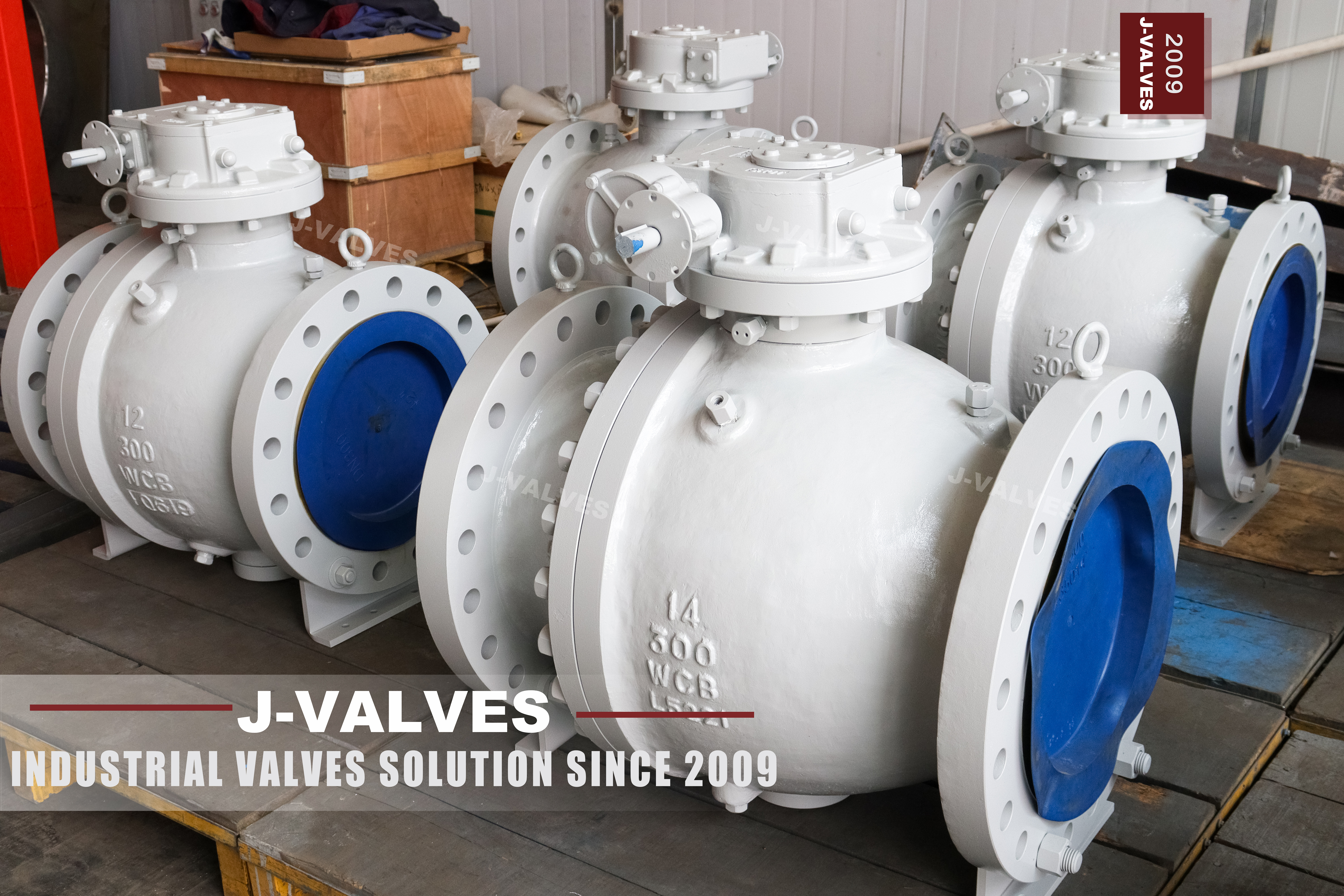
A large diameter trunnion ball valve carries its ball on an upper and a lower shaft, and those two shafts sit in bearings that take the whole thrust of the line pressure. That single mechanical fact is why a 14 inch valve can be turned by one person with a gear operator while a floating ball valve of the same size would need a stem the size of a fence post. The seat in a trunnion valve only has to seal; it does not have to carry the ball.
This page covers the 14 inch Class 300 A216 WCB configuration in detail, because that is the size and class where the transition from floating to trunnion is complete and where the engineering decisions become visible. J-VALVES builds these valves from 2 inch to 56 inch in Class 150 to 2500, cast and forged, at its works in Wenzhou, Zhejiang, and the same body pattern scales from 14 inch up to 36 inch without a change in principle. What follows is the mechanics, the material limits of WCB, the four seat arrangements and when each is correct, the torque budget that sizes the actuator, and the installation details that decide whether a 500 kg valve survives its first decade.
Why 14 Inch Forces the Trunnion Construction
Start with the force. A 14 inch Class 300 valve has a bore of about 355 mm, giving a flow area of roughly 0.099 square metres. At the Class 300 rating of 51.1 bar, the pressure force trying to push the ball downstream is about 505 kN, or just over 50 tonnes. In a floating ball valve that force has to be carried by the seat ring in compression and by the stem in bending. No practical stem survives it, and no soft seat keeps its shape under it.
In a trunnion valve the same 50 tonnes is carried by the lower trunnion into a bearing and then into the body. The stem sees only the torque needed to rotate the ball against seat friction, which for this size is measured in thousands of newton metres rather than hundreds of kilonewtons of bending. The seat is loaded by a spring plus a controlled piston area, not by the full line pressure.
Characteristic | Floating ball | Trunnion mounted |
|---|---|---|
Sealing force source | Line pressure pushing the ball into the seat | Spring preload plus piston area on the seat ring |
Sealing at low pressure | Weak, because force depends on pressure | Good, because the spring provides preload |
Seat load at high pressure | Very high, seat can extrude or crush | Controlled by the piston area, independent of ball thrust |
Stem loading | Bending from the full pressure force | Torsion only |
Practical upper size | About 8 inch, or 12 inch at Class 150 | No practical upper limit in this range |
Double block and bleed | Possible but limited | Standard, with an independent upstream and downstream seat |
Body cavity relief | Through the seat by design | Depends on seat type, which is why the SPE and DPE distinction matters |
The break point is not a fixed number. It is where the stem torque and the seat stress both become unreasonable at the same time, and in practice that is around 8 inch at Class 300 and above, and around 12 inch at Class 150. A 14 inch Class 300 valve is comfortably past the line.
What A216 WCB Is, and Where It Stops
WCB is the workhorse cast carbon steel of the valve industry: ASTM A216 grade WCB, with 0.30 percent maximum carbon, 1.00 percent maximum manganese, 0.60 percent maximum silicon, and minimum mechanical properties of 485 MPa tensile and 250 MPa yield. It is cheap, weldable, machinable, and available in every foundry in the world.
It is also a carbon steel, which means it has a ductile-to-brittle transition. The transition is the reason WCB carries a hard minimum temperature of -29 degrees C rather than a range. Below that, the Charpy energy falls off a shelf and a casting that was tough at ambient becomes brittle, and a valve body is a pressure vessel with stress concentrations at every section change.
Property | WCB | Consequence for a 14 inch valve |
|---|---|---|
Tensile strength, minimum | 485 to 655 MPa | Ample for Class 300 wall thickness |
Yield strength, minimum | 250 MPa | Governs the flange and body bolt design, not the barrel |
Minimum service temperature | -29 degrees C | Not for LNG, not for low temperature glycol, not for arctic ambient without impact testing |
Maximum service temperature | 425 degrees C | Above this, creep and graphitisation become the issue, and a chrome-moly steel is required |
Class 300 rating at 38 degrees C | 51.1 bar | The figure the shell test is based on |
Class 300 rating at 425 degrees C | About 36 bar | Roughly 70 percent of the cold rating; read the exact value from ASME B16.34 Table 2 at the design temperature |
Corrosion allowance | None inherent | Wall thickness to B16.34 is a pressure allowance; a wet or sour service needs an added corrosion allowance or a different material |
Two misapplications are common enough to name. The first is using WCB for low temperature service because the line is insulated and "it will not get that cold". Insulation does not raise the metal temperature during a depressurisation or a shutdown in winter, and the valve becomes the coldest point in the system. The second is using WCB in wet sour service without a corrosion allowance, where the wall is adequate on day one and thin on year eight.
The 14 Inch Class 300 Build in Detail
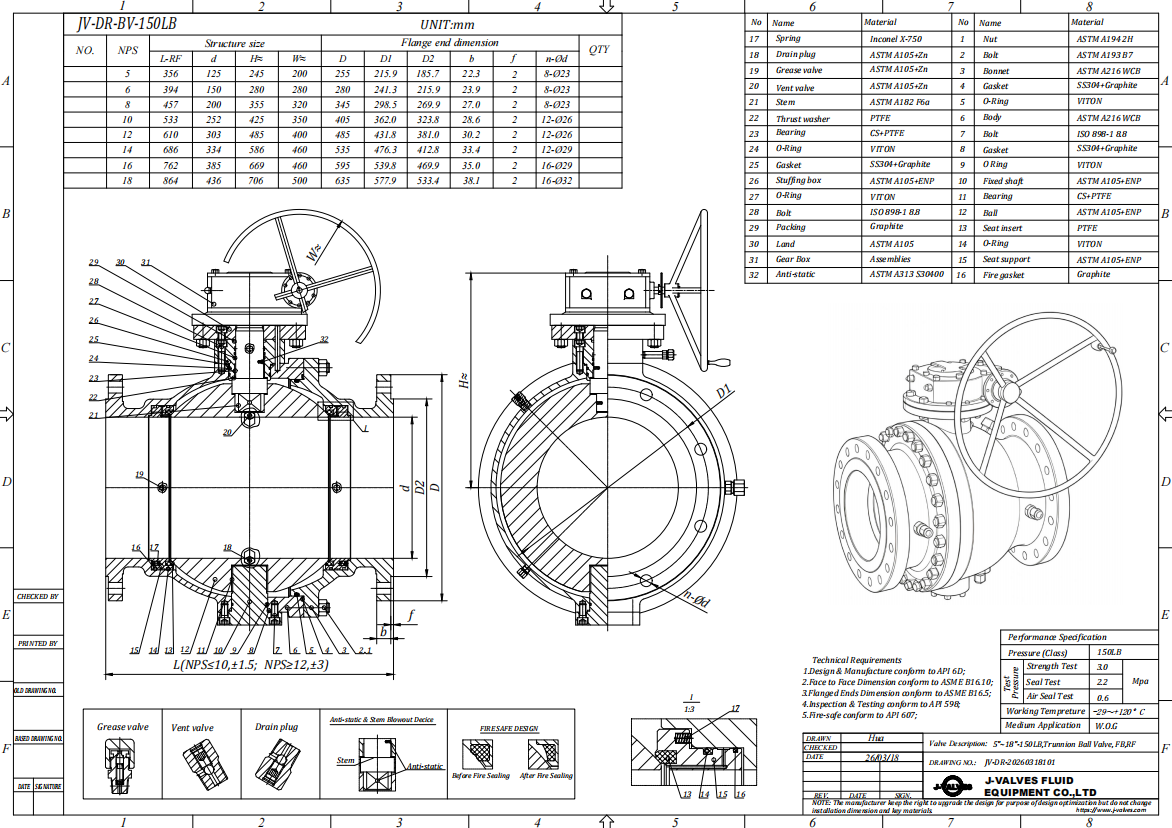
At this size the valve is a two piece side entry body: a main body casting with the trunnion bores machined in it, and one end closure that carries the upstream seat. The closure is bolted with a ring of large studs and sealed with a spiral wound gasket or an O-ring, depending on the specification. Some buyers prefer a fully welded body at this size for buried duty; that removes the body joint as a leak path but also removes the ability to service the seats, and it is a decision to make at enquiry rather than after delivery.
Feature | Typical 14 inch Class 300 WCB execution | Note |
|---|---|---|
Nominal size | 14 inch, DN350 | Full bore gives a bore close to 355 mm; reduced bore 14x12 gives about 305 mm |
Pressure class | Class 300, PN50 | PN50 is a rating equivalence, not a flange dimension equivalence |
Face-to-face | To ASME B16.10 short pattern | Insulated lines often need the long pattern; state the requirement |
Flange | ASME B16.5 Class 300, RF or RTJ | B16.47 applies above 24 inch only |
Body | A216 WCB cast, two piece side entry | Impact tested on request, but the grade limit stays -29 degrees C |
Ball | WCB with ENP, or A105 with ENP, or F304 / F316 | ENP thickness and adhesion matter more than the substrate at this size |
Stem | F6a, F304 or F316 | F6a is the martensitic 410 type; check hardness and plating |
Seat | RPTFE, Devlon, PPL, or Stellite faced metal | Selection is a temperature and dirt decision, not a preference |
Bearing | PTFE lined stainless, or self-lubricating RPTFE | Large bore needs a metal backed bearing to keep torque predictable |
Operator | Worm gear with handwheel, or actuator | Gear ratio typically 40:1 to 80:1 at this size |
Approximate weight | In the region of 400 to 550 kg bare | Confirm from the certified drawing; lifting plan depends on it |
Weight deserves its own sentence because it is the item most often left out of a project plan. A 14 inch Class 300 trunnion valve with a gear operator and a pneumatic actuator can exceed 700 kg. That load cannot hang between two flanges. It needs a pipe support within one diameter of each flange, and the support has to allow the thermal movement of the line without transferring bending into the body.
Single Piston, Double Piston and the DIB Variants
The most consequential choice on a trunnion valve is the seat arrangement, and it is the point where catalogue language usually collapses into jargon. There are really only two behaviours: whether the seat is pushed onto the ball by line pressure from behind, and whether the body cavity can relieve itself into the line.
In a single piston effect seat, here called SPE, line pressure on the upstream side pushes the seat ring towards the ball and seals it. Pressure arriving in the body cavity, from the downstream side, pushes the same seat ring away from the ball. The practical result is that the cavity is self relieving: if trapped liquid expands as it warms, it pushes the seat off the ball and escapes into the downstream line instead of over-pressurising the body.
In a double piston effect seat, DPE, pressure from either side pushes the seat towards the ball. The seal is double, so if the upstream seat is damaged the downstream seat still holds. The price is that the cavity can no longer relieve itself, because pressure in the cavity pushes both seats outward into the ball. A DPE valve therefore needs an external relief device, a thermal relief valve on the cavity, or an operating procedure that guarantees the cavity is never filled with liquid and isolated.
Seat configuration | Seals both directions | Cavity self relieving | Double barrier | Where it is used |
|---|---|---|---|---|
SPE, single piston | Yes | Yes | No | Default for most line isolation; the safe choice for liquid that can be trapped |
DPE, double piston (DIB-1) | Yes | No, needs external relief | Yes | Where a positive double barrier is required, and where a relief device is installed |
Combination, SPE upstream and DPE downstream (DIB-2) | Yes | Yes, in the preferred direction only | Yes, in the preferred direction only | Where both a barrier and self relief are wanted, with flow direction fixed |
DIB-2 is the compromise most often specified on pipeline valves, because it gives a double barrier against the pressure that matters while keeping the cavity able to relieve in the other direction. The catch is that the valve has a preferred direction, which has to be marked on the body and respected at installation. A DIB-2 valve installed backwards is an unrelieved cavity with a single barrier, which is the worst of both arrangements.
Double block and bleed is a separate feature and it is independent of the seat type. It means the body cavity has a drain or bleed port with a valve on it, so that with the main valve closed, the cavity can be vented and the integrity of both seats checked without disturbing the line. At 14 inch this is standard, and the port is normally NPT threaded with a plug or a small needle valve.
Trunnion, Bearing and Stem Design
The lower trunnion is the part that makes the whole design work, and it is worth understanding what it does under load. It is a shaft, integral with or fixed to the ball, running in a bearing in the body. Line pressure tries to push the ball downstream; the trunnion resists that with a bending moment that is largest at the bearing, and the bearing carries the resulting radial load. The bearing material therefore has to be strong enough not to Brinell under a 50 tonne load and slippery enough that the ball still turns after two years of standing.
Three bearing constructions are used. A PTFE lined stainless sleeve is the cheapest and works well at moderate load. A self-lubricating RPTFE or Devlon bush is common at this size and gives predictable torque. A metal backed bearing with a PTFE or bronze liner is used where the load is high enough that a plain bush would extrude, which is the case above about 20 inch or above Class 600.
The stem is a separate part and does not carry the ball load. It is sealed by two O-rings plus a graphite gasket, giving a triple barrier that satisfies both the low emission requirement and the fire safe requirement, because the graphite survives when the elastomer does not. The anti blowout feature is a shoulder on the stem that bears against the body or the gland plate, so that if the stem retaining arrangement fails the stem cannot be ejected by line pressure. API 6D requires this, and it is verified by a push test rather than by inspection.
Low emission performance is certified to ISO 15848 and is quoted as a class and a temperature band, for example Class BH at ambient. At 14 inch the stem seal is the only dynamic seal in the valve, which makes it the one that matters for fugitive emissions, and it is worth asking for the actual test certificate rather than the claim.
Torque, Gear Ratio and Actuator Sizing
No single torque figure can be quoted honestly for a 14 inch Class 300 valve, because the number depends on seat material, on the pressure at the moment of operation, on how long the valve has been closed, and on the medium. What can be stated is how the figure is built up, because that is what an actuator sizing calculation needs.
Break-to-open torque has four components: the seat friction from the compressed seat ring, the bearing friction in the trunnions, the stem seal friction, and the hydrostatic thrust component if the seat is not pressure balanced. Running torque is lower and is roughly the bearing plus seal friction. The break-to-open figure is the one that sizes the actuator, and it is normally taken at the maximum differential pressure the valve will ever see, not at the normal operating pressure.
Torque component | Driven by | How it changes |
|---|---|---|
Seat friction | Seat material, seat preload, differential pressure | Rises with pressure and with time closed; a PEEK or metal seat is much higher than PTFE |
Trunnion bearing friction | Bearing material, radial load, bore size | Rises with pressure; a metal backed bearing is more predictable than a plain bush |
Stem seal friction | Packing type and gland bolt load | Rises if the gland is over-tightened, which is a common site error |
Hydrostatic thrust | Seat design and whether it is balanced | Present in some seat designs; confirm from the seat drawing |
The practical instruction is to require a factory torque test at the specified differential pressure and to size the actuator on the measured value with a margin of at least 1.5, and 2.0 for dirty or high cycling duty. A gear operator at this size will typically have a ratio between 40:1 and 80:1, giving a handwheel effort that a single person can manage at the rated torque. Below the rated torque the effort is proportionally lower, which is why the handwheel feels light on a new valve and heavy after a winter.

Fire Safe, Testing and Certification
API 607 and ISO 10497 are qualification tests on a specific design in a specific size and class, and the certificate states which. A common commercial problem is a supplier offering a fire safe certificate for a 4 inch valve as evidence for a 14 inch valve. They are not the same qualification. When the specification requires fire safe, ask for the certificate and read the size and class column.
The routine test sequence is shell at 1.5 times the 38 degrees C rating, seat at 1.1 times, both directions, with the leakage measured against ISO 5208 rate A or B as specified. For a 14 inch Class 300 valve the shell test pressure is about 76.7 bar and the seat test about 56.2 bar, and both are held for the duration the standard requires. A double block and bleed valve gets an additional cavity test with both seats closed.
Test | Pressure basis | Acceptance | Record |
|---|---|---|---|
Shell | 1.5 times the 38 degrees C rating, about 76.7 bar here | No leak, no permanent deformation | Chart or log, duration, medium |
Seat, both directions | 1.1 times the rating, about 56.2 bar | ISO 5208 rate A or B as specified | Leakage rate and duration |
Cavity, DBB | At the seat test pressure | No leakage past either seat into the cavity | Recorded separately |
Torque | At the specified differential | Within the declared value | Break-to-open and running, for actuator sizing |
Dimensional | Face-to-face, flange, bore | To B16.10 and B16.5 | Dimensional report with the serial number |
Non destructive | On request | Radiography or UT of the body closure weld where applicable | Report by heat and serial |
Material certification is normally EN 10204 3.1 for the body, ball, stem and closure, tied to the heat numbers and to the valve serial number. NACE MR0175 is available on request for sour service, and at this size it affects the bolting and the stem more than the body, because the hardness limits apply to the high strength parts.

Installation of a Half Tonne Valve
Four installation points decide the service life of a valve this size.
Support it independently. The valve must not be the structural link between two pipe sections. Put a support under the body or under the pipe within one diameter of each flange, and make one of the two supports a sliding support so thermal growth does not load the body.
Align the flanges before bolting. A 14 inch Class 300 flange pair with a spiral wound gasket will not pull a misalignment closed, and forcing it puts a bending moment into the body casting that shows up as a cracked closure ten years later. Bring the flanges parallel to within the gasket manufacturer's tolerance, then tighten in a star pattern in three passes.
Respect the seat direction on a DIB-2 valve. The preferred sealing direction is marked on the body, and the marking exists because the cavity relief depends on it. Installing against the arrow converts a double barrier into a single one.
Plan the operator access. A gear operator on a 14 inch valve sits about 600 mm above the body centreline, and a handwheel that needs 200 N of effort needs a platform to stand on. If the valve is at height, specify a chain wheel or an extended spindle rather than adding a ladder to the maintenance scope.
How to Specify a 14 Inch Trunnion Ball Valve
Size and bore: full bore 14 inch, or reduced bore 14x12.
Class 300, with the design temperature range stated, not just the operating temperature.
Body material by standard and grade: ASTM A216 WCB, with impact test requirement stated or excluded.
Body construction: two piece side entry, three piece, or fully welded.
Face-to-face: short pattern to B16.10, or long pattern for insulated service.
Flange facing: RF or RTJ, and the gasket type that goes with it.
Ball and stem material, with plating specification and thickness.
Seat material and seat arrangement: SPE, DPE, DIB-1 or DIB-2, with the direction requirement.
Whether double block and bleed is required, and the bleed port size and type.
Operator: gear with handwheel, or pneumatic double acting or spring return, with the torque basis and the air supply.
Fire safe to API 607 with the size and class on the certificate.
Test standard, third party witness, and the certification package required.
Delivery for a standard 14 inch Class 300 WCB valve is typically 5 to 8 weeks from Wenzhou, and longer if the body requires radiography or a third party witness. Drawings are issued for approval before machining, and the torque test record travels with the valve because the actuator is sized on it.

Large Diameter Trunnion Ball Valve FAQ
At what size does a ball valve have to be trunnion mounted?
There is no single number, because it depends on class. At Class 150 the practical break is around 12 inch; at Class 300 and above it is around 8 inch. The criterion is where the stem torque and the seat compressive stress both become unreasonable. A 14 inch Class 300 valve is well past that point and must be trunnion mounted.
What is the difference between DBB and DIB?
Double block and bleed means the valve has two seats and a cavity bleed port, so both seats can be verified with the valve closed. Double isolation and bleed means each seat provides a positive barrier in both directions, which requires double piston effect seats and, usually, an external cavity relief. DBB is a functional feature; DIB is a sealing philosophy. A DBB valve can be built with SPE seats and still be a valid DBB valve.
Why does a DPE seat need a cavity relief valve?
Because pressure in the body cavity pushes a double piston seat outward into the ball on both sides. If liquid is trapped in the cavity and warms up, thermal expansion has nowhere to go and the cavity pressure can exceed the line pressure. A thermal relief valve on the cavity, or an operating procedure that keeps the cavity vented, is mandatory with DPE seats.
Can WCB be used at -45 degrees C if it is impact tested?
No. Impact testing confirms the properties at the test temperature but does not change the grade's permitted minimum. A216 WCB is limited to -29 degrees C. For colder service the correct choices are A352 LCC or LC1 for castings, A350 LF2 for forgings, or an austenitic stainless, each with its own temperature limit and its own impact test requirement.
How much does a 14 inch Class 300 trunnion ball valve weigh?
Typically in the region of 400 to 550 kg bare, and over 700 kg with a gear operator and a large pneumatic actuator. The exact figure must come from the certified drawing, and it drives the lifting plan, the support design and the shipping crate specification.
What torque is needed to operate a 14 inch Class 300 valve?
It cannot be quoted as a single number because it depends on seat material, differential pressure and time closed. The correct approach is to require a measured break-to-open torque from the factory test at the specified differential, then size the actuator with a margin of at least 1.5, and 2.0 for dirty service. A gear ratio of 40:1 to 80:1 is typical at this size.
Is a fully welded body better for a buried 14 inch valve?
It removes the body closure as a leak path, which matters for buried and offshore service where access is difficult. The trade is that the seats can no longer be replaced, so the valve becomes a life-of-line item and the seat material has to be chosen for the whole design life. For a valve that may need seat maintenance, a bolted two piece body with a well protected closure is the better answer.
Related Ball Valve Types
Sibling pages cover the nickel aluminum bronze body for seawater, the long stem variant for buried and insulated lines, the reduced bore 8x6 configuration, the jacketed body for media that solidify, and the small bore double block and bleed valve for instrument isolation. The category page holds the full size and class matrix.
Hot Products


News
Ball Valves in A Kraft Pulp Mill: Black Liquor, Green Liquor And The Cost of Choosing The Alloy by Habit
White liquor at pH 14 cracks carbon steel welds, black liquor sets solid below 100 C, green liquor dregs grind seats: alloy choice and torque in a kraft mill.
Read More
Slug Flow And Ball Valves: What Actually Arrives At The Seat
A slug is liquid mass with momentum, not a pressure spike. What changes at the seat, in the cavity and at the actuator when liquid reaches a ball valve.
Read More
Ball Valves in Direct Lithium Extraction: PH 1 Eluate, Gypsum Scale And 438,000 Cycles in Twenty-Five Years
Direct lithium extraction swings valves from pH 1 eluate to pH 12 caustic, 48 column switches a day and gypsum scale. Materials, seats and torque.
Read More
Ball Valves in Geothermal Brine: Silica Scale, Chloride Cracking And The Cooling Trap
Why geothermal brine destroys ball valves: retrograde silica scale, calcite at the flash point, chloride cracking above 60 C and the 250 C seat limit.
Read More